


Hindered Amine Light Stabilizers (HALS) Market Overview
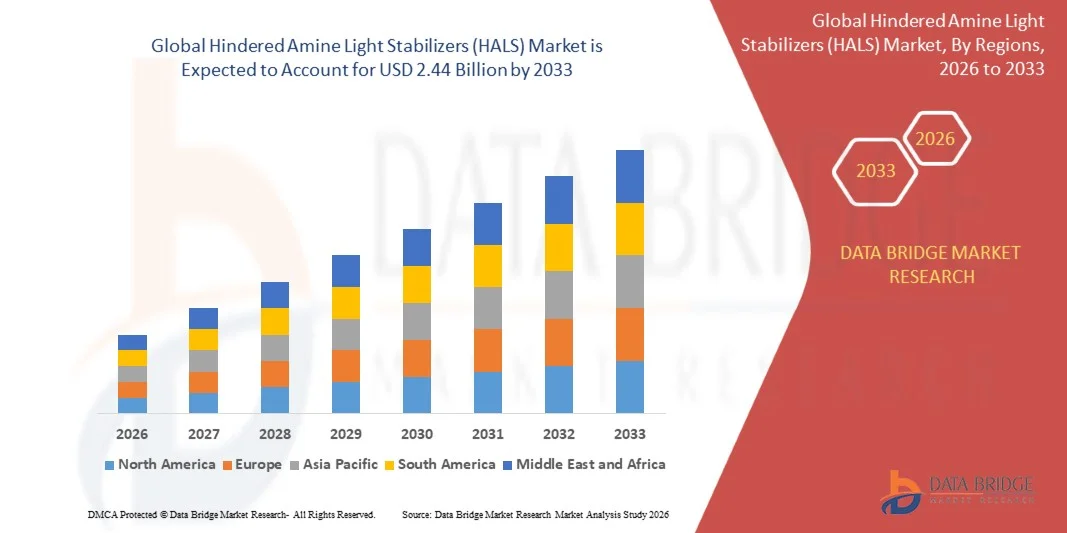
As per Data Bridge Market Research analysis The hindered amine light stabilizers (HALS) market was valued at USD 1.41 billion in 2025 and is projected to reach USD 2.44 billion by 2033, growing at a CAGR of 7.15% from 2026 to 2033. The market is experiencing consistent growth driven by rising demand for high-performance polymer additives, increasing adoption of durable plastic materials, and expanding applications across automotive, construction, packaging, and agriculture industries. The market growth is supported by the growing need for enhanced polymer stability, improved weathering resistance, and longer service life of plastic products exposed to ultraviolet (UV) radiation and environmental conditions.
The increasing utilization of plastics in outdoor applications, combined with rising demand for lightweight and durable materials, is compelling manufacturers to adopt advanced light stabilization technologies. HALS are widely used in polyolefins, coatings, adhesives, and engineering plastics due to their ability to protect polymers from UV-induced degradation, discoloration, and loss of mechanical properties, supporting market expansion across multiple end-use industries.
Market Size & Forecast
- Global Market Value (2025): USD 1.41 Billion
- Expected Market Value (2033): USD 2.44 Billion
- Forecast CAGR (2026–2033): 7.15%
- Leading Region in 2025: North America
- Fastest Growing Region: Asia Pacific
Key Market Trends & Insights
- North America dominated the hindered amine light stabilizers (HALS) market with a revenue share of 32.54% in 2025, supported by strong demand for high-performance polymer additives, established automotive and construction industries, and increasing adoption of UV-resistant materials across coatings, plastics, and specialty applications.
- The polymeric segment led the market with a 48.3% share in 2025, driven by its superior permanence, low volatility, excellent extraction resistance, and long-term stabilization performance in demanding outdoor applications.
- Asia-Pacific is expected to be the fastest-growing region at a CAGR of 7.26% during the forecast period, fueled by rapid industrialization, expanding polymer production capacity, rising automotive manufacturing, and increasing demand for UV-resistant and durable materials across China, India, and Southeast Asian countries.
- Oligomeric are the fastest-growing type, projected to register a CAGR of 7.9%, reflecting the surge in demand for stabilization solutions that combine high efficiency with reduced migration characteristics.
- The HALS 770 segment dominated the product type category with a 33.7% revenue share in 2025, led by its broad applicability across polypropylene, polyethylene, elastomers, adhesives, coatings, and engineering plastics.
- Plastics accounted for 58.6% of the market, preferred by extensive utilization of HALS in polyethylene, polypropylene, engineering plastics, and specialty polymers.
- The adhesives and sealants segment is the fastest-growing application category, with a CAGR of 8.4%, driven by rising demand for durable bonding materials used in construction, automotive, and industrial applications
Report Scope and Hindered Amine Light Stabilizers (HALS) Market Segmentation
|
Attributes |
Hindered Amine Light Stabilizers (HALS) Key Market Insights |
|
Segments Covered |
|
|
Countries Covered |
North America
Europe
Asia-Pacific
Middle East and Africa
South America
|
|
Key Market Players |
|
|
Market Opportunities |
|
|
Value Added Data Infosets |
In addition to the insights on market scenarios such as market value, growth rate, segmentation, geographical coverage, and major players, the market reports curated by the Data Bridge Market Research also include import export analysis, production capacity overview, production consumption analysis, price trend analysis, climate change scenario, supply chain analysis, value chain analysis, raw material/consumables overview, vendor selection criteria, PESTLE Analysis, Porter Analysis, and regulatory framework. |
Hindered Amine Light Stabilizers (HALS) Market Trends
Trend: Rising Demand for UV-Resistant Polymer Materials in Outdoor Applications
Manufacturers across automotive, construction, agriculture, and packaging industries are increasingly adopting hindered amine light stabilizers (HALS) to enhance polymer durability, improve weathering resistance, and extend product lifespan under prolonged UV exposure. The growing utilization of plastics in outdoor applications is driving demand for advanced stabilization technologies that prevent polymer degradation, discoloration, and loss of mechanical properties. Coatings, films, fibers, and molded plastic products are increasingly incorporating HALS formulations to maintain performance in demanding environmental conditions, while continuous developments in polymer additive technologies are supporting the adoption of high-performance stabilization solutions across diverse end-use industries. For instance, in October 2025, BASF introduced Tinuvin NOR 600, a next-generation NOR-HALS light stabilizer designed to enhance the durability of PVC and polyolefin-based plastics against sunlight and heat, supporting demanding outdoor applications such as roofing membranes and artificial turf.
The increasing demand for durable and UV-resistant plastic materials is strengthening the adoption of HALS as a critical additive solution for improving polymer performance and extending product lifecycle across outdoor applications.
Hindered Amine Light Stabilizers (HALS) Market Dynamics
Key Market Driver: Increasing Adoption of Durable Plastics Across Automotive and Construction Industries
The rising demand for lightweight, durable, and weather-resistant plastic materials is creating substantial growth opportunities for hindered amine light stabilizers as manufacturers seek improved polymer performance in outdoor applications. Automotive manufacturers, construction companies, and plastic processors are increasingly utilizing HALS to protect polymer components from UV-induced degradation, maintain aesthetic appearance, and enhance long-term material reliability. The expansion of infrastructure development, growing automotive production, and increasing use of polymer-based materials in demanding environments are accelerating the integration of advanced light stabilization technologies across global industries. For instance, in October 2024, Clariant introduced AddWorks IBC 760, a light and heat stabilizer containing a hindered amine light stabilizer (HALS), UV absorber, and antioxidant designed to extend the service life of silyl modified polymer (SMP) sealants by reducing cracking and yellowing under sunlight and high-temperature conditions. The solution targets construction, automotive, and other outdoor applications requiring enhanced durability and weather resistance.
The expanding use of high-performance plastics in automotive and construction applications is driving long-term demand for HALS by enabling improved durability, stability, and resistance against environmental degradation.
Key Restraint/Challenge: High Cost of Advanced Polymer Stabilizer Formulations
A significant challenge in the hindered amine light stabilizers market is the relatively high cost associated with advanced additive formulations compared with conventional stabilization solutions. The production of high-performance HALS requires specialized chemical synthesis processes, quality control measures, and compatibility testing with different polymer systems, increasing overall manufacturing costs. Price fluctuations of raw materials and the need for customized formulations can limit adoption among small and medium-sized plastic processors, particularly in price-sensitive markets. These cost considerations may encourage manufacturers to evaluate alternative additives while creating challenges for widespread adoption of premium HALS technologies. For instance, in May 2023, BASF showcased its IrgaCycle additive solutions at interpack 2023, highlighting technologies designed to improve the durability, processing performance, and circularity of recycled plastic packaging by addressing processing challenges and maintaining material stability.
The high production cost and formulation complexity of advanced HALS products remain key challenges, particularly for cost-sensitive users, limiting wider adoption in certain applications and emerging markets.
Key Market Opportunity: Growing Development of Sustainable and High-Performance Polymer Additives
The increasing focus on sustainable plastics, recyclable materials, and extended product lifecycles presents a significant market opportunity for hindered amine light stabilizers. Advanced HALS formulations can support the development of durable polymer products by reducing degradation, improving service life, and maintaining material performance during repeated environmental exposure. Rising demand for sustainable packaging, automotive lightweighting, and long-lasting construction materials is encouraging manufacturers to develop innovative stabilization technologies with improved efficiency, compatibility, and environmental performance. The adoption of next-generation polymer additives is expected to create new growth opportunities across emerging applications and evolving material technologies. For instance, in April 2024, Clariant showcased its AddWorks portfolio with new stabilizers at CHINAPLAS 2024, highlighting solutions for light, thermal, and process stabilization to improve polymer performance across automotive, packaging, construction, and other plastic applications.
The shift toward sustainable and durable polymer materials is creating significant growth opportunities for HALS manufacturers by increasing demand for advanced additives that enhance product performance and lifespan.
Hindered Amine Light Stabilizers (HALS) Market Scope
The hindered amine light stabilizers (HALS) market is segmented on the basis of type, product type, application, and end user.
- By Type
On the basis of type, the hindered amine light stabilizers (HALS) market is segmented into monomeric, oligomeric, and polymeric. The polymeric segment dominated the market with an estimated 48.3% share in 2025, owing to its superior permanence, low volatility, excellent extraction resistance, and long-term stabilization performance in demanding outdoor applications. Polymeric HALS are extensively used in polyolefins, engineering plastics, automotive components, agricultural films, and construction materials where prolonged UV protection is required. Their high molecular weight minimizes migration and evaporation during processing and service life, enhancing polymer durability. Manufacturers increasingly prefer polymeric grades for products requiring long-term weatherability and thermal stability. Growing demand for high-performance plastic materials across automotive and infrastructure sectors continues to support adoption. Their ability to provide durable protection while maintaining polymer properties strengthens their leadership position in the market.
The oligomeric segment is projected to register the fastest growth at a CAGR of 7.9% from 2026 to 2033, driven by increasing demand for stabilization solutions that combine high efficiency with reduced migration characteristics. Oligomeric HALS provide balanced performance between monomeric and polymeric grades, making them suitable for a broad range of polymer applications. Their growing utilization in packaging materials, specialty polymers, coatings, and consumer products is supporting segment expansion. Increasing production of high-value plastic products requiring enhanced weather resistance is accelerating demand. Manufacturers are developing advanced oligomeric formulations to improve compatibility and processing efficiency. Rising emphasis on durable and sustainable polymer materials is expected to further support growth.
- By Product Type
On the basis of product type, the hindered amine light stabilizers (HALS) market is segmented into HALS 622, HALS 770, HALS 944, and others. The HALS 770 segment dominated the market with an estimated 33.7% share in 2025, driven by its broad applicability across polypropylene, polyethylene, elastomers, adhesives, coatings, and engineering plastics. HALS 770 is recognized for its strong light stabilization efficiency and excellent compatibility with multiple polymer systems. It is extensively used in outdoor applications requiring protection against UV-induced degradation, discoloration, and mechanical property loss. The product delivers effective long-term stabilization while preserving material appearance and performance. Strong adoption across automotive, packaging, and agricultural applications continues to support demand. Its established commercial use and proven effectiveness make it one of the most widely utilized HALS grades globally.
The HALS 944 segment is expected to witness the fastest growth at a CAGR of 8.1% from 2026 to 2033, supported by increasing demand for high molecular weight stabilizers offering superior extraction resistance and long-term outdoor durability. HALS 944 is increasingly used in polyolefins and engineering plastics exposed to severe weathering environments. The product provides excellent thermal stability and low volatility, making it suitable for demanding industrial applications. Growing utilization in construction materials, automotive components, and agricultural films is driving adoption. Manufacturers increasingly select HALS 944 for products requiring extended service life and enhanced weather resistance. Rising demand for premium stabilization solutions is expected to accelerate segment growth.
- By Application
On the basis of application, the hindered amine light stabilizers (HALS) market is segmented into plastics, paints and coatings, adhesives and sealants, and others. The plastics segment dominated the market with an estimated 58.6% share in 2025, owing to extensive utilization of HALS in polyethylene, polypropylene, engineering plastics, and specialty polymers. HALS play a critical role in protecting plastic products from UV degradation, cracking, discoloration, and loss of mechanical properties. Increasing demand for lightweight, durable, and weather-resistant plastic materials across automotive, packaging, agriculture, and construction industries is supporting market growth. Manufacturers increasingly incorporate HALS to extend product lifespan and maintain performance in outdoor environments. Growing production of plastic components for infrastructure and transportation applications further contributes to segment dominance. Continuous innovation in polymer stabilization technologies is strengthening adoption.
The adhesives and sealants segment is projected to register the fastest growth at a CAGR of 8.4% from 2026 to 2033, driven by rising demand for durable bonding materials used in construction, automotive, and industrial applications. HALS are increasingly incorporated into adhesive and sealant formulations to improve resistance to UV exposure, weathering, and environmental degradation. Growing use of advanced sealants in infrastructure projects and energy-efficient buildings is accelerating demand. Manufacturers are focusing on longer-lasting adhesive systems capable of maintaining performance under harsh environmental conditions. Expanding automotive production and increasing adoption of lightweight assembly technologies are further supporting growth. Rising investments in sustainable construction materials are expected to create additional opportunities.
- By End User
On the basis of end user, the hindered amine light stabilizers (HALS) market is segmented into packaging, automotive, agriculture films, construction, and other end-use industry. The packaging segment dominated the market with an estimated 34.2% share in 2025, driven by extensive use of UV-stabilized plastic materials in food packaging, industrial packaging, flexible films, and consumer goods packaging applications. HALS help maintain material integrity, appearance, and performance during storage and outdoor exposure. Growing global consumption of plastic packaging materials and increasing demand for longer product shelf life are supporting market expansion. Manufacturers increasingly utilize advanced stabilization technologies to improve packaging durability and reduce degradation. Rising adoption of high-performance flexible packaging solutions further contributes to growth. The segment continues to benefit from expanding consumer goods and e-commerce industries worldwide.
The agriculture films segment is anticipated to register the fastest growth at a CAGR of 8.6% from 2026 to 2033, supported by increasing use of greenhouse films, mulch films, and silage films requiring long-term UV protection. Agricultural films are continuously exposed to sunlight and harsh environmental conditions, making effective stabilization critical for maintaining performance and service life. HALS help prevent degradation, cracking, and premature failure of agricultural plastics. Growing focus on improving crop productivity and agricultural efficiency is driving demand for advanced film technologies. Expanding protected cultivation practices and greenhouse farming activities are further accelerating adoption. Increasing investments in modern agriculture are expected to support strong future growth.
Hindered Amine Light Stabilizers (HALS) Market Regional Analysis
North America dominated the hindered amine light stabilizers (HALS) market with a revenue share of 32.54% in 2025, supported by strong demand for high-performance polymer additives, established automotive and construction industries, and increasing adoption of UV-resistant materials across coatings, plastics, and specialty applications. The region also benefits from increasing adoption of UV-resistant materials, growing investments in sustainable polymer technologies, and continuous innovation in specialty additives for plastic applications. Rising utilization of lightweight polymer components, weather-resistant construction materials, and advanced packaging solutions is accelerating market development. Increasing focus on extending product lifespan, improving material durability, and enhancing resistance to environmental degradation continues to strengthen North America's leadership position in the global market.
U.S. Hindered Amine Light Stabilizers (HALS) Market Insight
The U.S. hindered amine light stabilizers (HALS) market is witnessing steady growth due to increasing demand for high-performance polymer additives across automotive, packaging, construction, and agricultural applications. The country's well-established plastics manufacturing industry, coupled with growing investments in sustainable polymer technologies and advanced recycling solutions, is supporting market expansion. Rising adoption of lightweight polymer components and UV-resistant materials is further driving demand for HALS in durable outdoor applications. In addition, increasing emphasis on extending plastic product lifespan and improving material performance is accelerating the adoption of advanced light stabilization technologies. At NPE 2024 in the U.S., Clariant introduced new AddWorks polymer additive solutions, including PFAS-free processing aids and additives for recycled plastics, demonstrating continued investment in high-performance polymer additives for the North American market
Europe Hindered Amine Light Stabilizers (HALS) Market Insight
The Europe hindered amine light stabilizers (HALS) market remains a major contributor to global revenue, driven by advanced polymer manufacturing capabilities, strong sustainability initiatives, and increasing demand for high-performance plastic additives. The widespread adoption of HALS in automotive, construction, packaging, and agricultural applications continues to support regional market expansion. Increasing investments in circular economy initiatives, plastic recycling, and specialty additives are further strengthening market growth. Furthermore, stringent environmental regulations and growing demand for durable polymer materials continue to encourage innovation across the European plastics industry. BASF announced expansion of its HALS production capacity in Germany and Italy to meet growing global demand for durable and sustainable plastic applications.
U.K. Hindered Amine Light Stabilizers (HALS) Market Insight
The U.K. hindered amine light stabilizers (HALS) market is experiencing steady growth, supported by increasing demand for sustainable packaging materials, high-performance coatings, and advanced polymer products. Growing emphasis on recyclable plastics and circular economy initiatives is encouraging manufacturers to adopt advanced stabilization technologies that improve durability and weather resistance. Rising investments in construction, infrastructure modernization, and lightweight automotive materials are also supporting market demand. BASF's European light stabilizer portfolio continues to supply UV stabilization solutions for construction, packaging, and industrial polymer applications widely used across the U.K. plastics industry.
Germany Hindered Amine Light Stabilizers (HALS) Market Insight
The Germany hindered amine light stabilizers (HALS) market is expanding steadily due to the country's strong chemical manufacturing base, advanced polymer processing capabilities, and robust automotive industry. Manufacturers are increasingly utilizing HALS to improve the durability, weather resistance, and service life of engineering plastics and automotive components. Continuous innovation in specialty polymer additives and growing investments in sustainable plastics are further driving market growth. BASF's investment to expand HALS production capacity at Lampertheim, Germany, reflects increasing regional demand for light stabilizers used in automotive, construction, and greenhouse applications.
Asia-Pacific Hindered Amine Light Stabilizers (HALS) Market Insight
The Asia-Pacific hindered amine light stabilizers (HALS) market is expected to witness rapid growth, driven by expanding plastics manufacturing, increasing automotive production, and rising demand for durable polymer materials across China, India, Japan, and Southeast Asia. Growing investments in packaging, infrastructure development, and agricultural films are supporting regional market expansion. Increasing production of engineering plastics and rising adoption of UV-resistant materials are further accelerating demand for HALS across multiple end-use industries. In April 2024, Clariant showcased its next-generation additive portfolio at CHINAPLAS 2024, including the AddWorks range with new stabilizers for light, thermal, and process stabilization, highlighting increasing demand for high-performance polymer additives across automotive, packaging, construction, and engineering plastics in Asia-Pacific.
Japan Hindered Amine Light Stabilizers (HALS) Market Insight
The Japan hindered amine light stabilizers (HALS) market is witnessing consistent growth due to increasing demand for high-performance engineering plastics, automotive lightweight materials, and advanced electronic components. Manufacturers are increasingly utilizing HALS to improve UV stability, thermal resistance, and long-term durability of polymer products. Moreover, Japan's continued focus on sustainable manufacturing and high-quality polymer materials is supporting the adoption of advanced light stabilization technologies. BASF's Chimassorb and Tinuvin HALS portfolio is widely used in engineering plastics and polyolefins for demanding industrial applications, including those common in Japan's automotive and electronics sectors.
China Hindered Amine Light Stabilizers (HALS) Market Insight
The China hindered amine light stabilizers (HALS) market is growing rapidly, driven by expanding plastics production, increasing automotive manufacturing, and strong demand for UV-resistant polymer materials across packaging, construction, and agriculture sectors. Rising investments in sustainable plastics, recycling technologies, and high-performance polymer additives are significantly boosting market demand. In addition, continuous expansion of domestic polymer processing capacity and infrastructure development is positioning China among the fastest-growing HALS markets globally. Clariant highlighted advanced polymer additive solutions for performance enhancement and sustainability during its CHINAPLAS activities, supporting the increasing adoption of light stabilization technologies across China's plastics industry.
Hindered Amine Light Stabilizers (HALS) Market Share
The hindered amine light stabilizers (HALS) industry is primarily led by well-established companies, including:
- BASF SE (Germany)
- CLARIANT (Switzerland)
- SONGWON (South Korea)
- SABO S.p.A. (Italy)
- ADEKA CORPORATION (Japan)
- Solvay SA (Belgium)
- Evonik Industries AG (Germany)
- SI Group, Inc. (U.S.)
- Everlight Chemical Industrial Corporation (Taiwan)
- Mayzo, Inc. (U.S.)
- Ampacet Corporation (U.S.)
- Avient Corporation (U.S.)
- Chemipro Kasei Kaisha, Ltd. (Japan)
- Chitec Technology Co., Ltd. (Taiwan)
- Greenchemicals S.r.l. (Italy)
- Double Bond Chemical Ind., Co., Ltd. (Taiwan)
- Lycus Ltd. (China)
- Nanjing Union Rubber & Chemicals Co., Ltd. (China)
- Rianlon Corporation (China)
Latest Developments in Hindered Amine Light Stabilizers (HALS) Market
- In July 2024, BASF launched Tinuvin® NOR® 211 AR, a next-generation heat and light stabilizer developed for agricultural plastics. The new NOR-HALS solution improves resistance to UV radiation, thermal stress, sulfur, and chlorine exposure while extending the service life of greenhouse and mulch films. The product also supports sustainability by enabling thinner plastic films and reducing material consumption
- In July 2024, Clariant introduced AddWorks AGC 172 G, a new light stabilizer solution based on its patented aminoether HALS technology (Hostavin NOW) for agricultural greenhouse films. The product was developed to extend the service life of greenhouse films exposed to intense UV radiation and agrochemicals, improving crop protection performance and durability under challenging agricultural conditions
- In December 2022, Evonik completed the sale of its triacetone amine (TAA) derivatives business to SABO. TAA derivatives are essential precursors used in the manufacture of hindered amine light stabilizers (HALS). The acquisition strengthened SABO's backward integration and expanded its manufacturing footprint in Germany and China
- In March 2022, BASF announced the expansion of its production capacity for HALS and NOR-HALS at its Lampertheim (Germany) and Pontecchio Marconi (Italy) facilities. The investment was made to meet increasing global demand for light stabilizers used in automotive, agricultural films, construction materials, and consumer plastics, while improving supply reliability for customers.
- In July 2021, Clariant and Beijing Tiangang Auxiliary Co., Ltd. inaugurated a new production site in Cangzhou, China, to manufacture high-value light stabilizers. The facility strengthens Clariant's local manufacturing capabilities and supports the growing demand for light stabilizers in automotive, engineering plastics, packaging, coatings, and textile applications across China and Asia-Pacific

- Interactive Data Analysis Dashboard
- Company Analysis Dashboard for high growth potential opportunities
- Research Analyst Access for customization & queries
- Competitor Analysis with Interactive dashboard
- Latest News, Updates & Trend analysis
- Harness the Power of Benchmark Analysis for Comprehensive Competitor Tracking
Global Hindered Amine Light Stabilizers Hals Market, Supply Chain Analysis and Ecosystem Framework
To support market growth and help clients navigate the impact of geopolitical shifts, DBMR has integrated in-depth supply chain analysis into its Global Hindered Amine Light Stabilizers Hals Market research reports. This addition empowers clients to respond effectively to global changes affecting their industries. The supply chain analysis section includes detailed insights such as Global Hindered Amine Light Stabilizers Hals Market consumption and production by country, price trend analysis, the impact of tariffs and geopolitical developments, and import and export trends by country and HSN code. It also highlights major suppliers with data on production capacity and company profiles, as well as key importers and exporters. In addition to research, DBMR offers specialized supply chain consulting services backed by over a decade of experience, providing solutions like supplier discovery, supplier risk assessment, price trend analysis, impact evaluation of inflation and trade route changes, and comprehensive market trend analysis.
Data collection and base year analysis are done using data collection modules with large sample sizes. The stage includes obtaining market information or related data through various sources and strategies. It includes examining and planning all the data acquired from the past in advance. It likewise envelops the examination of information inconsistencies seen across different information sources. The market data is analysed and estimated using market statistical and coherent models. Also, market share analysis and key trend analysis are the major success factors in the market report. To know more, please request an analyst call or drop down your inquiry.
The key research methodology used by DBMR research team is data triangulation which involves data mining, analysis of the impact of data variables on the market and primary (industry expert) validation. Data models include Vendor Positioning Grid, Market Time Line Analysis, Market Overview and Guide, Company Positioning Grid, Patent Analysis, Pricing Analysis, Company Market Share Analysis, Standards of Measurement, Global versus Regional and Vendor Share Analysis. To know more about the research methodology, drop in an inquiry to speak to our industry experts.
Data Bridge Market Research is a leader in advanced formative research. We take pride in servicing our existing and new customers with data and analysis that match and suits their goal. The report can be customized to include price trend analysis of target brands understanding the market for additional countries (ask for the list of countries), clinical trial results data, literature review, refurbished market and product base analysis. Market analysis of target competitors can be analyzed from technology-based analysis to market portfolio strategies. We can add as many competitors that you require data about in the format and data style you are looking for. Our team of analysts can also provide you data in crude raw excel files pivot tables (Fact book) or can assist you in creating presentations from the data sets available in the report.













