


Hitter Based Hand Tools Market Size
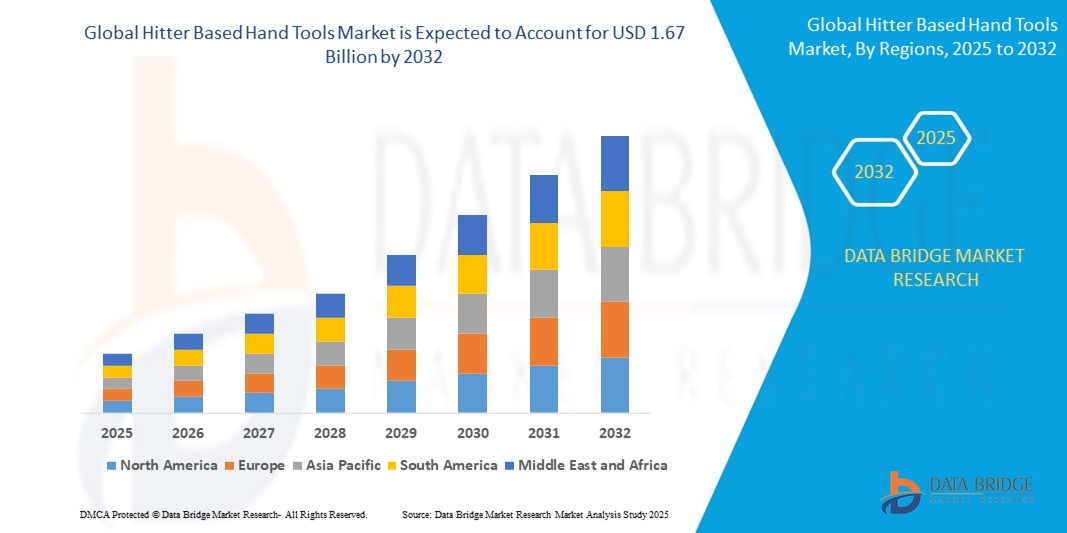
- The global hitter based hand tools market size was valued at USD 1.30 billion in 2024 and is expected to reach USD 1.67 billion by 2032, at a CAGR of 3.20% during the forecast period
- The market growth is largely fuelled by the increasing demand from construction, automotive, and manufacturing industries, where precision and durability of hand tools are crucial for daily operations. Rising infrastructure projects across emerging economies and a growing focus on DIY (do-it-yourself) activities also contribute to the expanding consumer base
- In addition, the resurgence of renovation and maintenance activities in residential and commercial sectors post-pandemic has further accelerated the demand for hitter-based hand tools, especially among small contractors and household users looking for reliable and long-lasting tool solutions
Hitter Based Hand Tools Market Analysis
- The market is witnessing steady growth due to rising consumer preference for high-quality and ergonomically designed tools that reduce fatigue and improve productivity
- Technological advancements such as the use of advanced materials (such as alloy steel, fiberglass handles), and innovations in design for better grip and shock absorption, are creating new opportunities
- Asia-Pacific dominated the hitter based hand tools market with the largest revenue share of 38.5% in 2024, driven by rapid industrialization, expanding construction activities, and growing demand for agricultural and forestry tools across countries such as China, India, and Japan
- Europe region is expected to witness the highest growth rate in the global hitter based hand tools market, driven by stringent safety regulations, rising DIY trends, and the growing demand for ergonomic and durable tools across construction, woodworking, and forestry applications
- The hammers segment dominated the market with the largest market revenue share in 2024, driven by their widespread use across multiple industries including construction, manufacturing, and DIY applications. Known for their versatility and availability in various subtypes such as claw hammers and sledgehammers, hammers remain a staple in both household and professional toolkits. Their continuous evolution with ergonomic designs and impact-resistant materials further sustains their dominance in the global market
Report Scope and Hitter Based Hand Tools Market Segmentation
|
Attributes |
Hitter Based Hand Tools Key Market Insights |
|
Segments Covered |
|
|
Countries Covered |
North America
Europe
Asia-Pacific
Middle East and Africa
South America
|
|
Key Market Players |
|
|
Market Opportunities |
• Growing Demand for Ergonomic and Multi-Functional Hand Tools • Expansion of E-Commerce Platforms in Emerging Economies |
|
Value Added Data Infosets |
In addition to the insights on market scenarios such as market value, growth rate, segmentation, geographical coverage, and major players, the market reports curated by the Data Bridge Market Research also include in-depth expert analysis, geographically represented company-wise production and capacity, network layouts of distributors and partners, detailed and updated price trend analysis and deficit analysis of supply chain and demand. |
Hitter Based Hand Tools Market Trends
“Rising Adoption of Vibration-Dampening Handles in Professional Tools”
- The adoption of VR and AR technologies in shooting ranges is transforming conventional firearm training by offering immersive, cost-effective, and scalable alternatives to live-fire experiences, especially in urban or restricted zones. These virtual environments enable repeatable practice sessions with minimal risk, reducing logistical hurdles associated with real ammunition. As cities tighten firearm discharge laws, virtual ranges offer a viable solution for consistent training without compromising safety
- These simulated training platforms replicate real-world scenarios, improve shooter accuracy, and allow law enforcement, military, and private users to train in dynamic environments without live ammunition, minimizing risk and operating costs. By integrating motion tracking and real-time performance analytics, these platforms offer personalized feedback for trainees. This is particularly useful for new recruits and first responders who require continuous performance evaluation in high-stress simulations
- Advanced VR systems now support biometric feedback, scenario branching, and multi-user interaction, enhancing realism and situational response training for high-stakes operations or civilian defense. These technologies enable shooters to experience variable outcomes based on their choices, promoting critical thinking under pressure. Features such as heartbeat tracking and eye-movement analysis provide deeper insight into a user’s psychological and physical readiness
- For instance, the U.S. Army has adopted AR-enabled training simulators for infantry marksmanship and decision-making exercises, while private companies in Germany and South Korea have launched VR-based shooting arcades for public safety training and recreational use. These installations demonstrate the technology’s global applicability across defense, public safety, and commercial sectors. They also reflect growing consumer interest in gamified training environments that balance realism and entertainment
- These innovations are creating new revenue streams for range operators, increasing accessibility for new demographics, and reducing the dependency on physical infrastructure and traditional ammunition. Mobile VR kits and subscription-based software solutions are allowing small and medium-sized training centers to enter the market with minimal capital investment. As a result, shooting sports and tactical education are becoming more inclusive, reaching broader age groups and geographies
Hitter Based Hand Tools Market Dynamics
Driver
“Infrastructure Expansion and Urban Development Stimulating Tool Demand”
• Governments across key regions are heavily investing in the modernization of firearm training infrastructure, driven by increasing national security concerns, expanding defense budgets, and a growing emphasis on readiness and operational accuracy
• These initiatives are supporting the development of high-tech shooting ranges that integrate ballistic tracking, automated target systems, and simulation-based learning platforms to enhance tactical preparedness for police and military personnel
• For instance, in 2023, the U.S. Department of Defense allocated substantial funding toward upgrading live-fire facilities with climate control systems, programmable targets, and soundproofing enhancements to improve training efficiency and environmental safety
• Similarly, nations such as India and the United Kingdom have launched multi-agency tactical training centers that include indoor and outdoor ranges designed for joint force exercises and emergency response scenarios
• These investments are expanding the demand for both permanent and modular range structures, encouraging innovation in range design, and creating long-term opportunities for manufacturers of range components and simulation systems
Restraint/Challenge
“Market Saturation and Counterfeit Product Penetration”
• High setup costs involving specialized construction, environmental safety measures, and compliance certifications are discouraging small and medium operators from entering or expanding in the market, as initial capital outlay often exceeds return expectations in the early years of operation and includes expenses for range design, ballistic containment, and safety compliance
• Ongoing maintenance expenses for smart range systems, HVAC installations, bullet containment, and electronic targets are placing heavy financial pressure on operators, especially in low-traffic or seasonal locations where usage rates cannot justify the operational overhead required to sustain high-tech infrastructure
• Complex urban zoning regulations and environmental objections are contributing to significant delays or cancellations of planned shooting ranges in densely populated regions where demand may otherwise be high, due to community pushback, legal restrictions on firearm use, and ecological assessments required for permitting
• For instance, several urban shooting range projects in Canada and Japan have been stalled or cancelled due to a mix of funding shortfalls, neighborhood resistance, and strict regulatory approval processes, making it difficult for private or institutional players to establish training facilities even when local interest and demand exist
• These financial and operational burdens are restricting market growth in underserved areas, highlighting the need for affordable range technologies and strategic government incentives to ensure broader accessibility and adoption while balancing public safety and commercial feasibility
Hitter Based Hand Tools Market Scope
The market is segmented on the basis of type, application, and sales channel.
- By Type
On the basis of type, the hitter based hand tools market is segmented into hammers, mallets, axes, shovels, and crowbars. The hammers segment dominated the market with the largest market revenue share in 2024, driven by their widespread use across multiple industries including construction, manufacturing, and DIY applications. Known for their versatility and availability in various subtypes such as claw hammers and sledgehammers, hammers remain a staple in both household and professional toolkits. Their continuous evolution with ergonomic designs and impact-resistant materials further sustains their dominance in the global market.
The axes segment is expected to witness the fastest growth rate from 2025 to 2032, propelled by increasing applications in forestry, agriculture, and outdoor rescue operations. Technological enhancements such as anti-vibration handles and lightweight alloys are boosting user efficiency, while the rise in sustainable logging and outdoor survival gear trends are broadening the product’s user base across both industrial and recreational end-users.
- By Application
On the basis of application, the hitter based hand tools market is segmented into household and DIY, construction, woodworking and framing, manufacturing and fitting, mining, forestry and agriculture, and rescue management. The construction segment led the market in 2024 with the highest revenue share due to extensive tool use in framing, demolition, and concrete tasks across commercial and residential projects. High demand for durable and precision-based tools in emerging urban infrastructure and real estate development is a key growth driver for this segment.
The rescue management segment is expected to witness the fastest growth rate from 2025 to 2032, driven by the rising demand for high-impact, portable, and multi-functional hand tools among emergency responders and disaster relief teams. Crowbars and axes are increasingly used in fire and rescue operations, with many tools being tailored for swift entry, debris clearance, and victim extraction, especially in regions prone to natural disasters.
- By Sales Channel
On the basis of sales channel, the market is segmented into bulk distributer sales, retail sales, and online sales. The bulk distributer sales segment held the largest share in 2024, attributed to strong procurement demand from construction companies, industrial manufacturers, and public sector agencies seeking standardized, large-volume purchases. Distributors often offer specialized procurement solutions, bulk discounts, and tailored product assortments, which attract high-value institutional buyers.
The online sales segment is expected to witness the fastest growth rate from 2025 to 2032, supported by the rise of e-commerce platforms and direct-to-consumer strategies by tool manufacturers. Online channels provide broader accessibility, product variety, user reviews, and home delivery, making them increasingly attractive for both DIY users and small-scale professionals across urban and semi-urban markets.
Hitter Based Hand Tools Market Regional Analysis
• Asia-Pacific dominated the hitter based hand tools market with the largest revenue share of 38.5% in 2024, driven by rapid industrialization, expanding construction activities, and growing demand for agricultural and forestry tools across countries such as China, India, and Japan
• The region benefits from a large skilled and semi-skilled labor force, increased DIY culture, and rising investments in infrastructure development, supporting widespread adoption of hand tools for various applications including construction, woodworking, and agriculture
• This growth is further supported by government initiatives promoting rural development and mechanization, alongside expanding manufacturing hubs that produce cost-effective hand tools for domestic and export markets
China Hitter Based Hand Tools Market Insight
The China hitter based hand tools market captured the largest revenue share in Asia-Pacific in 2024, fueled by rapid urbanization, infrastructure expansion, and modernization of agriculture. The growing middle class and rise in DIY activities are also driving demand for durable and ergonomic hand tools. Local manufacturers are increasingly adopting advanced materials and design innovations to meet evolving consumer preferences.
Japan Hitter Based Hand Tools Market Insight
The Japan hitter based hand tools market is expected to witness the fastest growth rate from 2025 to 2032, due to the country’s advanced manufacturing sector and strong woodworking tradition. The demand is driven by a mix of industrial applications and a vibrant DIY culture focused on precision and quality. Increasing automation in manufacturing and a preference for ergonomic, lightweight tools are shaping market growth. In addition, an aging workforce is boosting demand for tools designed to reduce strain and improve safety in forestry, agriculture, and rescue operations.
Europe Hitter Based Hand Tools Market Insight
The Europe hitter based hand tools market is expected to witness the fastest growth rate from 2025 to 2032, driven by strong demand in construction, manufacturing, and woodworking industries. Increasing focus on ergonomics and safety standards is encouraging the replacement of traditional tools with improved designs. Countries such as Germany, the U.K., and France are witnessing growing preferences for premium, durable hand tools integrated with advanced materials.
Germany Hitter Based Hand Tools Market Insight
The Germany hitter based hand tools market is expected to witness the fastest growth rate from 2025 to 2032, supported by the country’s robust manufacturing base and emphasis on precision engineering. The demand for high-quality, sustainable hand tools in industrial and residential sectors is increasing, driven by stringent safety regulations and rising interest in DIY activities. Innovation in lightweight and anti-vibration tools is gaining traction.
U.K. Hitter Based Hand Tools Market Insight
The U.K. hitter based hand tools market is expected to witness the fastest growth rate from 2025 to 2032, driven by expanding construction activities and growing DIY interest among consumers. Rising awareness about workplace safety and ergonomic design is influencing demand for premium hand tools in residential and commercial sectors. The country’s well-developed retail and e-commerce infrastructure supports wider availability of diverse tool types, encouraging adoption across construction, woodworking, and agricultural applications. Government initiatives promoting sustainable practices also boost demand for durable, long-lasting hand tools.
North America Hitter Based Hand Tools Market Insight
North America holds a significant share in the hitter based hand tools market, propelled by large-scale construction and renovation activities. The U.S. leads with rising demand for ergonomic and multi-functional tools, supported by increased DIY culture and professional trade adoption. The presence of key manufacturers investing in R&D and product innovation further fuels market growth.
U.S. Hitter Based Hand Tools Market Insight
The U.S. hitter based hand tools market accounted for the largest revenue share within North America in 2024, driven by strong demand across residential construction, woodworking, and rescue management sectors. Consumers increasingly prefer durable and ergonomically designed hand tools, with growing emphasis on tools that enhance productivity and safety. Expansion of e-commerce platforms is also making premium tools more accessible.
Hitter Based Hand Tools Market Share
The Hitter Based Hand Tools industry is primarily led by well-established companies, including:
- Techtronic Industries Co. Ltd. (Hong Kong)
- Stanley Black & Decker, Inc. (U.S.)
- Snap-On Incorporated (U.S.)
- Apex Tool Group LLC (U.S.)
- Q.E.P. Co., Inc. (U.S.)
- Vaughan Manufacturing (U.S.)
- The Ames Companies, Inc. (U.S.)
- ABC Hammers (U.S.)
- Hardcore Hammers (U.S.)
- Isotools (Spain)
- Besdrill Machinery (China)
- ABS Utensili S.r.l. (Italy)
- Hitter Inc. (Italy)
- Abvoltindi (Italy)

- Interactive Data Analysis Dashboard
- Company Analysis Dashboard for high growth potential opportunities
- Research Analyst Access for customization & queries
- Competitor Analysis with Interactive dashboard
- Latest News, Updates & Trend analysis
- Harness the Power of Benchmark Analysis for Comprehensive Competitor Tracking
Global Hitter Based Hand Tools Market, Supply Chain Analysis and Ecosystem Framework
To support market growth and help clients navigate the impact of geopolitical shifts, DBMR has integrated in-depth supply chain analysis into its Global Hitter Based Hand Tools Market research reports. This addition empowers clients to respond effectively to global changes affecting their industries. The supply chain analysis section includes detailed insights such as Global Hitter Based Hand Tools Market consumption and production by country, price trend analysis, the impact of tariffs and geopolitical developments, and import and export trends by country and HSN code. It also highlights major suppliers with data on production capacity and company profiles, as well as key importers and exporters. In addition to research, DBMR offers specialized supply chain consulting services backed by over a decade of experience, providing solutions like supplier discovery, supplier risk assessment, price trend analysis, impact evaluation of inflation and trade route changes, and comprehensive market trend analysis.
Data collection and base year analysis are done using data collection modules with large sample sizes. The stage includes obtaining market information or related data through various sources and strategies. It includes examining and planning all the data acquired from the past in advance. It likewise envelops the examination of information inconsistencies seen across different information sources. The market data is analysed and estimated using market statistical and coherent models. Also, market share analysis and key trend analysis are the major success factors in the market report. To know more, please request an analyst call or drop down your inquiry.
The key research methodology used by DBMR research team is data triangulation which involves data mining, analysis of the impact of data variables on the market and primary (industry expert) validation. Data models include Vendor Positioning Grid, Market Time Line Analysis, Market Overview and Guide, Company Positioning Grid, Patent Analysis, Pricing Analysis, Company Market Share Analysis, Standards of Measurement, Global versus Regional and Vendor Share Analysis. To know more about the research methodology, drop in an inquiry to speak to our industry experts.
Data Bridge Market Research is a leader in advanced formative research. We take pride in servicing our existing and new customers with data and analysis that match and suits their goal. The report can be customized to include price trend analysis of target brands understanding the market for additional countries (ask for the list of countries), clinical trial results data, literature review, refurbished market and product base analysis. Market analysis of target competitors can be analyzed from technology-based analysis to market portfolio strategies. We can add as many competitors that you require data about in the format and data style you are looking for. Our team of analysts can also provide you data in crude raw excel files pivot tables (Fact book) or can assist you in creating presentations from the data sets available in the report.













