Holistically Managed Grazing Market Overview
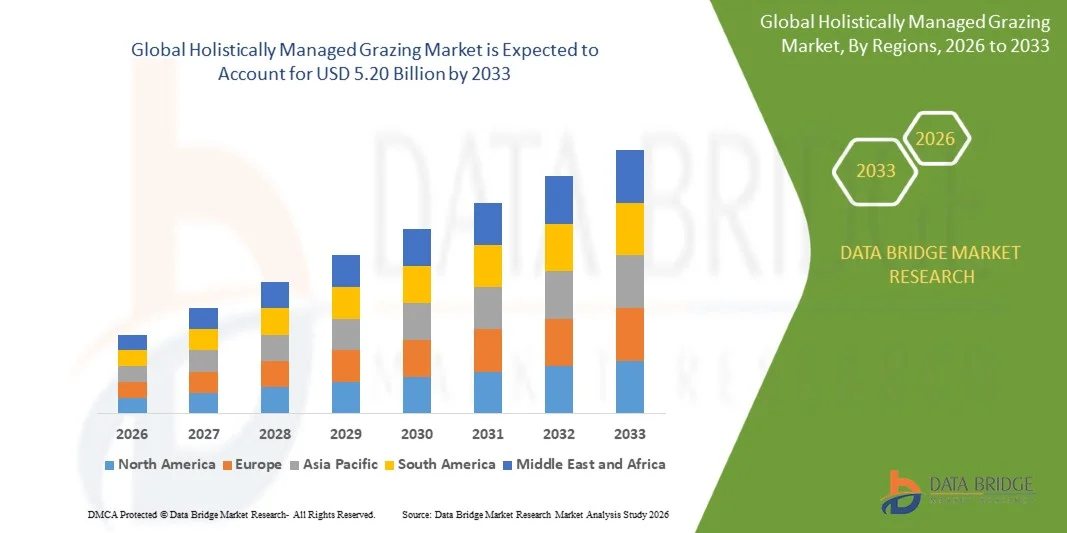
As per Data Bridge Market Research analysis, the Holistically Managed Grazing Market was valued at USD 1.70 billion in 2025 and is projected to reach USD 5.20 billion by 2033, growing at a CAGR of 6.2% from 2026 to 2033. The market is experiencing steady expansion due to increasing adoption of regenerative livestock management practices, growing emphasis on restoring soil health, and rising awareness regarding sustainable agricultural systems. Farmers and ranchers are increasingly implementing holistic grazing strategies to improve pasture productivity, enhance biodiversity, strengthen ecosystem resilience, and optimize livestock performance while reducing environmental impact.
The growing focus on climate-smart agriculture, carbon sequestration, and efficient land management is encouraging governments, agricultural organizations, and commercial livestock producers to invest in holistic grazing systems. Advancements in precision agriculture technologies, including GPS livestock tracking, remote pasture monitoring, drone-based vegetation assessment, and digital farm management platforms, are enabling producers to make informed grazing decisions while improving pasture utilization and long-term farm profitability.
Key Market Trends & Insights
- North America dominated the Holistically Managed Grazing Market with the largest revenue share in 2025, supported by strong adoption of regenerative livestock farming practices, extensive grazing land, and favourable government conservation initiatives.
- Asia-Pacific is expected to be the fastest-growing region during the forecast period, driven by increasing livestock populations, expanding sustainable farming initiatives, growing awareness of regenerative agriculture, and rising investments in pasture improvement across Australia, New Zealand, China, and India.
- The Adaptive Multi-Paddock Grazing segment accounted for the largest market share in 2025 due to its proven ability to improve forage productivity, enhance soil organic matter, and increase livestock carrying capacity.
- AI-enabled digital grazing management platforms are anticipated to register the fastest growth owing to increasing adoption of precision livestock farming, remote monitoring technologies, and predictive pasture management solutions.
- Commercial livestock farms represented the largest end-user segment in 2025 as producers continue to prioritize sustainable meat and dairy production while improving operational efficiency and long-term land productivity.
- Cloud-based farm management platforms are witnessing increasing adoption as producers seek scalable solutions for grazing planning, livestock monitoring, weather integration, and sustainability reporting.
- The Soil Restoration & Carbon Sequestration segment is among the fastest-growing application categories, driven by rising demand for carbon credits and increasing focus on climate-positive agricultural practices.
- Certification & verification services are gaining traction as food companies and retailers seek verified regenerative sourcing to meet sustainability commitments.
Market Size & Forecast
- Global Market Value (2025): USD 1.70 Billion
- Expected Market Value (2033): USD 5.20 Billion
- Forecast CAGR (2026–2033): 6.2%
- Leading Region in 2025: North America
- Fastest Growing Region: Asia-Pacific
Report Scope and Holistically Managed Grazing Market Segmentation
|
Attributes |
Holistically Managed Grazing Key Market Insights |
|
Segments Covered |
· By Grazing Type: Adaptive Multi-Paddock Grazing, Rotational Grazing, Planned Grazing, Continuous Grazing and Mob Grazing · By Livestock: Cattle, Sheep, Goats and Mixed Livestock · By Farm Size: Small Farms, Medium Farms and Large Commercial Farms · By Application: Livestock Production, Soil Restoration, Carbon Sequestration, Biodiversity Organizations, Research Institutions, and Non-Governmental Organizations · By Service Type: Grazing Planning & Consulting, Soil Health Assessment, Farm Management Services, Monitoring & Data Analytics and Training & Certification · By Technology Adoption: Conventional Monitoring, GPS & Remote Sensing, IoT-Enabled Grazing Systems, Drone-Based Monitoring and AI & Digital Farm Management Platforms · By Deployment: On-Farm Management and Cloud-Based Farm Management Platforms · By Support & Services: Consulting Services, Technical Support, Farm Implementation Services, Monitoring & Maintenance and Training Programs |
|
Countries Covered |
North America
Europe
Asia-Pacific
Middle East and Africa
South America
|
|
Key Market Players |
|
|
Market Opportunities |
· Integration of artificial intelligence and precision agriculture in grazing management · Growing demand for verified carbon credits and carbon farming programs · Development of certification and verification schemes for regenerative supply chains · Expansion of training and education services for farmers and ranchers · Increasing investment in technology platforms for monitoring and assessment |
|
Value Added Data Infosets |
In addition to the insights on market scenarios such as market value, growth rate, segmentation, geographical coverage, and major players, the market reports curated by the Data Bridge Market Research also include in-depth expert analysis, geographically represented company-wise production and capacity, network layouts of distributors and partners, detailed and updated price trend analysis, deficit analysis of supply chain and demand, soil health assessment, carbon sequestration verification, grazing planning optimization, sustainable agriculture certification analysis, supply chain traceability for regenerative products, livestock carrying capacity evaluation, remote sensing and monitoring technology assessment, farm profitability modeling, climate impact analysis, and policy and regulatory framework evaluation. |
Holistically Managed Grazing Market Trends
Trend: Growth in Carbon Sequestration & Climate Mitigation Programs
The growing emphasis on climate change mitigation has positioned holistically managed grazing as a key strategy for soil carbon sequestration. As companies and governments commit to net-zero targets, demand for verified carbon credits from regenerative grazing practices is surging. This trend is driving adoption across beef production, dairy farming, and mixed livestock operations, with producers leveraging carbon markets to generate additional revenue streams while improving land health. The integration of monitoring, reporting, and verification (MRV) technologies is further enhancing the credibility and scalability of carbon sequestration programs. Additionally, major food corporations are investing in regenerative agriculture programs and forming partnerships with ranchers to source regeneratively produced commodities, accelerating market growth.
Holistically Managed Grazing Market Dynamics
Key Market Driver: Rising Demand for Sustainable Livestock Production
The increasing global demand for sustainably produced meat, milk, and fiber is a primary driver of the holistically managed grazing market. Consumers are increasingly seeking products that are produced using environmentally responsible practices, and food companies are responding by establishing sustainable sourcing commitments. Holistically managed grazing offers a solution that improves animal welfare, enhances environmental outcomes, and supports rural livelihoods. Additionally, growing awareness of the links between diet, health, and environmental sustainability is encouraging producers to adopt grazing practices that align with consumer expectations.
Key Restraint/Challenge: Barriers to Widespread Adoption
Despite its benefits, the widespread adoption of holistically managed grazing faces significant challenges. The transition requires substantial changes in management practices, infrastructure development, and farmer mindset, which can be difficult to implement. The initial costs associated with training, planning, and infrastructure modifications can be prohibitive, particularly for small-scale producers and those in developing regions. Furthermore, the lack of policy support and financial incentives in many regions, combined with the need for extensive training and education, limits adoption rates. The reliance on dominant industry practices and the absence of enabling regulatory frameworks pose additional barriers to scalability.
Key Market Opportunity: Expansion of Carbon Markets and Sustainability Programs
The expansion of carbon markets and sustainability certification programs represents a significant opportunity for the holistically managed grazing market. Producers implementing holistic grazing practices can generate carbon credits, access premium markets, and participate in corporate sustainability programs. Organizations such as Land to Market are establishing standards that validate the ecological outcomes of holistic grazing practices, enabling producers to differentiate their products and access new revenue streams. The growing interest from food companies, retailers, and financial institutions in supporting regenerative agriculture is expected to accelerate market growth.
Holistically Managed Grazing Market Scope
The holistically managed grazing market is segmented on the basis of grazing type, livestock, farm size, application, end user, service type, technology adoption, deployment, and support & services.
- By Grazing Type
On the basis of grazing type, the Holistically Managed Grazing Market is segmented into adaptive multi-paddock grazing, rotational grazing, planned grazing, continuous grazing, and mob grazing. The Adaptive Multi-Paddock Grazing segment accounted for the largest market share in 2025 due to its proven ability to improve forage productivity, enhance soil organic matter, and increase livestock carrying capacity. This approach involves moving livestock through multiple paddocks in a planned sequence, allowing for adequate pasture recovery and improved plant diversity. These systems deliver high grazing efficiency without complex infrastructure, making them the preferred choice for commercial livestock producers and conservation-minded ranchers.
The Planned Grazing segment is projected to register the fastest growth from 2026 to 2033, driven by increasing adoption of systematic grazing planning approaches that align livestock needs with ecological objectives. Advances in digital grazing planning tools, combined with growing awareness of ecological benefits and declining costs of farm management software, are accelerating segment expansion.
- By Livestock
On the basis of livestock, the Holistically Managed Grazing Market is segmented into cattle, sheep, goats, and mixed livestock. The Cattle segment led the market in 2025, supported by extensive adoption of holistic grazing in beef and dairy production systems across North America, South America, and Australia. Major beef and dairy companies are increasingly integrating holistic grazing practices to meet sustainability targets and consumer demand for regeneratively sourced products.
The Mixed Livestock segment is expected to experience the fastest growth, driven by increasing interest in diversified farming systems that integrate multiple species for improved pasture utilization and ecological outcomes. The synergistic benefits of mixed grazing, including improved forage efficiency and reduced parasite pressure, are driving adoption among progressive farmers and ranchers.
- By Farm Size
On the basis of farm size, the Holistically Managed Grazing Market is segmented into small farms, medium farms, and large commercial farms. The Large Commercial Farms segment dominated the market in 2025, driven by the significant economies of scale, extensive grazing land holdings, and robust financial resources required to implement comprehensive holistic grazing systems. Large-scale operations are increasingly adopting advanced monitoring technologies and grazing planning platforms to optimize production efficiency and environmental outcomes.
The Medium Farms segment is expected to witness the fastest growth, as mid-sized operations seek to improve profitability, enhance sustainability credentials, and access premium markets. Government programs and agricultural extension services are increasingly supporting adoption among medium-sized farms through technical assistance and financial incentives.
- By Application
On the basis of application, the Holistically Managed Grazing Market is segmented into livestock production, soil restoration, carbon sequestration, biodiversity conservation, and pasture management. The Livestock Production segment dominated the market in 2025, reflecting the primary purpose of grazing systems in supporting meat, milk, and fiber production. Producers are increasingly adopting holistic grazing to improve production efficiency, animal health, and product quality while reducing environmental impacts.
The Soil Restoration & Carbon Sequestration segment is anticipated to witness the fastest growth, fueled by increasing awareness of the potential for agricultural soils to sequester atmospheric carbon and the growing demand for carbon credits. The integration of soil monitoring technologies and the expansion of carbon farming programs are further accelerating segment growth.
- By End User
On the basis of end user, the Holistically Managed Grazing Market is segmented into commercial livestock farms, agricultural cooperatives, government & conservation organizations, research institutions, and non-governmental organizations. The Commercial Livestock Farms segment dominated the market in 2025, as producers continue to prioritize sustainable meat and dairy production while improving operational efficiency and long-term land productivity.
The Government & Conservation Organizations segment is expected to witness significant growth, driven by increasing public investment in conservation programs, ecosystem restoration initiatives, and climate change adaptation strategies. Governments are increasingly recognizing the role of holistic grazing in achieving environmental and climate objectives.
- By Service Type
On the basis of service type, the Holistically Managed Grazing Market is segmented into grazing planning & consulting, soil health assessment, farm management services, monitoring & data analytics, and training & certification. The Grazing Planning & Consulting segment dominated the market in 2025 due to the complexity of transitioning to holistic grazing systems and the need for tailored expertise. Professional advisors provide critical guidance on grazing planning, ecosystem assessment, and carbon project development.
The Monitoring & Data Analytics segment is expected to witness the fastest growth, driven by the increasing need for data-driven decision-making in grazing management. The growing availability of remote sensing technologies, IoT sensors, and AI-powered analytics platforms is enabling producers to monitor pasture conditions, track livestock movements, and optimize grazing patterns more effectively.
- By Technology Adoption
On the basis of technology adoption, the Holistically Managed Grazing Market is segmented into conventional monitoring, GPS & remote sensing, IoT-enabled grazing systems, drone-based monitoring, and AI & digital farm management platforms. The GPS & Remote Sensing segment dominated the market in 2025, reflecting the widespread adoption of satellite-based pasture monitoring, livestock tracking, and vegetation assessment technologies. These tools enable producers to make informed grazing decisions based on accurate and timely data.
The AI & Digital Farm Management Platforms segment is anticipated to register the fastest growth, driven by increasing adoption of precision livestock farming, remote monitoring technologies, and predictive pasture management solutions. These platforms integrate multiple data sources to provide comprehensive decision support for grazing planning, livestock management, and sustainability reporting.
- By Deployment
On the basis of deployment, the Holistically Managed Grazing Market is segmented into on-farm management and cloud-based farm management platforms. The On-Farm Management segment dominated the market in 2025, preferred by commercial livestock producers, cooperatives, and research institutions that require direct control over grazing operations and real-time decision-making capabilities. Established distribution channels and regional partners facilitate faster deployment and adoption of on-farm solutions.
The Cloud-Based Farm Management Platforms segment is expected to witness the fastest growth, driven by increasing adoption of cloud computing technologies that enable real-time data access, remote monitoring, and collaborative decision-making across multiple locations. Cloud-based platforms offer scalable, cost-effective solutions for grazing planning, livestock monitoring, and sustainability reporting.
- By Support & Services
On the basis of support & services, the Holistically Managed Grazing Market is segmented into consulting services, technical support, farm implementation services, monitoring & maintenance, and training programs. The Consulting Services segment dominated the market in 2025 due to the critical role of professional advisors in guiding producers through the transition to holistic grazing systems. The widespread presence of regional consultants, agricultural extension agents, and service providers facilitates access to expertise and localized support.
The Training Programs segment is expected to witness the fastest growth, driven by the increasing need for skilled practitioners capable of implementing holistic grazing systems effectively. As organizations and training centers adopt advanced grazing approaches, training and capacity building become essential for ensuring successful implementation and long-term sustainability.
Holistically Managed Grazing Market Regional Analysis
North America Holistically Managed Grazing Market Insight
North America dominated the holistically managed grazing market and accounted for the largest revenue share in 2025, supported by strong adoption of regenerative livestock farming practices, extensive grazing land, and favorable government conservation initiatives. The region benefits from federal programs like the USDA Climate-Smart Commodity Program, the presence of major food corporations driving regenerative sourcing, and strong research and innovation in agroecology and soil health monitoring. Increasing focus on carbon farming, biodiversity restoration, and sustainable livestock production continues to strengthen North America's leadership position in the global market.
U.S. Holistically Managed Grazing Market Insight
The U.S. holistically managed grazing market is experiencing strong growth due to rising investments in regenerative agriculture, corporate sustainability commitments, and increasing participation in carbon farming programs. The country's mature agricultural infrastructure, combined with growing consumer demand for sustainably sourced products, is driving adoption across beef production, dairy farming, and mixed livestock operations. Furthermore, integration of AI, satellite monitoring, and data analytics technologies is improving grazing management and carbon verification, positioning the U.S. as a key innovation hub in the holistically managed grazing industry.
Canada Holistically Managed Grazing Market Insight
The Canada holistically managed grazing market is expanding steadily, supported by government initiatives to promote sustainable agriculture, growing awareness of soil health benefits, and increasing adoption of rotational grazing practices across the prairie provinces. Canadian ranchers are increasingly implementing holistic grazing systems to enhance resilience, improve forage productivity, and contribute to national climate goals. The presence of strong agricultural research institutions and extension services further supports market growth.
Europe Holistically Managed Grazing Market Insight
The Europe holistically managed grazing market is witnessing steady growth, driven by the European Union's Farm to Fork Strategy, strong consumer demand for sustainable food, and increasing adoption of regenerative practices in countries such as the U.K., France, and Germany. The region's focus on biodiversity conservation and climate change mitigation is further accelerating market growth. Continuous advancements in monitoring technologies, along with strong government focus on sustainable agriculture and innovation, are further driving market expansion.
U.K. Holistically Managed Grazing Market Insight
The U.K. holistically managed grazing market is experiencing steady growth, supported by rising adoption of regenerative agricultural practices, government support for sustainable farming, and growing demand for carbon credits. Increasing investments in training and advisory services and growing demand for cost-effective, nature-based solutions are contributing to market growth. The U.K.'s strong agricultural research base and commitment to environmental stewardship further position it as a key market in Europe.
Germany Holistically Managed Grazing Market Insight
The Germany holistically managed grazing market is expanding steadily due to the country's strong agricultural research capabilities, advanced environmental policies, and increasing adoption of next-generation regenerative practices. Agricultural organizations, research institutions, and training centers are increasingly utilizing holistic grazing systems for biodiversity restoration, climate adaptation, and sustainable production. Continuous advancements in monitoring technologies and AI integration, along with strong government focus on environmental protection and innovation, are further driving market growth in Germany.
Asia-Pacific Holistically Managed Grazing Market Insight
The Asia-Pacific holistically managed grazing market is expected to witness rapid growth, driven by increasing urbanization, expanding livestock production, and rising government investments in sustainable agriculture across countries such as China, India, and Australia. Growing awareness regarding land degradation, climate resilience, and food security is supporting regional market expansion. Additionally, the growing presence of international NGOs and development programs is accelerating grazing practice adoption across commercial and smallholder sectors.
Australia Holistically Managed Grazing Market Insight
The Australia holistically managed grazing market is experiencing robust growth, driven by the country's extensive cattle and sheep grazing systems, increasing focus on soil carbon sequestration, and the presence of leading organizations such as the Savory Institute's Australian Holistic Management Cooperative. Australian ranchers are increasingly adopting holistic grazing to enhance drought resilience, improve land condition, and participate in carbon markets.
India Holistically Managed Grazing Market Insight
The India holistically managed grazing market is expected to register the highest CAGR, driven by increasing government focus on sustainable livestock management, growing adoption of regenerative practices to combat land degradation, and the presence of a large smallholder farming community seeking cost-effective solutions. Growing awareness regarding sustainable grazing practices and increasing demand for cost-effective solutions are supporting regional market expansion.
China Holistically Managed Grazing Market Insight
The China holistically managed grazing market is growing rapidly, driven by increasing urbanization, expanding livestock production, and rising government focus on ecological restoration and sustainable agriculture. Growing adoption of technology-enabled grazing management across commercial and pastoral sectors is significantly boosting market demand. Rising investments in grassland restoration, increasing awareness regarding sustainable practices, and rapid technological advancements are positioning China as one of the fastest-growing markets for holistically managed grazing globally.
South America Holistically Managed Grazing Market Insight
The South America holistically managed grazing market is expanding, driven by the region's large beef production sector in countries such as Brazil and Argentina, increasing awareness of the environmental impacts of conventional grazing, and growing interest in sustainable intensification practices. The region's vast grassland ecosystems present significant opportunities for carbon sequestration and biodiversity conservation through adoption of holistic grazing practices.
Holistically Managed Grazing Market Share
The holistically managed grazing industry is primarily led by well-established organizations, including:
- Savory Institute (U.S.)
- MaiaGrazing (U.S.)
- PastureMap (U.S.)
- Agriwebb (Australia)
- Pasture.io (Australia)
- Holistic Management International (U.S.)
- Cargill, Incorporated (U.S.)
- Danone S.A. (France)
- General Mills Inc. (U.S.)
- Nestlé S.A. (Switzerland)
- Unilever (U.K.)
- Land to Market (U.S.)
- Soil Capital (Belgium)
- CIBO Technologies (U.S.)
- Continuum Ag (U.S.)
- Grounded Ingredients (U.S.)
- Farmbrite (U.S.)
- Elynx (Australia)
- Farmdeck (U.S.)
Latest Developments in Holistically Managed Grazing Market
- In June 2025, UGG, a division of Deckers Brands, announced it had achieved a significant milestone of influencing one million acres of grasslands across eighty farms in Australia towards regenerative farmland, a year ahead of schedule.
- In 2025, the Savory Global Network continued to expand, reaching over 50 regional learning Hubs across six continents, training over 16,000 farmers, ranchers, and pastoralists, and influencing management of over 21 million hectares of grasslands.
- In July 2025, research published in Sustainability Science examined cattle and land management practices from producers' perspectives to evaluate whether a broader adoption of the currently niche Holistic Grazing Management approach is desirable or possible.
- In July 2024, ALUS and General Mills announced the expansion of their regenerative agriculture pilot program, "Growing Roots," after exceeding several targets set for the initial two-year pilot period.
- In September 2024, General Mills partnered with Ahold Delhaize USA to transition more than 70,000 acres of farmland in Kansas and Canada's Saskatchewan province to regenerative agriculture by the end of 2025.
- In November 2024, Danone announced an ambitious initiative to reduce methane emissions from its fresh milk supply chain by 30% by 2030, against a 2020 baseline, aligning with the Global Methane Pledge.
- In November 2024, Cargill Incorporated announced new partnerships to accelerate the adoption of regenerative agriculture practices, including holistically managed grazing, across its global supply chains. The company is focusing on training, technical assistance, and carbon market access to support producers in transitioning to regenerative systems.

- Interactive Data Analysis Dashboard
- Company Analysis Dashboard for high growth potential opportunities
- Research Analyst Access for customization & queries
- Competitor Analysis with Interactive dashboard
- Latest News, Updates & Trend analysis
- Harness the Power of Benchmark Analysis for Comprehensive Competitor Tracking
Data collection and base year analysis are done using data collection modules with large sample sizes. The stage includes obtaining market information or related data through various sources and strategies. It includes examining and planning all the data acquired from the past in advance. It likewise envelops the examination of information inconsistencies seen across different information sources. The market data is analysed and estimated using market statistical and coherent models. Also, market share analysis and key trend analysis are the major success factors in the market report. To know more, please request an analyst call or drop down your inquiry.
The key research methodology used by DBMR research team is data triangulation which involves data mining, analysis of the impact of data variables on the market and primary (industry expert) validation. Data models include Vendor Positioning Grid, Market Time Line Analysis, Market Overview and Guide, Company Positioning Grid, Patent Analysis, Pricing Analysis, Company Market Share Analysis, Standards of Measurement, Global versus Regional and Vendor Share Analysis. To know more about the research methodology, drop in an inquiry to speak to our industry experts.
Data Bridge Market Research is a leader in advanced formative research. We take pride in servicing our existing and new customers with data and analysis that match and suits their goal. The report can be customized to include price trend analysis of target brands understanding the market for additional countries (ask for the list of countries), clinical trial results data, literature review, refurbished market and product base analysis. Market analysis of target competitors can be analyzed from technology-based analysis to market portfolio strategies. We can add as many competitors that you require data about in the format and data style you are looking for. Our team of analysts can also provide you data in crude raw excel files pivot tables (Fact book) or can assist you in creating presentations from the data sets available in the report.