


What is the Holographic Imaging Market Size and Growth Rate?
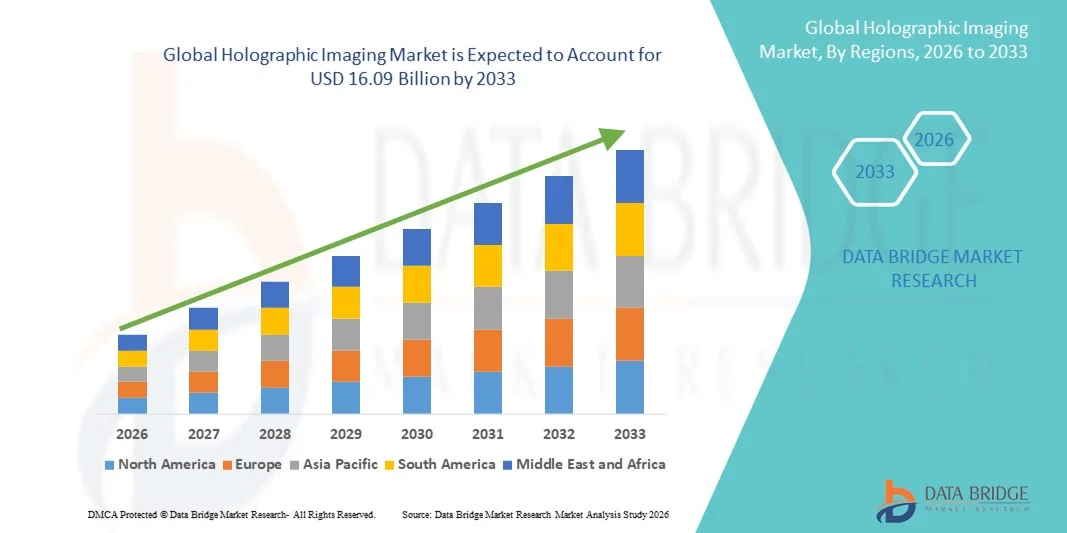
- As per Data Bridge Market Research Analysis the global holographic imaging market size was valued at USD 2.03 billion in 2025 and is expected to reach USD 16.09 billion by 2033, at a CAGR of 29.54% during the forecast period
- The market growth is largely fueled by the growing adoption of holographic imaging solutions across healthcare, defense, automotive, consumer electronics and industrial applications, driven by increased demand for advanced 3D imaging, non‑invasive diagnostics, and immersive visualization technologies that enhance precision and user experience
- Furthermore, rapid technological advancements in optical systems, computational holography and display technologies, combined with rising investments in mixed reality and digital twin applications, are enabling wider integration of holographic imaging into workflows and consumer platforms strengthening its role as a transformative imaging solution across sectors
Market Size & Forecast
- Global Market Value (2025): USD 2.03 billion
- Expected Market Value (2033): USD 16.09 billion
- Forecast CAGR (2026–2033): 29.54%
What are the Major Takeaways of Holographic Imaging Market?
- Holographic imaging, providing advanced 3D visualization and imaging capabilities, is increasingly becoming a critical technology across healthcare, defense, automotive, consumer electronics, and industrial sectors due to its ability to deliver immersive, precise, and non-invasive imaging solutions
- The growing adoption of holographic imaging is primarily driven by the rising demand for high-resolution 3D imaging, non-invasive diagnostics in healthcare, immersive experiences in consumer electronics, and enhanced visualization for industrial and defense applications
- North America dominated the holographic imaging market with the largest revenue share of 38.7% in 2025, fueled by early adoption of advanced imaging technologies, strong R&D investments, high healthcare expenditure, and a robust presence of leading technology providers developing AR/VR-integrated holographic solutions
- Asia-Pacific is expected to be the fastest-growing region during the forecast period due to rapid technological adoption, increasing investment in healthcare infrastructure, and growing use of holographic imaging in automotive and consumer electronics applications
- The medical imaging segment dominated the holographic imaging market with a share of 41.5% in 2025, driven by the rising demand for non-invasive diagnostics, advanced surgical planning, and enhanced visualization capabilities in hospitals and research centers
 Report Scope and Holographic Imaging Market Segmentation
|
Attributes |
Holographic Imaging Key Market Insights |
|
Segments Covered |
|
|
Countries Covered |
North America
Europe
Asia-Pacific
Middle East and Africa
South America
|
|
Key Market Players |
|
|
Market Opportunities |
|
|
Value Added Data Infosets |
|
What is the Key Trend in the Holographic Imaging Market?
Expansion Through AR/VR and Mixed Reality Integration
- A significant and accelerating trend in the global holographic imaging market is the integration with augmented reality (AR), virtual reality (VR), and mixed reality platforms, enhancing immersive visualization across healthcare, industrial design, and entertainment applications
- For instance, Microsoft HoloLens 3 leverages holographic imaging to overlay 3D medical data in surgical settings, while Magic Leap’s AR platform integrates holographic displays for industrial prototyping and immersive consumer experiences
- Holographic imaging systems combined with AR/VR enable real-time interactive simulations, precise 3D modeling, and collaborative remote visualization, significantly improving training, diagnostics, and design workflows
- The seamless integration of holographic imaging with immersive platforms allows users to manipulate 3D content intuitively, fostering higher engagement and operational efficiency across various professional and consumer applications
- This trend towards interactive, high-fidelity holographic visualization is fundamentally redefining expectations for 3D imaging technology, prompting companies such as Zebra Imaging to develop holographic displays compatible with AR/VR headsets
- The demand for holographic imaging solutions integrated with mixed reality platforms is growing rapidly across healthcare, industrial, and entertainment sectors, driven by the need for enhanced visualization, precision, and immersive experiences
- Companies are also exploring light-field and wavefront holography to improve image depth, clarity, and realism, enhancing user experience in both professional and consumer applications
Holographic Imaging Market Dynamics
Driver
Rising Demand for Advanced 3D Visualization Across Industries
- The increasing requirement for high-precision 3D imaging in healthcare, automotive, defense, and industrial sectors is a significant driver for the adoption of holographic imaging solutions
- For instance, in March 2025, RealView Imaging announced an advanced AR-based holographic system for cardiac surgery planning, aiming to provide precise 3D visualization of patient anatomy
- As professionals seek more accurate and interactive visualization tools, holographic imaging offers non-invasive, real-time 3D displays that improve decision-making and reduce errors in critical applications
- Furthermore, the growing use of holographic imaging in product design, industrial prototyping, and training simulations is making it an indispensable tool for innovation and operational efficiency
- The ability to overlay digital content onto physical environments and visualize complex structures in three dimensions is propelling adoption in both enterprise and research applications
- Increasing investments by governments and private institutions in digital twin technologies and smart manufacturing are driving demand for holographic imaging in industrial automation
- Rapid technological advancements in 3D scanning, laser projection, and computational holography are expanding the application scope, making holographic imaging more versatile and commercially viable
Restraint/Challenge
High Equipment Costs and Technical Complexity
- The relatively high cost of advanced holographic imaging systems and associated hardware poses a challenge to widespread market adoption, particularly among small and medium enterprises
- For instance, some healthcare providers delay adoption of holographic imaging due to expensive AR/VR-compatible displays and proprietary software licensing fees
- Technical complexity and the need for specialized training to operate holographic imaging solutions can hinder implementation, especially in regions with limited technical expertise
- Furthermore, standardization issues and compatibility challenges with existing imaging infrastructure create additional barriers for integration into established workflows
- While ongoing R&D and cost reductions are gradually improving accessibility, the perception of premium investment and technical learning curves can still slow adoption in budget-sensitive markets
- Cybersecurity and data privacy concerns associated with sharing and storing 3D holographic data can limit adoption in healthcare, defense, and enterprise applications
- The lack of widespread regulatory guidelines and standards for holographic imaging technology can create uncertainty, delaying investments and large-scale deployments
How is the Holographic Imaging Market Segmented?
The market is segmented on the basis of product type, application, and end user.
- By Product Type
On the basis of product type, the holographic imaging market is segmented into holographic display, holography software, holography microscopes, and holographic prints. The holographic display segment dominated the market with the largest revenue share in 2025, driven by its extensive adoption across healthcare visualization, industrial design, defense simulation, and immersive entertainment applications. Holographic displays enable real-time 3D visualization without the need for physical models, significantly improving spatial understanding and decision-making accuracy. Their integration with AR/VR and mixed reality platforms has further strengthened demand across medical imaging, surgical planning, and advanced training environments. In addition, continuous improvements in display resolution, brightness, and field of view are accelerating adoption across both enterprise and consumer sectors.
The holography software segment is expected to witness the fastest growth during the forecast period, fueled by rising demand for computational holography, 3D reconstruction, and digital twin technologies. Software solutions enable the processing, rendering, and manipulation of holographic data across medical, industrial, and research applications. The increasing shift toward cloud-based visualization platforms and AI-powered image processing is expanding software adoption. Moreover, software-driven holography reduces dependency on expensive hardware, making holographic imaging more accessible to smaller organizations and research institutions.
- By Application
On the basis of application, the holographic imaging market is segmented into medical imaging, medical education, surgery preplanning and assistance, interventional cardiology, biomedical research, digital intimacy, and others. The medical imaging segment dominated the market with the highest revenue share of 41.5% in 2025, driven by the growing need for non-invasive, high-resolution 3D visualization in diagnostics and clinical decision-making. Holographic imaging enables clinicians to visualize complex anatomical structures in three dimensions, improving diagnostic accuracy and treatment planning. Its use in oncology, cardiology, and neurology has increased significantly due to its ability to display volumetric patient data in real time. Rising healthcare digitization and investments in advanced imaging infrastructure further support segment dominance.
The surgery preplanning and assistance segment is projected to grow at the fastest rate during the forecast period, owing to the increasing adoption of holographic visualization in complex surgical procedures. Surgeons utilize holographic imaging to simulate procedures, assess anatomical risks, and plan interventions with greater precision. The technology enhances intraoperative guidance by overlaying holographic data onto real-world surgical environments. Growing demand for minimally invasive surgeries and precision medicine is accelerating adoption of holographic tools in operating rooms worldwide.
- By End User
On the basis of end user, the holographic imaging market is segmented into pharmaceutical and biotechnology companies, research organizations, academic medical centers, hospitals and clinics, and others. The hospitals and clinics segment dominated the market in 2025, driven by the increasing integration of holographic imaging into diagnostics, surgical planning, and clinical training. Hospitals are adopting holographic systems to improve patient outcomes through enhanced visualization and real-time data interaction. The technology supports multidisciplinary collaboration among clinicians and improves communication with patients through visual explanations of medical conditions. Growing investments in smart hospitals and digital healthcare infrastructure further reinforce segment leadership.
The pharmaceutical and biotechnology companies segment is expected to register the fastest growth during the forecast period, supported by rising use of holographic imaging in drug discovery, molecular visualization, and R&D workflows. Holographic imaging enables researchers to visualize complex biological structures and molecular interactions in three dimensions, accelerating research efficiency. The growing emphasis on biologics, personalized medicine, and advanced therapeutic development is driving demand within this segment. In addition, increasing R&D spending and adoption of digital research tools are contributing to rapid growth among pharmaceutical and biotechnology companies.
Which Region Holds the Largest Share of the Holographic Imaging Market?
- North America dominated the holographic imaging market with the largest revenue share of 38.7% in 2025, fueled by early adoption of advanced imaging technologies, strong R&D investments, high healthcare expenditure, and a robust presence of leading technology providers developing AR/VR-integrated holographic solutions
- End users in the region place high value on the precision, immersive visualization, and real-time 3D imaging capabilities offered by holographic imaging, particularly for medical diagnostics, surgical planning, and advanced research applications
- This widespread adoption is further supported by robust R&D investments, high healthcare expenditure, strong presence of leading technology providers, and rapid digital transformation, positioning holographic imaging as a preferred solution across hospitals, research institutions, and enterprise environments
U.S. Holographic Imaging Market Insight
The U.S. holographic imaging market captured the largest revenue share within North America in 2025, driven by strong adoption of advanced visualization technologies across healthcare, defense, and industrial sectors. Organizations are increasingly prioritizing precision imaging and immersive 3D visualization to improve diagnostics, surgical planning, and product design. The growing use of AR/VR-enabled holographic platforms in medical training and research further supports market expansion. Moreover, strong R&D funding, presence of leading technology providers, and early adoption of digital twin technologies are significantly contributing to market growth.
Europe Holographic Imaging Market Insight
The Europe holographic imaging market is projected to expand at a substantial CAGR during the forecast period, primarily driven by rising investments in healthcare digitization and advanced research infrastructure. Increasing demand for non-invasive imaging solutions and precision diagnostics is fostering adoption across hospitals and academic institutions. European industries are also leveraging holographic imaging for industrial design, automotive visualization, and training applications. The region is witnessing growing deployment across healthcare, research, and industrial environments, supported by strong regulatory focus on innovation and patient safety.
U.K. Holographic Imaging Market Insight
The U.K. holographic imaging market is anticipated to grow at a noteworthy CAGR during the forecast period, driven by the increasing adoption of advanced medical imaging and digital healthcare solutions. Rising emphasis on surgical planning, medical education, and remote collaboration is accelerating the use of holographic imaging technologies. The country’s strong academic research base and innovation-driven healthcare ecosystem further support market growth. In addition, increasing investments in AR/VR-enabled visualization tools are expected to sustain demand across clinical and research settings.
Germany Holographic Imaging Market Insight
The Germany holographic imaging market is expected to expand at a considerable CAGR during the forecast period, fueled by strong industrial innovation and demand for high-precision visualization technologies. Germany’s well-established healthcare and manufacturing infrastructure supports the adoption of holographic imaging in medical diagnostics, automotive design, and industrial prototyping. The country’s emphasis on engineering excellence and digital transformation is promoting the integration of holographic systems into research and enterprise workflows. A strong focus on data accuracy, reliability, and advanced imaging solutions aligns well with local market requirements.
Asia-Pacific Holographic Imaging Market Insight
The Asia-Pacific holographic imaging market is poised to grow at the fastest CAGR during the forecast period, driven by rapid technological advancement, expanding healthcare infrastructure, and increasing investments in digital innovation. Countries such as China, Japan, and India are witnessing rising adoption of holographic imaging across medical imaging, research, and industrial applications. Government initiatives supporting healthcare modernization and smart manufacturing are accelerating market penetration. In addition, the region’s growing role as a technology manufacturing hub is improving affordability and accessibility of holographic imaging solutions.
Japan Holographic Imaging Market Insight
The Japan holographic imaging market is gaining momentum due to the country’s advanced technological landscape and strong focus on precision healthcare solutions. Japanese institutions are increasingly adopting holographic imaging for medical visualization, surgical planning, and advanced research applications. Integration with robotics, AI, and IoT-driven medical systems is further enhancing adoption. Moreover, Japan’s aging population is driving demand for advanced diagnostic and visualization tools that support accurate, non-invasive, and efficient healthcare delivery.
India Holographic Imaging Market Insight
The India holographic imaging market accounted for a significant revenue share in Asia Pacific in 2025, supported by rapid expansion of healthcare infrastructure and growing adoption of advanced imaging technologies. Increasing investments in medical research, digital healthcare, and academic institutions are driving demand for holographic imaging solutions. India’s growing pool of skilled professionals and emphasis on innovation are accelerating usage across medical education and biomedical research. In addition, rising government focus on healthcare modernization and expanding access to advanced diagnostic tools are key factors propelling market growth
Which are the Top Companies in Holographic Imaging Market?
The Holographic Imaging industry is primarily led by well-established companies, including:
- Axiom Holographics (U.S.)
- RealView Imaging Ltd (Israel)
- Holoxica Limited (U.K.)
- Leia Inc. (U.S.)
- VNTANA, Inc. (U.S.)
- Zebra Imaging, Inc. (U.S.)
- Holografika Kft. (Hungary)
- Nanolive SA (Switzerland)
- zSpace, Inc. (U.S.)
- Lyncee Tec SA (Switzerland)
- VividQ Ltd (U.K.)
- Ovizio Imaging Systems NV/SA (Belgium)
- EchoPixel, Inc. (U.S.)
- HYPERVSN Ltd (U.K.)
- Holoconnects (U.S.)
- Provision Holding, Inc. (U.S.)
- Looking Glass Factory, Inc. (U.S.)
- MDH Hologram Ltd (India)
- Holoflex Limited (U.K.)
What are the Recent Developments in Global Holographic Imaging Market?
- In October 2025, MicroCloud Hologram Inc. announced a significant breakthrough in interactive 3D holographic technology, including improved quantum link efficiency and compact volumetric displays enabling natural interaction without VR headsets, signaling major strides toward mainstream holographic systems
- In September 2025, Phase Holographic Imaging (PHI) provided an update on the development progress of its next-generation HoloMonitor®, including AI-powered automated cell segmentation and enhanced imaging analysis, with commercial launch expected before the end of 2025 to expand into clinical and pharmaceutical applications
- In September 2025, Nika Optics showcased its latest volume holographic waveguide technology at the China International Optoelectronics Exposition (CIOE), demonstrating breakthroughs in optical efficiency and mass production for AR displays, alongside a strategic partnership to produce 500,000 waveguide units, boosting commercialization of holographic optical solutions
- In March 2025, Swave Photonics secured additional Series A funding of €6 million led by Samsung Ventures to advance its true holographic display technology for spatial and AI computing, aiming to bring high-quality 3D holographic displays into compact devices and spatial computing platforms
- In January 2025, PxE Holographic Imaging announced it will debut its next-generation Holographic RGB-IR-Depth Camera at CES 2025, showcasing technology that transforms standard 2D cameras into immersive 3D imaging systems for smartphones, laptops, automotive, and robotics, representing a foundational shift in digital imaging from 2D to true 3D holographic capture

- Interactive Data Analysis Dashboard
- Company Analysis Dashboard for high growth potential opportunities
- Research Analyst Access for customization & queries
- Competitor Analysis with Interactive dashboard
- Latest News, Updates & Trend analysis
- Harness the Power of Benchmark Analysis for Comprehensive Competitor Tracking
Data collection and base year analysis are done using data collection modules with large sample sizes. The stage includes obtaining market information or related data through various sources and strategies. It includes examining and planning all the data acquired from the past in advance. It likewise envelops the examination of information inconsistencies seen across different information sources. The market data is analysed and estimated using market statistical and coherent models. Also, market share analysis and key trend analysis are the major success factors in the market report. To know more, please request an analyst call or drop down your inquiry.
The key research methodology used by DBMR research team is data triangulation which involves data mining, analysis of the impact of data variables on the market and primary (industry expert) validation. Data models include Vendor Positioning Grid, Market Time Line Analysis, Market Overview and Guide, Company Positioning Grid, Patent Analysis, Pricing Analysis, Company Market Share Analysis, Standards of Measurement, Global versus Regional and Vendor Share Analysis. To know more about the research methodology, drop in an inquiry to speak to our industry experts.
Data Bridge Market Research is a leader in advanced formative research. We take pride in servicing our existing and new customers with data and analysis that match and suits their goal. The report can be customized to include price trend analysis of target brands understanding the market for additional countries (ask for the list of countries), clinical trial results data, literature review, refurbished market and product base analysis. Market analysis of target competitors can be analyzed from technology-based analysis to market portfolio strategies. We can add as many competitors that you require data about in the format and data style you are looking for. Our team of analysts can also provide you data in crude raw excel files pivot tables (Fact book) or can assist you in creating presentations from the data sets available in the report.













