


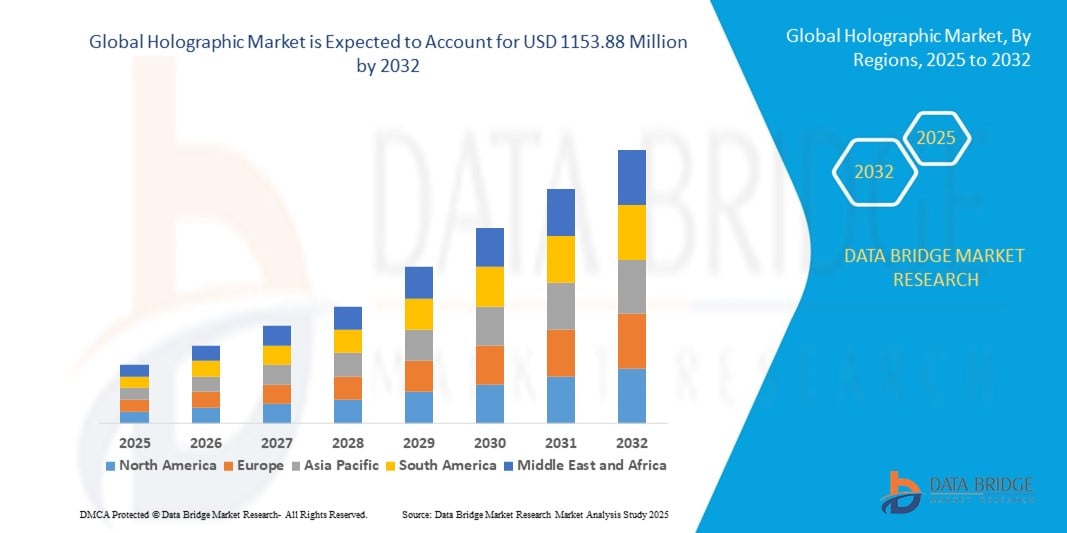
Holographic Market Size
- The global holographic market size was valued at USD 954.47 million in 2024 and is expected to reach USD 1153.88 million by 2032, at a CAGR of 2.4% during the forecast period
- The market growth is largely fuelled by increasing adoption of holographic technology across sectors such as retail, entertainment, education, and healthcare, driven by the demand for immersive visual experiences and advanced display solutions.
- Growing investments in augmented reality (AR) and virtual reality (VR) technologies, along with innovations in holographic imaging and projection, are further boosting market expansion
Holographic Market Analysis
- The entertainment and media industry remains one of the leading adopters of holographic displays, using the technology for concerts, exhibitions, and interactive experiences to engage audiences.
- The retail sector is increasingly utilizing holograms for advertising and product visualization, offering consumers a more dynamic and memorable shopping experience
- Asia-Pacific dominated the holographic market with the largest revenue share in 2024, driven by rapid digitalization, expanding consumer electronics manufacturing, and the rising adoption of immersive technologies across entertainment, retail, and healthcare sectors
- North America region is expected to witness the highest growth rate in the global holographic market, driven by technological innovation, expanding applications across industries, and a strong ecosystem of technology providers and startups
- The holographic display segment dominated the market with the largest market revenue share in 2024, driven by its expanding use in advertising, product visualization, and immersive entertainment experiences. Businesses are increasingly investing in holographic displays to create eye-catching presentations that stand out in competitive markets. The ability to deliver 3D visualizations without the need for special glasses has further boosted their appeal across various sectors
Report Scope and Holographic Market Segmentation
|
Attributes |
Holographic Key Market Insights |
|
Segments Covered |
|
|
Countries Covered |
North America
Europe
Asia-Pacific
Middle East and Africa
South America
|
|
Key Market Players |
|
|
Market Opportunities |
|
|
Value Added Data Infosets |
In addition to the insights on market scenarios such as market value, growth rate, segmentation, geographical coverage, and major players, the market reports curated by the Data Bridge Market Research also include in-depth expert analysis, geographically represented company-wise production and capacity, network layouts of distributors and partners, detailed and updated price trend analysis and deficit analysis of supply chain and demand. |
Holographic Market Trends
Rising Adoption Of Holographic Displays In Retail And Advertising
- The growing integration of holographic technology into retail and advertising is transforming the way brands engage with consumers by creating immersive, interactive experiences. These displays allow businesses to showcase products in 3D without physical inventory, enhancing visual appeal and customer engagement
- The increasing demand for innovative marketing tools is accelerating the deployment of holographic projection systems in shopping malls, exhibitions, and product launches. This trend is further supported by advancements in projection quality, portability, and cost-effectiveness, making the technology more accessible to a wider range of businesses
- The adoption of holographic displays in retail enables real-time content updates, targeted advertising, and personalization, providing brands with a competitive edge in crowded markets. The visually striking nature of holograms increases dwell time and brand recall among potential customers
- For instance, in 2024, several global retail chains implemented holographic window displays to showcase seasonal collections, resulting in significant foot traffic increases and higher conversion rates. This approach also reduced operational costs associated with physical product displays.
- While holographic displays are rapidly gaining traction in retail and advertising, their long-term success will depend on ongoing innovation, cost optimization, and ease of integration into existing marketing ecosystems. Manufacturers and service providers must focus on scalable solutions to meet rising demand across diverse market segments
Holographic Market Dynamics
Driver
Increasing Use Of Holographic Imaging In Healthcare And Education
• The rising adoption of holographic imaging in healthcare is enabling advanced visualization for medical training, surgical planning, and diagnostics. This technology allows practitioners to view complex anatomical structures in 3D with exceptional clarity, leading to better decision-making and improved patient outcomes. Hospitals and research centers are increasingly integrating holographic solutions into their workflow to enhance precision and reduce the risk of complications
• In education, holographic systems enhance learning by offering interactive 3D models and simulations, fostering better understanding in fields such as science, engineering, and design. These immersive experiences promote active learning and retention by enabling students to engage with lifelike content in real time. The approach is gaining traction among universities aiming to modernize STEM curricula
• The growing need for remote training solutions, coupled with technological advancements in display resolution and interactivity, is boosting demand for holographic solutions in academic institutions and medical facilities. Virtual and hybrid classrooms are leveraging holography to replicate in-person learning experiences. This shift is particularly valuable in regions where access to physical training facilities is limited.
• For instance, in 2023, several medical universities in Europe integrated holographic anatomy labs into their curriculum, significantly improving student performance in practical examinations. The technology allowed real-time manipulation of human anatomy models without the need for cadavers, cutting costs and improving safety. These implementations have set benchmarks for other institutions worldwid
• Despite strong growth drivers, market expansion will require addressing cost barriers and ensuring user-friendly interfaces to encourage broader adoption in both healthcare and educational settings. Manufacturers need to develop intuitive systems that require minimal training while offering multilingual support and integration with existing digital platforms
Restraint/Challenge
High Cost Of Advanced Holographic Systems And Limited Accessibility
• The high price of advanced holographic projection systems and related hardware restricts adoption among small and medium-sized enterprises, as well as institutions with limited budgets. Expenses extend beyond the initial purchase to include ongoing software licensing, content creation, and maintenance contracts. This financial burden often deters organizations from investing in the technology
• In many developing regions, lack of technical expertise and supporting infrastructure limits the installation and operation of holographic systems. Power supply inconsistencies, inadequate internet bandwidth, and absence of skilled technicians result in delayed deployment and underutilization of the technology. This creates a gap between interest and practical implementation
• The complexity of setup, combined with the need for specialized content and calibration, poses additional barriers for first-time adopters, especially in sectors with minimal exposure to advanced display solutions. Users often face long installation timelines and steep learning curves, which can impact productivity during the transition period
• For instance, in 2024, surveys indicated that over 60% of SMEs in Asia-Pacific expressed interest in holographic advertising but refrained from adoption due to high initial investment and technical challenges. Many cited the inability to justify ROI without affordable leasing models or shared service platforms. These findings underscore the need for creative financing solutions
• To unlock market potential, industry stakeholders must focus on cost-effective, plug-and-play solutions and develop partnerships that provide financing options and localized technical support. Regional manufacturing, modular designs, and cloud-based content management could significantly reduce costs and simplify deployment, making the technology viable for mass adoption
Holographic Market Scope
The market is segmented on the basis of offering, application, and technology.
- By Offering
On the basis of offering, the holographic market is segmented into holographic display, holographic printer, holographic sensor, holographic services, and others. The holographic display segment dominated the market with the largest market revenue share in 2024, driven by its expanding use in advertising, product visualization, and immersive entertainment experiences. Businesses are increasingly investing in holographic displays to create eye-catching presentations that stand out in competitive markets. The ability to deliver 3D visualizations without the need for special glasses has further boosted their appeal across various sectors.
The holographic printer segment is expected to witness the fastest growth rate from 2025 to 2032, fueled by increasing demand for high-resolution, 3D printed holographic images in security, packaging, and product authentication. Advancements in printing technology have made holographic printing more precise and cost-efficient, encouraging adoption in industries where anti-counterfeiting measures are critical.
- By Application
On the basis of application, the holographic market is segmented into entertainment and media, healthcare, automotive, retail, education, and others. The entertainment and media segment held the largest market revenue share in 2024, driven by the rising popularity of holographic concerts, exhibitions, and immersive storytelling experiences. Event organizers and production houses are leveraging holograms to create realistic, interactive performances that engage audiences in unique ways.
The healthcare segment is expected to witness the fastest growth rate from 2025 to 2032, driven by the increasing use of holographic imaging for medical training, diagnostics, and surgical planning. Holograms provide 3D visualization of organs and anatomical structures, enabling more accurate procedures and improving patient outcomes. The technology’s potential for remote collaboration in healthcare is also accelerating its adoption.
- By Technology
On the basis of technology, the holographic market is segmented into reflection holography, transmission holography, and hybrid holography. The reflection holography segment dominated the market in 2024, owing to its wide use in display applications and its ability to deliver high-quality images under varied lighting conditions. It remains a preferred choice for commercial and artistic purposes due to its visual clarity and depth perception.
The hybrid holography segment is expected to witness the fastest growth rate from 2025 to 2032, driven by its combination of multiple holographic techniques to enhance image quality, viewing angles, and adaptability across different applications. Its versatility makes it suitable for advanced display systems in fields ranging from defense to interactive retail installations.
Holographic Market Regional Analysis
• Asia-Pacific dominated the holographic market with the largest revenue share in 2024, driven by rapid digitalization, expanding consumer electronics manufacturing, and the rising adoption of immersive technologies across entertainment, retail, and healthcare sectors.
• The region’s growing middle-class population, increasing disposable incomes, and supportive government initiatives for technology innovation are accelerating the integration of holographic solutions.
• Strong manufacturing hubs in countries such as China, Japan, and South Korea are making holographic devices more affordable and accessible, positioning Asia-Pacific as the global leader in this market.
China Holographic Market Insight
The China holographic market accounted for the largest market revenue share in Asia-Pacific in 2024, fueled by the country’s strong manufacturing ecosystem, rapid technological adoption, and increasing applications in advertising, retail, and education. The government’s push towards digital transformation and smart city projects is further driving the demand for holographic solutions. In addition, local manufacturers are developing cost-effective and innovative products, boosting both domestic consumption and exports.
Japan Holographic Market Insight
The Japan holographic market is expected to witness the fastest growth rate from 2025 to 2032, supported by the nation’s advanced technology infrastructure, high consumer interest in futuristic experiences, and applications in entertainment, tourism, and healthcare. The use of holographic displays in concerts, exhibitions, and retail is expanding, while medical imaging solutions are also gaining traction. Japan’s focus on precision engineering and innovation continues to position it as a key contributor to the Asia-Pacific market.
North America Holographic Market Insight
The North America holographic market is expected to witness the fastest growth rate from 2025 to 2032, driven by high adoption in entertainment, healthcare, and advertising applications. The region’s robust technological infrastructure, strong research and development ecosystem, and presence of leading holographic solution providers are accelerating market penetration. The demand for advanced visualization in medical training, military simulation, and retail promotions continues to expand, supported by consumer willingness to invest in premium immersive technologies.
U.S. Holographic Market Insight
The U.S. holographic market is expected to witness the fastest growth rate from 2025 to 2032, fueled by the increasing adoption of holographic displays in events, live performances, education, and product marketing. The country’s thriving entertainment industry, coupled with advanced R&D capabilities in healthcare imaging, is driving innovation. Moreover, growing investments from tech giants and start-ups are making holographic solutions more accessible for both commercial and consumer applications.
Europe Holographic Market Insight
The Europe holographic market is expected to witness the fastest growth rate from 2025 to 2032, driven by rising adoption in retail, automotive design, and educational applications. Stringent quality standards, coupled with a strong focus on innovation and user experience, are fostering market growth. European enterprises are increasingly utilizing holographic displays for trade shows, virtual training, and advertising campaigns, supported by a well-established digital infrastructure and a growing demand for eco-friendly, energy-efficient display solutions.
Germany Holographic Market Insight
The Germany holographic market is expected to witness the fastest growth rate from 2025 to 2032, supported by strong industrial capabilities, advanced engineering expertise, and applications in automotive prototyping, healthcare visualization, and retail promotion. Germany’s manufacturing sector is leveraging holographic technology to enhance product design and quality control. In addition, increasing adoption in museums and cultural exhibitions is further broadening market applications.
U.K. Holographic Market Insight
The U.K. holographic market is expected to witness the fastest growth rate from 2025 to 2032, fueled by the country’s vibrant creative industry, adoption of immersive advertising, and applications in education and live events. The U.K. is emerging as a hub for interactive holographic experiences in tourism, museums, and corporate presentations. Furthermore, partnerships between universities, tech start-ups, and media companies are driving advancements in holographic content creation and deployment.
Holographic Market Share
The holographic industry is primarily led by well-established companies, including:
- HYPERVSN (U.K.)
- VividQ (U.K.)
- MDH Hologram Ltd. (China)
- SeeReal Technologies (Germany)
- Nanjing DSeeLab Digital Technology Co. (China)
- Realfiction Holdings AB (Denmark)
- Holoxica (U.K.)
- CY Vision (South Korea)
- Voxon Photonics (Australia)
- Light Field Lab, Inc. (U.S.)
Latest Developments in Global Holographic Market
- In January 2023, VividQ, a maker of holographic display technology for augmented reality gaming, has teamed up with waveguide designer Dispelix to make new 3D holographic imagery technology. The two companies have also announced the formation of a commercial partnership to develop the new 3D waveguide technology towards mass production readiness. This will enable headset manufacturers the ability to kick-start their AR product roadmaps now

- Interactive Data Analysis Dashboard
- Company Analysis Dashboard for high growth potential opportunities
- Research Analyst Access for customization & queries
- Competitor Analysis with Interactive dashboard
- Latest News, Updates & Trend analysis
- Harness the Power of Benchmark Analysis for Comprehensive Competitor Tracking
Global Holographic Market, Supply Chain Analysis and Ecosystem Framework
To support market growth and help clients navigate the impact of geopolitical shifts, DBMR has integrated in-depth supply chain analysis into its Global Holographic Market research reports. This addition empowers clients to respond effectively to global changes affecting their industries. The supply chain analysis section includes detailed insights such as Global Holographic Market consumption and production by country, price trend analysis, the impact of tariffs and geopolitical developments, and import and export trends by country and HSN code. It also highlights major suppliers with data on production capacity and company profiles, as well as key importers and exporters. In addition to research, DBMR offers specialized supply chain consulting services backed by over a decade of experience, providing solutions like supplier discovery, supplier risk assessment, price trend analysis, impact evaluation of inflation and trade route changes, and comprehensive market trend analysis.
Data collection and base year analysis are done using data collection modules with large sample sizes. The stage includes obtaining market information or related data through various sources and strategies. It includes examining and planning all the data acquired from the past in advance. It likewise envelops the examination of information inconsistencies seen across different information sources. The market data is analysed and estimated using market statistical and coherent models. Also, market share analysis and key trend analysis are the major success factors in the market report. To know more, please request an analyst call or drop down your inquiry.
The key research methodology used by DBMR research team is data triangulation which involves data mining, analysis of the impact of data variables on the market and primary (industry expert) validation. Data models include Vendor Positioning Grid, Market Time Line Analysis, Market Overview and Guide, Company Positioning Grid, Patent Analysis, Pricing Analysis, Company Market Share Analysis, Standards of Measurement, Global versus Regional and Vendor Share Analysis. To know more about the research methodology, drop in an inquiry to speak to our industry experts.
Data Bridge Market Research is a leader in advanced formative research. We take pride in servicing our existing and new customers with data and analysis that match and suits their goal. The report can be customized to include price trend analysis of target brands understanding the market for additional countries (ask for the list of countries), clinical trial results data, literature review, refurbished market and product base analysis. Market analysis of target competitors can be analyzed from technology-based analysis to market portfolio strategies. We can add as many competitors that you require data about in the format and data style you are looking for. Our team of analysts can also provide you data in crude raw excel files pivot tables (Fact book) or can assist you in creating presentations from the data sets available in the report.













