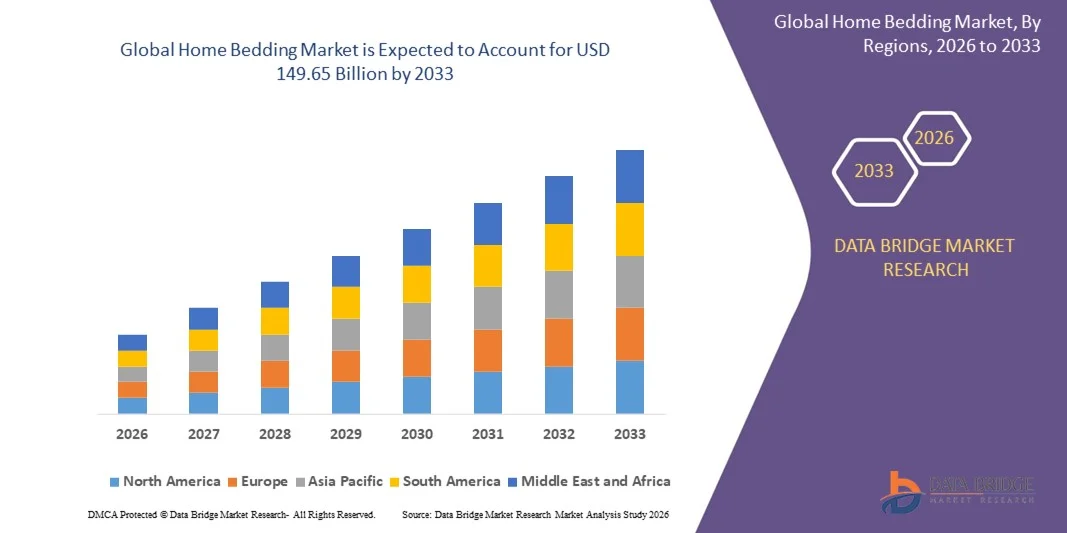
Global Home Bedding Market Size
- The Global Home Bedding Market size was valued at USD 96.92 billion in 2025 and is projected to reach USD 149.65 billion by 2033, expanding at a CAGR of 5.58% throughout the forecast period.
- Market growth is primarily driven by rising consumer focus on home aesthetics, increased spending on premium and comfort-oriented bedding products, and the expanding influence of interior décor trends across residential sectors.
- Additionally, growing awareness regarding sleep quality, coupled with demand for durable, sustainable, and technologically enhanced bedding solutions, is accelerating product adoption and significantly strengthening overall industry expansion.
Global Home Bedding Market Analysis
- Home bedding products, encompassing mattresses, pillows, blankets, bed linens, and comfort accessories, are becoming essential components of modern households as consumers increasingly prioritize comfort, sleep quality, and aesthetic coherence within bedroom spaces, supported by growing innovation in materials and designs.
- The rising demand for home bedding is primarily driven by heightened health and wellness awareness, increased spending on premium and eco-friendly bedding materials, and a growing preference for products that enhance rest, relaxation, and overall sleep experience.
- Asia-Pacific dominated the Global Home Bedding Market with the largest revenue share of 34.3% in 2025, supported by high consumer purchasing power, strong penetration of luxury bedding brands, and steady demand for sleep-enhancing products, with the U.S. experiencing notable growth due to rising adoption of premium mattresses, organic fabrics, and technologically advanced bedding solutions.
- North America is expected to be the fastest-growing region in the Global Home Bedding Market during the forecast period, fueled by rapid urbanization, expanding middle-class populations, and increasing consumer inclination toward stylish, comfortable, and affordable bedding products.
- The mattress segment dominated the market with the largest revenue share of 41.8% in 2025, driven by its essential role in sleep quality, rising consumer investment in orthopedic and memory-foam mattresses, and strong demand from both residential and hospitality sectors.
Report Scope and Global Home Bedding Market Segmentation
|
Attributes |
Home Bedding Key Market Insights |
|
Segments Covered |
|
|
Countries Covered |
North America
Europe
Asia-Pacific
Middle East and Africa
South America
|
|
Key Market Players |
• Tempur Sealy International (U.S.) |
|
Market Opportunities |
|
|
Value Added Data Infosets |
In addition to the insights on market scenarios such as market value, growth rate, segmentation, geographical coverage, and major players, the market reports curated by the Data Bridge Market Research also include in-depth expert analysis, pricing analysis, brand share analysis, consumer survey, demography analysis, supply chain analysis, value chain analysis, raw material/consumables overview, vendor selection criteria, PESTLE Analysis, Porter Analysis, and regulatory framework. |
Global Home Bedding Market Trends
Enhanced Comfort Through Smart Materials and Sleep Technology
- A significant and accelerating trend in the Global Home Bedding Market is the growing integration of advanced sleep technologies, smart materials, and innovative textile engineering designed to improve comfort, temperature regulation, and overall sleep quality. This evolution is redefining consumer expectations for modern bedding solutions.
- For Instance, bedding brands now offer temperature-adaptive fabrics and moisture-wicking materials that respond to body heat, helping maintain an optimal sleep climate. Similarly, premium mattress manufacturers are incorporating smart foam layers that adjust to body contours, offering enhanced pressure relief and spinal alignment.
- Technological advancements also enable features such as sleep-tracking sensors embedded in mattresses or mattress covers, providing insights into sleep cycles, restlessness, and breathing patterns. Some smart bedding systems even use AI-driven analytics to recommend personalized adjustments for improved sleep performance.
- The seamless integration of smart bedding with connected home platforms allows users to monitor sleep data and control adjustable beds, room temperature, or lighting through a unified interface, thereby enhancing the overall sleep environment and comfort experience.
- This trend toward intelligent, responsive, and wellness-focused bedding solutions is fundamentally transforming the home bedding landscape. As a result, companies are increasingly developing innovative bedding products incorporating materials such as phase-change fabrics, cooling gel layers, and pressure-adaptive foam technologies.
- The demand for bedding products featuring smart comfort innovations is rapidly rising across both residential and hospitality sectors as consumers prioritize health, convenience, and enhanced sleep optimization.
Global Home Bedding Market Dynamics
Driver
Growing Need Driven by Rising Wellness Awareness and Home Comfort Prioritization
- The increasing focus on health, well-being, and quality sleep among consumers, combined with a rising inclination toward enhancing home comfort, is a major driver for the heightened demand in the Global Home Bedding Market.
- For instance, in 2025, several leading bedding manufacturers expanded their portfolios of ergonomic mattresses and eco-friendly bedding materials, emphasizing innovations in pressure-relief technologies and sustainable fabrics. Such strategic product advancements are expected to fuel home bedding market growth during the forecast period.
- As consumers become more conscious of the impact of sleep quality on their overall health, bedding products offering enhanced comfort, improved durability, and scientifically designed support systems are increasingly viewed as essential upgrades over conventional options.
- Furthermore, the growing popularity of wellness-oriented home environments and the desire for aesthetically appealing, premium-quality bedroom furnishings are making modern bedding solutions an integral component of home improvement trends, especially in urban households.
- The convenience of online customization, the availability of organic and hypoallergenic materials, and innovative mattress-in-a-box models are key factors propelling adoption across residential and hospitality sectors. The rise of direct-to-consumer bedding brands and user-friendly online purchase options further contributes to the market’s expansion.
Restraint/Challenge
Concerns Regarding High Costs and Durability Variability
- Concerns surrounding the relatively high cost of premium bedding products—especially orthopedic mattresses, luxury linens, and technologically enhanced bedding—pose a significant challenge to broader market penetration. Such products are often priced well above traditional bedding, creating hesitancy among budget-conscious consumers.
- For Instance, rising raw material costs, particularly for memory foam, natural latex, and organic cotton, have contributed to higher retail prices, which can discourage adoption in price-sensitive markets.
- Addressing these challenges through improved cost-efficient manufacturing, enhanced transparency about product durability, and the introduction of mid-range alternatives is crucial for building consumer confidence. Many brands now highlight certifications such as OEKO-TEX, CertiPUR-US, and GOTS to reinforce product safety and quality. Additionally, variability in durability—especially among lower-priced products—can impact consumers’ willingness to invest in premium bedding.
- While more affordable product lines are emerging, the perceived premium cost of high-quality bedding solutions can still hinder widespread adoption, particularly in developing regions or among consumers who do not immediately recognize the long-term health benefits.
- Overcoming these challenges through value-driven pricing, consumer education on the importance of sleep health, and the development of durable yet affordable bedding options will be essential for sustaining market growth.
Global Home Bedding Market Scope
The home bedding market is segmented on the basis of product type, application and distribution channel.
- By Product Type
On the basis of product type, the Global Home Bedding Market is segmented into mattresses, bed linen, pillows, blankets, and others. The mattress segment dominated the market with the largest revenue share of 41.8% in 2025, driven by its essential role in sleep quality, rising consumer investment in orthopedic and memory-foam mattresses, and strong demand from both residential and hospitality sectors. Continuous innovation—such as hybrid constructions, cooling gel layers, and pressure-relief technologies—further strengthens its leading position.
The bed linen segment is expected to witness the fastest growth rate from 2026 to 2033, fueled by increasing consumer preference for premium fabrics, sustainable materials, and designer aesthetics. Bed linens such as organic cotton sheets, moisture-wicking fabrics, and antimicrobial textiles are gaining popularity due to growing health consciousness and demand for luxury bedroom décor. Expanding e-commerce platforms and customization options also contribute significantly to segment expansion.
- By Application
Based on application, the Global Home Bedding Market is segmented into personal, hotel, and others. The personal segment accounted for the largest market revenue share of 58.4% in 2025, driven by rising consumer spending on home improvement, increased awareness of sleep health, and strong demand for comfortable, durable, and aesthetically appealing bedding products. The growth of urban households, mattress-in-a-box offerings, and online retail penetration further supports dominance of the personal use category.
The hotel segment is expected to witness the fastest CAGR from 2026 to 2033, fueled by expanding hospitality infrastructure, increasing tourism, and the rising demand for premium bedding solutions in luxury and boutique hotels. Hotels prioritize high-quality mattresses, linen durability, and hypoallergenic materials to enhance guest experience. Global hotel renovations and standardized comfort protocols also contribute to accelerated demand for technologically enhanced and long-lasting bedding products.
- By Distribution Channel
On the basis of distribution channel, the Global Home Bedding Market is segmented into store-based and non-store-based channels. The store-based segment dominated the market with a 64.7% revenue share in 2025, owing to consumer preference for physically assessing bedding comfort, material quality, and fabric texture before purchase. Specialty bedding stores, home furnishing retailers, and large supermarkets continue to attract strong customer traffic, supported by in-store trials, expert guidance, and promotional offers.
The non-store-based segment is expected to witness the fastest CAGR from 2026 to 2033, driven by the rapid expansion of e-commerce platforms, competitive pricing strategies, and growing consumer acceptance of online mattress and bedding purchases. Features such as doorstep delivery, easy returns, virtual product demonstrations, and customization options enhance popularity. The rise of direct-to-consumer bedding brands and subscription-based bedding services further accelerates the growth of this segment.
Global Home Bedding Market Regional Analysis
- Asia-Pacific dominated the Global Home Bedding Market with the largest revenue share of 34.3% in 2025, driven by rising consumer focus on sleep wellness, increased spending on home décor, and the strong presence of premium bedding brands across the region.
- Consumers in the region place high value on comfort, product durability, and advanced features such as temperature-regulating fabrics, hypoallergenic materials, and ergonomic mattress designs. The popularity of luxury bedding products, organic textiles, and technologically enhanced sleep solutions also supports strong market penetration.
- This widespread adoption is further supported by high disposable incomes, a mature retail ecosystem, and a growing preference for personalized, aesthetically appealing bedroom environments. Additionally, the rapid expansion of online mattress-in-a-box brands and the increasing emphasis on home improvement contribute to North America’s prominent market position in both personal and hospitality bedding applications.
U.S. Home Bedding Market Insight
The U.S. home bedding market captured the largest revenue share of 81% in 2025 within North America, fueled by rising consumer emphasis on sleep health, increasing adoption of premium bedding products, and strong spending on home décor upgrades. Consumers are increasingly prioritizing high-quality mattresses, luxury linens, and technologically advanced bedding materials designed to improve comfort and sleep performance. The growing preference for online mattress-in-a-box brands, combined with robust demand for organic fabrics, cooling technologies, and customizable bedding solutions, continues to propel the industry. Moreover, the integration of sleep-tracking features in smart mattresses and the rapid expansion of e-commerce platforms significantly contribute to market growth in the U.S.
Europe Home Bedding Market Insight
The Europe home bedding market is projected to expand at a substantial CAGR throughout the forecast period, primarily driven by increasing health consciousness, stringent quality standards, and the rising demand for sustainable, eco-friendly fabrics. Urbanization and rising disposable incomes are fostering the adoption of premium bedding items across the region. European consumers place high value on comfort, durability, and aesthetic appeal, contributing to strong demand across residential, hospitality, and serviced apartment settings. The region is witnessing significant uptake in both new housing developments and renovation projects, with an increasing shift toward organic cotton, natural latex, and temperature-regulating bedding solutions.
U.K. Home Bedding Market Insight
The U.K. home bedding market is anticipated to grow at a noteworthy CAGR during the forecast period, driven by rising home improvement spending and growing preference for luxury and wellness-focused bedding products. Concerns regarding sleep quality and health are encouraging homeowners to invest in high-performance mattresses, hypoallergenic bedding, and premium linens. The U.K.’s rapid digital retail adoption, combined with strong online sales of bedding essentials, continues to stimulate market expansion. Additionally, the hospitality sector’s focus on enhancing guest comfort drives consistent demand for durable, high-quality bedding materials.
Germany Home Bedding Market Insight
The Germany home bedding market is expected to expand at a considerable CAGR during the forecast period, fueled by strong consumer awareness of ergonomic comfort, sustainable materials, and product quality. Germany’s emphasis on innovation and eco-friendly manufacturing supports the rising adoption of organic textiles, recyclable materials, and orthopedic mattress designs. The integration of smart bedding technologies—such as climate-adaptive fabrics and sleep-monitoring mattress covers—is becoming increasingly prevalent. A well-developed retail infrastructure and a preference for long-lasting, premium-grade bedding products align closely with local consumer expectations.
Asia-Pacific Home Bedding Market Insight
The Asia-Pacific home bedding market is projected to grow at the fastest CAGR of 24% from 2026 to 2033, driven by rapid urbanization, rising disposable incomes, and the increasing influence of Western lifestyle trends. Countries such as China, Japan, and India are witnessing strong demand for branded mattresses, designer bed linens, and multifunctional bedding products. Government support for housing development and digitalization boosts e-commerce penetration, making premium bedding more accessible. As APAC emerges as a major manufacturing hub for bedding materials and textiles, affordability, product variety, and availability continue to expand across diverse consumer segments.
Japan Home Bedding Market Insight
The Japan home bedding market is gaining momentum due to its advanced technology landscape, compact urban living conditions, and strong focus on health and wellness. Japanese consumers place high priority on sleep quality, driving demand for ergonomic mattress designs, breathable fabrics, and space-saving bedding solutions such as futon-inspired hybrid mattresses. The integration of bedding with IoT-enabled home systems—such as climate-responsive materials and smart beds—supports market growth. Additionally, Japan’s aging population is expected to accelerate demand for supportive, easy-to-maintain bedding designed for enhanced comfort and mobility.
China Home Bedding Market Insight
The China home bedding market accounted for the largest revenue share in Asia-Pacific in 2025, supported by a rapidly expanding middle class, high urbanization rates, and strong consumer interest in home décor upgrades. China stands as one of the world’s largest producers and consumers of bedding products, with rising demand for premium mattresses, luxury linens, and eco-friendly materials. The nation’s booming e-commerce ecosystem, combined with affordable product offerings from domestic manufacturers, fuels widespread adoption across residential, hospitality, and rental housing markets. Government initiatives promoting smart cities and improved living standards further strengthen the market outlook.
Global Home Bedding Market Share
The Home Bedding industry is primarily led by well-established companies, including:
• Tempur Sealy International (U.S.)
• Serta Simmons Bedding (U.S.)
• Casper Sleep Inc. (U.S.)
• Sleep Number Corporation (U.S.)
• IKEA (Sweden)
• Hilding Anders (Sweden)
• Hästens (Sweden)
• Brooklinen (U.S.)
• Parachute Home (U.S.)
• West Elm (U.S.)
• Bed Bath & Beyond (U.S.)
• Kurlon (India)
• Peps Industries (India)
• Fuanna Bedding (China)
• Luolai Home Textile (China)
• Mercury Home Textile (China)
• Dunlopillo (U.K.)
• Havelock Home (U.K.)
• Häfele Home (Germany)
• Springfit (Japan)
What are the Recent Developments in Global Home Bedding Market?
- In April 2024, Tempur Sealy International, a global leader in sleep solutions, launched a strategic initiative in South Africa to expand its premium bedding portfolio across residential and hospitality markets. The initiative focuses on delivering advanced mattress technologies and high-quality sleep products tailored to regional climate and comfort needs. By leveraging its global expertise in pressure-relief materials and innovative mattress engineering, Tempur Sealy aims to strengthen sleep health awareness while reinforcing its position in the rapidly growing Global Home Bedding Market.
- In March 2024, Serta Simmons Bedding introduced its next-generation hybrid mattress line engineered specifically for commercial and hospitality environments. The new collection features enhanced durability, cooling technologies, and ergonomic support to meet modern comfort expectations. This innovation highlights SSB’s continued commitment to providing high-performance bedding solutions that improve guest experience and operational efficiency in hotels, resorts, and serviced apartments.
- In March 2024, IKEA expanded its Smart Sleep Initiative in India through the launch of advanced bedding products integrated with climate-adaptive and breathable fabrics. The initiative focuses on improving sleep quality in diverse climatic conditions while offering eco-friendly, affordable solutions. This expansion underscores IKEA’s dedication to enhancing urban sleep environments and promoting sustainable home furnishings across fast-growing markets.
- In February 2024, Sleep Number Corporation announced a strategic partnership with a leading U.S. homebuilders association to integrate its smart mattresses and sleep-tracking technologies into newly constructed residential communities. The collaboration aims to provide homeowners with personalized sleep insights and automated comfort adjustments, highlighting Sleep Number’s commitment to advancing connected home wellness solutions.
- In January 2024, Casper Sleep Inc. unveiled its latest Cooling Foam Mattress Series at a major home and lifestyle exhibition in Las Vegas. Equipped with cutting-edge airflow technology and enhanced moisture-wicking materials, the new lineup offers improved temperature regulation and comfort. The launch reflects Casper’s focus on blending innovation, convenience, and modern design to strengthen its competitive position in the home bedding industry.

- Interactive Data Analysis Dashboard
- Company Analysis Dashboard for high growth potential opportunities
- Research Analyst Access for customization & queries
- Competitor Analysis with Interactive dashboard
- Latest News, Updates & Trend analysis
- Harness the Power of Benchmark Analysis for Comprehensive Competitor Tracking
Data collection and base year analysis are done using data collection modules with large sample sizes. The stage includes obtaining market information or related data through various sources and strategies. It includes examining and planning all the data acquired from the past in advance. It likewise envelops the examination of information inconsistencies seen across different information sources. The market data is analysed and estimated using market statistical and coherent models. Also, market share analysis and key trend analysis are the major success factors in the market report. To know more, please request an analyst call or drop down your inquiry.
The key research methodology used by DBMR research team is data triangulation which involves data mining, analysis of the impact of data variables on the market and primary (industry expert) validation. Data models include Vendor Positioning Grid, Market Time Line Analysis, Market Overview and Guide, Company Positioning Grid, Patent Analysis, Pricing Analysis, Company Market Share Analysis, Standards of Measurement, Global versus Regional and Vendor Share Analysis. To know more about the research methodology, drop in an inquiry to speak to our industry experts.
Data Bridge Market Research is a leader in advanced formative research. We take pride in servicing our existing and new customers with data and analysis that match and suits their goal. The report can be customized to include price trend analysis of target brands understanding the market for additional countries (ask for the list of countries), clinical trial results data, literature review, refurbished market and product base analysis. Market analysis of target competitors can be analyzed from technology-based analysis to market portfolio strategies. We can add as many competitors that you require data about in the format and data style you are looking for. Our team of analysts can also provide you data in crude raw excel files pivot tables (Fact book) or can assist you in creating presentations from the data sets available in the report.