Home Entertainment Market Size
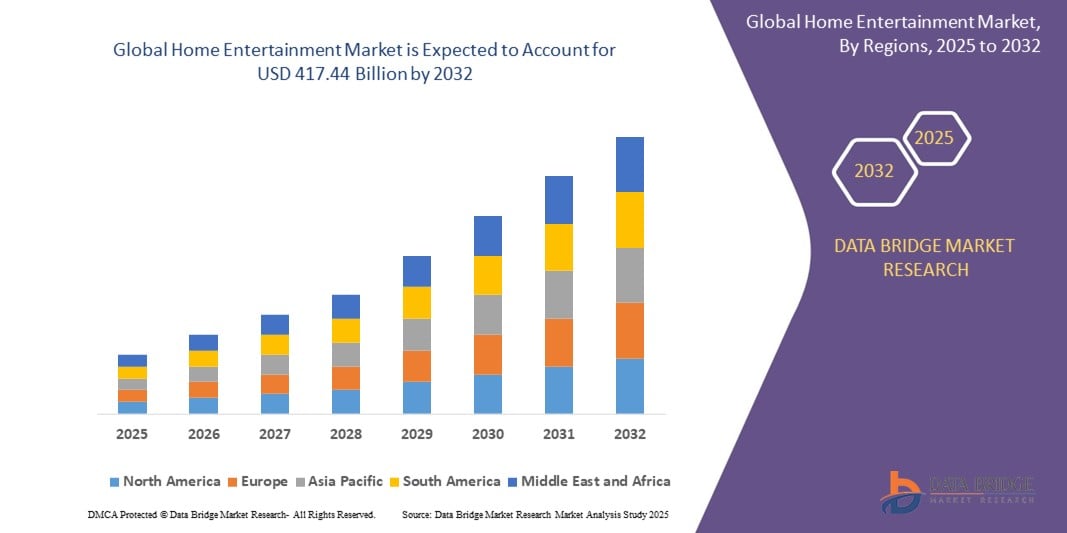
- The global home entertainment market size was valued at USD 299.68 billion in 2024 and is expected to reach USD 417.44 billion by 2032, at a CAGR of 4.23% during the forecast period
- The market growth is largely fuelled by the rising consumer demand for high-quality in-home media experiences, driven by technological advancements, increased internet penetration, and the expansion of streaming services
- Growing disposable income, changes in lifestyle, and the popularity of smart TVs, sound systems, gaming consoles, and subscription-based content platforms are also contributing significantly to the market’s expansion
Home Entertainment Market Analysis
- The shift in consumer preferences from traditional television to on-demand digital content is reshaping the industry landscape
- The increasing integration of artificial intelligence, voice assistance, and personalized recommendations in home entertainment systems enhances user engagement and satisfaction
- North America dominated the home entertainment market with the largest revenue share in 2024, driven by strong consumer spending, widespread internet access, and an increasing preference for in-home digital experiences
- Asia-Pacific region is expected to witness the highest growth rate in the global home entertainment market, driven by a massive population base, growing middle-class segment, and rising demand for digital content consumption. Countries such as China, Japan, and South Korea are witnessing rapid growth in home entertainment product adoption, bolstered by strong local manufacturing and technological innovation
- The video equipment segment dominated the market with the largest market revenue share in 2024, driven by the widespread adoption of smart TVs and advanced display technologies. Increasing demand for high-resolution viewing experiences, such as 4K and 8K content, alongside the integration of features such as voice control, HDR, and streaming support, contributes to this segment’s dominance. The replacement cycle for televisions and rising consumer spending on premium video devices have further accelerated growth
Report Scope and Home Entertainment Market Segmentation
|
Attributes |
Home Entertainment Key Market Insights |
|
Segments Covered |
|
|
Countries Covered |
North America
Europe
Asia-Pacific
Middle East and Africa
South America
|
|
Key Market Players |
|
|
Market Opportunities |
• Rising Demand for Immersive and Smart Home Entertainment Systems • Expansion of Subscription-Based Streaming Platforms in Emerging Markets |
|
Value Added Data Infosets |
In addition to the insights on market scenarios such as market value, growth rate, segmentation, geographical coverage, and major players, the market reports curated by the Data Bridge Market Research also include in-depth expert analysis, pricing analysis, brand share analysis, consumer survey, demography analysis, supply chain analysis, value chain analysis, raw material/consumables overview, vendor selection criteria, PESTLE Analysis, Porter Analysis, and regulatory framework. |
Home Entertainment Market Trends
“Growing Integration of Artificial Intelligence and Voice Control in Home Devices”
- Artificial Intelligence (AI) is revolutionizing home entertainment systems by enabling predictive content suggestions, automated settings optimization, and improved system interactivity
- Voice assistants such as Alexa, Google Assistant, and Siri are being integrated into smart TVs, speakers, and OTT platforms, allowing users to control playback, search content, and manage devices using natural language
- These systems can learn user habits and preferences over time, offering increasingly personalized content and automation across entertainment and smart home functions
- The rise of voice-enabled remotes and displays in devices reduces the need for physical controls, enhancing accessibility for elderly and disabled users
- For instance, LG's ThinQ AI televisions utilize Google Assistant and Alexa for content navigation and smart home control, offering consumers an immersive and hands-free experience
Home Entertainment Market Dynamics
Driver
“Rising Penetration of High-Speed Internet and Streaming Services”
- The widespread availability of high-speed broadband and mobile internet services has been a key enabler of the home entertainment revolution
- Households are shifting from traditional satellite or cable-based TV to Over-the-Top (OTT) content delivery platforms such as Netflix, Hulu, and Amazon Prime Video
- These services offer on-demand access, allowing viewers to consume content flexibly across smartphones, tablets, and smart TVs with high-definition or ultra-high-definition quality
- The rollout of 5G and fiber optic networks is further accelerating the ability to stream 4K and even 8K content with minimal latency, enhancing the user experience
- For instance, The expansion of JioFiber in India, offering affordable, high-speed internet, has triggered exponential growth in streaming consumption and OTT platform subscriptions, particularly in semi-urban and rural areas
Restraint/Challenge
“High Initial Cost of Smart Home Entertainment Systems”
- Despite growing demand, the high cost of acquiring advanced home entertainment systems remains a major barrier for middle- and lower-income households
- Premium features such as OLED displays, AI integration, Dolby Atmos sound systems, and virtual reality support significantly increase product prices
- For complete home entertainment experiences, users often need to purchase multiple components—such as smart TVs, soundbars, home theater setups, and gaming consoles—which collectively raise setup costs
- Moreover, continuous expenditures on OTT subscriptions, data plans, and software upgrades add to long-term ownership costs
- For instance, Sony’s BRAVIA XR Z9K 85-inch 8K Mini LED TV, priced over USD 7,000, represents how cutting-edge features remain inaccessible to price-sensitive consumers in emerging markets
Home Entertainment Market Scope
The market is segmented on the basis of product type, connectivity, and distribution channel.
- By Product Type
On the basis of product type, the home entertainment market is segmented into audio equipment, video equipment, and gaming consoles. The video equipment segment dominated the market with the largest market revenue share in 2024, driven by the widespread adoption of smart TVs and advanced display technologies. Increasing demand for high-resolution viewing experiences, such as 4K and 8K content, alongside the integration of features such as voice control, HDR, and streaming support, contributes to this segment’s dominance. The replacement cycle for televisions and rising consumer spending on premium video devices have further accelerated growth.
The gaming consoles segment is expected to witness the fastest growth rate from 2025 to 2032, fuelled by the surging popularity of immersive gaming experiences and online multiplayer platforms. Innovations in graphics, cloud gaming, and virtual reality are driving adoption among younger demographics. Moreover, the expansion of e-sports and exclusive game releases are prompting consumers to invest in advanced gaming consoles for interactive entertainment.
- By Connectivity
On the basis of connectivity, the home entertainment market is segmented into wired and wireless. The wireless segment held the largest market revenue share in 2024, driven by the rapid proliferation of smart home systems and consumer preference for uncluttered, flexible setups. Wireless-enabled devices such as smart speakers, soundbars, and streaming devices are increasingly integrated into home networks, allowing seamless content sharing and centralized control.
The wired segment is expected to witness the fastest growth rate from 2025 to 2032, especially for high-fidelity audio systems and home theater setups where stable, high-bandwidth transmission is crucial. Despite slower growth, it remains essential for consumers seeking robust connectivity for premium entertainment applications.
- By Distribution Channel
On the basis of distribution channel, the home entertainment market is segmented into offline and online. The offline segment dominated the market in 2024 due to the continued consumer preference for physically inspecting high-value entertainment products before purchase. Brick-and-mortar electronics retailers, showrooms, and multi-brand outlets play a key role in driving product visibility and offering real-time demonstrations.
The online segment, however, is expected to witness the fastest growth rate from 2025 to 2032, supported by the increasing penetration of e-commerce, competitive pricing, and wider availability of global brands. Convenience, doorstep delivery, and the surge in digital literacy are enabling more consumers to opt for online platforms to purchase home entertainment products.
Home Entertainment Market Regional Analysis
- North America dominated the home entertainment market with the largest revenue share in 2024, driven by strong consumer spending, widespread internet access, and an increasing preference for in-home digital experiences
- The region is home to many leading technology firms and streaming service providers, encouraging innovation and expanding access to diverse entertainment platforms
- High adoption of smart TVs, gaming consoles, and advanced audio systems further supports market growth, especially in the U.S. and Canada, where consumers seek immersive and personalized entertainment solutions
U.S. Home Entertainment Market Insight
The U.S. home entertainment market accounted for the largest revenue share within North America in 2024, propelled by rising demand for streaming content and rapid digital transformation. The popularity of services such as Netflix, Hulu, and Amazon Prime Video, combined with increasing smart TV penetration, continues to enhance the entertainment ecosystem. In addition, the growing number of households opting for home theater systems and gaming consoles as substitutes for out-of-home entertainment is accelerating market growth. Technological advancements and 5G rollout further support seamless content delivery and consumer engagement.
Europe Home Entertainment Market Insight
The Europe home entertainment market is expected to witness the fastest growth rate from 2025 to 2032, supported by increased broadband access and a shift toward digital consumption. Rising adoption of over-the-top (OTT) platforms, coupled with growing demand for smart home devices and immersive experiences, is reshaping the entertainment landscape. Moreover, strong content production across countries such as the U.K., Germany, and France helps maintain regional consumer interest and supports the integration of next-generation entertainment systems across households.
U.K. Home Entertainment Market Insight
The U.K. home entertainment market is expected to witness the fastest growth rate from 2025 to 2032, driven by a shift in consumer behavior towards subscription-based streaming services and digital content libraries. Consumers in the country increasingly prefer on-demand content and multi-device compatibility. With a robust infrastructure and high smartphone penetration, the market is benefitting from the rise in digital consumption, particularly among younger demographics. Strategic partnerships between telecom providers and content platforms are further enhancing accessibility and consumer satisfaction.
Germany Home Entertainment Market Insight
The Germany home entertainment market is expected to witness the fastest growth rate from 2025 to 2032, attributed to high consumer demand for high-quality audio-visual experiences and digital convenience. The country's emphasis on technological innovation and eco-conscious design supports the proliferation of energy-efficient home entertainment systems. German consumers show strong preferences for integrated home solutions, including smart TVs, streaming devices, and soundbars. The local market is also supported by the presence of established electronics brands offering cutting-edge devices suited to modern digital lifestyles.
Asia-Pacific Home Entertainment Market Insight
The Asia-Pacific home entertainment market is expected to witness the fastest growth rate from 2025 to 2032, driven by a large tech-savvy population, increasing urbanization, and the expansion of internet infrastructure. Countries such as China, India, Japan, and South Korea are witnessing a surge in demand for online content, mobile streaming, and connected devices. Government initiatives promoting digital access and rising disposable incomes are also key enablers. The growing popularity of online gaming and regional OTT platforms further contributes to the market’s rapid expansion.
Japan Home Entertainment Market Insight
Japan’s home entertainment market is driven by a blend of innovation, tradition, and consumer demand for premium audio-visual quality. The country’s advanced broadband network and cultural preference for in-home leisure have accelerated the adoption of smart TVs, gaming consoles, and immersive audio systems. Consumers are particularly drawn to content-rich platforms and value seamless connectivity across devices. The integration of AI and IoT into entertainment systems is also gaining traction, offering personalized experiences in both compact urban homes and larger households.
China Home Entertainment Market Insight
China accounted for the largest revenue share in the Asia-Pacific home entertainment market in 2024, supported by an enormous consumer base, rapid technological adoption, and strong growth in digital content platforms. The rise of domestic streaming services such as iQIYI, Tencent Video, and Youku, alongside the increasing affordability of smart devices, has propelled market penetration. China’s booming e-commerce and digital payment infrastructure also support seamless access to entertainment content and equipment, making it a powerhouse in the global home entertainment sector.
Home Entertainment Market Share
The Home Entertainment industry is primarily led by well-established companies, including:
- SAMSUNG (South Korea)
- SONY INDIA (Japan)
- L.G. Electronics (South Korea)
- Google LLC (U.S.)
- Panasonic Corporation (Japan)
- SHARP CORPORATION (U.S.)
- Koninklijke Philips N.V. (Netherlands)
- Hitachi Ltd. (Japan)
- TCL (China)
- Skyworth Group Limited (China)
- Haier Group (Hong Kong)
- TOSHIBA CORPORATION (Japan)
- Videocon Industries Limited (Mumbai)
- Grande Holdings Company Limited (Hong Kong)
- Xiaomi (China)
- Hisense International (China)
- VIZIO, Inc. (U.S.)
- INSIGNIA SYSTEMS (U.S.)
- Apple Inc (U.S.)
Latest Developments in Global Home Entertainment Market
- In August 2021, ABB India launched ISI-certified Millenium and Zenit switches, offering control and functionality in smart buildings. These switches, suitable for residences and commercial facilities, facilitate an easy transition to eco-friendly lighting solutions, compatible with modern smart home automation systems for enhanced comfort
- In August 2021, Schneider Electric launchedSquare DTM X and XD Series linked wiring devices at the 2021 CEDIA Expo. These devices automate home lighting, offer discrete power control, and provide plug-level energy usage data. With features such as easy installation and smart home connectivity, they aim to optimize energy efficiency
- In April 2021, Samsung launched its Neo QLED TV line, promising a cinematic viewing experience with true-to-life picture quality and a nearly bezel-less infinity one design. Featuring sizes ranging from 50 to 85 inches, these TVs incorporate the Neo Quantum Processor for superior upscaling capabilities, ensuring impressive 4K and 8K output
- In March 2021, Emerson and Ameren Missouri partnered to provide Sensi smart thermostats to Ameren Missouri customers. Customers receive the thermostats through instant discounts and participation in the Peak Time Savings program at no cost other than sales tax. This advanced technology allows remote thermostat control via smartphones, offering significant bill savings

- Interactive Data Analysis Dashboard
- Company Analysis Dashboard for high growth potential opportunities
- Research Analyst Access for customization & queries
- Competitor Analysis with Interactive dashboard
- Latest News, Updates & Trend analysis
- Harness the Power of Benchmark Analysis for Comprehensive Competitor Tracking
Data collection and base year analysis are done using data collection modules with large sample sizes. The stage includes obtaining market information or related data through various sources and strategies. It includes examining and planning all the data acquired from the past in advance. It likewise envelops the examination of information inconsistencies seen across different information sources. The market data is analysed and estimated using market statistical and coherent models. Also, market share analysis and key trend analysis are the major success factors in the market report. To know more, please request an analyst call or drop down your inquiry.
The key research methodology used by DBMR research team is data triangulation which involves data mining, analysis of the impact of data variables on the market and primary (industry expert) validation. Data models include Vendor Positioning Grid, Market Time Line Analysis, Market Overview and Guide, Company Positioning Grid, Patent Analysis, Pricing Analysis, Company Market Share Analysis, Standards of Measurement, Global versus Regional and Vendor Share Analysis. To know more about the research methodology, drop in an inquiry to speak to our industry experts.
Data Bridge Market Research is a leader in advanced formative research. We take pride in servicing our existing and new customers with data and analysis that match and suits their goal. The report can be customized to include price trend analysis of target brands understanding the market for additional countries (ask for the list of countries), clinical trial results data, literature review, refurbished market and product base analysis. Market analysis of target competitors can be analyzed from technology-based analysis to market portfolio strategies. We can add as many competitors that you require data about in the format and data style you are looking for. Our team of analysts can also provide you data in crude raw excel files pivot tables (Fact book) or can assist you in creating presentations from the data sets available in the report.