What is the Global Home Fitness Equipment Market Size and Growth Rate?
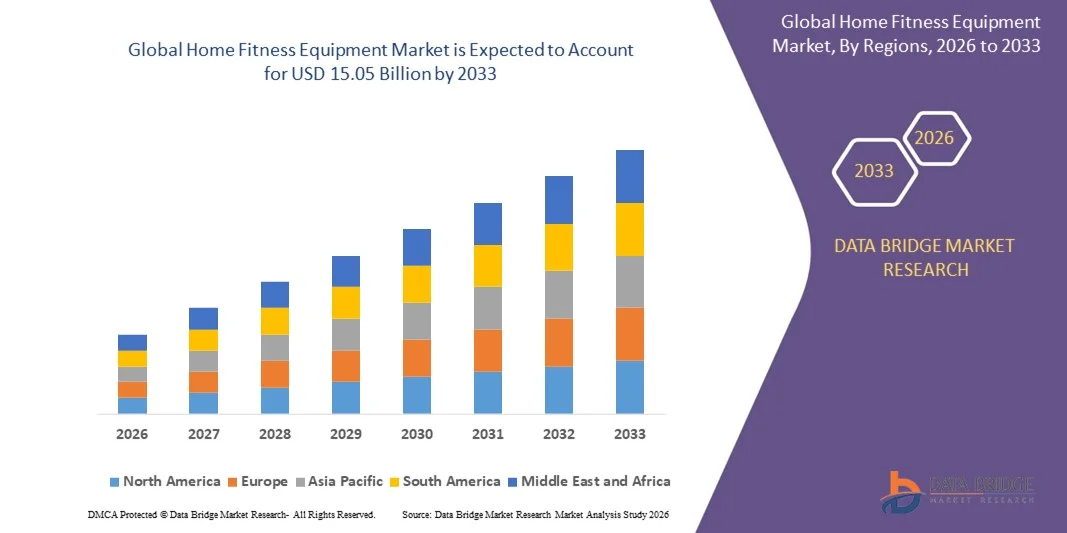
- As per Data Bridge Market Research Analysis the Global home fitness equipment market size was valued at USD 10.83 billion in 2025 and is expected to reach USD 15.05 billion by 2033, at a CAGR of4.19% during the forecast period
- Rising urbanization, modernization and adoption of healthy lifestyle is the root cause fostering the growth of home fitness equipment market
- Ever-rising youth population, increased awareness about maintaining health and fitness and increasing personal disposable income are some other indirect home fitness equipment market growth determinants
Market Size & Forecast
- Global Market Value (2025): USD 10.83 Billion
- Expected Market Value (2033): USD 15.05 Billion
- Forecast CAGR (2026–2033): 4.19%
What are the Major Takeaways of Home Fitness Equipment Market?
- Growth in the obese and overweight population will further propel growth in the home fitness equipment market value. Rising prevalence of cardiovascular diseases will also create lucrative growth opportunities in the long run
- Overall growth and expansion of health and wellness industry will further carve the way for the growth of home fitness equipment market. The recent coronavirus outbreak has further boosted the demand for home fitness equipment
- North America dominated the home fitness equipment market with a 38.35% revenue share in 2025, driven by increasing consumer awareness of fitness and wellness, high disposable income, and strong penetration of connected fitness solutions across the U.S. and Canada
- Asia-Pacific is projected to register the fastest CAGR of 7.9% from 2026 to 2033, supported by rapid urbanization, increasing health awareness, and rising adoption of smart home fitness solutions in China, Japan, India, South Korea, and Southeast Asia
- The Treadmills segment dominated the market with an estimated 38.6% share in 2025, driven by widespread consumer preference for cardiovascular workouts, ease of use, and availability of advanced features such as incline control, heart-rate monitoring, and interactive training program
Report Scope and Home Fitness Equipment Market Segmentation
|
Attributes |
Home Fitness Equipment Key Market Insights |
|
Segments Covered |
|
|
Countries Covered |
North America
Europe
Asia-Pacific
Middle East and Africa
South America
|
|
Key Market Players |
|
|
Market Opportunities |
|
|
Value Added Data Infosets |
In addition to the insights on market scenarios such as market value, growth rate, segmentation, geographical coverage, and major players, the market reports curated by the Data Bridge Market Research also include in-depth expert analysis, pricing analysis, brand share analysis, consumer survey, demography analysis, supply chain analysis, value chain analysis, raw material/consumables overview, vendor selection criteria, PESTLE Analysis, Porter Analysis, and regulatory framework. |
What is the Key Trend in the Home Fitness Equipment Market?
Rising Adoption of Smart, Connected, and Space-Efficient Home Fitness Solutions
- The home fitness equipment market is witnessing strong adoption of smart, connected, and compact fitness devices, including interactive treadmills, smart bikes, connected strength systems, and AI-enabled workout platforms designed for home environments
- Manufacturers are introducing digitally integrated equipment featuring touchscreen displays, virtual coaching, real-time performance tracking, and app-based connectivity to enhance user engagement and workout personalization
- Growing demand for space-saving, foldable, and multifunctional fitness equipment is driving adoption among urban consumers with limited living space
- For instance, companies such as Peloton, Technogym, NordicTrack, and Bowflex have expanded portfolios with connected fitness ecosystems, subscription-based training content, and cloud-enabled performance analytics
- Increasing focus on on-demand workouts, hybrid fitness models, and at-home training convenience is accelerating the shift toward digitally enabled home fitness solutions
- As consumers prioritize health, flexibility, and immersive workout experiences, smart Home Fitness Equipment will remain central to long-term market growth
What are the Key Drivers of Home Fitness Equipment Market?
- Rising consumer awareness regarding health, wellness, and preventive fitness, supported by increasing lifestyle-related disorders, is boosting demand for home-based exercise solutions
- For instance, during 2024–2025, leading manufacturers such as Technogym, ICON Health & Fitness, and Nautilus introduced AI-driven coaching, connected platforms, and smart resistance technologies
- Growing adoption of subscription-based fitness content, virtual classes, and personalized training programs is strengthening customer retention and equipment utilization
- Advancements in sensor technology, motion tracking, heart-rate monitoring, and cloud analytics have enhanced workout accuracy, user motivation, and performance insights
- Increasing preference for convenient, time-efficient workouts among working professionals and aging populations is driving equipment sales across North America, Europe, and Asia-Pacific
- Supported by rising disposable incomes and expanding digital fitness ecosystems, the Home Fitness Equipment market is positioned for sustained long-term growth
Which Factor is Challenging the Growth of the Home Fitness Equipment Market?
- High upfront costs associated with premium smart fitness equipment and recurring subscription fees limit adoption among price-sensitive consumers
- For instance, during 2024–2025, rising raw material costs, logistics expenses, and electronics component pricing increased overall equipment manufacturing costs
- Space constraints in small households and apartments restrict installation of large fitness machines such as treadmills and multi-gym systems
- Declining post-pandemic workout consistency and increasing preference for outdoor or gym-based fitness activities pose challenges to sustained equipment usage
- Intense competition from low-cost alternatives, fitness apps, and bodyweight training solutions places pricing pressure on manufacturers
- To address these challenges, companies are focusing on modular designs, flexible financing options, affordable subscription models, and compact product innovation to expand market reach
How is the Home Fitness Equipment Market Segmented?
The market is segmented on the basis of product type, distribution channel, and training type.
- By Product Type
On the basis of product type, the home fitness equipment market is segmented into Treadmills, Elliptical Machines, Stationary Cycles, Rowing Machines, Strength Training Equipment, and Other Product Types. The Treadmills segment dominated the market with an estimated 38.6% share in 2025, driven by widespread consumer preference for cardiovascular workouts, ease of use, and availability of advanced features such as incline control, heart-rate monitoring, and interactive training programs. Treadmills are widely adopted across residential users due to their effectiveness in weight management, endurance building, and overall fitness improvement.
The Strength Training Equipment segment is expected to grow at the fastest CAGR from 2026 to 2033, supported by rising interest in muscle building, body toning, and functional fitness. Increasing adoption of compact smart strength systems, adjustable dumbbells, resistance bands, and connected weight-training platforms is accelerating demand, particularly among younger consumers and urban households seeking space-efficient solutions.
- By Distribution Channel
On the basis of distribution channel, the home fitness equipment market is segmented into Offline and Online. The Offline segment dominated the market with a 61.4% share in 2025, supported by strong consumer preference for physical product evaluation, in-store demonstrations, professional guidance, and after-sales support. Specialty fitness stores, brand-owned outlets, and large sporting goods retailers continue to play a critical role in influencing purchasing decisions, especially for high-value equipment such as treadmills and multi-gym systems.
The Online segment is projected to grow at the fastest CAGR from 2026 to 2033, driven by expanding e-commerce penetration, competitive pricing, doorstep delivery, and availability of detailed product comparisons and user reviews. Rising adoption of direct-to-consumer (DTC) models, digital payment options, and promotional offers, combined with growing consumer comfort with online purchasing, is significantly boosting online sales of home fitness equipment globally.
- By Training Type
On the basis of training type, the home fitness equipment market is segmented into Cardiovascular Training Equipment, Strength Training Equipment, and Others. The Cardiovascular Training Equipment segment dominated the market with a 44.2% share in 2025, driven by increasing awareness of heart health, weight management, and overall physical endurance. Equipment such as treadmills, stationary bikes, ellipticals, and rowing machines remains highly popular among home users seeking effective calorie-burning and aerobic fitness solutions.
The Strength Training Equipment segment is expected to grow at the fastest CAGR from 2026 to 2033, supported by growing focus on muscle strengthening, metabolic health, and personalized workout routines. Rising popularity of resistance-based workouts, functional training, and smart strength platforms with digital coaching and performance tracking is accelerating adoption, positioning strength training as a key growth engine in the Home Fitness Equipment market.
Which Region Holds the Largest Share of the Home Fitness Equipment Market?
- North America dominated the home fitness equipment market with a 38.35% revenue share in 2025, driven by increasing consumer awareness of fitness and wellness, high disposable income, and strong penetration of connected fitness solutions across the U.S. and Canada. Growing adoption of smart fitness devices, AI-enabled equipment, and interactive home workout systems continues to fuel demand across residential, corporate, and fitness studio environments
- Leading companies in North America are introducing high-tech home fitness equipment with features such as virtual coaching, IoT-enabled tracking, multi-resistance systems, and cloud-based performance analytics, strengthening the region’s technological advantage. Continuous investment in connected fitness, digital health, and wellness platforms is supporting long-term market growth
- High consumer fitness adoption, well-established retail networks, and strong e-commerce infrastructure further reinforce North America’s leadership in the market
U.S. Home Fitness Equipment Market Insight
The U.S. is the largest contributor in North America, supported by growing health-conscious lifestyles, high penetration of fitness subscriptions and apps, and extensive adoption of smart home fitness devices. Rising interest in treadmill, elliptical, and strength training solutions with virtual coaching and interactive features accelerates demand. Presence of major fitness equipment brands, fitness-focused startups, and strong consumer engagement further drives market growth.
Canada Home Fitness Equipment Market Insight
Canada contributes significantly to regional growth, driven by urbanization, rising disposable income, and adoption of technologically advanced fitness equipment. Consumers increasingly prefer connected fitness devices for home use, combining strength training, cardiovascular workouts, and real-time tracking. Government initiatives promoting active lifestyles and wellness programs further enhance adoption across residential and corporate segments.
Asia-Pacific Home Fitness Equipment Market
Asia-Pacific is projected to register the fastest CAGR of 7.9% from 2026 to 2033, supported by rapid urbanization, increasing health awareness, and rising adoption of smart home fitness solutions in China, Japan, India, South Korea, and Southeast Asia. Growing smartphone penetration, fitness apps, and demand for interactive and space-efficient equipment drive market expansion. Strong interest in wearable fitness devices and AI-enabled home gym solutions further accelerates growth.
China Home Fitness Equipment Market Insight
China is the largest contributor in Asia-Pacific, with rising demand for smart treadmills, elliptical machines, and strength training equipment integrated with AI coaching. Rapid expansion of e-commerce, increasing disposable income, and growing fitness awareness among urban consumers support widespread adoption. Local manufacturing capabilities and competitive pricing further drive domestic and export market growth.
Japan Home Fitness Equipment Market Insight
Japan shows steady growth driven by increasing preference for compact, technologically advanced home fitness devices. Integration of smart sensors, VR-based training, and personalized coaching platforms encourages adoption among residential consumers. Demand is further supported by an aging population seeking cardiovascular and strength training solutions at home.
India Home Fitness Equipment Market Insight
India is emerging as a key growth hub, fueled by rising fitness awareness, expanding middle-class population, and government initiatives promoting wellness. Growing adoption of affordable smart fitness equipment, resistance training, and interactive workout systems drives market penetration in urban areas. Increasing investments in connected fitness solutions further support market expansion.
South Korea Home Fitness Equipment Market Insight
South Korea contributes significantly to regional growth due to high adoption of premium home fitness devices, smart wearable integration, and AI-based training programs. Rising popularity of at-home cardio and strength workouts, coupled with technological innovation and strong e-commerce infrastructure, supports sustained market growth.
Which are the Top Companies in Home Fitness Equipment Market?
The home fitness equipment industry is primarily led by well-established companies, including:
- Nautilus, Inc. (U.S.)
- ICON Health & Fitness (U.S.)
- Johnson Health Tech. (Taiwan)
- Precor Incorporated. (U.S.)
- Technogym S.p.A. (Italy)
- Cybex International, Inc. (U.S.)
- TRUE. (U.S.)
- adidas (Germany)
- Amer Sports (Finland)
- ASICS Asia Pte. Ltd. (Singapore)
- Brunswick Corporation. (U.S.)
- Pure Gym Limited (U.K.)
- HOIST Fitness Systems (U.S.)
- Vectra Fitness Parts LLC. (U.S.)
- Fitness World (India)
- Hammer Sport AG (Germany)
- Rogue Fitness. (U.S.)
- Core Health & Fitness, LLC (U.S.)
- Seca GmbH (Germany)
- JERAI FITNESS PVT LTD (India)
What are the Recent Developments in Global Home Fitness Equipment Market?
- In August 2023, Technogym SpA (Italy) launched Technogym Run, a seat-belt technology-based home treadmill, at its Technogym Dubai boutique and experience center, enhancing consumer access to innovative home fitness solutions and expanding brand presence in the Middle East
- In June 2023, Speediance, a Shenzhen Speediance Life Technology Co., Ltd.-owned brand (China), introduced Speediance Gym Pal, a smart strength training machine in the U.S. home fitness products market, enabling users to track workout progress and access strength-related insights, supporting growing demand for connected fitness devices
- In September 2021, Hy-Vee, Inc. (U.S.) partnered with Johnson Wellness & Fitness (U.S.) to open a new fitness equipment showroom in the U.S., offering a wide range of residential and commercial devices such as treadmills, ellipticals, and exercise bikes, further strengthening fitness accessibility for consumers
- In April 2021, Peloton Interactive Inc. (U.S.) completed the acquisition of Precor Incorporated (U.S.) to expand its product portfolio and solidify its position in the U.S. home and commercial fitness equipment industry, reinforcing leadership in connected and high-performance fitness solutions
- In May 2020, Peloton Interactive Inc. (U.S.) reported a 66% increase in its third-quarter online sales from home fitness equipment, reflecting a surge in consumer adoption of at-home workout solutions and accelerated growth of the digital fitness ecosystem

- Interactive Data Analysis Dashboard
- Company Analysis Dashboard for high growth potential opportunities
- Research Analyst Access for customization & queries
- Competitor Analysis with Interactive dashboard
- Latest News, Updates & Trend analysis
- Harness the Power of Benchmark Analysis for Comprehensive Competitor Tracking
Data collection and base year analysis are done using data collection modules with large sample sizes. The stage includes obtaining market information or related data through various sources and strategies. It includes examining and planning all the data acquired from the past in advance. It likewise envelops the examination of information inconsistencies seen across different information sources. The market data is analysed and estimated using market statistical and coherent models. Also, market share analysis and key trend analysis are the major success factors in the market report. To know more, please request an analyst call or drop down your inquiry.
The key research methodology used by DBMR research team is data triangulation which involves data mining, analysis of the impact of data variables on the market and primary (industry expert) validation. Data models include Vendor Positioning Grid, Market Time Line Analysis, Market Overview and Guide, Company Positioning Grid, Patent Analysis, Pricing Analysis, Company Market Share Analysis, Standards of Measurement, Global versus Regional and Vendor Share Analysis. To know more about the research methodology, drop in an inquiry to speak to our industry experts.
Data Bridge Market Research is a leader in advanced formative research. We take pride in servicing our existing and new customers with data and analysis that match and suits their goal. The report can be customized to include price trend analysis of target brands understanding the market for additional countries (ask for the list of countries), clinical trial results data, literature review, refurbished market and product base analysis. Market analysis of target competitors can be analyzed from technology-based analysis to market portfolio strategies. We can add as many competitors that you require data about in the format and data style you are looking for. Our team of analysts can also provide you data in crude raw excel files pivot tables (Fact book) or can assist you in creating presentations from the data sets available in the report.