What is the Home Fragrance & Room Spray Market Size and Growth Rate?
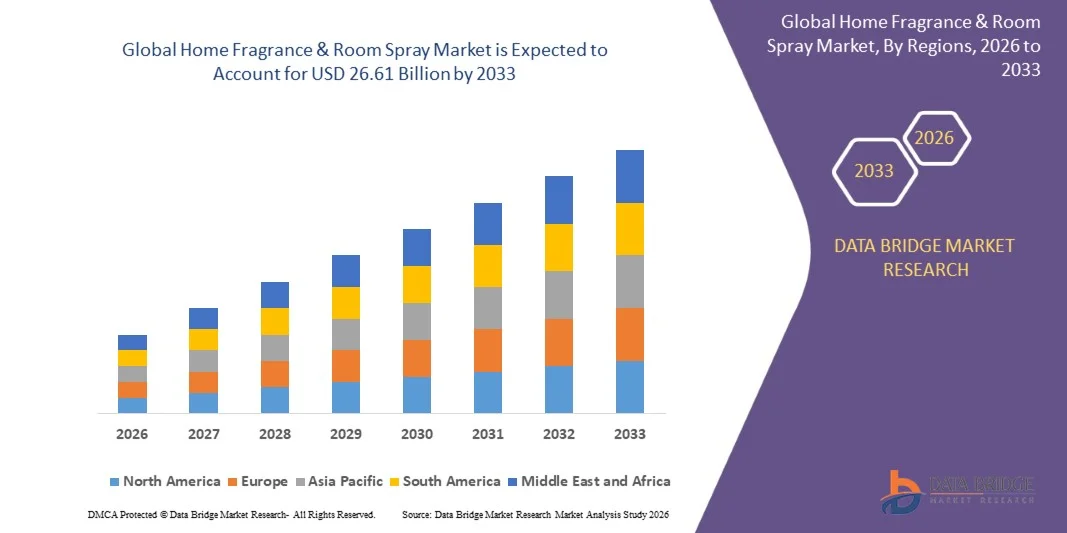
- As per Data Bridge Market Research analysis, the home fragrance & room spray market was valued at USD 13.16 billion in 2025 and is projected to reach USD 26.61 billion by 2033, growing at a CAGR of 9.20% from 2026 to 2033.
- The market is experiencing consistent growth driven by rising consumer investment in interior ambience, growing home décor and lifestyle personalization trends, and increasing demand for wellness-oriented fragrance products such as diffusers and aromatherapy blends.
- Growing awareness of chemical exposure and sustainability is encouraging consumers to shift toward natural, plant-based, and refillable fragrance formats. Expanding e-commerce penetration, influencer-driven marketing, and rising demand for signature scenting in commercial and hospitality spaces are further accelerating market expansion.
Market Size & Forecast
- Global Market Value (2025): USD 13.16 Billion
- Expected Market Value (2033): USD 26.61 Billion
- Forecast CAGR (2026–2033): 9.20%
- Leading Region in 2025: North America
- Fastest Growing Region: Asia-Pacific
What are the Major Takeaways of the Home Fragrance & Room Spray Market?
- North America dominated the global home fragrance & room spray market with the largest revenue share of 28.80% in 2025, supported by strong consumer spending on home care and lifestyle products and the presence of major fragrance brands and retail networks.
- Asia-Pacific is expected to be the fastest-growing region at a CAGR of 10.80% from 2026 to 2033, fueled by rising urbanization, growing disposable incomes, and expanding hospitality and retail infrastructure in China and India.
- The room sprays segment led the market with a 33.50% share in 2025, driven by consumer preference for instant, easy-to-use fragrance solutions across homes, offices, and hospitality spaces.
- Scented candles are the fastest-growing product type, projected to register a CAGR of 10.00%, reflecting the rising popularity of home décor personalization and wellness-oriented lifestyles.
- The floral segment dominated the fragrance type category with a 27.70% revenue share in 2025, supported by strong consumer preference for light, nature-inspired scents.
- The economy/mass price tier accounted for 38.70% of the market share in 2025, supported by wide retail availability of affordable air freshener sprays and plug-in units.
- The natural/essential oil-based ingredient segment is the fastest-growing category, with a CAGR of 12.30%, driven by rising demand for clean-label, plant-based fragrance formulations.
Report Scope and Home Fragrance & Room Spray Market Segmentation
|
Attributes |
Home Fragrance & Room Spray Key Market Insights |
|
Segments Covered |
|
|
Countries Covered |
North America
Europe
Asia-Pacific
Middle East and Africa
South America
|
|
Key Market Players |
|
|
Market Opportunities |
|
|
Value Added Data Infosets |
In addition to the insights on market scenarios such as market value, growth rate, segmentation, geographical coverage, and major players, the market reports curated by the Data Bridge Market Research also include in-depth expert analysis, pricing analysis, brand share analysis, consumer survey, demography analysis, supply chain analysis, value chain analysis, raw material/consumables overview, vendor selection criteria, PESTLE Analysis, Porter Analysis, and regulatory framework. |
What is the Key Trend in the Home Fragrance & Room Spray Market?
- Consumers are increasingly using fragrance as a defining element of home ambience, adopting candles, diffusers, and room sprays to create a consistent sensory atmosphere rather than simply masking odors.
- For instance, in September 2025, Victoria's Secret expanded into the home fragrance category with a new range of candles, room sprays, diffuser reeds, and liquid hand soaps, reflecting the growing entry of established lifestyle and apparel brands into the home scenting space.
- Growing consumer interest in aromatherapy and wellness is driving demand for diffusers and therapeutic scent blends designed to support relaxation, sleep quality, and emotional well-being.
- Brands are increasingly leveraging digital marketing, influencer collaborations, and lifestyle content to promote seasonal scent collections and build consumer awareness around fragrance-led home care products.
- As consumers continue to prioritize natural ingredients, sustainable packaging, and personalized scent experiences, manufacturers are expected to expand clean-label and refillable product lines, reinforcing wellness-driven fragrance as a core growth theme.
What are the Key Drivers of the Home Fragrance & Room Spray Market?
- The growing trend of home décor personalization and rising consumer expenditure on interior design are increasing demand for aesthetically designed, premium home fragrance products.
- For instance, in October 2025, Yankee Candle launched its YC Collection, a premium home fragrance line featuring a proprietary dye-free wax blend and minimalist vessels, reflecting the industry's shift toward elevated, design-led fragrance offerings.
- Increasing consumer focus on wellness and relaxation is driving adoption of aromatherapy-inspired products across bedrooms and meditation spaces.
- For instance, in October 2025, a new essential oil scent burner collection was launched combining aromatherapy with modern home décor, using a glass-and-metal design to gently diffuse fragrance oils throughout indoor spaces.
- With homes increasingly serving as spaces for relaxation, remote work, and social gatherings, sustained investment in scent-led interior design is expected to remain a key growth driver for the market.
Which Factors are Challenging the Growth of the Home Fragrance & Room Spray Market?
- Premium and natural fragrance formulations require higher-cost essential oils and sustainably sourced ingredients, which increases production costs compared with synthetic, mass-market alternatives.
- For instance, in March 2024, Indian essential oil producer D.G. Organics entered into a long-term sandalwood oil supply agreement with LVMH Moët Hennessy to secure consistent, sustainably sourced volumes amid dwindling forest reserves and price volatility, while air cargo rates on Asia-to-Europe routes rose roughly 45% in early 2025, further increasing the cost of importing botanical oils for fragrance manufacturers.
- Regulatory scrutiny around volatile organic compound (VOC) emissions and ingredient disclosure for aerosol air fresheners and sprays is increasing compliance costs for manufacturers across several regions.
- Intense competition from private-label and mass-market retail brands continues to pressure pricing and margins for established and boutique fragrance houses.
- The combination of rising ingredient costs, tightening regulatory requirements, and margin pressure from private-label competition continues to restrict broader adoption of premium and natural home fragrance products, particularly among cost-sensitive consumers in emerging markets.
How is the Home Fragrance & Room Spray Market Segmented?
The home fragrance & room spray market is segmented on the basis of product type, fragrance type, ingredient type, distribution channel, price tier, packaging type, end user, application, form, and sales channel.
- By Product Type
On the basis of product type, the global home fragrance & room spray market is segmented into room sprays, scented candles, reed diffusers, essential oil diffusers, and incense sticks & cones. The room sprays segment dominated the market with a 33.50% share in 2025, owing to consumer preference for instant, easy-to-use fragrance solutions that quickly refresh living spaces and eliminate odors without installation or preparation. Widespread availability across supermarkets, specialty stores, and online platforms, along with frequent seasonal and scent-variant launches, continues to reinforce the segment's leading position.
The scented candles segment is projected to register the fastest growth at a CAGR of 10.00% from 2026 to 2033, driven by the growing trend of home décor personalization and the rising popularity of wellness-oriented lifestyles. Increasing adoption of premium candle collections featuring natural wax blends, wooden wicks, and aesthetically designed containers is accelerating segment expansion.
- By Fragrance Type
On the basis of fragrance type, the global home fragrance & room spray market is segmented into floral, woody, citrus, fresh/aquatic, and oriental & spicy. The floral segment dominated the market with a 27.70% share in 2025, supported by strong consumer preference for light, nature-inspired scents such as rose, jasmine, and lavender that are widely used across candles, diffusers, and room sprays to create calming home environments.
The woody segment is expected to witness the fastest CAGR of 11.40% from 2026 to 2033, driven by rising consumer preference for long-lasting, sophisticated fragrance profiles such as sandalwood, cedarwood, and oud, which are increasingly associated with premium and luxury home fragrance experiences.
- By Ingredient Type
On the basis of ingredient type, the global home fragrance & room spray market is segmented into natural/essential oil-based, synthetic/aroma compound-based, and organic & eco-friendly. The synthetic/aroma compound-based segment dominated the market with a 54.20% share in 2025, owing to its cost-effectiveness, longer scent throw, and wide use across mass-market aerosol sprays and plug-in air fresheners.
The natural/essential oil-based segment is anticipated to witness the fastest CAGR of 12.30% from 2026 to 2033, driven by rising consumer awareness of chemical exposure and growing preference for plant-based, clean-label fragrance formulations.
- By Distribution Channel
On the basis of distribution channel, the global home fragrance & room spray market is segmented into supermarkets & hypermarkets, specialty stores, online retail, convenience stores, and department stores. The supermarkets & hypermarkets segment dominated the market with a 38.70% share in 2025, supported by high consumer footfall, strong in-store product visibility, and frequent bundled and seasonal promotions.
The online retail segment is projected to register the fastest CAGR of 10.00% from 2026 to 2033, fueled by growing digital adoption for lifestyle and home décor products, subscription-based fragrance programs, and wider brand and scent assortments available through e-commerce platforms.
- By Price Tier
On the basis of price tier, the global home fragrance & room spray market is segmented into economy/mass, mid-range/masstige, premium, and luxury/super-premium. The economy/mass segment dominated the market with a 38.70% share in 2025, supported by the wide availability of affordable air freshener sprays, gels, and plug-in units through large retail and discount store chains.
The mid-range/masstige segment is expected to witness the fastest CAGR of 10.00% from 2026 to 2033, driven by the growing presence of specialty lifestyle stores and online beauty retailers promoting curated, gift-ready home fragrance sets that balance quality, packaging, and affordability.
- By Packaging Type
On the basis of packaging type, the global home fragrance & room spray market is segmented into aerosol cans, pump sprays, bottles & jars, and sachets & pouches. The aerosol cans segment dominated the market with a 36.90% share in 2025, owing to its convenience, wide fragrance dispersion, and established presence across mass-market air freshener brands.
The pump sprays segment is projected to witness the fastest CAGR of 10.10% from 2026 to 2033, supported by growing consumer preference for propellant-free, refillable, and more sustainable packaging formats.
- By End User
On the basis of end user, the global home fragrance & room spray market is segmented into residential, commercial, and automotive. The residential segment dominated the market with a 71.40% share in 2025, driven by rising household spending on home décor and ambience-enhancing lifestyle products.
The commercial segment is expected to witness the fastest CAGR of 10.40% from 2026 to 2033, supported by growing adoption of signature scenting programs across boutique hotels, retail spaces, and hospitality venues seeking to create distinctive brand atmospheres.
- By Application
On the basis of application, the global home fragrance & room spray market is segmented into home décor & ambience, odor elimination, aromatherapy & wellness, and seasonal & occasion-based. The home décor & ambience segment dominated the market with a 33.60% share in 2025, driven by growing consumer investment in personalized, sensory-rich living environments.
The aromatherapy & wellness segment is anticipated to witness the fastest CAGR of 12.70% from 2026 to 2033, driven by rising consumer interest in relaxation, sleep quality, and emotional well-being, with diffusers and therapeutic scent blends becoming common additions to bedrooms and wellness-focused interiors.
- By Form
On the basis of form, the global home fragrance & room spray market is segmented into liquid, gel, solid/wax, and powder. The liquid segment dominated the market with a 48.30% share in 2025, supported by its widespread use across room sprays, reed diffusers, and refill formats.
The solid/wax segment is expected to witness the fastest CAGR of 10.50% from 2026 to 2033, driven by innovation in candle and wax-melt formats, including natural wax blends and decorative, reusable containers.
- By Sales Channel/Business Model
On the basis of sales channel, the global home fragrance & room spray market is segmented into brick-and-mortar retail, e-commerce/DTC, and subscription-based models. The brick-and-mortar retail segment dominated the market with a 61.20% share in 2025, supported by consumers' continued preference to experience fragrance in person before purchase.
The e-commerce/DTC segment is projected to witness the fastest CAGR of 13.90% from 2026 to 2033, driven by the growing popularity of digitally native fragrance brands, influencer-led marketing, and the convenience of home delivery and refill subscriptions.
Which Region Holds the Largest Share of the Home Fragrance & Room Spray Market?
- North America dominated the home fragrance & room spray market and accounted for the largest revenue share of 28.80% in 2025, supported by strong consumer spending on home care and lifestyle products and the widespread popularity of seasonal fragrance collections.
- The region also benefits from the presence of major home fragrance brands, large retail chains, and well-developed e-commerce platforms across the U.S. and Canada, which continue to expand product availability and encourage frequent consumer purchases, strengthening North America's leadership position in the global market.
U.S. Home Fragrance & Room Spray Market Insight
The U.S. home fragrance & room spray market is experiencing steady growth, supported by a strong culture of seasonal home styling and décor refreshes among consumers. Many households purchase scented candles, diffusers, and room sprays aligned with seasonal themes to enhance their living spaces. Frequent product launches and limited-edition fragrance collections continue to encourage repeat purchases, while growing social media influence is further embedding fragrance products within broader home décor trends.
Germany Home Fragrance & Room Spray Market Insight
The Germany home fragrance & room spray market is expanding steadily, supported by strong consumer interest in natural and functional fragrance formulations and a well-developed specialty retail landscape. Manufacturers and retailers are increasingly offering premium, eco-friendly, and refillable fragrance products to meet evolving consumer preferences. Continuous innovation in packaging and ingredient sourcing, along with rising regulatory focus on VOC emissions, is further shaping market growth in Germany.
Asia-Pacific Home Fragrance & Room Spray Market Insight
The Asia-Pacific home fragrance & room spray market is expected to witness rapid growth, driven by a growing middle-class population, rising disposable incomes, and rapid expansion of the hospitality and tourism sectors across China, India, and Japan. Growing consumer interest in home décor and wellness-oriented lifestyle products, along with the increasing availability of competitively priced locally manufactured fragrance products, is supporting regional market expansion.
Japan Home Fragrance & Room Spray Market Insight
The Japan home fragrance & room spray market is witnessing consistent growth, supported by rising consumer interest in home décor and wellness-focused living. Manufacturers and specialty retailers are increasingly introducing high-quality, natural fragrance formulations tailored to evolving consumer preferences. Growing integration of e-commerce and subscription-based delivery models is further contributing to market growth.
China Home Fragrance & Room Spray Market Insight
The China home fragrance & room spray market is growing rapidly, supported by the rapid growth of the country's home décor and lifestyle product sectors. As consumers increasingly invest in improving their living spaces, scented candles, reed diffusers, and aroma oils are being adopted to enhance indoor ambiance and comfort. Domestic brands are expanding their product portfolios and launching new scent collections tailored to local preferences, further supporting market growth across China.
Which are the Top Companies in Home Fragrance & Room Spray Market?
The home fragrance & room spray industry is primarily led by well-established companies, including:
- Reckitt Benckiser Group plc (U.K.)
- The Procter & Gamble Company (U.S.)
- S. C. Johnson & Son, Inc. (U.S.)
- Newell Brands Inc. (U.S.)
- Bath & Body Works, Inc. (U.S.)
- The Estée Lauder Companies Inc. (U.S.)
- Diptyque SAS (France)
- NEST New York (U.S.)
- Voluspa Inc. (U.S.)
- ScentAir Technologies, LLC (U.S.)
- Rituals Cosmetics B.V. (Netherlands)
- L'Occitane International S.A. (Luxembourg)
- Maison Berger Paris (France)
- Byredo AB (Sweden)
- Glasshouse Fragrances Pty Ltd. (Australia)
What are Latest Developments in Home Fragrance & Room Spray Market?
- In October 2025, Yankee Candle (Newell Brands) launched the YC Collection, a premium home fragrance line inspired by the quiet luxury trend, featuring scents crafted by renowned perfumers, a proprietary dye-free wax blend, and minimalist vessels with gold detailing, following the brand's Summer 2025 relaunch.
- In October 2025, Glasshouse Fragrances expanded its U.S. retail presence through a nationwide partnership with Anthropologie, making its scented candles, diffusers, and fragrance products available across approximately 130 stores as well as the retailer's online platform, beginning with a seasonal Holiday Express collection.
- In September 2025, Victoria's Secret entered the home fragrance category with a new collection of candles, room sprays, diffuser reeds, and liquid hand soaps in signature brand scents, sold through its online platform and select retail stores as part of a broader fragrance portfolio diversification strategy.
- In November 2025, Italian fragrance house Vranjes Firenze acquired a 51% stake in Integra Fragrances, expanding its home diffuser, candle, and personal fragrance assortment as part of a broader growth strategy including new store openings and product launches.
- In February 2026, CPL Aromas launched AromaHydro, a new water-based fragrance technology positioned as an alternative to alcohol-based perfume formulations, enabling manufacturers to create lighter, more sustainable home and personal fragrance products using water as the primary solvent.

- Interactive Data Analysis Dashboard
- Company Analysis Dashboard for high growth potential opportunities
- Research Analyst Access for customization & queries
- Competitor Analysis with Interactive dashboard
- Latest News, Updates & Trend analysis
- Harness the Power of Benchmark Analysis for Comprehensive Competitor Tracking
Data collection and base year analysis are done using data collection modules with large sample sizes. The stage includes obtaining market information or related data through various sources and strategies. It includes examining and planning all the data acquired from the past in advance. It likewise envelops the examination of information inconsistencies seen across different information sources. The market data is analysed and estimated using market statistical and coherent models. Also, market share analysis and key trend analysis are the major success factors in the market report. To know more, please request an analyst call or drop down your inquiry.
The key research methodology used by DBMR research team is data triangulation which involves data mining, analysis of the impact of data variables on the market and primary (industry expert) validation. Data models include Vendor Positioning Grid, Market Time Line Analysis, Market Overview and Guide, Company Positioning Grid, Patent Analysis, Pricing Analysis, Company Market Share Analysis, Standards of Measurement, Global versus Regional and Vendor Share Analysis. To know more about the research methodology, drop in an inquiry to speak to our industry experts.
Data Bridge Market Research is a leader in advanced formative research. We take pride in servicing our existing and new customers with data and analysis that match and suits their goal. The report can be customized to include price trend analysis of target brands understanding the market for additional countries (ask for the list of countries), clinical trial results data, literature review, refurbished market and product base analysis. Market analysis of target competitors can be analyzed from technology-based analysis to market portfolio strategies. We can add as many competitors that you require data about in the format and data style you are looking for. Our team of analysts can also provide you data in crude raw excel files pivot tables (Fact book) or can assist you in creating presentations from the data sets available in the report.