


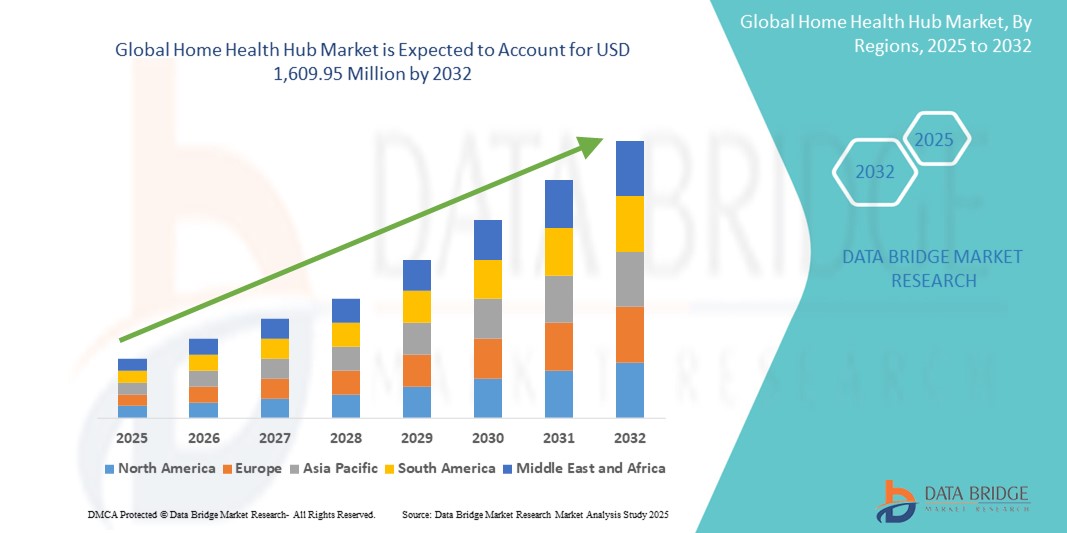
Home Health Hub Market Size
- The global home health hub market size was valued at USD 514.01 Million in 2024 and is expected to reach USD 1,609.95 Million by 2032, at a CAGR of 15.34% during the forecast period
- The market growth is largely fueled by the growing adoption and technological progress within remote patient monitoring systems, telehealth platforms, and connected healthcare devices, leading to increased digitalization in both homecare and outpatient care settings. The increasing prevalence of chronic diseases such as diabetes, cardiovascular disorders, and respiratory conditions has amplified the need for continuous health monitoring, driving the demand for home health hub solutions that enable real-time data tracking and communication between patients and healthcare providers
- Furthermore, rising consumer demand for personalized, user-friendly, and integrated digital health solutions is establishing home health hubs as a vital component in managing chronic conditions, post-acute care, and elderly patient monitoring. The convergence of IoT, AI, and wearable technologies within home health hubs is improving patient engagement and adherence to treatment regimens. These converging factors are accelerating the uptake of Home Health Hub solutions, thereby significantly boosting the industry's growth and transforming traditional healthcare delivery models into more proactive and patient-centered systems
Home Health Hub Market Analysis
- Home health hubs, offering centralized platforms for patient monitoring, data aggregation, and communication, are increasingly vital components of modern healthcare systems in both homecare and outpatient settings due to their enhanced convenience, real-time health tracking capabilities, and seamless integration with digital health ecosystems
- The escalating demand for home health hubs is primarily fueled by the widespread adoption of remote patient monitoring (RPM) technologies, rising prevalence of chronic diseases, an aging population, and growing emphasis on personalized healthcare. In addition, the shift toward value-based care is driving the development of interoperable and user-friendly hub platforms
- North America dominated the home health hub market with the largest revenue share of 41.7% in 2024, characterized by high digital health adoption rates, favorable reimbursement structures, and a robust healthcare IT infrastructure. The U.S. continues to experience substantial growth in home health hub deployments, particularly for chronic disease management and elderly care, driven by innovation from key players and support from regulatory initiatives
- Asia-Pacific is projected to be the fastest growing region in the home health hub market with a CAGR of 23.8% from 2025 to 2032, due to increasing urbanization, expanding healthcare access, rising disposable incomes, and government initiatives aimed at digitizing healthcare services in emerging economies such as India, China, and Indonesia
- The smartphone-based segment accounted for the largest market revenue share of 44.6% in 2024, driven by the increasing penetration of mobile health (mHealth) apps and widespread smartphone adoption for remote care and patient engagement
Report Scope and Home Health Hub Market Segmentation
|
Attributes |
Home Health Hub Key Market Insights |
|
Segments Covered |
|
|
Countries Covered |
North America
Europe
Asia-Pacific
Middle East and Africa
South America
|
|
Key Market Players |
|
|
Market Opportunities |
|
|
Value Added Data Infosets |
In addition to the insights on market scenarios such as market value, growth rate, segmentation, geographical coverage, and major players, the market reports curated by the Data Bridge Market Research also include in-depth expert analysis, pricing analysis, brand share analysis, consumer survey, demography analysis, supply chain analysis, value chain analysis, raw material/consumables overview, vendor selection criteria, PESTLE Analysis, Porter Analysis, and regulatory framework. |
Home Health Hub Market Trends
“Enhanced Convenience Through AI and Voice Integration”
- A significant and accelerating trend in the global home health hub market is the deepening integration with artificial intelligence (AI) and voice-controlled ecosystems such as Amazon Alexa, Google Assistant, and Apple HomeKit. This integration is transforming how users interact with home health devices, making remote care more intuitive and responsive
- For instance, modern home health hubs can now connect with smart speakers and digital assistants, enabling patients and caregivers to monitor health metrics, manage medication reminders, and communicate with healthcare providers using simple voice commands. Devices from companies like Current Health and Withings offer compatibility with AI-based platforms to improve the patient experience and care coordination
- AI plays a critical role by analyzing real-time health data collected from various connected medical devices (e.g., blood pressure monitors, glucose meters, pulse oximeters) and providing intelligent alerts, predictive analytics, and personalized health insights. For instance, some home health hubs are capable of detecting patterns in a patient’s vitals and triggering alerts before critical thresholds are crossed, enabling proactive interventions
- Voice control functionality enhances accessibility for elderly users and patients with mobility challenges, allowing them to engage with their health management systems hands-free. This has made Home Health Hubs a central node in smart healthcare environments, where devices interact seamlessly through voice and AI for a streamlined and user-friendly experience
- The integration of Home Health Hubs with broader smart home ecosystems also enables centralized control over multiple aspects of the patient's living environment—ranging from health monitoring to lighting and climate—creating a more comfortable, safe, and health-optimized home environment
- This trend towards intelligent, intuitive, and fully connected health systems is redefining remote patient monitoring and chronic disease management. As a result, key players like Philips, Resideo Technologies, and Medtronic are focusing on enhancing their Home Health Hub solutions with AI algorithms, machine learning models, and voice control capabilities to improve patient outcomes and caregiver efficiency
- The rising consumer expectation for personalized, automated, and voice-assisted healthcare at home is driving rapid growth in the Home Health Hub market, across both individual households and institutional care settings
Home Health Hub Market Dynamics
Driver
“Growing Need Due to Rising Chronic Disease Burden and Telehealth Expansion”
- The increasing global burden of chronic diseases such as diabetes, cardiovascular disorders, and COPD, along with the growing aging population, is significantly driving the demand for Home Health Hubs. These platforms provide centralized access to patient data, helping clinicians monitor health conditions remotely and intervene proactively
- For instance, in April 2024, Koninklijke Philips N.V. launched enhancements to its HealthSuite platform, enabling more comprehensive patient monitoring through integrated IoT medical devices. Such innovations are expected to fuel the growth of the Home Health Hub industry in the coming years
- With the rapid advancement of telehealth infrastructure and the widespread adoption of mobile health (mHealth) technologies, patients and healthcare providers are increasingly relying on remote health monitoring systems to manage conditions outside traditional clinical setting
- Furthermore, the growing preference for personalized and patient-centric care has accelerated the deployment of smart health hubs in both post-acute and chronic care scenarios, making them essential for value-based healthcare delivery
- Home Health Hubs allow seamless integration with various health tracking devices such as blood pressure monitors, glucose meters, and wearable sensors, facilitating comprehensive care coordination. The ease of data sharing among providers, caregivers, and patients enhances treatment adherence and outcomes, thereby propelling market demand
Restraint/Challenge
“Data Privacy Concerns and Infrastructure Limitations in Developing Regions”
- Despite the numerous benefits of Home Health Hubs, concerns regarding data security and patient privacy remain significant challenges. As these systems collect and transmit sensitive health information, they are vulnerable to cybersecurity breaches and unauthorized access, leading to compliance and trust issues
- For instance, rising global incidences of healthcare data breaches have made both patients and providers wary of adopting connected health solutions without robust cybersecurity measures in place
- Addressing these challenges requires the implementation of strict data protection protocols, HIPAA/GDPR compliance, and end-to-end encryption technologies. Companies such as Qualcomm and Honeywell are investing in advanced cybersecurity solutions and AI-driven threat detection to safeguard patient data across remote monitoring systems
- In addition, limited internet connectivity, lack of digital literacy, and inadequate healthcare infrastructure in developing regions act as barriers to the widespread deployment of Home Health Hub solutions. High costs associated with the installation and maintenance of sophisticated monitoring systems also restrict access for small healthcare providers and rural populations
Home Health Hub Market Scope
The market is segmented on the basis of product/services, patient monitoring, and end user.
- By Product/Services
On the basis of product/services, the home health hub market is segmented into smartphone-based, standalone, and services. The smartphone-based segment accounted for the largest market revenue share of 44.6% in 2024, driven by the increasing penetration of mobile health (mHealth) apps and widespread smartphone adoption for remote care and patient engagement.
The services segment is projected to witness the fastest CAGR of 20.4% from 2025 to 2032, supported by rising demand for professional remote monitoring, technical support, and integrated virtual care platforms.
- By Patient Monitoring
On the basis of patient monitoring, the home health hub market is segmented into high-acuity patient monitoring, moderate-acuity patient monitoring, and low-acuity patient monitoring. The high-acuity patient monitoring segment held the largest share of 47.1% in 2024, owing to the need for intensive remote management of critical patients post-discharge and those with severe chronic conditions.
The low-acuity patient monitoring segment is anticipated to expand at the fastest CAGR of 21.8% during 2025 to 2032, as it supports preventive care, wellness management, and post-acute follow-ups, particularly for elderly patients.
- By End User
On the basis of end user, the home health hub market is segmented into hospitals, healthcare payers, and home care agencies. The hospitals segment dominated the market with a revenue share of 49.3% in 2024, driven by increasing implementation of remote patient monitoring programs and efforts to reduce hospital readmissions.
The home care agencies segment is expected to grow at the fastest CAGR of 22.6% from 2025 to 2032, due to the growing preference for at-home care delivery, personalized chronic condition monitoring, and reduced costs associated with in-clinic care.
Home Health Hub Market Regional Analysis
- North America dominated the home health hub market with the largest revenue share of 41.7% in 2024, driven by the region’s proactive approach toward digital health transformation, a robust technological infrastructure, and increasing healthcare costs that encourage at-home monitoring solutions
- The growing elderly population and the prevalence of chronic diseases have also fueled demand for remote patient monitoring systems and connected care models across the region
- Consumers across North America highly value the convenience, real-time health tracking, and interoperability with other digital healthcare tools offered by home health hubs. This adoption is further supported by high healthcare expenditure, widespread internet access, and favorable reimbursement policies, making home-based digital health platforms more accessible and effective
U.S. Home Health Hub Market Insight
The U.S. home health hub market captured the largest revenue share of 82% in 2024 within North America. This dominance is fueled by the country’s strong emphasis on value-based care models, integration of AI-driven monitoring systems, and high smartphone penetration. The U.S. healthcare system is rapidly adopting telehealth, AI-integrated monitoring hubs, and mobile-based care management tools to support chronic disease patients and reduce hospital readmissions. Furthermore, major technology providers and startups are actively investing in advanced patient engagement platforms, significantly propelling the market.
Europe Home Health Hub Market Insight
The Europe home health hub market is projected to expand at a noteworthy CAGR during the forecast period, primarily driven by the rising demand for remote care amid aging populations and supportive government policies promoting digital health adoption. Countries such as Germany, France, and the U.K. are witnessing growing investments in home-based care technologies, with significant expansion in telemonitoring for cardiovascular, diabetic, and elderly patients. The EU's emphasis on data privacy and cross-border health interoperability is also creating a favorable ecosystem for secure and integrated home health hubs.
U.K. Home Health Hub Market Insight
The U.K. home health hub market is expected to grow at a strong CAGR during the forecast period, supported by NHS-backed digital health initiatives and increased funding for remote care technology post-COVID-19. The country is witnessing significant demand for patient-centric solutions that offer real-time monitoring, virtual consultations, and chronic care management. The U.K.'s digital-first approach in healthcare and strong telecommunications infrastructure further accelerates the uptake of home health hub solutions across both urban and rural settings.
Germany Home Health Hub Market Insight
The Germany home health hub market is poised to expand considerably, driven by the nation’s focus on healthcare digitalization and precision medicine. Germany's well-established insurance systems are beginning to reimburse digital health apps, including remote monitoring tools and home hubs, under the Digital Healthcare Act (DVG). This, combined with the country's emphasis on data security and regulatory compliance, is attracting innovation in home-based medical devices and boosting demand across aging and chronically ill populations.
Asia-Pacific Home Health Hub Market Insight
The Asia-Pacific home health hub market is projected to grow at the fastest CAGR of 23.8% from 2025 to 2032, due to the rapid expansion of digital health infrastructure, government-led health modernization programs, and the growing middle-class population. Countries like China, Japan, and India are witnessing increased adoption of mobile health solutions and telemonitoring services. The shift toward home-based chronic care management and the surge in smartphone and wearable usage are further catalyzing the market in this region.
Japan Home Health Hub Market Insight
The Japan home health hub market is gaining significant traction owing to the country’s aging demographics and technological leadership. With one of the highest elderly populations globally, there is a pressing need for remote health solutions that minimize hospital visits. Japan’s investment in robotics, IoT, and AI in healthcare is leading to highly integrated home health systems. Features like automated medication reminders, AI-assisted diagnostics, and seamless communication with healthcare providers are increasingly being embedded in Japanese home care settings.
China Home Health Hub Market Insight
The China home health hub market accounted for the largest market share in the Asia-Pacific region in 2024, driven by its vast population, increased healthcare digitization efforts under the "Healthy China 2030" initiative, and the rise of local health-tech companies. The adoption of home health hubs is supported by strong smartphone penetration, telemedicine platforms, and a focus on chronic disease management in urban centers. With expanding 5G infrastructure and AI investment, China is expected to remain a key growth engine for the global home health hub industry.
Home Health Hub Market Share
The home health hub industry is primarily led by well-established companies, including:
- AMC Health (U.S.)
- Cambridge Consultants (U.K.)
- Capsule Technologies Inc. (U.S.)
- eDevice (France)
- Pfizer Inc. (U.S.)
- Inhealthcare (U.K.)
- Qualcomm Technologies, Inc. (U.S.)
- Encompass Health Corporation (U.S.)
- Honeywell International Inc. (U.S.)
- MyVitalz, Inc. (U.S.)
- Koninklijke Philips N.V. (Netherlands)
- HiCare Services Pvt. Ltd (India)
- INiTSiator GmbH (Germany)
- Resideo Technologies Inc. (U.S.)
- Optum, Inc. (U.S.)
- OnKöl (U.S.)
- MeKo Manufacturing e.K. (Germany)
Latest Developments in Global Home Health Hub Market
- In August 2024, A USD 14.28 million health hub in Bakewell, Derbyshire, is set to open on 23 September. The Newholme Health Centre will feature an ambulance station and offer NHS outpatient services, including physiotherapy and audiology. The facility has been constructed on the site of the former ambulance station and the adjacent Newholme Hospital, which is scheduled for decommissioning
- In April 2024, The Food and Drug Administration's (FDA) device center has launched an initiative to support the development of at-home medical devices, prioritizing health equity in home-based care. According to a spokesperson speaking with Fierce Healthcare, the FDA invested over a million in an initial partnership. Insights from this "Home as a Health Care Hub" initiative may shape future regulations and the technology utilized in hospital-at-home programs
- In January 2021, Philips strengthened its position in inpatient care management solutions for hospitals by acquiring Capsule Technologies, Inc
- In March 2022, VEON Ltd., a global provider of connectivity and internet services, announced that its Bangladeshi mobile operator, Banglalink, launched Health Hub, the first comprehensive digital health platform in Bangladesh

- Interactive Data Analysis Dashboard
- Company Analysis Dashboard for high growth potential opportunities
- Research Analyst Access for customization & queries
- Competitor Analysis with Interactive dashboard
- Latest News, Updates & Trend analysis
- Harness the Power of Benchmark Analysis for Comprehensive Competitor Tracking
Data collection and base year analysis are done using data collection modules with large sample sizes. The stage includes obtaining market information or related data through various sources and strategies. It includes examining and planning all the data acquired from the past in advance. It likewise envelops the examination of information inconsistencies seen across different information sources. The market data is analysed and estimated using market statistical and coherent models. Also, market share analysis and key trend analysis are the major success factors in the market report. To know more, please request an analyst call or drop down your inquiry.
The key research methodology used by DBMR research team is data triangulation which involves data mining, analysis of the impact of data variables on the market and primary (industry expert) validation. Data models include Vendor Positioning Grid, Market Time Line Analysis, Market Overview and Guide, Company Positioning Grid, Patent Analysis, Pricing Analysis, Company Market Share Analysis, Standards of Measurement, Global versus Regional and Vendor Share Analysis. To know more about the research methodology, drop in an inquiry to speak to our industry experts.
Data Bridge Market Research is a leader in advanced formative research. We take pride in servicing our existing and new customers with data and analysis that match and suits their goal. The report can be customized to include price trend analysis of target brands understanding the market for additional countries (ask for the list of countries), clinical trial results data, literature review, refurbished market and product base analysis. Market analysis of target competitors can be analyzed from technology-based analysis to market portfolio strategies. We can add as many competitors that you require data about in the format and data style you are looking for. Our team of analysts can also provide you data in crude raw excel files pivot tables (Fact book) or can assist you in creating presentations from the data sets available in the report.













