


Home Medical Furniture Market Overview
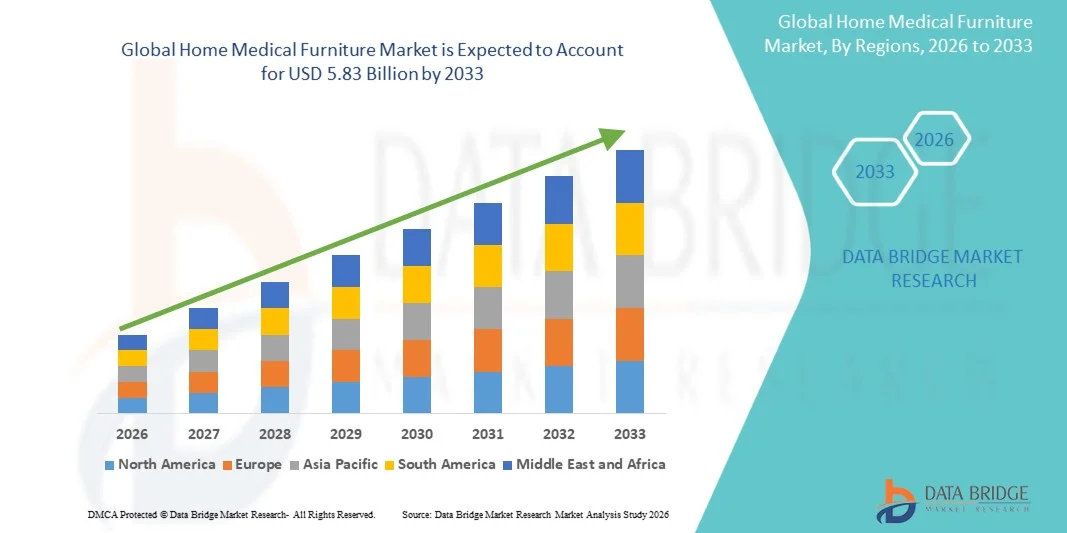
As per Data Bridge Market Research analysis the Home Medical Furniture Market was valued at USD 3.55 billion in 2025 and is projected to reach USD 5.83 billion by 2033, growing at a CAGR of 6.4% from 2026 to 2033. The market is experiencing steady growth driven by the rising aging population, increasing prevalence of chronic diseases, and growing preference for home-based healthcare services across developed and emerging economies.
The growing demand for cost-effective long-term care solutions, coupled with advancements in ergonomic and technologically enhanced medical furniture, is encouraging patients and caregivers to adopt specialized home healthcare equipment. Adjustable homecare beds, pressure-relief mattresses, lift chairs, and mobility-support furniture are increasingly being utilized to improve patient comfort, safety, and recovery outcomes. In addition, expanding home healthcare infrastructure, favorable reimbursement policies in several countries, and the shift toward patient-centered care are accelerating the adoption of home medical furniture solutions worldwide.
Key Market Trends & Insights
- North America dominated the Home Medical Furniture Market with the largest revenue share of 37.12% in 2025, supported by a rapidly aging population, high home healthcare adoption rates, and favorable reimbursement frameworks for home-based medical care.
- The Devices segment led the market with a 88.74% share in 2025, driven by the extensive use of homecare beds, lift chairs, bedside commodes, overbed tables, and pressure-relief mattresses in residential healthcare settings.
- Asia-Pacific is expected to be the fastest-growing region at a CAGR of 7.1% from 2026 to 2033, fueled by expanding healthcare infrastructure, rising geriatric populations, and growing awareness of home healthcare solutions across China, India, and Japan.
- Software is the fastest-growing product type, projected to register a CAGR of 8.1%, reflecting the surge in the integration of digital health technologies into home medical furniture ecosystems.
- The Metal segment dominated the material type category with a 46.83% revenue share in 2025, led by its superior durability, structural strength, and ability to withstand continuous patient use.
- Treatment/Care-related Applications accounted for 67.58% of the market, preferred by increasing utilization of home medical furniture for rehabilitation, chronic disease management, post-surgical recovery, and long-term elderly care
- The Preventive Applications segment is the fastest-growing application category, with a CAGR of 6.8%, driven by increasing awareness regarding fall prevention, pressure ulcer prevention, mobility assistance, and proactive elderly care.
Market Size & Forecast
- Global Market Value (2025): USD 3.55 Billion
- Expected Market Value (2033): USD 5.83 Billion
- Forecast CAGR (2026–2033): 6.4%
- Leading Region in 2025: North America
- Fastest Growing Region: Asia Pacific
Report Scope and Home Medical Furniture Market Segmentation
|
Attributes |
Home Medical Furniture Key Market Insights |
|
Segments Covered |
|
|
Countries Covered |
North America · U.S. · Canada · Mexico Europe · Germany · France · U.K. · Netherlands · Switzerland · Belgium · Russia · Italy · Spain · Turkey · Rest of Europe Asia-Pacific · China · Japan · India · South Korea · Singapore · Malaysia · Australia · Thailand · Indonesia · Philippines · Rest of Asia-Pacific Middle East and Africa · Saudi Arabia · U.A.E. · South Africa · Egypt · Israel · Rest of Middle East and Africa South America · Brazil · Argentina · Rest of South America |
|
Key Market Players |
· Invacare Corporation (U.S.) · Drive DeVilbiss Healthcare (U.S.) · GF Health Products, Inc. (U.S.) · Hillrom (U.S.) · Stryker (U.S.) · Joerns Healthcare LLC (U.S.) · Gendron Inc. (U.S.) · Savaria Corporation (Canada) · Human Care HC AB (Sweden) · Arjo AB (Sweden) · LINET Group SE (Netherlands) · Stiegelmeyer GmbH & Co. KG (Germany) · Wissner-Bosserhoff GmbH (Germany) · Hermann Bock GmbH (Germany) · AKS - Aktuelle Krankenpflege Systeme GmbH (Germany) · Gainsborough Specialist Beds Ltd (U.K.) · Opera Beds (U.K.) · Benmor Medical (U.K.) · Med-Mizer, Inc. (U.S.) · Transfer Master Products, Inc. (U.S.) |
|
Market Opportunities |
· Expansion of aging-in-place healthcare programs · Integration of smart monitoring technologies into home medical furniture · Rising healthcare access in emerging economies |
|
Value Added Data Infosets |
In addition to the insights on market scenarios such as market value, growth rate, segmentation, geographical coverage, and major players, the market reports curated by the Data Bridge Market Research also include in-depth expert analysis, patient epidemiology, pipeline analysis, pricing analysis, and regulatory framework. |
Home Medical Furniture Market Trends
Trend: Rising Demand for Smart and Ergonomic Home Care Furniture
Patients and caregivers are increasingly adopting technologically advanced home medical furniture that enhances comfort, safety, and care efficiency. Adjustable electric beds, pressure-relief mattresses, smart recliners, and mobility-support furniture equipped with monitoring and positioning features are gaining popularity among elderly and chronically ill patients. Healthcare providers and homecare agencies are similarly utilizing ergonomic furniture solutions to reduce caregiver strain and improve patient outcomes, while connected technologies enable remote monitoring and personalized care management within residential settings.
For instance, in March 2024, several leading home healthcare equipment manufacturers expanded their portfolios with smart homecare beds featuring integrated fall-detection systems, remote controls, and patient-monitoring capabilities, reflecting the growing preference for connected home medical furniture solutions.
Home Medical Furniture Market Dynamics
Key Market Driver: Growing Preference for Home-Based Healthcare Services
The increasing shift toward home-based healthcare and aging-in-place care models has created substantial demand for specialized home medical furniture that supports long-term treatment, rehabilitation, and chronic disease management. Healthcare providers, insurers, and government agencies are encouraging homecare solutions as a cost-effective alternative to extended hospital stays, reducing healthcare expenditures while improving patient comfort. This transition is accelerating demand for homecare beds, lift chairs, overbed tables, and mobility-support furniture across both developed and emerging healthcare markets.
For instance, in January 2025, multiple healthcare systems across North America expanded home healthcare programs for elderly patients, increasing procurement of adjustable medical beds and support furniture to facilitate safe and effective in-home care.
Key Restraint/Challenge: High Cost of Advanced Home Medical Furniture
A significant restraint in the Home Medical Furniture Market is the relatively high acquisition cost of technologically advanced products. Premium electric beds, pressure-management mattresses, smart recliners, and integrated monitoring-enabled furniture require substantial investment, limiting accessibility for cost-sensitive households and uninsured patients. The overall ownership burden may also include maintenance expenses, replacement components, and installation requirements, making adoption challenging in lower-income regions and among individual consumers with limited healthcare budgets.
For instance, in 2024, several home healthcare providers reported slower adoption of premium smart-bed systems in developing markets due to affordability concerns and reimbursement limitations, highlighting ongoing cost-related barriers to market expansion.
Key Market Opportunity: Expansion of Smart Connected Home Healthcare Ecosystems
The integration of digital health technologies into home medical furniture presents a significant market opportunity. Connected furniture platforms can support remote patient monitoring, automated safety alerts, caregiver communication, and real-time health data collection. The growing adoption of telehealth services and remote care models is further encouraging manufacturers to develop intelligent furniture solutions that improve care coordination and patient independence, creating substantial growth opportunities across aging populations worldwide.
For instance, in February 2025, several medical furniture manufacturers introduced connected homecare beds capable of transmitting patient movement and occupancy data to caregivers, demonstrating the expanding role of smart furniture within digitally enabled home healthcare ecosystems.
Home Medical Furniture Market Scope
The home medical furniture market is segmented on the basis of product type, material, application, and sales channel.
- By Product Type
On the basis of product type, the Home Medical Furniture Market is segmented into software and devices. The Devices segment dominated the market with an estimated 88.74% share in 2025, owing to the extensive use of homecare beds, lift chairs, bedside commodes, overbed tables, and pressure-relief mattresses in residential healthcare settings. These products are essential for supporting mobility, comfort, rehabilitation, and long-term patient care at home. Growing demand for home healthcare services among elderly and chronically ill populations continues to drive adoption. Healthcare providers and caregivers increasingly rely on medical furniture devices to improve patient safety and quality of care. Continuous product innovation in adjustable and powered furniture solutions is further strengthening market penetration. Their critical role in daily patient management ensures continued segment dominance.
The Software segment is projected to register the fastest growth at a CAGR of 8.1% from 2026 to 2033, driven by the increasing integration of digital health technologies into home medical furniture ecosystems. Software platforms support remote monitoring, predictive maintenance, patient tracking, and caregiver communication through connected devices. The growing adoption of telehealth and smart home healthcare solutions is creating demand for advanced software-enabled functionality. Improvements in cloud computing, artificial intelligence, and IoT connectivity are enhancing operational efficiency and patient outcomes. Healthcare organizations are increasingly utilizing digital platforms to optimize care delivery and data management. The transition toward intelligent and connected healthcare environments is expected to accelerate growth significantly
- By Material
On the basis of material, the Home Medical Furniture Market is segmented into metal, wood, plastic/polymer, and composite materials. The Metal segment dominated the market with an estimated 46.83% share in 2025 due to its superior durability, structural strength, and ability to withstand continuous patient use. Metal is extensively utilized in homecare beds, mobility-support equipment, and transfer furniture because it provides high load-bearing capacity and long service life. Manufacturers increasingly employ corrosion-resistant steel and lightweight aluminum to improve product performance and reliability. The material also supports the integration of motorized mechanisms and adjustable components commonly used in advanced homecare furniture. Easy maintenance and compliance with healthcare safety standards further support widespread adoption. These advantages continue to reinforce metal’s leadership position within the market.
The Composite Materials segment is expected to witness the fastest growth at a CAGR of 7.3% from 2026 to 2033, driven by rising demand for lightweight, durable, and aesthetically appealing furniture solutions. Composite materials offer enhanced flexibility in product design while maintaining strength and durability comparable to traditional materials. These materials are increasingly used in premium home medical furniture due to their resistance to corrosion, moisture, and wear. Manufacturers are investing in advanced material technologies to improve patient comfort and product longevity. Growing consumer preference for home-friendly medical furniture designs is also supporting adoption. Continuous innovation in composite manufacturing processes is expected to create substantial growth opportunities for the segment.
- By Application
On the basis of application, the Home Medical Furniture Market is segmented into preventive applications and treatment/care-related applications. The Treatment/Care-related Applications segment accounted for the largest market share of approximately 67.58% in 2025, driven by increasing utilization of home medical furniture for rehabilitation, chronic disease management, post-surgical recovery, and long-term elderly care. Adjustable beds, pressure-relief surfaces, and patient-support furniture play a critical role in improving treatment effectiveness and patient comfort. Rising prevalence of mobility impairments and age-related health conditions is increasing demand for specialized care furniture. Healthcare providers are encouraging home-based treatment models to reduce hospitalization costs and improve patient satisfaction. Expanding home healthcare services globally further support segment growth. The segment remains central to the delivery of effective home-based medical care.
The Preventive Applications segment is projected to register the fastest growth at a CAGR of 7.0% from 2026 to 2033, fueled by increasing awareness regarding fall prevention, pressure ulcer prevention, mobility assistance, and proactive elderly care. Healthcare systems are emphasizing preventive strategies to reduce long-term treatment costs and improve quality of life. Advanced home medical furniture equipped with ergonomic and safety-enhancing features is helping patients maintain independence and reduce injury risks. Aging populations worldwide are creating significant demand for preventive healthcare solutions. Consumers and caregivers are increasingly investing in products that support healthy aging and safe living environments. The growing focus on preventive health management is expected to accelerate segment expansion.
- By Sales Channel
On the basis of sales channel, the Home Medical Furniture Market is segmented into B2C and B2B. The B2B segment dominated the market with an estimated 61.42% share in 2025, supported by large-scale procurement activities from home healthcare providers, rehabilitation centers, hospitals, nursing agencies, and medical equipment distributors. Institutional buyers typically purchase home medical furniture in significant volumes to support patient care programs and home healthcare initiatives. Long-term supplier agreements, product standardization requirements, and after-sales support services further strengthen the segment. Healthcare organizations prioritize certified and reliable furniture solutions to ensure patient safety and operational efficiency. Growing investment in organized home healthcare infrastructure is contributing to sustained demand. These factors collectively maintain the segment’s dominant market position.
The B2C segment is anticipated to witness the fastest growth at a CAGR of 7.4% from 2026 to 2033, driven by rising consumer awareness, increasing online retail penetration, and growing preference for direct healthcare purchases. Patients and caregivers are increasingly purchasing homecare beds, recliners, mobility-support furniture, and related products through e-commerce platforms and specialty retailers. Improved accessibility to healthcare products and flexible financing options are encouraging broader adoption. Manufacturers are also expanding direct-to-consumer distribution strategies to strengthen customer engagement and market reach. Growing emphasis on independent living and aging-in-place care models is further supporting demand. The rapid evolution of digital commerce channels is expected to significantly accelerate segment growth.
Home Medical Furniture Market Regional Analysis
North America dominated the Home Medical Furniture Market with the largest revenue share of 37.12% in 2025, supported by a rapidly aging population, high home healthcare adoption rates, and favorable reimbursement frameworks for home-based medical care. The region also benefits from favorable reimbursement policies, increasing prevalence of chronic diseases, and the presence of leading medical furniture manufacturers. Growing demand for home-based long-term care, advanced homecare beds, and mobility-support solutions continues to drive market expansion. Rising healthcare expenditures and increasing preference for aging-in-place care models are further accelerating product adoption across residential healthcare settings. Continuous innovation in smart and connected medical furniture solutions continues to strengthen North America's leadership position in the global market.
U.S. Home Medical Furniture Market Insight
The U.S. home medical furniture market is witnessing strong growth due to rising demand for home healthcare services, increasing prevalence of chronic diseases, and a rapidly expanding elderly population. The country’s advanced healthcare infrastructure, along with growing adoption of adjustable beds, mobility-support furniture, and pressure-relief mattresses, is driving demand across residential care settings. In addition, favorable reimbursement policies and increasing preference for aging-in-place care models are accelerating product adoption among patients and caregivers across the country.
Europe Home Medical Furniture Market Insight
The Europe home medical furniture market remains a major contributor to global revenue, driven by strong healthcare systems, growing elderly populations, and increasing focus on home-based patient care. The widespread use of homecare beds, patient lift equipment, and rehabilitation furniture is supporting market expansion across the region. Increasing investments in elderly care infrastructure, coupled with favorable healthcare policies and rising demand for long-term care solutions, continue to enhance the adoption of home medical furniture throughout Europe.
U.K. Home Medical Furniture Market Insight
The U.K. home medical furniture market is experiencing steady growth, supported by rising adoption of home healthcare services, increasing elderly care requirements, and growing demand for patient comfort solutions. Increasing investments in homecare infrastructure and rising utilization of adjustable beds, mobility aids, and support furniture are contributing to market growth. Furthermore, integration of smart monitoring features and connected healthcare technologies is improving care efficiency, positioning the U.K. as a key market within the home medical furniture industry.
Germany Home Medical Furniture Market Insight
The Germany home medical furniture market is expanding steadily due to the country’s advanced healthcare system, aging population, and increasing preference for home-based care solutions. Healthcare providers and consumers are increasingly utilizing specialized furniture for rehabilitation, chronic disease management, and long-term elderly care. Continuous advancements in ergonomic furniture designs, smart healthcare integration, and patient safety technologies, along with strong government support for home healthcare services, are further driving market growth in Germany.
Asia-Pacific Home Medical Furniture Market Insight
The Asia-Pacific home medical furniture market is expected to witness rapid growth, driven by increasing healthcare awareness, expanding elderly populations, and rising investments in home healthcare infrastructure across countries such as China, India, and Japan. Growing prevalence of chronic diseases, increasing demand for affordable care solutions, and rising adoption of specialized homecare furniture are supporting regional market expansion. In addition, improving healthcare accessibility and growing consumer awareness regarding independent living are accelerating product adoption across the region.
Japan Home Medical Furniture Market Insight
The Japan home medical furniture market is witnessing consistent growth due to rising demand for elderly care solutions, increasing life expectancy, and strong adoption of home healthcare services. Healthcare providers and caregivers are increasingly utilizing advanced homecare beds, mobility-support products, and rehabilitation furniture to improve patient outcomes. Moreover, increasing integration of smart healthcare technologies and the country’s focus on aging-in-place care strategies are further contributing to market growth.
China Home Medical Furniture Market Insight
The China home medical furniture market is growing rapidly, driven by increasing healthcare expenditure, expanding elderly populations, and rising government focus on home-based healthcare services. Growing adoption of adjustable beds, mobility assistance furniture, and patient support solutions across urban and rural areas is significantly boosting market demand. In addition, rising investments in healthcare infrastructure, increasing awareness regarding elderly care, and continuous product innovation are positioning China as one of the fastest-growing markets for home medical furniture globally.
Home Medical Furniture Market Share
The home medical furniture industry is primarily led by well-established companies, including:
- Invacare Corporation (U.S.)
- Drive DeVilbiss Healthcare (U.S.)
- GF Health Products, Inc. (U.S.)
- Hillrom (U.S.)
- Stryker (U.S.)
- Joerns Healthcare LLC (U.S.)
- Gendron Inc. (U.S.)
- Savaria Corporation (Canada)
- Human Care HC AB (Sweden)
- Arjo AB (Sweden)
- LINET Group SE (Netherlands)
- Stiegelmeyer GmbH & Co. KG (Germany)
- Wissner-Bosserhoff GmbH (Germany)
- Hermann Bock GmbH (Germany)
- AKS - Aktuelle Krankenpflege Systeme GmbH (Germany)
- Gainsborough Specialist Beds Ltd (U.K.)
- Opera Beds (U.K.)
- Benmor Medical (U.K.)
- Med-Mizer, Inc. (U.S.)
- Transfer Master Products, Inc. (U.S.)
Latest Developments in Home Medical Furniture Market
- In October 2025, SonderCare launched the Impulse Essential 39-inch Residential Comfort Bed in the United States. The new homecare bed was developed to provide premium comfort, safety, and residential aesthetics at a more accessible price point. The launch demonstrates growing industry efforts to make advanced home medical furniture available to a broader patient population while supporting the shift toward home-based care
- In September 2025, Invacare launched the new Accent Medical Profiling Bed, designed for both homecare and long-term care environments. The bed offers improved comfort, accessibility, easy setup, and enhanced safety features for patients and caregivers. The launch reflects growing demand for affordable, high-quality home medical furniture solutions that support aging populations and expanding home healthcare services
- In December 2023, Arjo announced that its product portfolio had achieved full MDR and UKCA certification compliance. This regulatory milestone strengthened the company's position in medical beds and patient care furniture by ensuring continued market access across Europe and the United Kingdom. The development underscores the increasing importance of regulatory compliance and product quality within the home medical furniture industry
- In September 2024, Invacare showcased its latest homecare and long-term care innovations at REHACARE International 2024. The company introduced advanced mobility and homecare solutions designed to improve patient independence and caregiver efficiency. The event highlighted ongoing innovation across home medical furniture and assistive care products as manufacturers respond to increasing demand for home-based healthcare
- In September 2023, Arjo announced the launch of its Evenda bed range for long-term and dementia care applications. The new bed was developed to improve safety, independence, and quality of life for people living with dementia while supporting caregivers through enhanced ergonomic features. The launch highlights the industry's growing focus on specialized home and long-term care furniture solutions for aging populations

- Interactive Data Analysis Dashboard
- Company Analysis Dashboard for high growth potential opportunities
- Research Analyst Access for customization & queries
- Competitor Analysis with Interactive dashboard
- Latest News, Updates & Trend analysis
- Harness the Power of Benchmark Analysis for Comprehensive Competitor Tracking
Data collection and base year analysis are done using data collection modules with large sample sizes. The stage includes obtaining market information or related data through various sources and strategies. It includes examining and planning all the data acquired from the past in advance. It likewise envelops the examination of information inconsistencies seen across different information sources. The market data is analysed and estimated using market statistical and coherent models. Also, market share analysis and key trend analysis are the major success factors in the market report. To know more, please request an analyst call or drop down your inquiry.
The key research methodology used by DBMR research team is data triangulation which involves data mining, analysis of the impact of data variables on the market and primary (industry expert) validation. Data models include Vendor Positioning Grid, Market Time Line Analysis, Market Overview and Guide, Company Positioning Grid, Patent Analysis, Pricing Analysis, Company Market Share Analysis, Standards of Measurement, Global versus Regional and Vendor Share Analysis. To know more about the research methodology, drop in an inquiry to speak to our industry experts.
Data Bridge Market Research is a leader in advanced formative research. We take pride in servicing our existing and new customers with data and analysis that match and suits their goal. The report can be customized to include price trend analysis of target brands understanding the market for additional countries (ask for the list of countries), clinical trial results data, literature review, refurbished market and product base analysis. Market analysis of target competitors can be analyzed from technology-based analysis to market portfolio strategies. We can add as many competitors that you require data about in the format and data style you are looking for. Our team of analysts can also provide you data in crude raw excel files pivot tables (Fact book) or can assist you in creating presentations from the data sets available in the report.













