


Homeland Cyber Warfare Market Size
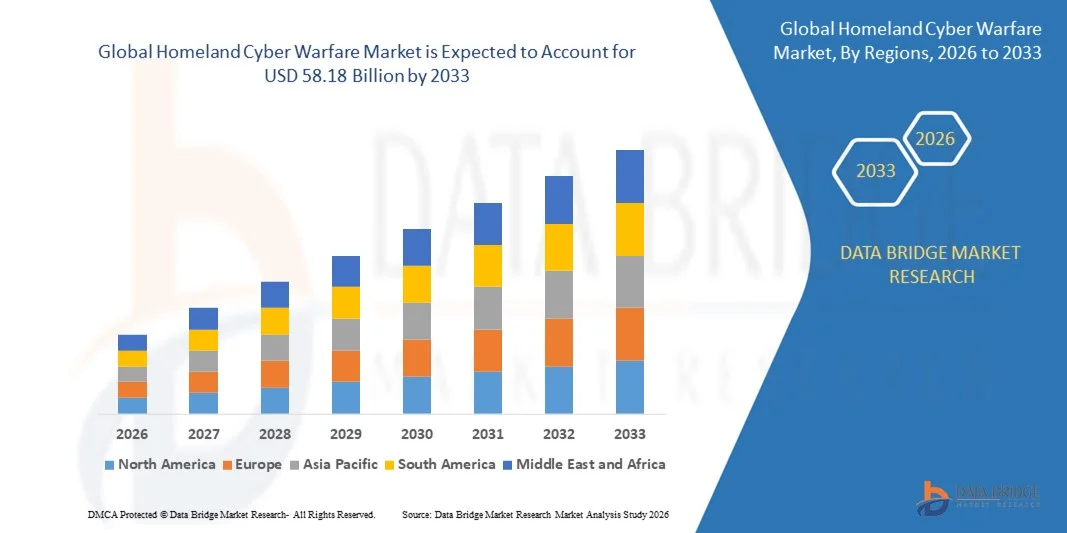
- The global homeland cyber warfare market size was valued at USD 17.99 billion in 2025 and is expected to reach USD 58.18 billion by 2033, at a CAGR of 15.80% during the forecast period
- The market growth is largely fueled by the escalating frequency, complexity, and sophistication of cyberattacks targeting governments, critical infrastructure, and defense networks, prompting nations to invest heavily in cyber warfare capabilities to protect sovereignty and national security
- Furthermore, increasing digital transformation across sectors such as energy, transportation, finance, and defense is expanding the attack surface, driving demand for advanced homeland cyber warfare solutions that can detect, analyze, and respond to threats in real time; these converging factors are accelerating adoption of cyber defense technologies, thereby significantly boosting the industry’s growth
Homeland Cyber Warfare Market Analysis
- Homeland cyber warfare encompasses a range of defensive capabilities, including threat intelligence, security operations centers (SOCs), intrusion detection and prevention systems (IDPS), incident response platforms, and AI‑driven analytics, which are increasingly essential to national defense strategies in an era of pervasive cyber threats
- The escalating need to safeguard critical national infrastructure, stringent government regulations, rising geopolitical tensions, and expanding adoption of sophisticated cyber defense technologies are primary drivers of market demand, as governments and large enterprises seek resilient, integrated solutions to mitigate cyber risk and ensure operational continuity
- North America dominated the homeland cyber warfare market with a share of 40.24% in 2025, due to increasing government investments in national cybersecurity infrastructure, defense modernization programs, and rising awareness of advanced cyber threats
- Asia-Pacific is expected to be the fastest growing region in the homeland cyber warfare market during the forecast period due to rising cyber threats, rapid digitalization, and increased government spending in countries such as China, Japan, and India
- Solutions segment dominated the market with a market share of 62.5% in 2025, due to its comprehensive offerings that include threat intelligence platforms, network security tools, and cyber defense solutions. Government agencies and critical infrastructure operators often prioritize solutions for their ability to provide proactive threat mitigation and real-time monitoring. The segment benefits from continuous innovation in cybersecurity technologies and integration with advanced analytics platforms
Report Scope and Homeland Cyber Warfare Market Segmentation
|
Attributes |
Homeland Cyber Warfare Key Market Insights |
|
Segments Covered |
|
|
Countries Covered |
North America
Europe
Asia-Pacific
Middle East and Africa
South America
|
|
Key Market Players |
|
|
Market Opportunities |
|
|
Value Added Data Infosets |
In addition to the market insights such as market value, growth rate, market segments, geographical coverage, market players, and market scenario, the market report curated by the Data Bridge Market Research team includes in-depth expert analysis, import/export analysis, pricing analysis, production consumption analysis, and pestle analysis. |
Homeland Cyber Warfare Market Trends
Growing Adoption of AI-Driven Cyber Defense Systems
- A significant trend in the homeland cyber warfare market is the increasing implementation of AI-driven cyber defense systems across government and defense agencies, driven by the escalating complexity of cyber threats targeting critical infrastructure. These systems enhance threat detection, real-time monitoring, and automated response, positioning AI as a core element of national cybersecurity strategy
- For instance, companies such as Darktrace and Palo Alto Networks provide AI-based cybersecurity platforms that help governments and defense organizations identify and neutralize sophisticated attacks before they impact critical operations. Such solutions strengthen threat intelligence, improve incident response, and reduce potential operational disruptions
- The adoption of AI-driven threat analytics is growing rapidly as these systems can predict attack patterns, detect anomalies, and provide actionable insights. This is establishing AI as a pivotal tool for enhancing situational awareness and decision-making in homeland cyber operations
- Defense sectors are increasingly integrating AI technologies to manage cyber risk across national infrastructure, including energy grids, transportation networks, and financial systems. This trend is accelerating investments in predictive cybersecurity solutions that safeguard critical assets from evolving digital threats
- The market is witnessing expansion in automated response mechanisms where AI algorithms can neutralize detected threats in real-time, reducing reliance on manual intervention. This capability is driving a shift toward proactive rather than reactive cyber defense strategies
- Governments are deploying AI-assisted platforms to support national cyber command centers, enabling continuous monitoring and coordinated threat management. This growing reliance on intelligent systems reinforces AI’s role in fortifying homeland cybersecurity capabilities
Homeland Cyber Warfare Market Dynamics
Driver
Rising Cyber Threats Targeting Critical Infrastructure
- The increasing frequency and sophistication of cyberattacks targeting critical infrastructure, including power grids, water systems, and transportation networks, is driving investment in homeland cyber warfare capabilities. Organizations require advanced tools to identify, mitigate, and respond to these persistent threats efficiently
- For instance, the U.S. Department of Homeland Security leverages AI-powered cybersecurity frameworks and threat intelligence platforms to protect vital infrastructure from cyber incursions. These measures enhance resilience, enable faster threat response, and minimize potential national security risks
- Threats from state-sponsored and criminal actors are becoming more complex, involving ransomware, malware, and phishing campaigns specifically designed to disrupt critical operations. This complexity necessitates integrated defense solutions that can address multi-layered attacks in real time
- Increasing digitalization of government services and the adoption of IoT in urban infrastructure have expanded the attack surface, intensifying the need for proactive cyber defense. Agencies are prioritizing cyber risk management as a core component of national security strategy
- Collaboration between private cybersecurity firms and government agencies is enhancing threat detection, sharing intelligence, and developing joint response protocols. This partnership approach strengthens national preparedness against cyber threats
Restraint/Challenge
High Implementation Costs and Complexity of Advanced Cyber Warfare Solutions
- The homeland cyber warfare market faces challenges due to the high costs associated with deploying advanced cybersecurity systems that require cutting-edge AI, continuous updates, and integration with legacy infrastructure. These financial and technical demands can slow adoption and create barriers for smaller agencies
- For instance, implementing comprehensive AI-driven cybersecurity platforms from companies such as FireEye involves substantial initial investment, specialized personnel, and ongoing maintenance expenses. These requirements increase operational overhead and can limit scalability
- The complexity of integrating multiple security layers across diverse networks and systems adds to the operational burden, demanding skilled cybersecurity professionals and robust governance frameworks
- Maintaining continuous threat monitoring, threat intelligence updates, and system resilience involves extensive resource allocation, further elevating overall costs and complexity. Agencies must balance operational effectiveness with budget constraints
- Challenges in achieving interoperability between new AI-based solutions and existing legacy systems continue to impede seamless implementation. These constraints collectively necessitate careful planning, specialized expertise, and significant investment to realize the full potential of homeland cyber defense solutions
Homeland Cyber Warfare Market Scope
The market is segmented on the basis of component, deployment type, system, and end user.
- By Component
On the basis of component, the Homeland Cyber Warfare market is segmented into solutions and services. The solutions segment dominated the market with the largest revenue share of 62.5% in 2025, driven by its comprehensive offerings that include threat intelligence platforms, network security tools, and cyber defense solutions. Government agencies and critical infrastructure operators often prioritize solutions for their ability to provide proactive threat mitigation and real-time monitoring. The segment benefits from continuous innovation in cybersecurity technologies and integration with advanced analytics platforms. Solutions also allow for customizable deployments tailored to specific organizational requirements, enhancing operational resilience and reducing exposure to cyber threats. Their scalability and compatibility with existing IT and OT systems further strengthen adoption.
The services segment is expected to witness the fastest growth rate from 2026 to 2033, fueled by increasing reliance on outsourced cybersecurity expertise and managed services. For instance, companies such as Booz Allen Hamilton offer specialized cyber defense services that help governments and private entities rapidly respond to emerging threats. Services provide flexibility, allowing organizations to scale resources based on threat levels and operational demands. They also include continuous threat intelligence updates, training, and incident response, which are critical in dynamic cyber warfare environments. Growing demand for cybersecurity consulting and integration services is driving investments in this segment, particularly in regions facing heightened digital threats.
- By Deployment Type
On the basis of deployment type, the Homeland Cyber Warfare market is segmented into on-premises and cloud. The on-premises segment dominated the market in 2025, owing to its high control over sensitive data, secure infrastructure, and compliance with stringent government regulations. Organizations with critical national security responsibilities often prefer on-premises deployment for mission-critical applications and to minimize exposure to external threats. The segment also benefits from the ability to customize security protocols and integrate legacy systems without compromising data sovereignty. On-premises solutions provide dedicated support, advanced monitoring capabilities, and reduced latency, which are crucial for real-time cyber defense operations. Their robust infrastructure ensures reliable performance under high-threat scenarios.
The cloud segment is expected to witness the fastest CAGR from 2026 to 2033, driven by the growing adoption of scalable and flexible cyber defense platforms. For instance, Microsoft Azure Government offers cloud-based cybersecurity solutions tailored for homeland security applications. Cloud deployment allows organizations to leverage advanced AI-driven analytics, real-time threat intelligence sharing, and remote access capabilities. It also reduces capital expenditure on hardware and enables rapid updates and deployment of security patches. Governments and private entities increasingly rely on cloud solutions to manage distributed networks and respond effectively to evolving cyber threats.
- By System
On the basis of system, the Homeland Cyber Warfare market is segmented into intelligence and surveillance systems, detection and monitoring systems, access control systems, platforms, rescue and recovery systems, command and control systems, and countermeasure systems. The intelligence and surveillance system segment dominated the market in 2025, driven by the need for real-time threat assessment, monitoring of critical infrastructures, and analysis of cyber activities. These systems provide actionable insights for decision-makers and enhance situational awareness for national defense operations. They often integrate advanced analytics, AI, and machine learning to predict potential attacks and mitigate risks proactively. Agencies rely on intelligence systems to coordinate with other cyber defense mechanisms, ensuring rapid response to security breaches. Their ability to process large volumes of data and provide early warning signals makes them indispensable in homeland cyber operations.
The platforms segment is anticipated to witness the fastest growth rate from 2026 to 2033, fueled by increasing adoption of integrated cyber warfare platforms for holistic defense management. For instance, Palantir’s cyber defense platforms provide centralized monitoring, threat intelligence, and predictive analytics for national security operations. Platforms allow seamless integration of multiple systems, providing interoperability between surveillance, detection, and command systems. They enhance coordination, reduce response times, and enable strategic deployment of cyber countermeasures. Growing demand for unified platforms to consolidate cybersecurity operations is driving investments, particularly in regions focusing on strengthening digital defense infrastructure.
- By End User
On the basis of end user, the Homeland Cyber Warfare market is segmented into public sector and private sector. The public sector dominated the market in 2025, driven by national defense agencies, law enforcement, and government intelligence organizations investing heavily in cybersecurity to protect critical infrastructure. These users prioritize robust, mission-critical systems with high reliability, compliance, and security features tailored for national defense applications. Public sector investments focus on threat intelligence, surveillance, and command systems to address both internal and external cyber threats. Collaboration between defense agencies and private cybersecurity firms further strengthens capabilities. Continuous policy updates, regulatory compliance, and strategic modernization initiatives support sustained demand in this segment.
The private sector segment is expected to witness the fastest growth rate from 2026 to 2033, fueled by the rising need for corporate cybersecurity in critical infrastructure, energy, and financial industries. For instance, IBM Security provides cyber defense solutions for private enterprises engaged in sensitive operations. Private organizations increasingly adopt homeland cyber warfare solutions to safeguard digital assets, ensure business continuity, and comply with industry-specific regulations. Demand is driven by the need for real-time monitoring, incident response, and integrated threat intelligence. Outsourced cybersecurity services and managed solutions contribute to rapid adoption, particularly in sectors facing evolving digital threats and sophisticated cyber attacks.
Homeland Cyber Warfare Market Regional Analysis
- North America dominated the homeland cyber warfare market with the largest revenue share of 40.24% in 2025, driven by increasing government investments in national cybersecurity infrastructure, defense modernization programs, and rising awareness of advanced cyber threats
- Organizations in the region prioritize the deployment of comprehensive cyber defense solutions to protect critical infrastructure, government networks, and essential services from sophisticated cyber attacks
- This widespread adoption is further supported by the presence of leading cybersecurity companies, strong public-private partnerships, and regulatory mandates enforcing robust cyber defense protocols, establishing North America as the most mature market for homeland cyber warfare solutions
U.S. Homeland Cyber Warfare Market Insight
The U.S. homeland cyber warfare market captured the largest revenue share in 2025 within North America, fueled by extensive government spending on defense and cybersecurity modernization programs. For instance, the Department of Defense’s ongoing Cybersecurity Maturity Model Certification (CMMC) initiatives are driving adoption across defense contractors. The market growth is further propelled by the increasing sophistication of cyberattacks targeting critical infrastructure and federal agencies. In addition, the expansion of AI-powered security operations centers and real-time threat intelligence platforms enhances the country’s cyber defense capabilities. The integration of homeland cyber warfare systems with other national security technologies is significantly contributing to the market’s expansion.
Europe Homeland Cyber Warfare Market Insight
The Europe homeland cyber warfare market is projected to expand at a substantial CAGR throughout the forecast period, driven by strict EU cybersecurity regulations such as the NIS2 Directive and the rising need to protect critical national infrastructure. For instance, France’s ANSSI is actively implementing nationwide cyber defense strategies to strengthen resilience. Growing investments in threat intelligence, national cyber defense units, and public-private partnerships are fostering market adoption. European governments are increasingly collaborating with technology providers to enhance detection and response capabilities. The market is also seeing growth in both government-led and commercial cyber warfare solutions.
U.K. Homeland Cyber Warfare Market Insight
The U.K. homeland cyber warfare market is anticipated to grow at a noteworthy CAGR during the forecast period, driven by the increasing frequency of cyberattacks targeting government agencies, financial institutions, and energy grids. For instance, the National Cyber Security Centre (NCSC) actively supports the deployment of advanced threat monitoring and defense systems. Rising awareness among enterprises about the risks of ransomware and cyber espionage is encouraging adoption of comprehensive cyber warfare solutions. The U.K.’s robust cybersecurity ecosystem, including private defense contractors and research institutions, is expected to continue to stimulate market growth. In addition, the integration of homeland cyber warfare systems with intelligence and surveillance platforms is strengthening national defense capabilities.
Germany Homeland Cyber Warfare Market Insight
The Germany homeland cyber warfare market is expected to expand at a considerable CAGR during the forecast period, fueled by increasing awareness of cyber threats and government-led initiatives to secure critical infrastructure. For instance, the Federal Office for Information Security (BSI) supports nationwide cybersecurity programs and threat intelligence sharing. The country’s emphasis on data privacy, compliance, and digital sovereignty drives the adoption of sophisticated cyber defense solutions. Germany’s advanced IT infrastructure and strong defense sector promote the integration of homeland cyber warfare systems across public and private sectors. The market is witnessing significant adoption in sectors such as energy, transportation, and telecommunications.
Asia-Pacific Homeland Cyber Warfare Market Insight
The Asia-Pacific homeland cyber warfare market is poised to grow at the fastest CAGR during the forecast period of 2026 to 2033, driven by rising cyber threats, rapid digitalization, and increased government spending in countries such as China, Japan, and India. For instance, India’s National Critical Information Infrastructure Protection Centre (NCIIPC) is enhancing national cyber defense capabilities. Growing awareness of cybersecurity risks among enterprises and the expansion of smart infrastructure are encouraging adoption of homeland cyber warfare solutions. The region’s emphasis on developing indigenous cybersecurity technologies, coupled with strong government initiatives, is expanding the market. In addition, the rising number of cyberattacks targeting financial institutions, energy grids, and government networks is propelling demand across APAC.
Japan Homeland Cyber Warfare Market Insight
The Japan homeland cyber warfare market is gaining momentum due to increasing cyber threats targeting critical infrastructure, financial systems, and public services. For instance, Japan’s Ministry of Defense has been investing heavily in advanced threat intelligence and defense platforms. The country’s focus on smart city initiatives and IoT adoption increases the need for robust homeland cyber warfare solutions. Aging infrastructure modernization and integration of AI-driven monitoring systems further support market growth. In addition, collaboration between government agencies and private cybersecurity firms is enhancing national resilience against sophisticated cyberattacks.
China Homeland Cyber Warfare Market Insight
The China homeland cyber warfare market accounted for the largest revenue share in Asia-Pacific in 2025, attributed to growing government investments in cyber defense and national security initiatives. For instance, the Chinese Ministry of State Security emphasizes strengthening critical infrastructure protection and cyber intelligence capabilities. China’s rapid digital transformation, expanding IT infrastructure, and increased adoption of AI and big data for threat detection are key factors driving the market. The country’s focus on developing indigenous cybersecurity technologies and advanced homeland cyber warfare systems further propels growth. In addition, public-private collaborations are enhancing nationwide cybersecurity preparedness and resilience.
Homeland Cyber Warfare Market Share
The homeland cyber warfare industry is primarily led by well-established companies, including:
- Cisco Systems, Inc. (U.S.)
- IBM (U.S.)
- Raytheon Technologies Corporation (U.S.)
- Northrop Grumman (U.S.)
- Lockheed Martin Corporation (U.S.)
- Boeing (U.S.)
- General Dynamics Corporation (U.S.)
- BAE Systems (U.K.)
- Airbus S.A.S. (France)
- Leonardo S.p.A. (Italy)
- Honeywell International, Inc. (U.S.)
- Thales Group (France)
- Collins Aerospace (U.S.)
- Unisys (U.S.)
- Palo Alto Networks (U.S.)
- F-Secure (Finland)
- L3Harris Technologies, Inc. (U.S.)
- BluVector (U.S.)
- Qualys, Inc. (U.S.)
- Accenture (Ireland)
Latest Developments in Global Homeland Cyber Warfare Market
- In March 2026, Palo Alto Networks announced multiple AI-driven cybersecurity partnerships with major technology firms, focusing on embedding AI-powered security into 5G networks and IoT infrastructure. This initiative enhances the protection of critical communications, industrial control systems, and connected devices, which are key targets in homeland cyber warfare scenarios. The partnerships accelerate the adoption of advanced threat detection and automated response solutions across national security and enterprise networks, reinforcing market growth by addressing the expanding attack surface and evolving cyber threats
- In February 2026, Palo Alto Networks completed its acquisition of CyberArk, strengthening its cybersecurity portfolio by integrating CyberArk’s leading identity and privileged access management solutions. This acquisition enhances Palo Alto’s ability to protect against identity-based attacks, insider threats, and credential abuse, which are increasingly critical in homeland cyber warfare. The move also positions the company to offer a more unified, AI-driven cybersecurity platform for government agencies and large enterprises, boosting market confidence in comprehensive defense solutions and signaling a trend toward consolidation in the sector
- In February 2026, Arctic Wolf acquired Sevco Security, expanding its security operations capabilities with advanced attack surface management and continuous asset monitoring. This acquisition allows Arctic Wolf to proactively detect vulnerabilities and prioritize threats before they can be exploited, a key factor in defending national infrastructure. By integrating Sevco’s technologies, Arctic Wolf strengthens its presence in the homeland cyber warfare market, enabling more effective managed detection and response services and meeting the increasing demand from governments and critical infrastructure operators
- In February 2026, Booz Allen Hamilton completed the acquisition of Defy Security, broadening its cybersecurity consulting and defense services portfolio. This move enhances Booz Allen’s ability to deliver advanced threat detection, mitigation, and resilience solutions for government and enterprise clients. The acquisition reinforces the company’s position as a key player in homeland cyber warfare, enabling it to address sophisticated cyber threats, support national security missions, and capture a larger share of government and defense cybersecurity spending
- In February 2026, Universitas Pertahanan Republik Indonesia and Thales Group partnered on a cybersecurity training program, aimed at building high-level cyber defense expertise for military and civilian personnel. This partnership strengthens national cybersecurity workforce capabilities, equipping professionals with advanced skills to counter increasingly sophisticated cyber threats targeting critical infrastructure. The initiative also demonstrates the market’s growing focus on human capital development, highlighting that investment in training and knowledge-sharing is as vital as technology adoption for national cyber defense

- Interactive Data Analysis Dashboard
- Company Analysis Dashboard for high growth potential opportunities
- Research Analyst Access for customization & queries
- Competitor Analysis with Interactive dashboard
- Latest News, Updates & Trend analysis
- Harness the Power of Benchmark Analysis for Comprehensive Competitor Tracking
Data collection and base year analysis are done using data collection modules with large sample sizes. The stage includes obtaining market information or related data through various sources and strategies. It includes examining and planning all the data acquired from the past in advance. It likewise envelops the examination of information inconsistencies seen across different information sources. The market data is analysed and estimated using market statistical and coherent models. Also, market share analysis and key trend analysis are the major success factors in the market report. To know more, please request an analyst call or drop down your inquiry.
The key research methodology used by DBMR research team is data triangulation which involves data mining, analysis of the impact of data variables on the market and primary (industry expert) validation. Data models include Vendor Positioning Grid, Market Time Line Analysis, Market Overview and Guide, Company Positioning Grid, Patent Analysis, Pricing Analysis, Company Market Share Analysis, Standards of Measurement, Global versus Regional and Vendor Share Analysis. To know more about the research methodology, drop in an inquiry to speak to our industry experts.
Data Bridge Market Research is a leader in advanced formative research. We take pride in servicing our existing and new customers with data and analysis that match and suits their goal. The report can be customized to include price trend analysis of target brands understanding the market for additional countries (ask for the list of countries), clinical trial results data, literature review, refurbished market and product base analysis. Market analysis of target competitors can be analyzed from technology-based analysis to market portfolio strategies. We can add as many competitors that you require data about in the format and data style you are looking for. Our team of analysts can also provide you data in crude raw excel files pivot tables (Fact book) or can assist you in creating presentations from the data sets available in the report.













