


What is the Homeland Security Drones Market Size and Growth Rate?
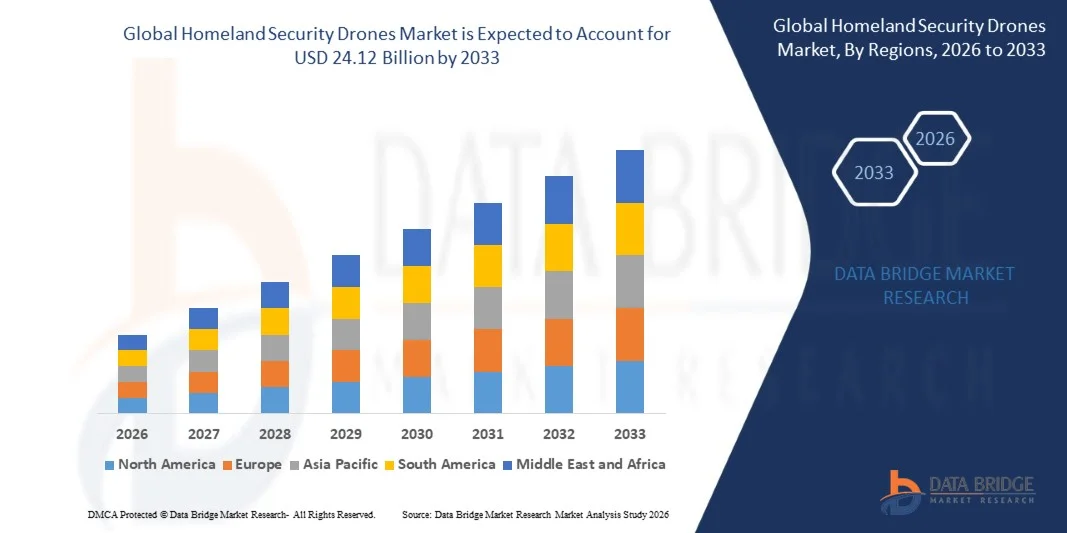
- As per Data Bridge Market Research analysis, the homeland security drones market was valued at USD 8.70 billion in 2025 and is projected to reach USD 24.12 billion by 2033, growing at a CAGR of 13.6% from 2026 to 2033.
- The market is experiencing consistent growth as border agencies, law enforcement bodies, and emergency services adopt unmanned aerial systems (UAS) for surveillance, critical infrastructure protection, disaster response, and public-safety missions, supported by advances in artificial intelligence, autonomous navigation, and high-resolution imaging.
- Rising cross-border threats, tighter national-security priorities, and larger government and defense budgets are pushing agencies toward real-time aerial monitoring. Platforms that combine thermal imaging, sensors, and AI-based analytics are helping organizations improve surveillance efficiency, lower risk to personnel, and respond faster during emergencies.
Market Size & Forecast
- Global Market Value (2025): USD 8.70 Billion
- Expected Market Value (2033): USD 24.12 Billion
- Forecast CAGR (2026–2033): 13.6%
- Leading Region in 2025: North America
- Fastest Growing Region: Asia Pacific
What are the Major Takeaways of the Homeland Security Drones Market?
- North America dominated the homeland security drones market with the largest revenue share of 38.2% in 2025, supported by heavy government spending on border security, advanced surveillance infrastructure, and widespread use of unmanned aerial systems by law enforcement and defense agencies.
- Asia-Pacific is expected to be the fastest-growing region at a CAGR of 15.9% from 2026 to 2033, fueled by rising security concerns, defense modernization programs, expanding border surveillance needs, and growing investment in drone-based monitoring across China, India, and other emerging economies.
- The fixed wing drones segment led the market with a 41.6% share in 2025, driven by long endurance, wide area coverage, and the ability to run persistent surveillance over borders, coastlines, and critical infrastructure.
- Hybrid VTOL drones are the fastest-growing drone type, projected to register a CAGR of 17.2%, reflecting rising demand for platforms that pair vertical takeoff and landing with long-range flight performance.
- The electro optical cameras segment dominated the payload category with a 39.8% revenue share in 2025, led by wide adoption of high-resolution imaging for aerial surveillance, reconnaissance, and monitoring.
- Remotely piloted drones accounted for 46.3% of the technology category in 2025, preferred for their proven operational record, reliability, and broad deployment by government and security agencies.
- The secure encrypted communication segment is the fastest-growing communication system category, with a CAGR of 16.4%, driven by concerns over cyber threats, unauthorized access, and data-security gaps in drone operations.
Report Scope and Homeland Security Drones Market Segmentation
|
Attributes |
Homeland Security Drones Key Market Insights |
|
Segments Covered |
|
|
Countries Covered |
North America
Europe
Asia-Pacific
Middle East and Africa
South America
|
|
Key Market Players |
|
|
Market Opportunities |
|
|
Value Added Data Infosets |
In addition to the market insights such as market value, growth rate, market segments, geographical coverage, market players, and market scenario, the market report curated by the Data Bridge Market Research team includes in-depth expert analysis, import/export analysis, pricing analysis, production consumption analysis, and pestle analysis. |
What is the Key Trend in the Homeland Security Drones Market?
- Homeland security agencies are increasingly adopting AI-enabled drones that combine advanced sensors, autonomous navigation, and real-time analytics to strengthen border surveillance, threat detection, and situational awareness.
- For instance, in April 2024, according to U.S. Customs and Border Protection (CBP), small unmanned aircraft systems (UAS) continued to support Border Patrol operations with aerial reconnaissance, surveillance, and tracking, improving situational awareness across challenging border terrain.
- Payload integration, including thermal imaging, electro-optical cameras, LiDAR, and AI-based analytics, is allowing drones to carry out intelligence, surveillance, and reconnaissance (ISR) missions with greater accuracy.
- Law enforcement agencies and emergency responders are using drone-based solutions for disaster monitoring, public safety operations, and rapid incident response with continuous aerial visibility.
- For instance, in March 2024, according to the U.S. Department of Homeland Security (DHS) Science and Technology Directorate’s National Urban Security Technology Laboratory (NUSTL), new guidance was released to help public safety agencies adopt small UAS for search and rescue, situational awareness, and post-incident damage assessment.
- As governments continue to prioritize automated surveillance, national-security modernization, and cost-efficient intelligence gathering, adoption of advanced homeland security drones is expected to accelerate, making them a core tool for border protection and emergency response.
What are the Key Drivers of the Homeland Security Drones Market?
- Growing needs in border security, counterterrorism, and critical infrastructure protection have significantly increased demand for drones that deliver persistent aerial surveillance and real-time intelligence.
- For instance, in April 2025, according to the U.S. House Homeland Security Committee, UAS play a critical role in border security, drug interdiction, disaster mitigation, and emergency response by improving real-time situational awareness for homeland security missions.
- Governments, defense agencies, and law enforcement bodies are integrating drone technologies to raise operational efficiency, reduce human risk, and strengthen response capability during security missions.
- For instance, in April 2025, according to the House Homeland Security Committee, increased investment in border surveillance technologies, including UAS, was proposed to extend the operational reach of CBP agents and improve monitoring along U.S. borders.
- With geopolitical tensions rising and investment in autonomous surveillance platforms growing, homeland security drones will remain essential to national defense, border management, and public safety.
What Factors Are Challenging the Growth of the Homeland Security Drones Market?
- Advanced homeland security drones need substantial investment because they integrate autonomous systems, high-resolution sensors, satellite communication, cybersecurity, and data-processing technologies.
- These costs limit adoption among smaller law enforcement agencies, regional security organizations, and developing countries with constrained defense and security budgets.
- For instance, in March 2024, according to the U.S. Government Accountability Office (GAO), unauthorized drone flights near airports and critical locations raise safety and security concerns, while gaps in detection, mitigation capability, and legal authority continue to complicate effective drone management.
- Regulatory restrictions, airspace-management challenges, privacy concerns, and cybersecurity vulnerabilities can also slow deployment in several regions.
- For instance, in June 2024, according to the GAO, drone integration remains difficult, with limited support for law enforcement in using Remote Identification technology and continuing difficulty in managing unauthorized drone activity in national airspace.
- High deployment costs, regulatory complexity, and cybersecurity concerns continue to restrict wider adoption, particularly among smaller organizations and emerging markets.
How is the Homeland Security Drones Market Segmented?
The homeland security drones market is segmented on the basis of drone type, payload, technology, communication system, range, application, and distribution channel.
- By Drone Type
On the basis of drone type, the homeland security drones market is segmented into fixed wing drones, rotary wing drones, multirotor drones, hybrid VTOL drones, and tethered drones. The fixed wing drones segment dominated the market with 41.6% share in 2025, owing to long endurance, large coverage area, and suitability for persistent surveillance across borders, coastlines, and critical infrastructure. Agencies deploy them widely for ISR because they can stay airborne for extended periods at high flight efficiency. They are increasingly paired with electro-optical cameras, infrared sensors, and radar to improve threat detection. Border security modernization programs are further strengthening adoption.
The hybrid VTOL drones segment is projected to register the fastest growth at a CAGR of 17.2% from 2026 to 2033, driven by demand for platforms that combine vertical takeoff and landing with long-range flight. They overcome the operating limits of conventional fixed wing and rotary wing aircraft by working in confined or complex locations without a runway. Border security, disaster response, and infrastructure inspection are key use cases. Progress in autonomous flight control and battery technology is improving endurance and reliability. Growing preference for multi-mission unmanned platforms is expected to accelerate the segment.
- By Payload
On the basis of payload, the homeland security drones market is segmented into electro optical cameras, infrared imaging systems, multi sensor payloads, radar payloads, loudspeaker systems, searchlight systems, and payload release systems. The electro optical cameras segment dominated the market with 39.8% share in 2025, supported by broad use of high-resolution imaging for surveillance, reconnaissance, and monitoring. These payloads give security agencies real-time visual intelligence to identify, track, and assess threats. Better resolution, zoom, and stabilization are lifting operational effectiveness, while AI analytics enable automated object detection. Lower cost and compatibility with many drone platforms sustain the segment’s lead.
The multi sensor payloads segment is expected to witness the fastest growth at a CAGR of 16.1% from 2026 to 2033, driven by demand for integrated systems that gather several data types in one flight. Combining electro-optical, infrared, and radar sensing gives complete situational awareness in varied weather and visibility conditions. Agencies value sensor fusion for complex missions because it can reduce the number of drones needed per operation. Rising use in border surveillance, counterterrorism, and emergency response is expected to support strong growth.
- By Technology
On the basis of technology, the homeland security drones market is segmented into autonomous drones, remotely piloted drones, artificial intelligence enabled drones, swarm drone systems, edge computing drones, and cloud connected drones. The remotely piloted drones segment dominated the market with 46.3% share in 2025, owing to established operational use, reliability, and broad deployment across government and security agencies. Trained operators keep direct control in sensitive environments where human judgment remains essential. Existing regulatory frameworks and operator training programs have supported large-scale use. Continued upgrades in communications and payloads keep these systems effective.
The artificial intelligence enabled drones segment is projected to be the fastest-growing technology segment at a CAGR of 18.4% from 2026 to 2033, driven by demand for autonomous threat detection, predictive analytics, and real-time decision support. These drones can process large volumes of surveillance data and flag unusual activity, easing operator workload. Machine learning is improving object recognition, navigation accuracy, and mission efficiency. Edge computing allows faster on-board processing without full reliance on external networks. Growing investment in autonomous security technologies is expected to accelerate adoption.
- By Communication System
On the basis of communication system, the homeland security drones market is segmented into radio frequency communication, satellite communication, cellular communication, mesh networking, secure encrypted communication, and multi link communication. The radio frequency communication segment dominated the market with 43.7% share in 2025, owing to wide adoption, reliability, and established infrastructure in homeland security and law enforcement operations. RF links enable real-time command and control for short-to-medium range surveillance and emergency missions. Compatibility with existing UAS platforms and lower deployment cost support continued use. Better frequency management and interference mitigation are improving operational reliability.
The secure encrypted communication segment is projected to register the fastest growth at a CAGR of 16.4% from 2026 to 2033, driven by cyber threats, unauthorized access, and data-security vulnerabilities in drone operations. Agencies are prioritizing encrypted links to protect sensitive surveillance and mission data from interception, jamming, and cyberattacks. The spread of autonomous and AI-enabled drones is raising the need for secure data transmission. Investment in resilient communication architectures for high-risk environments is expected to accelerate adoption.
- By Range
On the basis of range, the homeland security drones market is segmented into very short range, short range, medium range, long range, and extended range. The long range drones segment dominated the market with 36.9% share in 2025, supported by demand for wide-area surveillance, border monitoring, and maritime security. These systems let agencies cover large regions with fewer ground resources. They can carry advanced payloads and maintain links over long distances, making them suited to persistent ISR. National security modernization spending continues to support the segment.
The extended range drones segment is expected to witness the fastest growth at a CAGR of 15.8% from 2026 to 2033, driven by demand for continuous surveillance over remote and high-risk areas. Greater endurance and flexibility suit maritime security, border control, and large-scale infrastructure protection. Progress in satellite communication, autonomous navigation, and energy-efficient propulsion is improving performance. Rising geopolitical tension and the need for persistent coverage are expected to accelerate adoption.
- By Application
On the basis of application, the homeland security drones market is segmented into border security, critical infrastructure protection, public safety, law enforcement, counter terrorism, search and rescue, and hazardous material monitoring. The border security segment dominated the market with 33.5% share in 2025, driven by cross-border threats, illegal activity, and the need for continuous aerial surveillance. Drones with advanced imaging and AI analytics give security personnel real-time intelligence across remote and difficult terrain. They reduce risk by limiting human exposure in high-threat areas. Government investment in border modernization programs is a major support.
The search and rescue segment is projected to be the fastest-growing application at a CAGR of 15.4% from 2026 to 2033, supported by growing use of drones for disaster response, emergency management, and humanitarian operations. Drones provide rapid aerial assessment after natural disasters, accidents, and large-scale emergencies. Thermal cameras, AI-based detection, and autonomous flight are improving rescue efficiency. Responders use them to locate missing people and assess hazardous areas that rescue teams cannot easily reach. More frequent climate-related disasters are expected to drive demand.
- By Distribution Channel
On the basis of distribution channel, the homeland security drones market is segmented into direct sales, channel partner sales, project-based procurement, and online sales. The project-based procurement segment dominated the market with 52.1% share in 2025, owing to large acquisitions by government, defense, and homeland security bodies. Such programs usually involve customized platforms, integrated payloads, communication systems, and long-term maintenance agreements. They also require testing, deployment support, and training, which favors contract-based buying. Rising government spending on surveillance infrastructure strengthens the segment.
The channel partner sales segment is expected to witness the fastest growth at a CAGR of 14.9% from 2026 to 2033, driven by demand from regional security organizations, law enforcement agencies, and commercial operators. Partners extend manufacturers’ reach with local technical support, installation, and maintenance. Smaller agencies that need cost-effective procurement options are a key source of growth. Faster deployment and better after-sales support are expected to push the channel further.
Which Region Holds the Largest Share of the Homeland Security Drones Market?
- North America dominated the homeland security drones market with the largest revenue share of 38.2% in 2025, supported by significant government spending on border security, advanced surveillance infrastructure, and widespread use of unmanned aerial systems by law enforcement and defense agencies.
- The region also benefits from extensive adoption of AI-enabled drones, advanced sensor payloads, and secure communication systems across border security, law enforcement, and critical infrastructure protection. National security modernization, autonomous surveillance, and real-time intelligence gathering continue to reinforce North America’s leadership.
U.S. Homeland Security Drones Market Insight
The U.S. homeland security drones market is witnessing strong growth due to increasing investment in border surveillance, law enforcement modernization, and advanced UAS capability. The country’s extensive homeland security infrastructure, strong defense ecosystem, and rising adoption of AI-enabled drones and autonomous surveillance platforms are driving demand across border security, critical infrastructure protection, and emergency response. In addition, CBP Air and Marine Operations operates MQ-9 Predator B unmanned aircraft systems to provide long-endurance ISR support for border security missions.
Asia-Pacific Homeland Security Drones Market Insight
The Asia-Pacific homeland security drones market is expected to witness rapid growth, driven by border security requirements, defense modernization programs, and growing adoption of unmanned aerial systems in China, India, Japan, and South Korea. Concerns over territorial security, maritime surveillance, and critical infrastructure protection support regional expansion. In addition, investment in indigenous drone manufacturing is accelerating adoption across government, defense, and public safety sectors. India’s Ministry of Defence has approved procurement initiatives for advanced unmanned systems to strengthen surveillance and reconnaissance for security operations.
Japan Homeland Security Drones Market Insight
The Japan homeland security drones market is witnessing consistent growth due to rising investment in disaster management, infrastructure monitoring, and advanced surveillance technologies. Government agencies and security organizations are increasingly using drones for emergency response, search and rescue, coastal monitoring, and public safety. Moreover, Japan’s focus on autonomous technologies, robotics, and disaster preparedness supports market growth. The Ministry of Land, Infrastructure, Transport and Tourism (MLIT) has promoted drone use for disaster response, infrastructure inspection, and emergency assessment.
China Homeland Security Drones Market Insight
The China homeland security drones market is growing rapidly, driven by investment in public security infrastructure, border monitoring, and AI-enabled surveillance. The country’s large drone manufacturing ecosystem and strong government backing for unmanned technologies boost demand. Growing deployment in law enforcement, emergency response, and urban security monitoring adds momentum. Public security agencies have expanded UAS use for patrol, emergency response, and large-event security; for example, the Xiamen Public Security Bureau uses police UAVs with high-magnification cameras and voice systems for aerial patrol, traffic monitoring, and public safety management.
U.K. Homeland Security Drones Market Insight
The U.K. homeland security drones market is experiencing steady growth, supported by adoption of drones for law enforcement, emergency response, border monitoring, and critical infrastructure protection. Rising investment in counter-drone technologies, secure communication systems, and advanced surveillance platforms contributes to development. Furthermore, AI, autonomous flight, and improved imaging are raising operational efficiency across security applications. The Civil Aviation Authority (CAA) continues to develop regulatory frameworks, safety requirements, and guidance for UAS operations to support safe adoption.
Germany Homeland Security Drones Market Insight
The Germany homeland security drones market is expanding steadily due to demand for advanced surveillance, border protection technologies, and emergency response systems. Government agencies, infrastructure operators, and security organizations use drones for monitoring, inspection, and situational awareness. Continuous advances in autonomous systems, sensors, and secure communication platforms further drive growth. The Federal Police (Bundespolizei) has used drones for surveillance and operational support, including monitoring hard-to-reach areas.
Which are the Top Companies in Homeland Security Drones Market?
The homeland security drones industry is primarily led by well-established companies, including:
- Teledyne Technologies Incorporated (U.S.)
- Leonardo S.p.A. (Italy)
- AIRBUS (Netherlands)
- Thales (France)
- Draganfly Innovations Inc. (Canada)
- Saab AB (Sweden)
- Rheinmetall AG (Germany)
- EDGE Group PJSC (U.A.E.)
- SZ DJI Technology Co., Ltd. (China)
- Guangzhou EHang Intelligent Technology Co. Ltd (China)
- Skydio, Inc. (U.S.)
- Quantum Systems GmbH (Germany)
- DELAIR SAS (France)
- Elbit Systems Ltd. (Israel)
- Flyability SA (Switzerland)
- Wingtra AG (Switzerland)
- ideaForge Technology Limited (India)
- Israel Aerospace Industries Ltd. (Israel)
- Performance Drone Works Inc. (U.S.)
- BRINC Drones Inc. (U.S.)
What are Latest Developments in Homeland Security Drones Market?
- In February 2025, DJI announced the launch of DJI Dock 3, a “drone-in-a-box” enterprise solution for 24/7 remote operations in public safety, emergency response, and infrastructure monitoring. It integrates with the Matrice 4D and Matrice 4TD enterprise drones for automated deployment and remote operation, supporting wider use of autonomous drone platforms in homeland security applications.
- In January 2025, DJI introduced the Matrice 4 Series enterprise drones, including the Matrice 4T and Matrice 4E, with AI-powered detection, multi-sensor payloads, and a laser range finder. The platforms target public safety, search and rescue, inspection, and security missions needing real-time aerial intelligence, reflecting growing integration of AI and advanced sensors.
- In October 2024, Teledyne FLIR Defense unveiled the Cerberus XL C-UAS mobile counter-drone system at the Association of the U.S. Army (AUSA) Annual Meeting. The system integrates long-range 3D radar, thermal and visual imaging, and radio-frequency detection to detect and defeat drone threats to military facilities, critical infrastructure, and homeland security operations.
- In May 2024, Teledyne FLIR Defense introduced the Rogue 1 loitering munition system, a vertical takeoff and landing small UAS with modular payload options and autonomous flight capability for rapidly deployable intelligence and precision missions, highlighting growing use of VTOL platforms in tactical operations.
- In September 2023, Skydio launched the Skydio X10 autonomous drone for first responders, infrastructure operators, and government security organizations. It combines AI-powered autonomy, advanced navigation, and high-performance imaging for emergency response, public safety, and national security missions.

- Interactive Data Analysis Dashboard
- Company Analysis Dashboard for high growth potential opportunities
- Research Analyst Access for customization & queries
- Competitor Analysis with Interactive dashboard
- Latest News, Updates & Trend analysis
- Harness the Power of Benchmark Analysis for Comprehensive Competitor Tracking
Data collection and base year analysis are done using data collection modules with large sample sizes. The stage includes obtaining market information or related data through various sources and strategies. It includes examining and planning all the data acquired from the past in advance. It likewise envelops the examination of information inconsistencies seen across different information sources. The market data is analysed and estimated using market statistical and coherent models. Also, market share analysis and key trend analysis are the major success factors in the market report. To know more, please request an analyst call or drop down your inquiry.
The key research methodology used by DBMR research team is data triangulation which involves data mining, analysis of the impact of data variables on the market and primary (industry expert) validation. Data models include Vendor Positioning Grid, Market Time Line Analysis, Market Overview and Guide, Company Positioning Grid, Patent Analysis, Pricing Analysis, Company Market Share Analysis, Standards of Measurement, Global versus Regional and Vendor Share Analysis. To know more about the research methodology, drop in an inquiry to speak to our industry experts.
Data Bridge Market Research is a leader in advanced formative research. We take pride in servicing our existing and new customers with data and analysis that match and suits their goal. The report can be customized to include price trend analysis of target brands understanding the market for additional countries (ask for the list of countries), clinical trial results data, literature review, refurbished market and product base analysis. Market analysis of target competitors can be analyzed from technology-based analysis to market portfolio strategies. We can add as many competitors that you require data about in the format and data style you are looking for. Our team of analysts can also provide you data in crude raw excel files pivot tables (Fact book) or can assist you in creating presentations from the data sets available in the report.












