


What is the Homeland Security Market Size and Growth Rate?
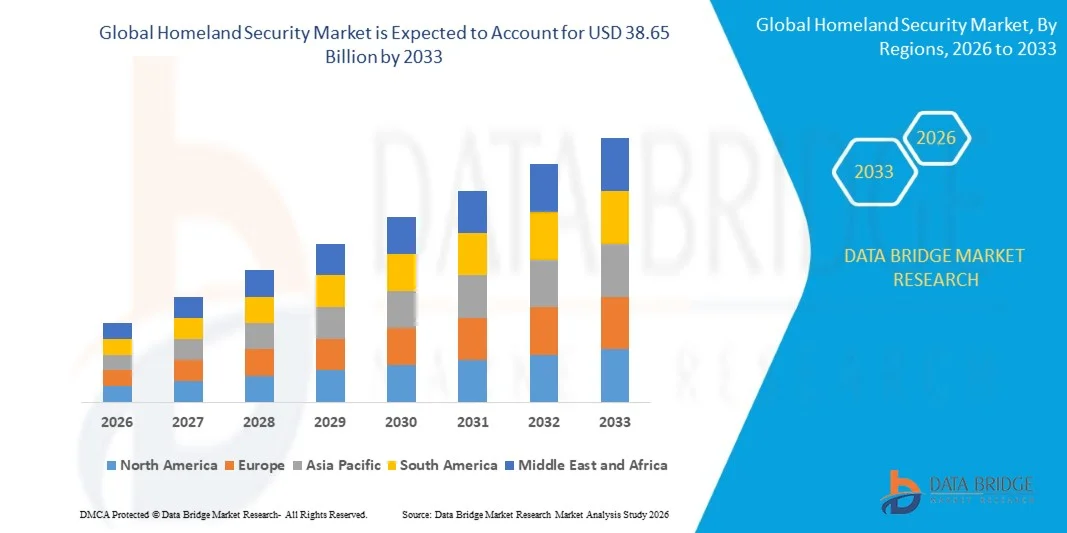
As per Data Bridge Market Research Analysis the Homeland Security Market was valued at USD 24.62 Billion in 2025 and is projected to reach USD 38.65 Billion by 2033, growing at a CAGR of 5.80% from 2026 to 2033. The market is experiencing consistent growth driven by rising geopolitical tensions, increasing terrorist threats, and growing investments in advanced surveillance, cybersecurity, and border protection systems. Expanding adoption of AI-enabled intelligence platforms, integrated command and control systems, and real-time threat detection technologies is further strengthening market growth across developed and emerging economies.
The increasing global focus on national security modernization, combined with rising cyber warfare risks and rapid digital transformation of critical infrastructure, is significantly accelerating demand for advanced homeland security solutions. Governments are increasingly deploying integrated security architectures across transportation networks, energy grids, and public safety systems to enhance resilience and response capabilities. Continuous technological advancements in AI, biometrics, drones, and data analytics are further enabling more proactive and predictive security operations across global security ecosystems.
Key Market Trends & Insights
- North America dominated the Homeland Security Market with the largest revenue share of 30.9% in 2025, supported by advanced security infrastructure, high defense spending, and early adoption of AI-enabled surveillance and threat detection systems
- The critical infrastructure security segment led the market with a 38.2% share in 2025, driven by rising threats to energy grids, transportation networks, and communication systems across major economies
- Asia-Pacific is expected to be the fastest-growing region at a CAGR of 9.7% from 2026 to 2033, fueled by rapid urbanization, rising terrorism threats, and increasing government investments in advanced security infrastructure
- Detection and monitoring system are the fastest-growing system type, projected to register a CAGR of 15.2% from 2026 to 2033, supported by rising demand for early threat identification across airports, seaports, and public spaces
- The intelligence and surveillance system segment dominated the system category with a 34.7% revenue share in 2025, led by extensive deployment of satellite surveillance, drones, and AI-enabled monitoring networks
- Public sector accounted for 32.4% of the market in 2025, preferred by strong government spending on national defense, border protection, and counterterrorism initiatives
- The cyber security segment is the fastest-growing type category, with a CAGR of 14.6% from 2026 to 2033, driven by increasing frequency of cyberattacks targeting government databases and critical infrastructure networks
Market Size & Forecast
- Global Market Value (2025): USD 24.62 Billion
- Expected Market Value (2033): USD 38.65 Billion
- Forecast CAGR (2026–2033): 5.80%
- Leading Region in 2025: North America
- Fastest Growing Region: Asia-Pacific
Report Scope and Homeland Security Market Segmentation
|
Attributes |
Homeland Security Key Market Insights |
|
Segments Covered |
|
|
Countries Covered |
North America · U.S. · Canada · Mexico Europe · Germany · France · U.K. · Netherlands · Switzerland · Belgium · Russia · Italy · Spain · Turkey · Rest of Europe Asia-Pacific · China · Japan · India · South Korea · Singapore · Malaysia · Australia · Thailand · Indonesia · Philippines · Rest of Asia-Pacific Middle East and Africa · Saudi Arabia · U.A.E. · South Africa · Egypt · Israel · Rest of Middle East and Africa South America · Brazil · Argentina · Rest of South America |
|
Key Market Players |
· Lockheed Martin Corporation (U.S.) · Raytheon Company (U.S.) · Northrop Grumman Corporation (U.S.) · Thales Group (France) · IBM Corporation (U.S.) · FLIR Systems, Inc. (U.S.) · BAE Systems (U.K.) · General Dynamics Information Technology, Inc. (U.S.) · Unisys Corporation (U.S.) · Elbit Systems Ltd. (Israel) · Science Applications International Corporation (SAIC) (U.S.) · Harris Corporation (U.S.) · The Boeing Company (U.S.) · Leidos Holdings, Inc. (U.S.) · CACI International Inc (U.S.) · Ernst & Young Global Limited (U.K.) · Accenture plc (Ireland) · Atos SE (France) · Deloitte Touche Tohmatsu Limited (U.K.) · KPMG International Cooperative (Netherlands) · PricewaterhouseCoopers (PwC) (U.K.) · Booz Allen Hamilton Holding Corporation (U.S.) · Honeywell International Inc. (U.S.) |
|
Market Opportunities |
· Smart City Security Expansion · Critical Infrastructure Cybersecurity Demand · Drone and Counter UAS Deployment Growth |
|
Value Added Data Infosets |
In addition to the insights on market scenarios such as market value, growth rate, segmentation, geographical coverage, and major players, the market reports curated by the Data Bridge Market Research also include in-depth expert analysis, geographically represented company-wise production and capacity, network layouts of distributors and partners, detailed and updated price trend analysis and deficit analysis of supply chain and demand. |
What is the Key Trend in the Homeland Security Market?
Trend: AI Driven Surveillance Adoption in Homeland Security
Homeland security agencies are increasingly deploying AI-enabled surveillance systems to enhance real-time threat detection, predictive intelligence, and situational awareness across critical infrastructure and public spaces. Advanced technologies such as facial recognition, automated video analytics, and drone-based monitoring are being widely integrated into national security frameworks to improve response efficiency. Countries are also investing in centralized intelligence platforms to unify data from multiple surveillance networks for faster decision-making.
Organizations such as the U.S. Department of Homeland Security (DHS) and technology providers such as IBM Corporation and Palantir Technologies are actively supporting AI-powered security platforms to strengthen threat identification and response capabilities across airports, borders, and urban security systems.
Homeland Security Market Dynamics
Key Market Driver: Rising Geopolitical Tensions and Security Spending
Increasing geopolitical conflicts, cross-border terrorism threats, and internal security challenges are significantly driving investments in homeland security systems worldwide. Governments are expanding budgets for cybersecurity, border protection, and critical infrastructure defense to strengthen national resilience against evolving threats. The growing need for rapid threat detection and coordinated emergency response is accelerating adoption of advanced surveillance, intelligence, and defense technologies.
For instance, the U.S. Department of Defense (DoD) allocated over USD 842 billion in its FY2024 defense budget, with significant spending directed toward intelligence modernization, cybersecurity infrastructure, and integrated command systems to enhance national security readiness.
Key Restraint/Challenge: High Cost and Legacy System Integration Issues
The high cost of deploying advanced homeland security systems and integrating them with outdated legacy infrastructure remains a major challenge for governments and agencies. Modern technologies such as AI surveillance, biometric systems, and integrated command platforms require significant capital investment, skilled workforce, and continuous system upgrades. Interoperability issues between legacy security systems and new digital platforms further slow down large-scale deployment.
For instance, modernization programs within legacy transportation and border security systems managed under the U.S. Transportation Security Administration (TSA) highlight the complexity and cost burden associated with upgrading older screening and monitoring infrastructure to next-generation digital security systems.
Key Market Opportunity: Drone and Counter UAS Deployment Growth
The increasing use of drones for surveillance, reconnaissance, and border monitoring is creating strong demand for counter-unmanned aerial systems (C-UAS) in homeland security applications. Security agencies are deploying advanced detection, tracking, and neutralization technologies to mitigate risks posed by unauthorized drone activity near airports, military bases, and critical infrastructure. Integration of radar systems, RF detection, and AI-based tracking is improving response accuracy and operational safety.
For instance, the U.S. Department of Defense and companies such as Raytheon Technologies and Lockheed Martin are actively developing and deploying counter-drone solutions, including advanced radar and electronic warfare systems, to protect sensitive airspace and strengthen national defense capabilities.
How is the Homeland Security Market Segmented?
The homeland security market is segmented on the basis of type, system, and end user.
- By Type
On the basis of type, the Homeland Security Market is segmented into cyber security, aviation security, maritime security, law enforcement and intelligence gathering, critical infrastructure security, risk and emergency services, border security, and chemical, biological, radiological, nuclear, and explosives security. The Critical Infrastructure Security segment dominated the market with the largest share of 38.2% in 2025, driven by rising threats to energy grids, transportation networks, and communication systems across major economies. Governments are increasingly investing in advanced monitoring and protection frameworks to safeguard essential national assets. Integration of AI-driven surveillance and real-time threat detection systems strengthens its deployment across high-risk zones. Expanding public-private security partnerships further reinforces its leadership position in the market.
The Cyber Security segment is projected to register the fastest growth at a CAGR of 14.6% from 2026 to 2033, driven by increasing frequency of cyberattacks targeting government databases and critical infrastructure networks. Rapid digitalization of defense systems and cloud-based security architectures is accelerating demand for advanced encryption and threat intelligence solutions. Rising adoption of zero-trust security frameworks across defense agencies is improving resilience against sophisticated cyber threats. Continuous expansion of connected devices across national security ecosystems is further increasing vulnerability exposure, thereby boosting segment growth.
- By System
On the basis of system, the Homeland Security Market is segmented into intelligence and surveillance systems, detection and monitoring systems, access control systems, platforms, rescue and recovery systems, command and control systems, and countermeasure systems. The Intelligence and Surveillance Systems segment dominated the market with a share of 34.7% in 2025, supported by extensive deployment of satellite surveillance, drones, and AI-enabled monitoring networks. Governments are prioritizing real-time situational awareness to prevent terrorism and cross-border threats. Integration of advanced analytics and facial recognition technologies is enhancing operational efficiency across security agencies. Increasing modernization of national defense infrastructure further strengthens segment dominance.
The Detection and Monitoring Systems segment is projected to register the fastest growth at a CAGR of 15.2% from 2026 to 2033, driven by rising demand for early threat identification across airports, seaports, and public spaces. Deployment of advanced sensor technologies, biometric scanners, and automated screening systems is improving accuracy and response time. Increasing focus on preventive security strategies is accelerating adoption across urban security infrastructure. Growing investments in smart city initiatives and perimeter protection systems are further supporting segment expansion.
- By End User
On the basis of end user, the Homeland Security Market is segmented into public sector and private sector. The Public Sector segment dominated the market with a share of 32.4% in 2025, driven by strong government spending on national defense, border protection, and counterterrorism initiatives. Large-scale deployment of surveillance infrastructure and emergency response systems is primarily funded by federal and regional authorities. Rising geopolitical tensions and internal security threats are further strengthening public sector investments. Continuous modernization of defense agencies and law enforcement bodies reinforces its dominant position in the market.
The Private Sector segment is projected to register the fastest growth at a CAGR of 13.8% from 2026 to 2033, driven by increasing adoption of advanced security solutions across airports, corporate facilities, energy plants, and financial institutions. Rising awareness of physical and cyber threats is pushing private organizations to invest in integrated security systems. Expansion of critical infrastructure under private ownership is further accelerating demand for advanced monitoring and access control solutions. Growing collaboration between private firms and government agencies is enhancing overall security ecosystem integration.
Which Region Holds the Largest Share of the Homeland Security Market?
North America dominated the homeland security market and accounted for the largest revenue share of 30.9% in 2025, driven by advanced security infrastructure, high defense spending, and early adoption of AI-enabled surveillance and threat detection systems. The region benefits from strong integration of cyber-physical security frameworks across critical infrastructure, transportation networks, and border protection systems. Government agencies and private contractors are increasingly investing in real-time intelligence, drone surveillance, and biometric identification technologies to enhance national security readiness. In addition, the presence of leading defense and security technology providers continues to reinforce North America’s dominant position in the global market.
U.S. Homeland Security Market Insight
The U.S. Homeland Security market is witnessing strong growth driven by rising investments in counterterrorism systems, cybersecurity modernization, and advanced border surveillance technologies. Federal agencies are increasingly adopting AI-powered intelligence platforms, predictive analytics, and cloud-based command and control systems to strengthen threat response capabilities. The country’s large defense budget and continuous modernization of agencies such as DHS and FEMA are accelerating large-scale deployment of integrated security solutions. In addition, growing focus on protecting critical infrastructure such as energy grids, airports, and communication networks is further boosting market expansion across the U.S.
Canada Homeland Security Market Insight
The Canada Homeland Security market is experiencing steady growth supported by increasing investments in border security management, cybersecurity infrastructure, and emergency response systems. Government agencies are adopting advanced surveillance technologies, data-driven intelligence systems, and automated detection solutions to strengthen national safety frameworks. Rising concerns related to cyber threats targeting public services and critical infrastructure are further driving adoption of digital security solutions. In addition, expanding cooperation with international security organizations and increased funding for disaster response systems are contributing to market growth in Canada.
Europe Homeland Security Market Insight
The Europe Homeland Security market is expanding steadily due to rising geopolitical tensions, increasing terrorism threats, and strong regulatory focus on public safety and critical infrastructure protection. Countries across the region are heavily investing in integrated surveillance systems, border control technologies, and cyber defense frameworks to strengthen national security capabilities. The adoption of AI-enabled monitoring systems and cross-border intelligence sharing platforms is improving operational efficiency across security agencies. In addition, modernization of public safety infrastructure and increased funding for emergency response systems continue to support regional market growth.
U.K. Homeland Security Market Insight
The U.K. Homeland Security market is growing steadily driven by strong emphasis on counterterrorism operations, cybersecurity resilience, and advanced public surveillance systems. Government agencies are increasingly deploying facial recognition technologies, AI-based threat detection platforms, and integrated command and control systems to improve national security effectiveness. The country’s mature digital infrastructure and strong intelligence capabilities are supporting rapid adoption of advanced security technologies. In addition, rising investments in protecting transport hubs, financial centers, and public venues are further strengthening market expansion in the U.K.
Germany Homeland Security Market Insight
The Germany Homeland Security market is expanding due to increasing investments in critical infrastructure protection, border security modernization, and cybersecurity frameworks. Strong regulatory compliance requirements and data protection standards are driving adoption of secure and advanced surveillance systems. Enterprises and government agencies are increasingly integrating AI-driven analytics, smart monitoring systems, and automated detection technologies to improve threat response efficiency. In addition, rising focus on industrial security across automotive, energy, and manufacturing sectors is further accelerating market development in Germany.
Asia-Pacific Homeland Security Market Insight
The Asia-Pacific Homeland Security market is expected to register the fastest growth with a CAGR of 9.7% from 2026 to 2033, driven by rapid urbanization, rising terrorism threats, and increasing government investments in advanced security infrastructure. Countries such as China, India, Japan, and South Korea are heavily investing in smart surveillance systems, border protection technologies, and cyber defense capabilities. Expanding smart city initiatives and digital transformation of public safety systems are further boosting adoption of integrated security platforms. In addition, growing focus on critical infrastructure protection and disaster management is accelerating regional market expansion.
Japan Homeland Security Market Insight
The Japan Homeland Security market is witnessing steady growth supported by advanced technological infrastructure, strong disaster management systems, and increasing adoption of AI-based surveillance solutions. Government agencies are leveraging robotics, sensor-based monitoring, and predictive analytics to enhance emergency response and public safety efficiency. The country’s high exposure to natural disasters is driving investments in rescue and recovery systems as well as early warning technologies. In addition, rising focus on cybersecurity and protection of critical infrastructure is further strengthening market demand in Japan.
China Homeland Security Market Insight
The China Homeland Security market is growing rapidly due to large-scale deployment of smart surveillance networks, strong government investments in public safety infrastructure, and increasing adoption of AI-powered security systems. The country is extensively using facial recognition, big data analytics, and integrated command platforms to enhance national security monitoring and threat detection. Rapid urban expansion and smart city development initiatives are further accelerating demand for advanced homeland security solutions. In addition, increasing focus on cyber defense and border security modernization is driving sustained market growth in China.
Homeland Security Market Share
The homeland security industry is primarily led by well-established companies, including:
- Lockheed Martin Corporation (U.S.)
- Raytheon Company (U.S.)
- Northrop Grumman Corporation (U.S.)
- Thales Group (France)
- IBM Corporation (U.S.)
- FLIR Systems, Inc. (U.S.)
- BAE Systems (U.K.)
- General Dynamics Information Technology, Inc. (U.S.)
- Unisys Corporation (U.S.)
- Elbit Systems Ltd. (Israel)
- Science Applications International Corporation (SAIC) (U.S.)
- Harris Corporation (U.S.)
- The Boeing Company (U.S.)
- Leidos Holdings, Inc. (U.S.)
- CACI International Inc (U.S.)
- Ernst & Young Global Limited (U.K.)
- Accenture plc (Ireland)
- Atos SE (France)
- Deloitte Touche Tohmatsu Limited (U.K.)
- KPMG International Cooperative (Netherlands)
- PricewaterhouseCoopers (PwC) (U.K.)
- Booz Allen Hamilton Holding Corporation (U.S.)
- Honeywell International Inc. (U.S.)
What are Latest Developments in Homeland Security Market ?
- In April 2023, the U.S.-based defense technology company L3Harris Technologies, Inc. completed testing of its advanced positioning, navigation, and timing (PNT) solution in collaboration with the U.S. Air Force Research Laboratory (AFRL). This development strengthens the Homeland Security and defense technology market by enhancing resilient space-based navigation capabilities critical for military operations. The innovation is designed to mitigate vulnerabilities in traditional GPS systems, improving operational continuity in contested environments. It further accelerates demand for secure PNT solutions as governments prioritize protection against jamming and spoofing threats. The advancement reinforces the broader shift toward space-enabled defense infrastructure for national security resilience
- In April 2023, the U.S. Department of Homeland Security (DHS) introduced the Biennial National Strategy for Transportation Security (NSTS), focusing on modernization of transportation protection frameworks and system interoperability. This initiative impacts the Homeland Security market by promoting an open-architecture approach for Transportation Security Equipment (TSE), enabling better integration and scalability of security technologies. The strategy also introduces One-Stop Security to streamline international travel while maintaining strict threat detection standards. It enhances demand for advanced screening systems, surveillance technologies, and automated security infrastructure across airports and transport hubs. The policy further supports long-term investment in smart, connected transportation security ecosystems
- In March 2023, the U.S. administration released a National Cybersecurity Strategy aimed at strengthening digital ecosystem protection by shifting cybersecurity responsibility toward organizations best equipped to manage risks. This development significantly drives the Homeland Security market by increasing demand for enterprise-grade cybersecurity solutions, threat intelligence platforms, and zero-trust security frameworks. It emphasizes long-term resilience through regulatory alignment and improved risk accountability across public and private sectors. The strategy accelerates adoption of advanced cloud security, identity protection, and AI-driven threat detection systems. It further reinforces cybersecurity as a core pillar of national security infrastructure
- In March 2022, Teledyne FLIR Defense, a subsidiary of Teledyne Technologies Incorporated, launched the Lightweight Vehicle Surveillance System (LVSS) with enhanced air domain awareness (ADA) and counter-unmanned aerial system (C-UAS) capabilities. This innovation strengthens the Homeland Security market by addressing rising threats from drones and unmanned aerial systems in sensitive areas. The system improves real-time detection, tracking, and neutralization of aerial threats, enhancing border security and force protection operations. Its rapid deployment capability and advanced sensor integration support military and law enforcement agencies in dynamic threat environments. The development boosts demand for mobile and scalable surveillance solutions in modern defense operations
- In June 2022, according to a World Bank press release, global digital payment adoption reached two-thirds of the population worldwide, with developing countries increasing from 35% in 2014 to 57% in 2021. This trend impacts the Homeland Security market by expanding the digital ecosystem that requires stronger cybersecurity and financial fraud prevention mechanisms. The rapid growth of digital transactions increases exposure to cyber threats, identity theft, and financial system attacks. It drives governments and security agencies to enhance cyber intelligence, digital authentication, and secure transaction monitoring systems. The development further strengthens the role of cybersecurity within national security and economic stability frameworks

- Interactive Data Analysis Dashboard
- Company Analysis Dashboard for high growth potential opportunities
- Research Analyst Access for customization & queries
- Competitor Analysis with Interactive dashboard
- Latest News, Updates & Trend analysis
- Harness the Power of Benchmark Analysis for Comprehensive Competitor Tracking
Global Homeland Security Market, Supply Chain Analysis and Ecosystem Framework
To support market growth and help clients navigate the impact of geopolitical shifts, DBMR has integrated in-depth supply chain analysis into its Global Homeland Security Market research reports. This addition empowers clients to respond effectively to global changes affecting their industries. The supply chain analysis section includes detailed insights such as Global Homeland Security Market consumption and production by country, price trend analysis, the impact of tariffs and geopolitical developments, and import and export trends by country and HSN code. It also highlights major suppliers with data on production capacity and company profiles, as well as key importers and exporters. In addition to research, DBMR offers specialized supply chain consulting services backed by over a decade of experience, providing solutions like supplier discovery, supplier risk assessment, price trend analysis, impact evaluation of inflation and trade route changes, and comprehensive market trend analysis.
Data collection and base year analysis are done using data collection modules with large sample sizes. The stage includes obtaining market information or related data through various sources and strategies. It includes examining and planning all the data acquired from the past in advance. It likewise envelops the examination of information inconsistencies seen across different information sources. The market data is analysed and estimated using market statistical and coherent models. Also, market share analysis and key trend analysis are the major success factors in the market report. To know more, please request an analyst call or drop down your inquiry.
The key research methodology used by DBMR research team is data triangulation which involves data mining, analysis of the impact of data variables on the market and primary (industry expert) validation. Data models include Vendor Positioning Grid, Market Time Line Analysis, Market Overview and Guide, Company Positioning Grid, Patent Analysis, Pricing Analysis, Company Market Share Analysis, Standards of Measurement, Global versus Regional and Vendor Share Analysis. To know more about the research methodology, drop in an inquiry to speak to our industry experts.
Data Bridge Market Research is a leader in advanced formative research. We take pride in servicing our existing and new customers with data and analysis that match and suits their goal. The report can be customized to include price trend analysis of target brands understanding the market for additional countries (ask for the list of countries), clinical trial results data, literature review, refurbished market and product base analysis. Market analysis of target competitors can be analyzed from technology-based analysis to market portfolio strategies. We can add as many competitors that you require data about in the format and data style you are looking for. Our team of analysts can also provide you data in crude raw excel files pivot tables (Fact book) or can assist you in creating presentations from the data sets available in the report.













