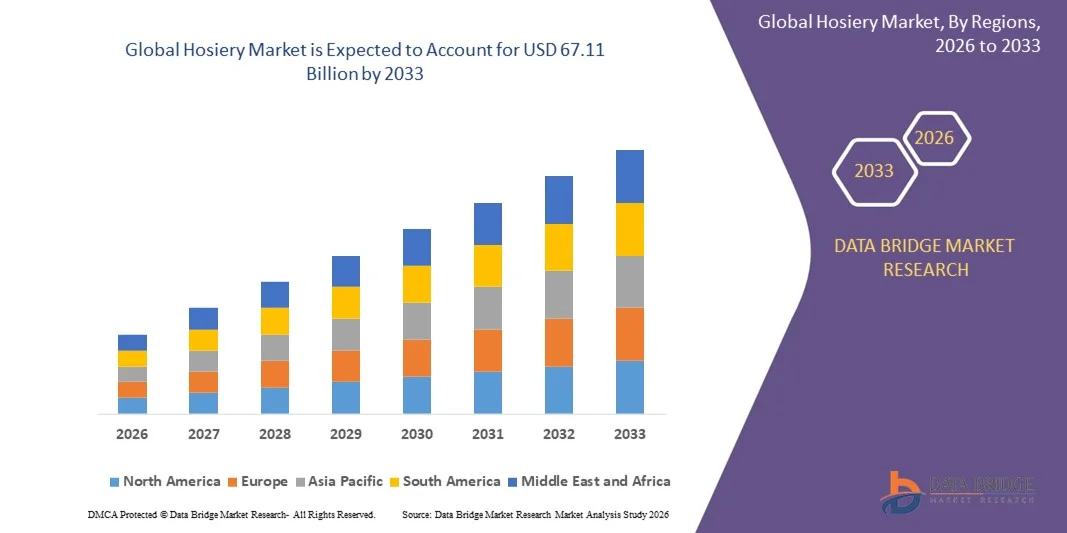
Hosiery Market Size
- The global hosiery market size was valued at USD 43.4 billion in 2025 and is expected to reach USD 67.11 billion by 2033, at a CAGR of 5.60% during the forecast period
- The hosiery market growth is largely driven by rising demand for everyday apparel essentials combined with increasing fashion consciousness among consumers across all age groups
- Furthermore, growing preference for comfort, durability, and design-driven hosiery products, supported by innovation in fabrics and sustainable materials, is strengthening consumer adoption. These factors together are accelerating demand across mass and premium segments, thereby supporting steady market expansion
Hosiery Market Analysis
- Hosiery products, including socks, tights, pantyhose, and body stockings, have become integral components of daily wear, professional attire, and athleisure fashion due to their functional benefits, comfort, and evolving aesthetic appeal
- The increasing demand for hosiery is primarily fueled by rising urban lifestyles, higher disposable incomes, expanding participation of women in the workforce, and growing emphasis on seasonal, performance-based, and sustainable apparel choices
- North America dominated hosiery market with a share of 38.6% in 2025, due to high consumer spending on apparel essentials and strong demand for comfort-focused and fashion-oriented hosiery products
- Asia-Pacific is expected to be the fastest growing region in the hosiery market during the forecast period due to rapid urbanization, rising disposable incomes, and expanding middle-class populations
- Socks segment dominated the market with a market share of 67.46% in 2025, due to their daily utility across casual, formal, and athletic wear categories. High replacement frequency, wide product availability, and continuous innovation in fabric blends and comfort features have supported strong demand. Socks are widely adopted across all age groups and genders, further strengthening their volume sales. Their affordability and presence across mass and premium price tiers also contribute to sustained market leadership
Report Scope and Hosiery Market Segmentation
|
Attributes |
Hosiery Key Market Insights |
|
Segments Covered |
|
|
Countries Covered |
North America
Europe
Asia-Pacific
Middle East and Africa
South America
|
|
Key Market Players |
|
|
Market Opportunities |
|
|
Value Added Data Infosets |
In addition to the insights on market scenarios such as market value, growth rate, segmentation, geographical coverage, and major players, the market reports curated by the Data Bridge Market Research also include in-depth expert analysis, pricing analysis, brand share analysis, consumer survey, demography analysis, supply chain analysis, value chain analysis, raw material/consumables overview, vendor selection criteria, PESTLE Analysis, Porter Analysis, and regulatory framework. |
Hosiery Market Trends
Rising Demand for Sustainable and Eco-Friendly Hosiery
- A major trend shaping the hosiery market is the growing demand for sustainable and eco-friendly products, driven by increasing consumer awareness of environmental impact and ethical fashion practices. Consumers are actively seeking hosiery made from recycled fibers, organic cotton, and low-impact dyes, encouraging brands to shift toward responsible sourcing and production methods
- For instance, companies such as Swedish Stockings and L’eggs are introducing hosiery collections made from recycled materials to align with sustainability goals and attract environmentally conscious consumers. These initiatives are enhancing brand value while supporting reduced environmental footprint across manufacturing processes
- The trend is also supported by rising transparency in supply chains, where consumers expect clear communication regarding material sourcing and recyclability. Brands adopting sustainability certifications and circular fashion models are gaining stronger customer trust and long-term loyalty
- Fashion-forward sustainable hosiery is gaining traction as brands combine eco-friendly materials with modern designs, prints, and performance features. This is helping overcome the perception that sustainable products compromise on style or comfort
- Retailers and e-commerce platforms are increasingly highlighting sustainable hosiery lines through dedicated categories and marketing campaigns. This increased visibility is accelerating adoption and reinforcing sustainability as a key differentiating factor in the hosiery market
- Overall, the shift toward eco-friendly hosiery is reshaping product development strategies and influencing purchasing decisions, positioning sustainability as a core growth trend across both mass and premium segments
Hosiery Market Dynamics
Driver
Increasing Fashion Consciousness and Everyday Apparel Consumption
- The hosiery market is strongly driven by rising fashion consciousness and the growing role of hosiery as an essential component of everyday apparel. Consumers increasingly view hosiery as a functional and style-enhancing element across casual, formal, and athleisure wear
- For instance, brands such as Calzedonia and Falke continuously expand their product portfolios with trend-aligned designs, seasonal collections, and versatile hosiery suited for multiple occasions. These offerings support higher purchase frequency and strengthen consumer engagement
- Urban lifestyles and expanding participation of women in the workforce are increasing demand for hosiery products that complement professional attire while offering comfort and durability. This is sustaining consistent demand across urban and semi-urban markets
- Growing influence of social media and fashion trends is also encouraging experimentation with colors, textures, and layering styles, further boosting hosiery consumption. Consumers are increasingly purchasing hosiery to match evolving outfits rather than as a purely functional product
- In addition, rising disposable incomes are supporting demand across both mass and premium categories, enabling consumers to prioritize quality, fit, and brand value. This sustained emphasis on fashion and daily usage continues to reinforce the primary growth driver of the hosiery market
Restraint/Challenge
Price Sensitivity and High Competition from Unorganized Players
- The hosiery market faces significant challenges due to high price sensitivity among consumers, particularly in mass and price-conscious regions where purchasing decisions are strongly influenced by affordability. Unorganized and local manufacturers offer low-cost hosiery products, intensifying competition and placing pressure on established brands to maintain competitive pricing
- For instance, numerous small-scale manufacturers across Asia and Latin America supply inexpensive socks and tights through local retail channels, capturing substantial market share through aggressive pricing. This limits the ability of organized players to fully pass on rising raw material and production costs to consumers
- The presence of unbranded products with minimal regulatory oversight further complicates market dynamics by creating quality inconsistencies and reducing brand differentiation. Consumers in certain markets often prioritize price over durability or sustainability, affecting the uptake of premium hosiery
- Rising costs associated with sustainable materials, compliance, and branding initiatives also challenge profitability for organized players operating in competitive environments. Balancing cost efficiency with quality and ethical standards remains a key concern
- Overall, intense competition from unorganized players and strong price sensitivity constrain margin expansion and create barriers to premiumization. These factors continue to challenge long-term value creation and structured growth within the global hosiery market
Hosiery Market Scope
The market is segmented on the basis of product type, end-user, price range, and distribution channel.
- By Product Type
On the basis of product type, the hosiery market is segmented into body stockings, socks, knee-highs and hold-ups, tights and pantyhose, and hosiery accessories. The socks segment dominated the market with the largest revenue share of 67.46% in 2025, driven by their daily utility across casual, formal, and athletic wear categories. High replacement frequency, wide product availability, and continuous innovation in fabric blends and comfort features have supported strong demand. Socks are widely adopted across all age groups and genders, further strengthening their volume sales. Their affordability and presence across mass and premium price tiers also contribute to sustained market leadership.
The tights and pantyhose segment is expected to witness the fastest growth from 2026 to 2033, supported by rising fashion consciousness and growing preference for layered and coordinated outfits. Increased adoption in professional wear, athleisure trends, and seasonal fashion collections is driving demand. Improvements in stretchability, durability, and skin-friendly materials are also enhancing product appeal. Expanding online visibility and brand-led styling campaigns are accelerating growth for this segment.
- By End-User
On the basis of end-user, the hosiery market is segmented into women, men, and kids. The women segment accounted for the largest market share in 2025, driven by a broader product range covering fashion, formal, casual, and functional hosiery. Women’s hosiery benefits from higher purchase frequency influenced by fashion cycles, workplace dressing norms, and seasonal demand. Product diversification in terms of designs, colors, and materials continues to attract consistent consumer interest. Strong brand presence and targeted marketing further reinforce dominance in this segment.
The kids segment is projected to register the fastest growth rate during the forecast period, supported by rising spending on children’s apparel and increasing awareness of comfort-focused clothing. Parents are prioritizing soft, breathable, and durable hosiery products suitable for school and outdoor activities. Growth in organized retail and online platforms offering size-specific options is improving accessibility. Licensed characters and playful designs are also boosting adoption among younger consumers.
- By Price Range
On the basis of price range, the hosiery market is segmented into mass and premium categories. The mass segment dominated the market in 2025 due to its affordability and wide penetration across supermarkets, specialty stores, and online channels. High-volume sales driven by everyday usage and frequent replacement cycles support strong revenue generation. Mass-priced hosiery appeals to a broad consumer base seeking functional and value-driven products. Consistent demand from urban and semi-urban regions further strengthens this segment’s position.
The premium segment is expected to grow at the fastest pace from 2026 to 2033, driven by rising disposable incomes and growing preference for high-quality fabrics and branded products. Consumers are increasingly willing to pay for enhanced comfort, durability, and aesthetic appeal. Premium hosiery brands leverage sustainable materials and advanced knitting technologies to differentiate offerings. Expansion of premium collections through online retail is also accelerating growth.
- By Distribution Channel
On the basis of distribution channel, the hosiery market is segmented into supermarkets/hypermarkets, specialty stores, online retail stores, and others. Supermarkets and hypermarkets held the largest market share in 2025, supported by high footfall and the convenience of one-stop shopping. Wide product assortment and competitive pricing encourage impulse and repeat purchases. These outlets provide strong visibility for mass-market hosiery brands, driving consistent sales volumes. Established supply chains further enhance product availability across regions.
Online retail stores are anticipated to witness the fastest growth during the forecast period, driven by increasing digital adoption and preference for home-based shopping. Online platforms offer extensive product variety, detailed size guides, and easy comparison, improving consumer confidence. Promotional discounts and doorstep delivery further support adoption. The growing influence of social media and direct-to-consumer brand strategies is accelerating online channel expansion.
Hosiery Market Regional Analysis
- North America dominated the hosiery market with the largest revenue share of 38.6% in 2025, driven by high consumer spending on apparel essentials and strong demand for comfort-focused and fashion-oriented hosiery products
- Consumers in the region prioritize quality, durability, and style, with growing preference for premium fabrics, sustainable materials, and branded offerings across women’s, men’s, and kids’ segments
- This strong adoption is further supported by high disposable incomes, a well-established retail infrastructure, and widespread penetration of online shopping platforms, positioning hosiery as a staple product across daily wear, professional attire, and seasonal fashion
U.S. Hosiery Market Insight
The U.S. hosiery market captured the largest revenue share within North America in 2025, supported by high replacement rates and consistent demand across casual, formal, and athletic use cases. Consumers increasingly favor hosiery products that combine comfort with performance features such as breathability, stretch, and durability. The strong presence of organized retail, along with rapid growth of direct-to-consumer and online channels, continues to drive market expansion. In addition, rising interest in premium and sustainable hosiery products is shaping purchasing behavior across diverse consumer groups.
Europe Hosiery Market Insight
The Europe hosiery market is projected to expand at a steady CAGR during the forecast period, driven by strong fashion consciousness and demand for season-specific hosiery products. Consumers across the region show high preference for quality craftsmanship, design aesthetics, and eco-friendly materials. Growth is supported by well-established fashion industries and consistent demand from professional and formal wear segments. Increasing adoption of premium and sustainable hosiery lines is further strengthening market development across key European countries.
U.K. Hosiery Market Insight
The U.K. hosiery market is anticipated to grow at a notable CAGR, fueled by evolving fashion trends and sustained demand for everyday essentials. Consumers are increasingly seeking versatile hosiery suitable for workwear, casual outfits, and seasonal layering. The country’s robust retail and e-commerce ecosystem enhances product accessibility and brand visibility. Growing awareness of sustainable and ethically produced apparel is also influencing hosiery purchasing decisions in the U.K.
Germany Hosiery Market Insight
The Germany hosiery market is expected to witness considerable growth during the forecast period, supported by demand for high-quality, durable, and functional apparel products. German consumers emphasize comfort, longevity, and material quality, driving steady demand for premium hosiery. Strong manufacturing capabilities and preference for sustainable textiles further reinforce market growth. The integration of hosiery into both daily wear and professional attire continues to sustain consistent consumption across demographics.
Asia-Pacific Hosiery Market Insight
The Asia-Pacific hosiery market is poised to grow at the fastest CAGR during the forecast period of 2026 to 2033, driven by rapid urbanization, rising disposable incomes, and expanding middle-class populations. Increasing fashion awareness and growing participation of women in the workforce are boosting demand for diverse hosiery products. The region’s strong manufacturing base supports large-scale production and cost-efficient supply. Expanding online retail penetration is further accelerating market accessibility across urban and semi-urban areas.
Japan Hosiery Market Insight
The Japan hosiery market is gaining momentum due to strong emphasis on comfort, quality, and seasonal apparel needs. Consumers prefer hosiery products that offer advanced fabric performance, precise fitting, and long-lasting wear. Demand is supported by professional dress codes and high adoption of hosiery in formal and workwear settings. Japan’s aging population is also contributing to demand for soft, skin-friendly, and easy-to-wear hosiery products.
China Hosiery Market Insight
The China hosiery market accounted for the largest revenue share in Asia-Pacific in 2025, driven by large population size, rising urbanization, and increasing fashion awareness. Growing disposable incomes and strong demand from mass and premium segments are supporting market expansion. China’s dominance as a global manufacturing hub enables wide product availability across price ranges. The rapid growth of e-commerce platforms and domestic brands continues to accelerate hosiery adoption across residential and commercial consumer bases.
Hosiery Market Share
The hosiery industry is primarily led by well-established companies, including:
- Bombas (U.S.)
- Falke KGaA (Germany)
- Calzedonia Group (Italy)
- Under Armour Inc. (Hosiery) (U.S.)
- Golden Lady Company S.p.A. (Italy)
- Nike Inc. (Hosiery) (U.S.)
- Heist Studios (U.K.)
- Hanesbrands Inc. (U.S.)
- Puma SE (Socks) (Germany)
- Iconix Brand Group (U.S.)
- Wolford AG (Austria)
- Renfro Brands (Burlington) (U.S.)
- Spanx Inc. (U.S.)
- Carolina Hosiery Mill Inc. (U.S.)
- Adidas AG (Hosiery) (Germany)
- G-III Apparel Group (Donna Karan) (U.S.)
- Jockey International Inc. (U.S.)
- Lululemon Athletica (Hosiery) (Canada)
- CSP International Fashion Group (Italy)
- SKIMS (U.S.)
Latest Developments in Global Hosiery Market
- In November 2024, L’eggs relaunched its brand with modernized shapewear tights made from recycled materials, aiming to reconnect with a younger and more style-driven consumer base. This relaunch allowed the brand to move beyond its traditional image and compete more effectively in the premium and sustainable hosiery segment. By combining functional shapewear benefits with eco-conscious materials, L’eggs strengthened brand relevance and stimulated renewed consumer interest. The development reflects a broader market trend toward performance-led, sustainable hosiery offerings
- In October 2024, Swedish Stockings partnered with influencer Camille Charrière to launch a fashion-forward hosiery collection featuring bold prints and sparkly designs. The collaboration enhanced brand visibility and credibility among fashion-conscious consumers while reinforcing its commitment to sustainability. This strategy helped expand reach through digital and social media channels, driving higher engagement and brand loyalty. It also highlights the growing role of influencer collaborations in shaping purchasing decisions within the hosiery market
- In June 2023, the LYCRA Company introduced its Sheer Sensation technology to address common performance issues in hosiery, including static build-up and limited color vibrancy. Improved dye absorption enabled richer and more diverse color options, increasing product appeal across fashion and everyday wear categories. This innovation strengthened LYCRA’s technology leadership and encouraged manufacturers to adopt higher-performance materials. The development supports market differentiation through enhanced comfort, aesthetics, and fabric functionality
- In September 2022, Puma launched a new collection incorporating 20% to 70% recycled materials, including tights, as part of its sustainability roadmap. This initiative supported the growing demand for eco-friendly athleisure hosiery and aligned with evolving consumer expectations around responsible fashion. By integrating sustainability into high-performance products, Puma expanded its appeal among environmentally conscious and active consumers. The move also reinforced sustainability as a key competitive factor in the hosiery market
- In April 2022, Centric Brands LLC acquired the hosiery segment of Daytona Apparel Group, significantly strengthening its market presence and product diversification. The acquisition enabled Centric Brands to leverage established supply chains and retail relationships to scale hosiery offerings. This strategic expansion improved competitive positioning and supported long-term growth through portfolio broadening. It also reflects ongoing consolidation trends within the global hosiery market aimed at enhancing operational efficiency and market reach

- Interactive Data Analysis Dashboard
- Company Analysis Dashboard for high growth potential opportunities
- Research Analyst Access for customization & queries
- Competitor Analysis with Interactive dashboard
- Latest News, Updates & Trend analysis
- Harness the Power of Benchmark Analysis for Comprehensive Competitor Tracking
Data collection and base year analysis are done using data collection modules with large sample sizes. The stage includes obtaining market information or related data through various sources and strategies. It includes examining and planning all the data acquired from the past in advance. It likewise envelops the examination of information inconsistencies seen across different information sources. The market data is analysed and estimated using market statistical and coherent models. Also, market share analysis and key trend analysis are the major success factors in the market report. To know more, please request an analyst call or drop down your inquiry.
The key research methodology used by DBMR research team is data triangulation which involves data mining, analysis of the impact of data variables on the market and primary (industry expert) validation. Data models include Vendor Positioning Grid, Market Time Line Analysis, Market Overview and Guide, Company Positioning Grid, Patent Analysis, Pricing Analysis, Company Market Share Analysis, Standards of Measurement, Global versus Regional and Vendor Share Analysis. To know more about the research methodology, drop in an inquiry to speak to our industry experts.
Data Bridge Market Research is a leader in advanced formative research. We take pride in servicing our existing and new customers with data and analysis that match and suits their goal. The report can be customized to include price trend analysis of target brands understanding the market for additional countries (ask for the list of countries), clinical trial results data, literature review, refurbished market and product base analysis. Market analysis of target competitors can be analyzed from technology-based analysis to market portfolio strategies. We can add as many competitors that you require data about in the format and data style you are looking for. Our team of analysts can also provide you data in crude raw excel files pivot tables (Fact book) or can assist you in creating presentations from the data sets available in the report.