


Hospital ICU Beds Market Overview
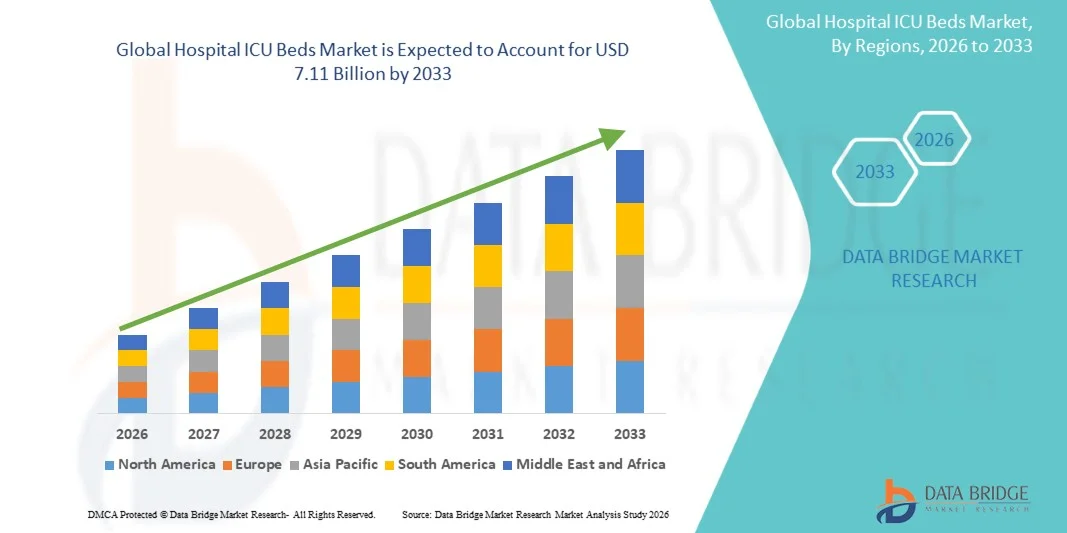
The Hospital ICU Beds Market was valued at USD 4.89 billion in 2025 and is projected to reach USD 7.11 billion by 2033, growing at a CAGR of 4.80% from 2026 to 2033. The Hospital ICU Beds Market is experiencing consistent growth driven by rising demand for advanced critical care infrastructure, increasing prevalence of chronic and life-threatening diseases, growing geriatric population, and continuous advancements in smart hospital bed technologies. The increasing need for intensive care capacity, along with rising healthcare investments and expansion of hospitals and specialty care centers, is accelerating the adoption of advanced ICU beds worldwide.
The growing number of critical care admissions, increasing surgical procedures, and rising focus on patient safety and healthcare quality are encouraging hospitals and healthcare facilities to invest in technologically advanced ICU beds. Electric ICU beds, smart beds integrated with monitoring systems, pressure management features, and patient positioning technologies are replacing conventional beds in many markets, offering improved patient comfort, enhanced caregiver efficiency, and better clinical outcomes. Furthermore, expanding healthcare infrastructure across emerging economies and increasing adoption of connected and AI-enabled hospital solutions are creating new growth opportunities for the Hospital ICU Beds Market.
Key Market Trends & Insights
- North America dominated the Hospital ICU Beds Market with the largest revenue share of 36.2% in 2025, supported by advanced healthcare infrastructure, high adoption of technologically advanced ICU equipment, increasing demand for critical care facilities, and strong investments in hospital modernization. The region benefits from the presence of leading medical equipment manufacturers, higher healthcare expenditure, and growing adoption of electric ICU beds integrated with monitoring and patient safety technologies.
- The electric or motorized ICU beds segment dominated the market with a 48.6% share in 2025, owing to increasing demand for advanced critical care infrastructure, rising adoption of smart hospital solutions, and growing preference for automated patient care equipment.
- Asia-Pacific is expected to be the fastest-growing region at a CAGR of 8.1% from 2026 to 2033, fueled by expanding hospital infrastructure, rising healthcare expenditure, increasing prevalence of chronic diseases, and growing investments in critical care facilities across China, India, Japan, and Southeast Asian countries. Government initiatives to improve emergency and intensive care capacity are further accelerating market growth.
- The touch control panel segment is projected to be the fastest-growing control panel type, registering a CAGR of 8.5% from 2026 to 2033, reflecting increasing demand for user-friendly, digitalized ICU equipment. Touch-based interfaces provide easier operation, improved accessibility for healthcare professionals, and integration with smart hospital systems, enhancing workflow efficiency in critical care environments.
- The stainless steel segment dominated the Material category with a 45.7% revenue share in 2025, owing to its durability, corrosion resistance, ease of sterilization, and suitability for demanding hospital environments. Stainless steel remains widely preferred for ICU beds due to its ability to withstand frequent cleaning procedures and maintain long-term operational performance.
Market Size & Forecast
- Global Market Value (2025): USD 4.89 Billion
- Expected Market Value (2033): USD 7.11 Billion
- Forecast CAGR (2026–2033): 4.80%
- Leading Region in 2025: North America
- Fastest Growing Region: Asia-Pacific
Report Scope and Hospital ICU Beds Market Segmentation
|
Attributes |
Hospital ICU Beds Key Market Insights |
|
Segments Covered |
|
|
Countries Covered |
North America · U.S. · Canada · Mexico Europe · Germany · France · U.K. · Netherlands · Switzerland · Belgium · Russia · Italy · Spain · Turkey · Rest of Europe Asia-Pacific · China · Japan · India · South Korea · Singapore · Malaysia · Australia · Thailand · Indonesia · Philippines · Rest of Asia-Pacific Middle East and Africa · Saudi Arabia · U.A.E. · South Africa · Egypt · Israel · Rest of Middle East and Africa South America · Brazil · Argentina · Rest of South America |
|
Key Market Players |
• Invacare Corporation (U.S.) |
|
Market Opportunities |
· Integration of Smart Technologies and IoT-Enabled ICU Beds · Rising Demand for Advanced Critical Care Infrastructure in Emerging Markets · Development of Advanced ICU Beds with Enhanced Patient Safety and Mobility Features |
|
Value Added Data Infosets |
In addition to the insights on market scenarios such as market value, growth rate, segmentation, geographical coverage, and major players, the market reports curated by the Data Bridge Market Research also include in-depth expert analysis, geographically represented company-wise production and capacity, network layouts of distributors and partners, detailed and updated price trend analysis and deficit analysis of supply chain and demand. |
Hospital ICU Beds Market Trends
Trend: Increasing Adoption of Smart and Advanced ICU Beds in Critical Care Management
Healthcare providers are increasingly adopting advanced hospital ICU beds equipped with smart monitoring features, automated positioning systems, pressure management technologies, and integrated patient safety solutions to improve critical care outcomes. Modern ICU beds enable real-time patient monitoring, automated adjustments, and improved caregiver efficiency, helping reduce complications associated with prolonged hospitalization and immobility. The integration of sensors, electronic controls, and connectivity features is transforming conventional ICU beds into intelligent care platforms that support better clinical decision-making. Hospitals and intensive care units are also investing in advanced ICU infrastructure to enhance patient comfort, reduce nursing workload, and improve overall quality of care.
Hospital ICU Beds Market Dynamics
Key Market Driver: Rising Demand for Advanced Critical Care Infrastructure and Increasing ICU Admissions
The increasing prevalence of chronic diseases, cardiovascular disorders, respiratory illnesses, and critical health conditions is driving demand for advanced ICU beds globally. The growing number of surgical procedures, aging population, and rising need for intensive monitoring are encouraging hospitals and healthcare facilities to upgrade their critical care infrastructure. According to global healthcare trends, the COVID-19 pandemic highlighted the importance of ICU capacity and accelerated investments in critical care equipment, including technologically advanced hospital beds. Healthcare providers are increasingly adopting electric and smart ICU beds with features such as automated positioning, integrated weighing systems, side rail safety mechanisms, and patient monitoring capabilities to improve treatment efficiency and patient outcomes.
Key Restraint/Challenge: High Cost of Advanced ICU Beds and Limited Adoption in Cost-Sensitive Markets
A major challenge in the Hospital ICU Beds Market is the high acquisition and maintenance cost associated with advanced ICU bed systems. Modern ICU beds equipped with motorized functions, electronic controls, integrated monitoring technologies, and smart connectivity features require significant investment in procurement, installation, servicing, and staff training. Smaller hospitals and healthcare facilities, particularly in developing regions, often face budget constraints that limit adoption of premium ICU bed technologies. In addition, maintenance requirements and the need for technical expertise to operate advanced systems can further impact deployment, especially in resource-limited healthcare settings.
Key Market Opportunity: Integration of IoT, AI-Based Monitoring, and Connected Healthcare Solutions
The integration of digital technologies such as IoT-enabled monitoring, artificial intelligence, and connected hospital systems presents significant growth opportunities for the Hospital ICU Beds market. Smart ICU beds with embedded sensors and connectivity capabilities can enable continuous monitoring of patient position, movement, weight changes, and vital care parameters, supporting early intervention and personalized treatment strategies. The increasing adoption of smart hospitals and digital healthcare infrastructure is creating demand for connected ICU solutions. Furthermore, investments in healthcare modernization across emerging economies, particularly in Asia-Pacific, are expected to expand access to advanced critical care equipment and accelerate future market growth.
Hospital ICU Beds Market Scope
The hospital ICU beds market is segmented on the basis of technology, control panel, material, components, ICU type, and end use.
- By Technology
On the basis of technology, the Hospital ICU Beds Market is segmented into electric or motorized ICU beds, semi-electric or hybrid ICU beds, and mechanical or manual ICU beds. The electric or motorized ICU beds segment dominated the market with a 48.6% share in 2025, owing to increasing demand for advanced critical care infrastructure, rising adoption of smart hospital solutions, and growing preference for automated patient care equipment. These beds offer multiple advantages, including automated height adjustment, backrest and leg positioning, improved patient mobility, and enhanced caregiver efficiency. The segment is gaining strong adoption across intensive care units due to its ability to reduce manual handling efforts and improve patient safety. Increasing prevalence of chronic diseases, aging population, and rising ICU admissions are encouraging hospitals to invest in technologically advanced ICU beds. In addition, integration of electronic controls, monitoring systems, and connected healthcare technologies is further strengthening the adoption of electric ICU beds globally. The growing focus on improving clinical workflow efficiency and reducing healthcare worker burden is also supporting segment growth. Hospitals are increasingly replacing traditional mechanical beds with electric models to enhance operational efficiency and provide better patient comfort.
The electric or motorized ICU beds segment is expected to witness the fastest growth at a CAGR of 8.3% from 2026 to 2033, driven by increasing investments in smart healthcare infrastructure and growing demand for digitally enabled critical care solutions. The rising adoption of connected hospital systems and IoT-based healthcare equipment is creating new opportunities for advanced ICU beds. These beds enable better patient monitoring, automated positioning, and improved workflow management in intensive care environments. Growing demand for patient-centric care models and advanced medical technologies is encouraging hospitals to upgrade their existing ICU facilities. Furthermore, increasing healthcare expenditure across developed and emerging economies is supporting the adoption of premium electric ICU beds. Continuous innovations in automation, remote control systems, and integrated monitoring capabilities are expected to accelerate segment expansion.
- By Control Panel
On the basis of control panel, the Hospital ICU Beds Market is segmented into remote, touch, switch, and revolving gear control systems. The remote control segment dominated the market with a 39.5% share in 2025, supported by increasing adoption of convenient and efficient ICU bed operation systems across hospitals and critical care facilities. Remote-controlled ICU beds enable healthcare professionals to adjust bed height, positioning, and movement without requiring direct manual operation. This improves caregiver efficiency and reduces physical strain associated with patient handling activities. The segment is widely adopted due to its ease of use, reliability, and suitability for high-pressure ICU environments. Growing focus on improving nursing workflow and enhancing patient safety is driving demand for remote-controlled ICU beds. In addition, increasing investments in hospital modernization and replacement of conventional equipment with advanced systems are supporting segment growth. The ability to provide quick adjustments during emergency situations further enhances the preference for remote-based control systems.
The touch control segment is expected to witness the fastest growth at a CAGR of 8.0% from 2026 to 2033, driven by increasing adoption of digital healthcare technologies and smart hospital infrastructure. Touch-based control panels offer user-friendly interfaces, improved accessibility, and advanced operational capabilities compared with conventional controls. The growing integration of touchscreen systems with connected healthcare platforms is enhancing the functionality of ICU beds. Hospitals are increasingly adopting digital interfaces to improve workflow efficiency and reduce operational complexity. Rising demand for modern patient management solutions and advanced medical equipment is supporting segment expansion. In addition, touch-control systems enable easier customization and improved interaction between healthcare professionals and equipment.
- By Material
On the basis of material, the Hospital ICU Beds Market is segmented into stainless steel, aluminium, copper, alloy with powder coated finish, ABS, and others. The stainless steel segment dominated the market with a 42.7% share in 2025, due to its superior durability, corrosion resistance, strength, and suitability for healthcare environments. Stainless steel ICU beds are widely preferred because they can withstand frequent cleaning, sterilization, and long-term usage. Hospitals prioritize stainless steel materials due to their ability to maintain hygiene standards and support infection prevention practices. The segment benefits from strong demand across hospitals, specialty care centers, and intensive care units. Increasing focus on durable medical infrastructure and long operational life is supporting adoption of stainless steel ICU beds. in addition, their resistance to wear and damage makes them suitable for high-use healthcare environments. Growing investments in hospital expansion and modernization are further contributing to segment dominance.
The ABS segment is expected to witness the fastest growth at a CAGR of 8.2% from 2026 to 2033, driven by increasing demand for lightweight, cost-effective, and flexible ICU bed designs. ABS materials provide advantages such as improved design flexibility, impact resistance, and ease of maintenance. The growing adoption of modern hospital furniture solutions is encouraging manufacturers to incorporate alternative materials into ICU bed production. Increasing demand for aesthetically improved and ergonomically designed hospital equipment is also supporting segment growth. Furthermore, ABS-based components help reduce overall bed weight while maintaining durability and performance. Rising healthcare investments in emerging markets are expected to accelerate the adoption of ABS-based ICU beds.
- By Components
On the basis of components, the Hospital ICU Beds Market is segmented into up to three functions, up to five functions, up to seven functions, CPR functions, castors, head and foot board, side railing, monitors, cameras, sensors, and others. the up to five functions segment dominated the market with a 36.8% share in 2025, owing to its widespread adoption across hospitals due to balanced functionality and affordability. These beds provide essential features required for intensive care management, including patient positioning, height adjustment, and movement control. The segment is preferred by healthcare providers because it offers advanced capabilities without significantly increasing operational costs. Increasing demand for efficient critical care solutions is supporting adoption across general hospitals and intensive care units. The segment benefits from growing ICU admissions and rising need for reliable patient management equipment. Furthermore, these beds provide flexibility for healthcare workers while maintaining ease of operation.
The up to seven functions segment is expected to witness the fastest growth at a CAGR of 8.5% from 2026 to 2033, driven by rising demand for multifunctional ICU beds with advanced patient handling capabilities. These beds provide enhanced positioning options and support complex critical care requirements. Growing adoption in specialized hospitals and advanced intensive care units is accelerating segment growth. Increasing focus on improving patient outcomes and reducing complications associated with prolonged hospitalization is supporting demand. The integration of advanced features such as automated adjustments and improved mobility functions is further driving adoption.
- By ICU Type
On the basis of ICU type, the Hospital ICU Beds Market is segmented into traditional medical ICU, cardiac care ICU, neonatal ICU, pediatric ICU, trauma ICU, psychiatric ICU, post-anesthesia care unit, high dependency unit, and mobile ICU. The traditional medical ICU segment dominated the market with a 34.6% share in 2025, supported by the widespread requirement for critical care beds across hospitals. Traditional medical ICUs manage a broad range of medical conditions, creating continuous demand for advanced ICU bed solutions. Increasing prevalence of chronic diseases, respiratory disorders, and emergency care requirements is driving segment growth. Hospitals are investing in ICU expansion to improve patient management capabilities. The segment benefits from the large number of general intensive care facilities globally. In addition, increasing healthcare infrastructure development and rising hospital admissions are strengthening demand.
The mobile ICU segment is expected to witness the fastest growth at a CAGR of 9.0% from 2026 to 2033, driven by increasing demand for emergency medical services and advanced patient transportation solutions. Mobile ICU systems support critical care delivery outside traditional hospital settings, improving emergency response capabilities. Growing focus on improving healthcare accessibility and emergency preparedness is accelerating adoption. Increasing investments in ambulance infrastructure and pre-hospital care solutions are supporting market expansion.
- By End Use
On the basis of end use, the Hospital ICU Beds Market is segmented into general hospitals, multi-specialty hospitals, specialized hospitals, ambulatory surgery centres, and others. The general hospitals segment dominated the market with a 40.2% share in 2025, due to high patient volumes, increasing ICU requirements, and continuous investment in hospital infrastructure. General hospitals represent the largest application area as they provide critical care services across multiple medical specialties. Rising demand for intensive care capacity and advanced patient monitoring solutions is supporting segment growth. Hospitals are increasingly upgrading ICU facilities with modern beds to improve treatment efficiency and patient safety. Growing healthcare expenditure and increasing focus on quality care delivery are further strengthening segment dominance.
The specialized hospitals segment is expected to witness the fastest growth at a CAGR of 8.7% from 2026 to 2033, driven by increasing expansion of specialty healthcare facilities and rising demand for dedicated critical care units. Specialized hospitals focusing on cardiology, oncology, neurology, and other advanced treatments require technologically advanced ICU infrastructure. Growing adoption of advanced medical equipment and increasing investments in specialty healthcare services are supporting segment expansion. Furthermore, rising demand for personalized and high-quality patient care is accelerating adoption of advanced ICU beds in specialized facilities.
Hospital ICU Beds Market Regional Analysis
North America dominated the hospital ICU beds market and accounted for the largest revenue share of 36.2% in 2025, supported by advanced healthcare infrastructure, high adoption of technologically advanced ICU equipment, increasing demand for critical care facilities, and strong investments in hospital modernization. The region benefits from the presence of leading medical equipment manufacturers, higher healthcare expenditure, and growing adoption of electric ICU beds integrated with monitoring and patient safety technologies. Increasing focus on improving critical care capacity, reducing hospital-acquired complications, and enhancing patient management efficiency continues to strengthen North America’s leading position in the global market.
U.S. Hospital ICU Beds Market Insight
The U.S. hospital ICU beds market is witnessing strong growth due to rising demand for advanced critical care infrastructure, increasing ICU admissions, and continuous investments in healthcare facility modernization. The country’s well-established healthcare system, presence of major medical device companies, and increasing adoption of smart ICU beds with automated positioning and monitoring capabilities are driving market expansion. Furthermore, growing prevalence of chronic diseases, aging population, and rising demand for efficient patient care solutions are encouraging hospitals to upgrade conventional beds with advanced electric and connected ICU bed systems.
Europe Hospital ICU Beds Market Insight
The Europe hospital ICU beds market remains a major contributor to global revenue, driven by advanced healthcare systems, increasing adoption of technologically advanced medical equipment, and growing investments in hospital infrastructure. The region is witnessing rising demand for electric ICU beds, connected monitoring solutions, and patient safety technologies to improve critical care outcomes. In addition, government initiatives focused on strengthening healthcare capacity, improving emergency care services, and modernizing hospitals are supporting market growth across European countries.
U.K. Hospital ICU Beds Market Insight
The U.K. hospital ICU beds market is experiencing steady growth, supported by increasing investments in healthcare infrastructure, rising demand for intensive care capacity, and growing adoption of advanced hospital equipment. Healthcare facilities are increasingly implementing electric and smart ICU beds to improve patient handling, enhance caregiver efficiency, and support better clinical outcomes. Furthermore, modernization initiatives within hospitals and increasing focus on improving critical care services are contributing to the expansion of the ICU beds market in the country.
Germany Hospital ICU Beds Market Insight
The Germany hospital ICU beds market is expanding steadily due to the country’s strong healthcare infrastructure, advanced medical technology sector, and increasing focus on high-quality critical care management. Hospitals and healthcare providers are adopting advanced ICU beds with automated functions, integrated monitoring systems, and enhanced patient safety features. In addition, Germany’s emphasis on healthcare innovation, digital transformation, and modernization of medical facilities is driving demand for next-generation ICU bed solutions.
Asia-Pacific Hospital ICU Beds Market Insight
The Asia-Pacific hospital ICU beds market is expected to witness the fastest growth, expanding at a CAGR of 8.1% from 2026 to 2033, driven by expanding hospital infrastructure, rising healthcare expenditure, increasing prevalence of chronic diseases, and growing investments in critical care facilities across China, India, Japan, and Southeast Asian countries. Government initiatives to improve emergency and intensive care capacity, along with increasing healthcare modernization efforts, are accelerating regional market growth. Furthermore, rising demand for advanced patient management systems and increasing adoption of electric ICU beds are supporting market expansion across the region.
Japan Hospital ICU Beds Market Insight
The Japan hospital ICU beds market is witnessing consistent growth due to the country’s advanced healthcare infrastructure, aging population, and increasing demand for high-quality critical care solutions. Hospitals are increasingly adopting technologically advanced ICU beds with automated positioning, monitoring capabilities, and patient safety features to improve care efficiency. Moreover, Japan’s focus on healthcare innovation, robotics, and smart hospital solutions is contributing to the growing adoption of advanced ICU bed technologies.
China Hospital ICU Beds Market Insight
The China hospital ICU beds market is growing rapidly, driven by expanding healthcare infrastructure, rising healthcare expenditure, increasing demand for critical care services, and government initiatives to strengthen hospital capacity. The growing prevalence of chronic diseases and increasing investments in intensive care units are accelerating demand for advanced ICU beds. In addition, rising adoption of electric ICU beds, connected healthcare technologies, and modern patient management systems is positioning China as one of the fastest-growing markets for Hospital ICU Beds globally.
Hospital ICU Beds Market Share
The Hospital ICU Beds industry is primarily led by well-established companies, including:
- Invacare Corporation (U.S.)
- Arjo AB (Sweden)
- LINET Group SE (Czech Republic)
- Gendron Inc. (U.S.)
- Malvestio S.p.A. (Italy)
- Stiegelmeyer GmbH & Co. KG (Germany)
- Wellell Inc. (Taiwan)
- Paramount Bed Holdings Co., Ltd. (Japan)
- Medline Industries, LP (U.S.)
- Joerns Healthcare LLC (U.S.)
- Span America (U.S.)
- Merivaara Corp. (Finland)
- Schmitz u. Söhne GmbH & Co. KG (Germany)
- Favero Health Projects S.p.A. (Italy)
- Haelvoet NV (Belgium)
- Pardo (Spain)
- Vernacare (United Kingdom)
- Stryker Medical (U.S.)
- Hill-Rom (U.S.)
- Blickman Industries (U.S.)
- Promotal (France)
- Apex Medical Corp. (Taiwan)
- Drive DeVilbiss Healthcare (United Kingdom)
- Aertecnica S.r.l. (Italy)
- Narang Medical Limited (India)
- Midmark Corporation (U.S.)
- Shanghai Pinxing Medical Equipment Co., Ltd. (China)
- Chang Gung Medical Technology Co., Ltd. (Taiwan)
- Zhangjiagang Medi Medical Equipment Co., Ltd. (China)
- Hebei Pukang Medical Instruments Co., Ltd. (China)
- Besco Medical Co., Ltd. (China)
- Hopefull Medical Equipment Co., Ltd. (China)
Latest Developments in Hospital ICU Beds Market
- In February 2021, Stryker, a leading medical technology company, announced the EMEA launch of its ProCuity Hospital Bed Series, a wireless and smart hospital bed designed for multiple patient care environments, including intensive care settings. The ProCuity bed series incorporates wireless connectivity, advanced fall prevention technologies, and integration capabilities with nurse call systems to improve patient safety and caregiver workflow efficiency. This launch reflects the growing industry focus on connected hospital beds and digital healthcare infrastructure to enhance critical care delivery
- In June 2021, Volvo Group India, along with 3M India and Hitachi ABB Power Grids, supported the inauguration of a 56-bed ICU facility at Sir C.V. Raman General Hospital in Bengaluru, India, as part of healthcare infrastructure expansion during the COVID-19 pandemic. The facility included advanced critical care equipment, including ICU beds and patient monitoring systems, strengthening intensive care capacity and highlighting increased investment in hospital critical care infrastructure
- In July 2021, Cognizant, through its Operation C3 initiative, supported the development of a 50-bed modern ICU facility at Osmania General Hospital in Hyderabad, India. The newly established ICU was equipped with advanced medical infrastructure, including ICU beds, multiparameter monitors, ECG machines, and other critical care equipment, improving access to intensive care services and supporting healthcare capacity expansion
- In February 2023, Stryker announced the launch of its SmartMedic platform in India, an ICU bed upgrade solution designed to enhance patient care and caregiver safety. The platform enables advanced ICU bed capabilities such as patient weight management, monitoring of patient repositioning from nursing stations, and performing X-rays without moving critically ill patients. SmartMedic also supports wireless connectivity with nurse call systems, improving hospital workflow efficiency and reducing patient discomfort during ICU care. This development highlights the increasing adoption of connected and technology-enabled ICU bed solutions
- In June 2023, HDFC Bank Parivartan launched a 10-bed ICU facility in Assam, India, equipped with critical care infrastructure including ICU beds, ventilators, ECG systems, defibrillators, and monitoring equipment. The initiative focused on improving intensive care accessibility and strengthening healthcare infrastructure in underserved regions, demonstrating the rising demand for ICU capacity expansion in emerging markets
- In June 2023, eGov Foundation, in partnership with the Assam Government, announced the installation of 365 ICU beds across 23 government hospitals under the 10BedICU Project. The initiative included the development of ICU wards and tele-ICU hubs to improve critical care access and support remote healthcare delivery. This development highlights the increasing adoption of scalable ICU infrastructure models to address healthcare capacity gaps
- In March 2024, Getinge, a global provider of medical technology solutions, continued expanding its critical care portfolio with advanced hospital bed and intensive care solutions designed to improve patient safety, workflow efficiency, and caregiver support. The company focused on integrating mobility features, ergonomic designs, and advanced healthcare technologies to support modern ICU environments. This development reflects the broader industry trend toward multifunctional and patient-centric ICU bed systems
- In September 2024, LINET Group, a leading manufacturer of hospital and ICU beds, showcased its advanced intensive care bed solutions featuring smart positioning functions, patient handling support, and improved mobility technologies. The company emphasized the importance of digitalized ICU environments and advanced bed systems in improving clinical outcomes and reducing workload for healthcare professionals
- In January 2025, Stryker expanded its focus on connected healthcare solutions by advancing smart hospital bed technologies that support patient monitoring, safety alerts, and improved clinical workflows. The company continued development of ICU bed platforms with integrated digital capabilities to support hospitals transitioning toward connected and data-driven critical care environments

- Interactive Data Analysis Dashboard
- Company Analysis Dashboard for high growth potential opportunities
- Research Analyst Access for customization & queries
- Competitor Analysis with Interactive dashboard
- Latest News, Updates & Trend analysis
- Harness the Power of Benchmark Analysis for Comprehensive Competitor Tracking
Data collection and base year analysis are done using data collection modules with large sample sizes. The stage includes obtaining market information or related data through various sources and strategies. It includes examining and planning all the data acquired from the past in advance. It likewise envelops the examination of information inconsistencies seen across different information sources. The market data is analysed and estimated using market statistical and coherent models. Also, market share analysis and key trend analysis are the major success factors in the market report. To know more, please request an analyst call or drop down your inquiry.
The key research methodology used by DBMR research team is data triangulation which involves data mining, analysis of the impact of data variables on the market and primary (industry expert) validation. Data models include Vendor Positioning Grid, Market Time Line Analysis, Market Overview and Guide, Company Positioning Grid, Patent Analysis, Pricing Analysis, Company Market Share Analysis, Standards of Measurement, Global versus Regional and Vendor Share Analysis. To know more about the research methodology, drop in an inquiry to speak to our industry experts.
Data Bridge Market Research is a leader in advanced formative research. We take pride in servicing our existing and new customers with data and analysis that match and suits their goal. The report can be customized to include price trend analysis of target brands understanding the market for additional countries (ask for the list of countries), clinical trial results data, literature review, refurbished market and product base analysis. Market analysis of target competitors can be analyzed from technology-based analysis to market portfolio strategies. We can add as many competitors that you require data about in the format and data style you are looking for. Our team of analysts can also provide you data in crude raw excel files pivot tables (Fact book) or can assist you in creating presentations from the data sets available in the report.













