


What is the Hot-Fill Food Packaging Market Size and Growth Rate?
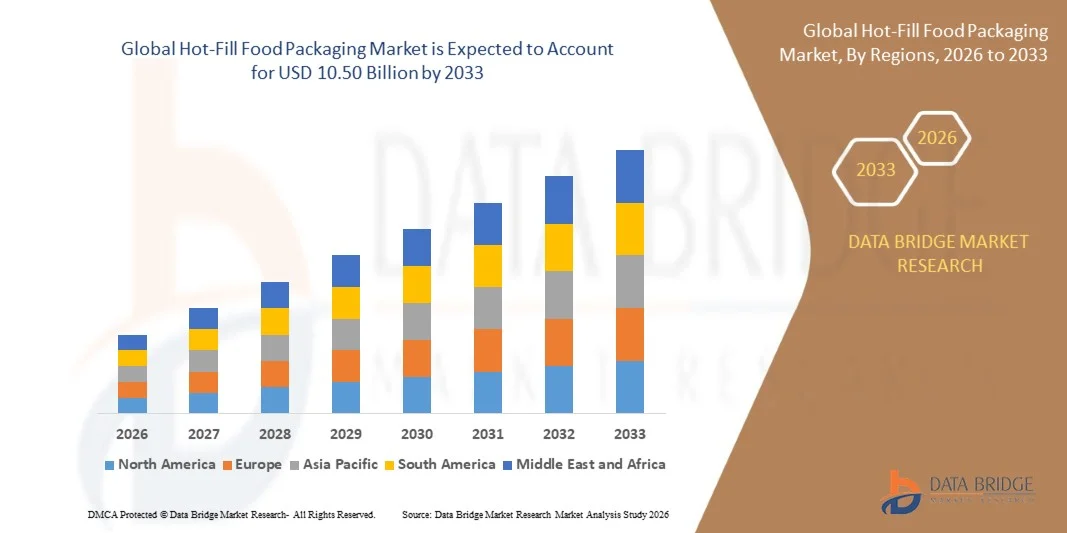
- As per Data Bridge Market Research analysis, the hot-fill food packaging market was valued at USD 7.30 billion in 2025 and is projected to reach USD 10.50 billion by 2033, growing at a CAGR of 4.60% from 2026 to 2033.
- The market is experiencing consistent growth driven by rising demand for convenient and shelf-stable food products, increasing consumption of sauces, juices, ready-to-eat foods, and processed fruits and vegetables, and growing adoption of packaging solutions capable of withstanding high-temperature filling processes.
- The increasing focus on food safety, extended shelf life, and product quality, combined with the expansion of packaged food and beverage production and growing sustainability requirements, is compelling manufacturers to adopt hot-fill packaging solutions. Lightweight, recyclable, and material-efficient packaging formats are gaining traction by offering reliable thermal and barrier performance while reducing packaging material consumption and supporting evolving environmental requirements.
Market Size & Forecast
- Global Market Value (2025): USD 7.30 Billion
- Expected Market Value (2033): USD 10.50 Billion
- Forecast CAGR (2026–2033): 4.60%
- Leading Region in 2025: North America
- Fastest Growing Region: Asia Pacific
What are the Major Takeaways of the Hot-Fill Food Packaging Market?
- North America dominated the hot-fill food packaging market with the largest revenue share of 39.9% in 2025, supported by an advanced food processing industry, strong demand for shelf-stable foods, and increasing adoption of convenient packaging solutions.
- Asia-Pacific is expected to be the fastest-growing region at a CAGR of 6.0% from 2026 to 2033, fueled by growing demand for convenience foods, expanding food processing industries, urbanization, and increasing consumption of packaged products.
- The plastic segment led the market with a 60.1% share in 2025, driven by its lightweight construction, durability, versatility, and compatibility with hot-fill processing
- Paperboard are the fastest-growing material type, projected to register a CAGR of 5.2%, reflecting the surge in demand for recyclable and material-efficient packaging solutions.
- The bottles segment dominated the packaging type category with a 35.3% revenue share in 2025, led by extensive use across sauces, condiments, juices, and fruit beverages. Bottles offer convenient handling, dispensing, storage, and transportation characteristics for hot-filled food products.
- Sauces & condiments accounted for 34.8% of the market share in 2025, preferred by extensive use of hot-fill packaging for ketchup, dressings, sauces, and other shelf-stable condiments.
- The processed fruits & vegetables segment is the fastest-growing application category, with a CAGR of 5.3%, driven by increasing demand for convenient and shelf-stable processed foods.
Report Scope and Hot-Fill Food Packaging Market Segmentation
|
Attributes |
Hot-Fill Food Packaging Key Market Insights |
|
Segments Covered |
|
|
Countries Covered |
North America
Europe
Asia-Pacific
Middle East and Africa
South America
|
|
Key Market Players |
|
|
Market Opportunities |
|
|
Value Added Data Infosets |
In addition to the insights on market scenarios such as market value, growth rate, segmentation, geographical coverage, and major players, the market reports curated by the Data Bridge Market Research also include import export analysis, production capacity overview, production consumption analysis, price trend analysis, climate change scenario, supply chain analysis, value chain analysis, raw material/consumables overview, vendor selection criteria, PESTLE Analysis, Porter Analysis, and regulatory framework. |
What is the Key Trend in the Hot-Fill Food Packaging Market?
- Food manufacturers are increasingly adopting lightweight hot-fill packaging to extend shelf life, maintain product safety, and support convenient distribution of sauces, juices, and processed foods while reducing packaging material consumption today.
- For instance, in April 2026, Amcor launched its upgraded Apex PET jars with Elevate technology, enabling pasta sauce brands to use hot-fill processes at temperatures of up to 205°F while improving resistance to deformation and reducing packaging-related costs
- Lightweight bottle designs reduce material consumption while maintaining dimensional stability during high-temperature filling and subsequent cooling operations.
- Flexible hot-fill pouches are gaining adoption by offering portability, efficient material usage, and formats for sauces, ready-to-eat meals, and liquid foods.
- For instance, in November 2024, Pretium Packaging introduced 250 ml and 330 ml hot-fillable PET bottles designed as glass alternatives for beverages and liquid food products filled at temperatures up to 85°C. The company also highlighted compatibility with post-consumer recycled PET (rPET), supporting the shift toward more sustainable hot-fill packaging.
- As food manufacturers increasingly prioritize sustainability, convenience, and shelf stability, recyclable materials, mono-material structures, and lightweight hot-fill formats are expected to shape packaging development across food and beverage applications over the coming years and across multiple product categories.
What are the Key Drivers of the Hot-Fill Food Packaging Market?
- The rising demand for shelf-stable and convenient food products has significantly increased adoption of hot-fill packaging capable of supporting microbial control, extended shelf life, and ambient distribution across food and beverage categories across global markets.
- For instance, in June 2025, the University of Georgia Extension highlighted hot-fill-hold processing as a thermal preservation method for acidified foods, noting that the process helps inactivate pathogens and extend the shelf life of products. This supports the use of hot-fill packaging for shelf-stable sauces, jams, and other acidified foods.
- Food processors are integrating hot-fill packaging into product development to reduce preservative dependence, improve distribution flexibility, and maintain product quality throughout storage, retail handling, and channels.
- For instance, in August 2023, UFlex introduced its F-PSX high-barrier transparent BOPET film, which is suitable for hot-fill, sterilization, and pasteurization applications, including microwavable food products. The development demonstrates how packaging suppliers are expanding high-barrier solutions to meet the growing need for convenient and heat-processed food packaging.
- With food manufacturers increasingly expanding shelf-stable portfolios and consumers seeking convenient products, hot-fill packaging will remain important for preserving food safety, extending shelf life, supporting efficient ambient distribution and quality
What Factors are Challenging the Growth of the Hot-Fill Food Packaging Market?
- Hot-fill packaging requires specialized materials and package designs that withstand filling temperatures, increasing complexity and limiting material flexibility compared with conventional packaging formats.
- For instance, in June 2025, the University of Georgia Extension stated that hot-fill-hold packaging must withstand high holding temperatures for several minutes and that many plastics can deform under these conditions, requiring packaging specifically validated for hot-fill-hold processing.
- These technical requirements can increase packaging costs for manufacturers seeking lightweight, recyclable, and high-performance packaging materials.
- For instance, in October 2025, Packaging Journal highlighted that thermal preservation places high demands on packaging materials, which must withstand elevated temperatures without deformation while maintaining an oxygen-tight seal. The article noted that many materials can reach their performance limits under these conditions, increasing material-selection requirements for hot-fill applications.
- The need to balance thermal resistance, barrier performance, recyclability, and dimensional stability continues to create formulation and engineering challenges for packaging manufacturers seeking reliable hot-fill performance across applications.
How is the Hot-Fill Food Packaging Market Segmented?
The hot-fill food packaging market is segmented on the basis of material, packaging type, and application.
- By Material
On the basis of material, the hot-fill food packaging market is segmented into plastic, glass, paperboard, and other materials. The plastic segment dominated the market with a 60.1% share in 2025, owing to its lightweight construction, durability, versatility, and compatibility with hot-fill processing. Plastic packaging is extensively used across bottles, pouches, cups, and tubs for sauces, beverages, and processed foods. Its ability to provide flexible shapes and convenient handling makes it suitable for a wide range of food products. Advancements in heat-resistant plastic materials are further improving their performance during hot-fill operations. Manufacturers are also increasingly focusing on recyclable and lightweight plastic structures to address sustainability requirements.
The paperboard segment is projected to register the fastest growth at a CAGR of 5.2% from 2026 to 2033, driven by rising demand for recyclable and material-efficient packaging solutions. Advancements in barrier coatings are improving the suitability of paperboard for hot-fill food applications. The material provides a lightweight alternative for food manufacturers seeking to reduce packaging material consumption. Increasing consumer preference for sustainable packaging is also encouraging greater use of fiber-based materials. Manufacturers are investing in improved paperboard structures to enhance resistance to moisture, heat, and product interaction. Growing sustainability initiatives across the food and beverage industry are further supporting adoption.
- By Packaging Type
On the basis of packaging type, the hot-fill food packaging market is segmented into bottles, jars, pouches, cups & tubs, and other packaging types. The bottles segment dominated the market with a 35.3% share in 2025, supported by extensive use across sauces, condiments, juices, and fruit beverages. Bottles offer convenient handling, dispensing, storage, and transportation characteristics for hot-filled food products. Their established compatibility with thermal processing makes them a widely adopted format among food manufacturers. Bottles can also incorporate different closure and dispensing systems to improve consumer convenience. Availability in both plastic and glass formats provides manufacturers with flexibility according to product requirements.
The pouches segment is expected to witness the fastest growth at a CAGR of 5.7% from 2026 to 2033, driven by increasing demand for lightweight, convenient, and material-efficient packaging. Hot-fill pouches provide portability and efficient transportation while requiring less packaging material than many rigid formats. Their flexible structure makes them suitable for sauces, processed foods, and beverages. Growing consumer preference for convenient and easy-to-use packaging is further supporting adoption. Improvements in barrier films and heat-resistant structures are expanding the suitability of pouches for hot-fill applications. Manufacturers are also increasingly considering flexible packaging as part of lightweighting and sustainability strategies.
- By Application
On the basis of application, the hot-fill food packaging market is segmented into sauces & condiments, juices & fruit beverages, soups & broths, processed fruits & vegetables, and others. The sauces & condiments segment dominated the market with a 34.8% share in 2025, driven by extensive use of hot-fill packaging for ketchup, dressings, sauces, and other shelf-stable condiments. Hot filling supports thermal processing and helps maintain product safety and shelf stability. Bottles, jars, and pouches are widely used for packaging different types of sauces and condiments. Increasing consumption of ready-to-use food products is supporting demand for convenient packaged sauces. The growing variety of premium, specialty, and international sauces is further expanding packaging requirements.
The processed fruits & vegetables segment is projected to register the fastest growth at a CAGR of 5.3% from 2026 to 2033, supported by increasing demand for convenient and shelf-stable processed foods. Hot-fill packaging provides thermal resistance and product protection for processed fruit and vegetable products. Rising consumer preference for convenient foods is encouraging manufacturers to expand packaged offerings in this category. Pouches, jars, bottles, and cups can provide convenient storage and portioning options for these products. Improvements in packaging barriers are also supporting longer product shelf life and improved product protection. Expansion of packaged food distribution through modern retail and other channels is further supporting demand.
Which Region Holds the Largest Share of the Hot-Fill Food Packaging Market?
- North America dominated the hot-fill food packaging market with the largest revenue share of 39.9% in 2025, supported by an advanced food processing industry, strong demand for shelf-stable foods, and increasing adoption of convenient packaging solutions.
- The region also benefits from established food and beverage manufacturing infrastructure, high consumption of sauces, condiments, juices, and processed foods, and growing demand for lightweight and recyclable packaging solutions. Increasing investment in sustainable packaging technologies and innovations in heat-resistant plastic and flexible packaging continues to strengthen North America’s leadership position in the global market.
U.S. Hot-Fill Food Packaging Market Insight
The U.S. hot-fill food packaging market is witnessing strong growth due to rising demand for shelf-stable foods, convenient packaged products, and ready-to-use sauces and beverages. The country’s mature food and beverage processing industry, along with increasing adoption of lightweight, recyclable, and high-barrier packaging solutions, is driving demand across sauces, condiments, juices, and processed foods. In addition, growing emphasis on packaging sustainability, extended shelf life, and efficient food distribution is accelerating adoption of advanced hot-fill packaging formats across food manufacturers.
Asia-Pacific Hot-Fill Food Packaging Market Insight
The Asia-Pacific hot-fill food packaging market is expected to witness rapid growth, driven by increasing urbanization, expanding food processing industries, and rising consumption of packaged and shelf-stable foods across countries such as China, India, and Japan. Growing consumer preference for convenient food products, rising investments in modern packaging infrastructure, and increasing demand for lightweight and flexible packaging solutions are supporting regional market expansion. In addition, the growing production of sauces, fruit beverages, processed fruits, and vegetables is accelerating adoption of hot-fill packaging across the region.
Japan Hot-Fill Food Packaging Market Insight
The Japan hot-fill food packaging market is witnessing consistent growth due to rising demand for convenient packaged foods, advanced food processing technologies, and high-quality packaging solutions. Food manufacturers are increasingly adopting hot-fill packaging for sauces, beverages, processed foods, and other shelf-stable products to support product safety and extended shelf life. Moreover, increasing integration of lightweight, recyclable, and high-performance packaging materials and the country’s focus on efficient food distribution are further contributing to market growth.
China Hot-Fill Food Packaging Market Insight
The China hot-fill food packaging market is growing rapidly, driven by expanding food processing capacity, increasing urbanization, and rising consumer demand for convenient and shelf-stable food products. Growing adoption of lightweight plastic, flexible packaging, and advanced barrier technologies across food and beverage applications is significantly boosting market demand. In addition, rising consumption of sauces, fruit beverages, processed fruits and vegetables, and ready-to-eat foods is accelerating packaging innovation, positioning China as one of the fastest-growing markets for hot-fill food packaging globally.
U.K. Hot-Fill Food Packaging Market Insight
The U.K. hot-fill food packaging market is experiencing steady growth, supported by rising demand for convenient, shelf-stable, and ready-to-consume food products. Increasing investments in recyclable packaging materials and growing demand for lightweight and flexible formats are contributing to market growth across sauces, condiments, beverages, and processed foods. Furthermore, increasing focus on packaging sustainability, food safety, and extended shelf life is encouraging manufacturers to adopt advanced hot-fill packaging technologies, positioning the U.K. as a key market in the European food packaging industry.
Germany Hot-Fill Food Packaging Market Insight
The Germany hot-fill food packaging market is expanding steadily due to the country’s strong food processing industry, advanced packaging capabilities, and increasing adoption of sustainable packaging technologies. Food manufacturers are increasingly utilizing hot-fill packaging for sauces, beverages, processed fruits, vegetables, and other shelf-stable products to improve product protection and distribution efficiency. Continuous advancements in recyclable materials, lightweight packaging, and high-barrier structures, along with strong industry focus on sustainability and resource efficiency, are further driving market growth in Germany.
Which are the Top Companies in Hot-Fill Food Packaging Market?
The hot-fill food packaging industry is primarily led by well-established companies, including:
- Sonoco Products Company (U.S.)
- Silgan Holdings Inc. (U.S.)
- ALPLA Werke Alwin Lehner GmbH & Co KG (Austria)
- Graham Packaging Company (U.S.)
- Pretium Packaging (U.S.)
- RESILUX NV (Belgium)
- Placon (U.S.)
- Gualapack S.p.A. (Italy)
- Gerresheimer AG (Germany)
- Plastipak Holdings, Inc. (U.S.)
- CKS Packaging, Inc. (U.S.)
- Comar, LLC (U.S.)
- Logoplaste (Portugal)
- Retal Industries LTD (Cyprus)
- Winpak LTD. (Canada)
- Coveris (Austria)
- Huhtamäki Oyj (Finland)
- Mondi plc (U.K.)
- ProAmpac (U.S.)
- Tetra Pak International S.A. (Switzerland)
What are Latest Developments in Hot-Fill Food Packaging Market?
- In January 2025, DePoly and Plastic Technologies Inc. (PTI) announced the development of a closed-loop recycled PET bottle made from PET and polyester waste, with preliminary testing indicating suitability for food contact and long-term storage applications, including hot-fill. The development demonstrates progress toward using recycled materials in food packaging while maintaining the performance requirements needed for hot-fill applications.
- In November 2024, Pretium Packaging developed new 250 ml and 330 ml hot-fillable PET beverage bottles designed as alternatives to glass for beverages and other liquid products filled at elevated temperatures. The new bottles were developed to provide smaller and mid-sized brands with access to hot-fill PET packaging, while the manufacturing platform can also accommodate recycled PET resin for customers seeking recycled-content solutions.
- In June 2022, Berry Global launched its Nova range of hot-fill sauce bottles, featuring a curved design intended to improve dispensing and consumer convenience. Manufactured using a PP/EVOH/PP structure, the bottles were developed for sauce applications and support both cold and hot filling, while their squeezability and product evacuation characteristics are designed to help reduce food waste.
- In September 2021, UFlex, Mespack, and Hoffer Plastics collaborated to develop a recycle-ready single-material PP-based hot-fill pouch for ready-to-eat food applications. The solution combined a PP-based pouch structure with a recyclable spout cap and was designed to provide barrier performance, heat-sealing capability, and extended shelf life while improving recyclability. The pouch was intended for products including baby food, food purees, and pet food.
- In May 2021, Waddington Europe, a division of Novolex, launched its TamperVisible Hot Fill product line for soups and sauces, incorporating recycled PET into thermoformed packaging. The packaging was designed to withstand hot-fill temperatures while providing tamper visibility, microwaveability, and improved recyclability. The range was offered with different recycled-content blends, including a fully recycled-content option, demonstrating the industry's move toward combining hot-fill performance with circular packaging solutions.

- Interactive Data Analysis Dashboard
- Company Analysis Dashboard for high growth potential opportunities
- Research Analyst Access for customization & queries
- Competitor Analysis with Interactive dashboard
- Latest News, Updates & Trend analysis
- Harness the Power of Benchmark Analysis for Comprehensive Competitor Tracking
Global Hot Fill Food Packaging Market, Supply Chain Analysis and Ecosystem Framework
To support market growth and help clients navigate the impact of geopolitical shifts, DBMR has integrated in-depth supply chain analysis into its Global Hot Fill Food Packaging Market research reports. This addition empowers clients to respond effectively to global changes affecting their industries. The supply chain analysis section includes detailed insights such as Global Hot Fill Food Packaging Market consumption and production by country, price trend analysis, the impact of tariffs and geopolitical developments, and import and export trends by country and HSN code. It also highlights major suppliers with data on production capacity and company profiles, as well as key importers and exporters. In addition to research, DBMR offers specialized supply chain consulting services backed by over a decade of experience, providing solutions like supplier discovery, supplier risk assessment, price trend analysis, impact evaluation of inflation and trade route changes, and comprehensive market trend analysis.
Data collection and base year analysis are done using data collection modules with large sample sizes. The stage includes obtaining market information or related data through various sources and strategies. It includes examining and planning all the data acquired from the past in advance. It likewise envelops the examination of information inconsistencies seen across different information sources. The market data is analysed and estimated using market statistical and coherent models. Also, market share analysis and key trend analysis are the major success factors in the market report. To know more, please request an analyst call or drop down your inquiry.
The key research methodology used by DBMR research team is data triangulation which involves data mining, analysis of the impact of data variables on the market and primary (industry expert) validation. Data models include Vendor Positioning Grid, Market Time Line Analysis, Market Overview and Guide, Company Positioning Grid, Patent Analysis, Pricing Analysis, Company Market Share Analysis, Standards of Measurement, Global versus Regional and Vendor Share Analysis. To know more about the research methodology, drop in an inquiry to speak to our industry experts.
Data Bridge Market Research is a leader in advanced formative research. We take pride in servicing our existing and new customers with data and analysis that match and suits their goal. The report can be customized to include price trend analysis of target brands understanding the market for additional countries (ask for the list of countries), clinical trial results data, literature review, refurbished market and product base analysis. Market analysis of target competitors can be analyzed from technology-based analysis to market portfolio strategies. We can add as many competitors that you require data about in the format and data style you are looking for. Our team of analysts can also provide you data in crude raw excel files pivot tables (Fact book) or can assist you in creating presentations from the data sets available in the report.













