


Human Centric Lighting Market Overview
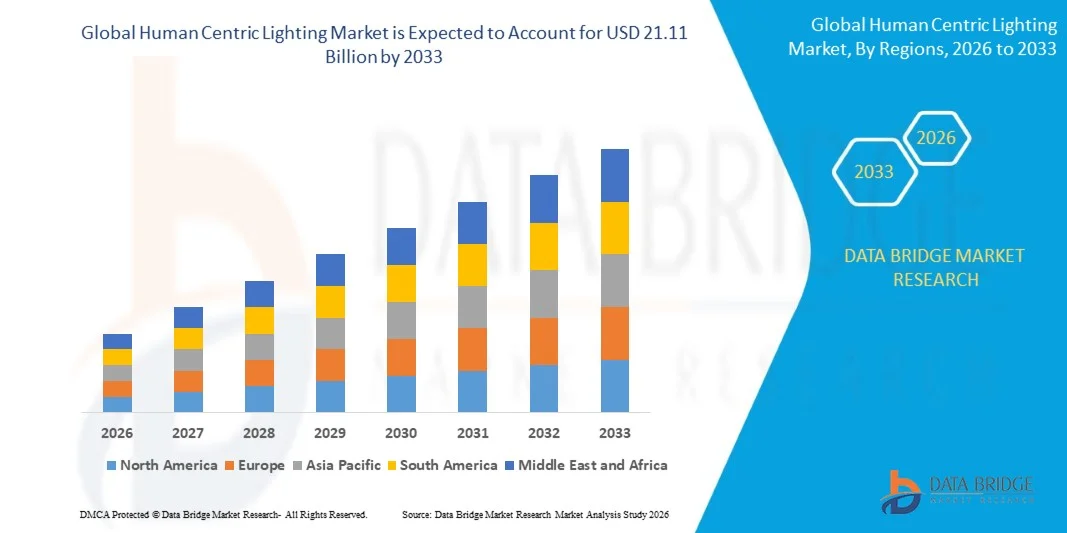
The Human Centric Lighting Market was valued at USD 4.57 billion in 2025 and is projected to reach USD 21.11 billion by 2033, growing at a CAGR of 21.08% from 2026 to 2033. The market is experiencing rapid growth driven by increasing awareness of the impact of lighting on human health and well-being, rising adoption of smart building technologies, and growing demand for energy-efficient lighting systems across commercial, healthcare, educational, and residential environments.
The growing emphasis on occupant comfort, productivity, and circadian rhythm regulation is encouraging organizations and building owners to implement advanced lighting solutions that mimic natural daylight patterns. Human centric lighting systems are increasingly being integrated with IoT-enabled controls, sensors, and building management platforms, allowing dynamic adjustment of light intensity and color temperature based on user needs and environmental conditions. In addition, stricter energy efficiency regulations, expanding investments in smart cities, and increasing focus on employee wellness and patient recovery outcomes are accelerating the adoption of human centric lighting technologies worldwide, supporting long-term market expansion across both developed and emerging economies.
Key Market Trends & Insights
- North America dominated the human centric lighting market with the largest revenue share of 38.42% in 2025, supported by strong adoption of smart lighting systems, significant investments in building automation, increasing workplace wellness initiatives, and the presence of leading lighting technology providers across the region.
- Asia-Pacific is expected to be the fastest-growing region, recording a CAGR of 23.4% from 2026 to 2033. Growth is driven by rapid urbanization, expanding smart city projects, increasing investments in commercial infrastructure, growing awareness of healthy indoor environments, and rising adoption of connected lighting technologies across China, Japan, India, and Southeast Asia.
- The Sensors and Drivers segment held the largest market revenue share of approximately 38.6% in 2025 driven by their critical role in enabling adaptive lighting control, daylight harvesting, occupancy detection, and circadian lighting adjustments. The growing deployment of smart lighting systems across commercial buildings, healthcare facilities, and educational institutions continues to support strong demand for advanced sensors and driver technologies.
- The Microprocessor and Micro Controllers segment is projected to register the fastest growth at a CAGR of 23.7% from 2026 to 2033, driven by increasing integration of AI-enabled lighting controls, IoT connectivity, and automated building management systems. Rising adoption of intelligent lighting platforms capable of real-time data processing and personalized lighting environments is accelerating segment expansion.
- The Commercial segment held the largest market revenue share of approximately 34.9% in 2025 driven by widespread adoption across office buildings, corporate campuses, hospitality facilities, and smart commercial infrastructure. Organizations are increasingly investing in human centric lighting solutions to improve employee well-being, productivity, and energy efficiency while supporting sustainability objectives.
- The Healthcare segment is projected to register the fastest growth at a CAGR of 24.5% from 2026 to 2033, driven by growing recognition of the role of circadian lighting in patient recovery, sleep regulation, and healthcare outcomes. Increasing implementation of wellness-focused lighting systems in hospitals, clinics, senior living facilities, and rehabilitation centers is contributing significantly to segment growth.
Market Size & Forecast
- Global Market Value (2025): USD 4.57 Billion
- Expected Market Value (2033): USD 21.11 Billion
- Forecast CAGR (2026–2033): 21.08%
- Leading Region in 2025: North America
- Fastest Growing Region: Asia-Pacific
Report Scope and Human Centric Lighting Market Segmentation
|
Attributes |
Human Centric Lighting Key Market Insights |
|
Segments Covered |
· By Component: Sensors and Drivers, Microprocessor and Micro Controllers, Switches and Dimmers, Transmitters, and Receivers · By End Users: Healthcare, Education, Residential, Commercial, Industrial, and Others (Retail) |
|
Countries Covered |
North America · U.S. · Canada · Mexico Europe · Germany · France · U.K. · Netherlands · Switzerland · Belgium · Russia · Italy · Spain · Turkey · Rest of Europe Asia-Pacific · China · Japan · India · South Korea · Singapore · Malaysia · Australia · Thailand · Indonesia · Philippines · Rest of Asia-Pacific Middle East and Africa · Saudi Arabia · U.A.E. · South Africa · Egypt · Israel · Rest of Middle East and Africa South America · Brazil · Argentina · Rest of South America |
|
Key Market Players |
• Zumtobel Group (Austria) |
|
Market Opportunities |
• Increasing Adoption Of Human Centric Lighting In Smart Buildings And Smart Cities |
|
Value Added Data Infosets |
In addition to the insights on market scenarios such as market value, growth rate, segmentation, geographical coverage, and major players, the market reports curated by the Data Bridge Market Research also include in-depth expert analysis, geographically represented company-wise production and capacity, network layouts of distributors and partners, detailed and updated price trend analysis and deficit analysis of supply chain and demand. |
Human Centric Lighting Market Trends
Trend: Growing Adoption Of Circadian Lighting And Smart Wellness-Focused Building Solutions
Increasing awareness of the relationship between lighting conditions, human health, and overall well-being is driving demand for human centric lighting systems across commercial, healthcare, educational, and residential environments. Traditional lighting systems primarily focus on illumination efficiency, whereas human centric lighting solutions are designed to support circadian rhythms, enhance productivity, improve sleep quality, and promote occupant comfort through dynamic adjustments in light intensity and color temperature.
In modern office buildings, organizations are increasingly implementing human centric lighting systems, For instance tunable LED lighting integrated with occupancy sensors and building management platforms, to improve employee concentration, reduce fatigue, and enhance workplace wellness. Healthcare facilities are also adopting these systems to support patient recovery and regulate sleep-wake cycles. According to studies published by the Lighting Research Center, exposure to circadian-effective lighting can improve alertness and cognitive performance by up to 12% in workplace environments.
The rapid expansion of smart buildings and connected infrastructure is further accelerating adoption. In 2025, several large-scale smart office projects across Europe and North America reported measurable improvements in employee satisfaction and productivity after deploying intelligent circadian lighting systems, reinforcing market demand for wellness-oriented lighting technologies.
Human Centric Lighting Market Dynamics
Key Market Driver: Rising Demand For Health And Well-Being Focused Indoor Environments
Organizations, educational institutions, and healthcare providers are increasingly prioritizing occupant wellness as part of broader sustainability and workplace optimization strategies. Growing scientific evidence linking lighting quality with sleep patterns, productivity, mood, and overall health is creating strong demand for advanced lighting systems capable of supporting biological and behavioral needs.
Commercial offices are increasingly deploying human centric lighting solutions, For instance tunable white LED systems, to align indoor lighting conditions with natural daylight cycles and improve employee performance. Schools and universities are also incorporating adaptive lighting technologies to enhance student concentration and learning outcomes. According to the World Green Building Council, employee well-being initiatives can significantly improve workplace productivity and reduce absenteeism, encouraging wider adoption of human-centric building technologies.
Similarly, hospitals and senior care facilities are integrating circadian lighting systems to support patient recovery and improve resident comfort. Real-world healthcare installations across Germany and the Netherlands during 2024 demonstrated improvements in sleep quality and patient satisfaction following deployment of dynamic lighting environments, strengthening market growth.
Key Restraint/Challenge: High Initial Installation Costs And Integration Complexity
Despite strong long-term benefits, human centric lighting systems require higher upfront investments compared to conventional LED lighting solutions. Advanced lighting controls, sensors, software platforms, and intelligent building integration capabilities contribute to elevated implementation costs, creating budgetary challenges for small and medium-sized organizations.
In addition, successful deployment often requires integration with existing building management systems, IoT infrastructure, and energy management platforms. Retrofitting older buildings can involve complex wiring modifications, software configuration, and commissioning processes that increase project timelines and installation expenses. Limited awareness regarding return on investment also affects adoption rates in cost-sensitive markets.
Industry assessments indicate that advanced human centric lighting installations can cost 20–40% more than conventional commercial LED systems depending on project scale and customization requirements. These economic factors continue to influence purchasing decisions across several end-user segments.
Key Market Opportunity: Expansion Of Smart Buildings And Connected Lighting Ecosystems
Rapid development of smart buildings, smart cities, and IoT-enabled infrastructure is creating significant opportunities for human centric lighting manufacturers and solution providers. Modern buildings increasingly require intelligent lighting systems capable of supporting energy efficiency, occupant wellness, and automated environmental management through connected digital platforms.
Building owners are increasingly investing in integrated lighting solutions, For instance cloud-connected lighting controls, occupancy-based automation, and daylight harvesting systems, to optimize energy consumption while enhancing user experience. According to industry estimates, smart building deployments worldwide continue to expand at double-digit growth rates, creating a substantial addressable market for advanced lighting technologies.
In addition, ongoing advancements in LED technology, wireless controls, artificial intelligence, and sensor-based automation are improving system functionality and reducing operational costs. Smart commercial developments commissioned during 2025 across the U.S., Singapore, and the U.A.E. reported energy savings of approximately 20–35% after implementing intelligent human centric lighting systems, supporting strong long-term market opportunities across global commercial and institutional sectors.
Human Centric Lighting Market Scope
The market is segmented on the basis of component and end users.
- By Component
On the basis of component, the human centric lighting market is segmented into Sensors and Drivers, Microprocessor and Micro Controllers, Switches and Dimmers, Transmitters, and Receivers. The Sensors and Drivers segment held the largest market revenue share of approximately 38.6% in 2025 driven by their critical role in enabling adaptive lighting control, daylight harvesting, occupancy detection, and circadian lighting adjustments. The growing deployment of smart lighting systems across commercial buildings, healthcare facilities, and educational institutions continues to support strong demand for advanced sensors and driver technologies.
The Microprocessor and Micro Controllers segment is projected to register the fastest growth at a CAGR of 23.7% from 2026 to 2033, driven by increasing integration of AI-enabled lighting controls, IoT connectivity, and automated building management systems. Rising adoption of intelligent lighting platforms capable of real-time data processing and personalized lighting environments is accelerating segment expansion.
- By End Users
On the basis of end users, the human centric lighting market is segmented into Healthcare, Education, Residential, Commercial, Industrial, and Others (Retail). The Commercial segment held the largest market revenue share of approximately 34.9% in 2025 driven by widespread adoption across office buildings, corporate campuses, hospitality facilities, and smart commercial infrastructure. Organizations are increasingly investing in human centric lighting solutions to improve employee well-being, productivity, and energy efficiency while supporting sustainability objectives.
The Healthcare segment is projected to register the fastest growth at a CAGR of 24.5% from 2026 to 2033, driven by growing recognition of the role of circadian lighting in patient recovery, sleep regulation, and healthcare outcomes. Increasing implementation of wellness-focused lighting systems in hospitals, clinics, senior living facilities, and rehabilitation centers is contributing significantly to segment growth.
Human Centric Lighting Market Regional Analysis
North America Human Centric Lighting Market Insight
North America dominated the human centric lighting market with the largest revenue share of 38.42% in 2025, supported by widespread adoption of smart building technologies, strong investments in workplace wellness initiatives, and increasing awareness of the impact of lighting on health and productivity. Organizations across the region are increasingly implementing advanced lighting systems that support circadian rhythm regulation, employee well-being, and energy efficiency. The presence of leading technology providers and favorable building modernization trends further strengthens market growth across commercial, healthcare, and educational sectors.
U.S. Human Centric Lighting Market Insight
The U.S. human centric lighting market captured the largest revenue share in 2025 within North America, fueled by growing demand for intelligent building solutions and increasing focus on occupant wellness. Businesses are increasingly adopting tunable LED lighting systems to improve employee productivity, reduce fatigue, and enhance workplace comfort. The rapid expansion of smart offices, healthcare facilities, and connected infrastructure projects, combined with strong adoption of IoT-enabled lighting controls, continues to propel market growth across the country.
Europe Human Centric Lighting Market Insight
The Europe human centric lighting market is expected to witness the fastest growth rate from 2026 to 2033, primarily driven by stringent energy efficiency regulations and increasing emphasis on healthy indoor environments. Governments, commercial organizations, and educational institutions are investing in advanced lighting technologies to improve occupant well-being while reducing energy consumption. Growing adoption of sustainable building certifications and smart city initiatives is further accelerating the implementation of human centric lighting systems throughout the region.
U.K. Human Centric Lighting Market Insight
The U.K. human centric lighting market is expected to witness the fastest growth rate from 2026 to 2033, driven by increasing investments in smart commercial buildings and growing awareness regarding the health benefits of adaptive lighting solutions. Organizations are increasingly deploying circadian lighting systems to enhance employee performance, comfort, and workplace satisfaction. The country's strong focus on sustainability, digital transformation, and energy-efficient infrastructure continues to support market expansion.
Germany Human Centric Lighting Market Insight
The Germany human centric lighting market is expected to witness the fastest growth rate from 2026 to 2033, fueled by increasing adoption of smart building technologies and strong demand for energy-efficient lighting solutions. Germany’s emphasis on innovation, workplace wellness, and environmental sustainability is encouraging the deployment of advanced lighting systems across offices, hospitals, and educational institutions. The integration of human centric lighting with intelligent building automation platforms is becoming increasingly prevalent throughout the country.
Asia-Pacific Human Centric Lighting Market Insight
The Asia-Pacific human centric lighting market is expected to witness the fastest growth rate from 2026 to 2033, supported by rapid urbanization, expanding smart city projects, and rising investments in commercial infrastructure across countries such as China, Japan, and India. Growing awareness of the relationship between lighting, health, and productivity is encouraging adoption across offices, schools, healthcare facilities, and residential buildings. Increasing deployment of connected lighting technologies is further supporting regional market growth.
Japan Human Centric Lighting Market Insight
The Japan human centric lighting market is expected to witness the fastest growth rate from 2026 to 2033 due to the country's advanced technology ecosystem, aging population, and growing demand for wellness-focused building environments. Japanese organizations are increasingly implementing circadian lighting systems to improve workplace efficiency and occupant comfort. The integration of human centric lighting with smart building technologies and healthcare facilities is further accelerating market development throughout the country.
China Human Centric Lighting Market Insight
The China human centric lighting market accounted for the largest market revenue share in Asia-Pacific in 2025, attributed to the country's large-scale smart city developments, expanding commercial real estate sector, and rapid adoption of intelligent building technologies. China remains one of the largest markets for advanced lighting solutions, supported by increasing investments in healthcare infrastructure, educational facilities, and modern office spaces. Government initiatives promoting energy-efficient buildings and digital transformation are key factors propelling market growth in China.
Human Centric Lighting Market Share
The Human Centric Lighting industry is primarily led by well-established companies, including:
- Zomtobel Group (Austria)
- Signify Holding (Netherlands)
- Hubble Inc (U.S.)
- OSRAM Licht AG (Germany)
- LEDVance Gmbh (Germany)
- Leadarson IoT Technology Inc. (China)
- Wipro Group (India)
- Glamox A.S. (Norway)
- Legrand S.A. (France)
- TRILUX GmBH & Co. KG (Germany)
Latest Developments in Human Centric Lighting Market
- In August 2023, Juno Lighting Group, a product launch development, introduced its Trac-Master New Narrow Profile LED Wall Wash Track Fixtures featuring 90-degree vertical aiming and 360-degree horizontal rotation. The new fixtures are designed to provide greater lighting flexibility while minimizing visual clutter and improving architectural integration. This innovation enhances user experience in commercial and institutional spaces and supports growing demand for adaptive human centric lighting solutions. The launch strengthens the trend toward aesthetically optimized and highly customizable lighting environments.
- In June 2023, Mark Architectural Lighting, a product launch development, introduced the Magellan large-format architectural luminaire designed to deliver soft, uniform illumination across both intimate and large-scale spaces. The solution incorporates nLight and nLight AIR controls, enabling intelligent lighting management and enhanced occupant comfort. The launch supports increasing adoption of connected lighting systems and strengthens demand for wellness-focused lighting applications across commercial buildings and public infrastructure.
- In April 2023, Luminaire LED, a product launch development, released its Vandal Resistant Downlight (VRDL) Series engineered for demanding outdoor and high-security environments. The new lighting solution provides durable performance while maintaining high-quality illumination and architectural aesthetics. The development expands the availability of robust lighting systems suitable for transportation hubs, public facilities, and commercial infrastructure, contributing to broader adoption of advanced lighting technologies.
- In October 2022, Juno Lighting Group, a product enhancement development, launched upgraded Juno Trac T381L and T261L track fixtures compatible with WarmDim technology. The enhanced fixtures offer high light output, smooth dimming capabilities, improved color consistency, and approximately 80% efficiency. The innovation addresses increasing demand for lighting systems that support comfort, ambiance, and circadian well-being, reinforcing growth within the human centric lighting market.
- In December 2021, Lucidity Lights, Inc., an acquisition development, acquired selected strategic assets from Evolution Lighting Inc. to expand its technological capabilities and strengthen its manufacturing and distribution network. The acquisition enhanced Lucidity’s product portfolio with advanced lighting expertise while improving market reach and operational efficiency. This strategic move increased competitive positioning and supported ongoing innovation within the intelligent and human-centric lighting industry.

- Interactive Data Analysis Dashboard
- Company Analysis Dashboard for high growth potential opportunities
- Research Analyst Access for customization & queries
- Competitor Analysis with Interactive dashboard
- Latest News, Updates & Trend analysis
- Harness the Power of Benchmark Analysis for Comprehensive Competitor Tracking
Global Human Centric Lighting Market, Supply Chain Analysis and Ecosystem Framework
To support market growth and help clients navigate the impact of geopolitical shifts, DBMR has integrated in-depth supply chain analysis into its Global Human Centric Lighting Market research reports. This addition empowers clients to respond effectively to global changes affecting their industries. The supply chain analysis section includes detailed insights such as Global Human Centric Lighting Market consumption and production by country, price trend analysis, the impact of tariffs and geopolitical developments, and import and export trends by country and HSN code. It also highlights major suppliers with data on production capacity and company profiles, as well as key importers and exporters. In addition to research, DBMR offers specialized supply chain consulting services backed by over a decade of experience, providing solutions like supplier discovery, supplier risk assessment, price trend analysis, impact evaluation of inflation and trade route changes, and comprehensive market trend analysis.
Data collection and base year analysis are done using data collection modules with large sample sizes. The stage includes obtaining market information or related data through various sources and strategies. It includes examining and planning all the data acquired from the past in advance. It likewise envelops the examination of information inconsistencies seen across different information sources. The market data is analysed and estimated using market statistical and coherent models. Also, market share analysis and key trend analysis are the major success factors in the market report. To know more, please request an analyst call or drop down your inquiry.
The key research methodology used by DBMR research team is data triangulation which involves data mining, analysis of the impact of data variables on the market and primary (industry expert) validation. Data models include Vendor Positioning Grid, Market Time Line Analysis, Market Overview and Guide, Company Positioning Grid, Patent Analysis, Pricing Analysis, Company Market Share Analysis, Standards of Measurement, Global versus Regional and Vendor Share Analysis. To know more about the research methodology, drop in an inquiry to speak to our industry experts.
Data Bridge Market Research is a leader in advanced formative research. We take pride in servicing our existing and new customers with data and analysis that match and suits their goal. The report can be customized to include price trend analysis of target brands understanding the market for additional countries (ask for the list of countries), clinical trial results data, literature review, refurbished market and product base analysis. Market analysis of target competitors can be analyzed from technology-based analysis to market portfolio strategies. We can add as many competitors that you require data about in the format and data style you are looking for. Our team of analysts can also provide you data in crude raw excel files pivot tables (Fact book) or can assist you in creating presentations from the data sets available in the report.













