


What is the Humanoid Robot Market Size and Growth Rate?
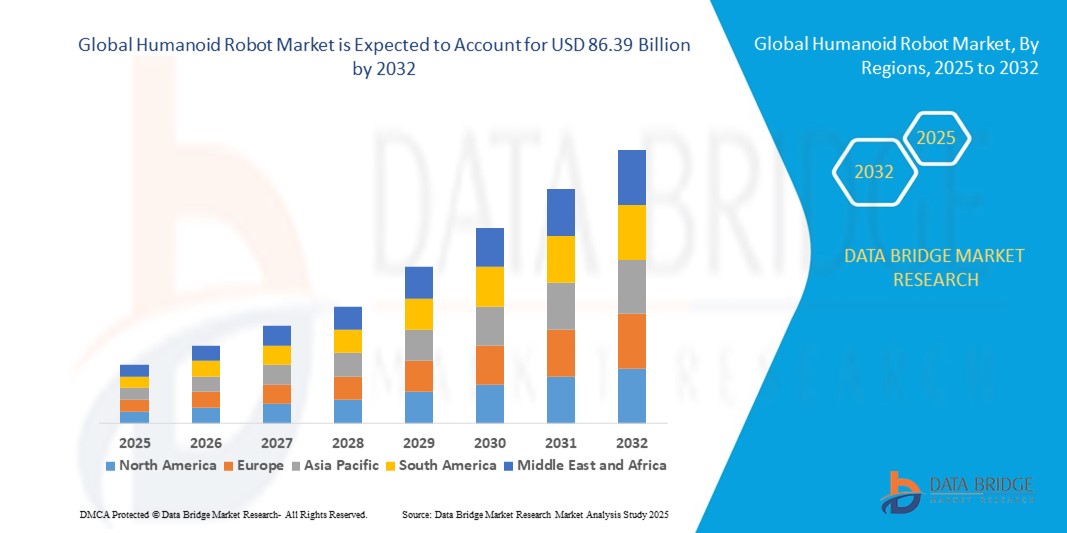
- As per Data Bridge Market Research Analysis theglobal humanoid robot market size was valued at USD 3.65 billion in 2024 and is expected to reach USD 86.39 billion by 2032, at a CAGR of 48.5% during the forecast period
- The market growth is driven by increasing demand for automation, advancements in AI and machine learning, and growing applications in healthcare, personal assistance, and industrial sectors
- Rising consumer awareness of humanoid robots' capabilities in improving efficiency, safety, and human-robot interaction is further propelling market demand across various industries
Market Size and Forecast:
- Global Market Value (2024): USD 3.65 billion
- Expected Market Value (2032): USD 86.39 billion
- Forecast CAGR (2025–2032): 48.5%
What are the Major Takeaways of Humanoid Robot Market?
- The humanoid robot market is experiencing robust growth due to increasing adoption in industries seeking automation, enhanced human-robot collaboration, and advanced functionalities such as AI-driven decision-making and natural language processing
- Demand from both industrial and consumer segments is encouraging manufacturers to innovate with advanced sensors, AI algorithms, and durable bipedal or wheel-driven designs
- North America dominates the humanoid robot market with the largest revenue share of 52.7% in 2024, driven by a mature robotics industry, significant R&D investments, and widespread adoption in healthcare and manufacturing
- Asia-Pacific is expected to be the fastest-growing region during the forecast period, fueled by rapid industrialization, increasing investments in AI and robotics, and rising demand in countries such as China, Japan, and South Korea
- The wheel drive segment dominated the largest market revenue share of 65.6% in 2024, driven by its effective mobility and adaptable maneuverability, enabling applications in customer service, education, and entertainment. Instances include SoftBank’s Pepper and UBTECH’s Alpha Mini, which leverage wheel-based systems for seamless navigation in human-centric environments
Report Scope and Humanoid Robot Market Segmentation
|
Attributes |
Humanoid Robot Key Market Insights |
|
Segments Covered |
|
|
Countries Covered |
North America
Europe
Asia-Pacific
Middle East and Africa
South America
|
|
Key Market Players |
|
|
Market Opportunities |
|
|
Value Added Data Infosets |
In addition to the insights on market scenarios such as market value, growth rate, segmentation, geographical coverage, and major players, the market reports curated by the Data Bridge Market Research also include in-depth expert analysis, geographically represented company-wise production and capacity, network layouts of distributors and partners, detailed and updated price trend analysis and deficit analysis of supply chain and demand. |
What are the Humanoid Robot Market Trends?
Increasing Integration of Advanced AI and Machine Learning
- The global humanoid robot market is experiencing a significant trend toward integrating advanced Artificial Intelligence (AI) and Machine Learning (ML) technologies
- These technologies enable sophisticated data processing, real-time decision-making, and enhanced adaptability, providing deeper insights into robot performance, human interaction, and environmental awareness
- AI-powered humanoid robots facilitate proactive problem-solving, such as anticipating maintenance needs or optimizing tasks such as navigation and manipulation in dynamic environments
- For instances, companies are developing AI-driven platforms that analyze human behavior to improve robot-assisted caregiving or optimize industrial inspection processes based on real-time environmental data
- This trend enhances the value proposition of humanoid robots, making them more appealing to industries such as healthcare, manufacturing, and hospitality
- AI and ML algorithms can analyze complex datasets, including human speech patterns, gestures, and contextual cues, to improve functionalities such as natural language processing, autonomous decision-making, and human-robot interaction
Humanoid Robot Market Dynamics
Driver
Rising Demand for Automation and Human-Robot Collaboration
- Increasing demand for automation in industries such as manufacturing, healthcare, and retail is a major driver for the global humanoid robot market
- Humanoid robots enhance operational efficiency through functionalities such as perception and sensing, mobility and navigation, and autonomous decision-making, which are critical for tasks such as material handling, caregiving, and customer service
- Government initiatives and investments in robotics research, particularly in North America, which dominates the market, are accelerating the adoption of humanoid robots
- The proliferation of IoT and advancements in 5G technology enable faster data transmission and lower latency, supporting sophisticated applications such as real-time human interaction and remote operation in humanoid robots
- Manufacturers are increasingly integrating humanoid robots with advanced features such as computer vision, deep learning, and neural networks as standard offerings to meet industry demands and enhance operational value
Restraint/Challenge
High Development Costs and Ethical Concerns
- The substantial initial investment required for developing and deploying humanoid robots, including hardware, software, and integration of advanced technologies such as AI, ML, and neural networks, poses a significant barrier, particularly in emerging markets
- Integrating humanoid robots into existing workflows or environments can be complex and costly, requiring specialized infrastructure and expertise
- Ethical concerns, including job displacement, human-robot interaction safety, and the potential misuse of autonomous decision-making capabilities, present major challenges
- The fragmented regulatory landscape across regions, particularly regarding AI ethics, data privacy, and robot safety standards, complicates operations for global manufacturers and service providers
- These factors can deter adoption, especially in regions such as Asia-Pacific, the fastest-growing market, where cost sensitivity and ethical considerations may impact market expansion
Humanoid Robot market Scope
The market is segmented on the basis of motion type, technology, functionality, application, and end user.
- By Motion Type
On the basis of motion type, the global humanoid robot market is segmented into wheel drive and biped. The wheel drive segment dominated the largest market revenue share of 65.6% in 2024, driven by its effective mobility and adaptable maneuverability, enabling applications in customer service, education, and entertainment. Instances include SoftBank’s Pepper and UBTECH’s Alpha Mini, which leverage wheel-based systems for seamless navigation in human-centric environments.
The biped segment is anticipated to witness the fastest growth rate of 52.3% from 2025 to 2032, fueled by increasing demand for human-such as mobility to navigate complex environments and perform intricate tasks with precision. Advancements in AI and biomechanics enhance bipedal robots’ autonomy and adaptability, making them ideal for applications such as personal assistance and caregiving.
- By Technology
On the basis of technology, the global humanoid robot market is segmented into traditional, computer vision, AI & machine learning (ML), natural language, deep learning, neural network, and others. The AI & ML segment is expected to hold the largest market revenue share of 35% in 2024, owing to its critical role in enhancing robot decision-making, autonomy, and interaction capabilities. AI-powered systems enable robots to learn from experiences and adapt to dynamic environments, driving adoption across industries.
The deep learning segment is projected to experience the fastest growth from 2025 to 2032, driven by its ability to improve robots’ perception, pattern recognition, and real-time processing. This supports advanced functionalities such as facial recognition and environmental awareness, particularly in healthcare and surveillance applications.
- By Functionality
On the basis of functionality, the global humanoid robot market is segmented into perception & sensing, human interaction & communication, mobility & navigation, learning and adaptation, manipulation and grasping, autonomous decision making, and others. The perception & sensing segment is expected to hold the largest market revenue share of 31% in 2024, driven by the critical need for advanced sensors to enable robots to interpret and interact with their surroundings effectively.
The human interaction & communication segment is anticipated to witness robust growth from 2025 to 2032, propelled by rising demand for robots capable of natural language processing, emotional recognition, and seamless human-robot interaction. This is particularly relevant in hospitality and caregiving, where empathetic engagement enhances user experience.
- By Application
On the basis of application, the global humanoid robot market is segmented into inspection, maintenance & material handling, research & space exploration, personal assistance & caregiving, security and surveillance, search and rescue, and others. The personal assistance & caregiving segment is expected to hold the largest market revenue share of 31.6% in 2024, driven by the growing aging population and demand for assistive robots in healthcare and elderly care, exemplified by robots such as TMSUK’s Robear for patient lifting.
The education & entertainment segment is projected to witness the fastest growth from 2025 to 2032, fueled by increasing adoption of humanoid robots in classrooms for computational thinking and interactive learning, as well as in entertainment for immersive experiences. Innovations such as Maker Labs’ AI teacher robot highlight this trend.
- By End User
On the basis of end user, the global humanoid robot market is segmented into manufacturing, healthcare, research & education, hospitality, retail, entertainment and gaming, agriculture, BFSI (banking, financial services, and insurance), and others. The healthcare segment is expected to hold the largest market revenue share of 28% in 2024, driven by the critical role of humanoid robots in patient care, surgical assistance, and rehabilitation, supported by advancements in AI and sensor integration.
The education segment is anticipated to experience rapid growth of 49% from 2025 to 2032, fueled by increasing adoption of humanoid robots for personalized learning and student engagement. Robots such as SoftBank’s Pepper are being integrated into educational settings to enhance teaching and computational thinking.
Humanoid Robot Market Regional Analysis
- North America dominates the humanoid robot market with the largest revenue share of 52.7% in 2024, driven by a mature robotics industry, significant R&D investments, and widespread adoption in healthcare and manufacturing
- Consumers and industries prioritize humanoid robots for enhancing operational efficiency, improving human-robot interaction, and addressing labor shortages, particularly in regions with advanced industrial and healthcare sectors
- Growth is supported by advancements in AI, machine learning, and sensor technologies, alongside increasing adoption in both commercial and consumer segments
U.S. Humanoid Robot Market Insight
The U.S. humanoid robot market captured the largest revenue share of 81.7% in 2024 within North America, fueled by strong investments in robotics R&D and growing demand for automation in manufacturing and healthcare. The trend towards integrating humanoid robots for tasks such as material handling and eldercare, coupled with supportive government policies, boosts market expansion. Companies such as Boston Dynamics and Figure AI are driving innovation, with robots such as Atlas and Figure 02 being developed for diverse applications.
Europe Humanoid Robot Market Insight
The European humanoid robot market is expected to witness significant growth, supported by regulatory emphasis on automation and safety standards. Consumers and industries seek robots with advanced functionalities such as human interaction and autonomous decision-making to improve productivity and service quality. The growth is prominent in both industrial automation and service applications, with countries such as Germany and France showing significant uptake due to technological advancements and labor shortages.
U.K. Humanoid Robot Market Insight
The U.K. market for humanoid robots is expected to witness rapid growth, driven by demand for enhanced human-robot interaction and automation in urban settings. Increased interest in applications such as personal assistance and public relations, along with rising awareness of AI-driven solutions, encourages adoption. Evolving regulations on safe human-robot collaboration influence market dynamics, balancing functionality with compliance.
Germany Humanoid Robot Market Insight
Germany is expected to witness rapid growth in the humanoid robot market, attributed to its advanced manufacturing sector and high focus on automation and efficiency. German industries prefer robots with advanced AI and machine learning capabilities for tasks such as inspection and material handling. The integration of these robots in premium manufacturing and healthcare applications supports sustained market growth.
Asia-Pacific Humanoid Robot Market Insight
The Asia-Pacific region is expected to witness the fastest growth rate, driven by expanding robotics industries and rising investments in countries such as China, Japan, and South Korea. Increasing awareness of automation benefits, labor shortages, and government initiatives promoting smart technologies boost demand. The region’s strong robotics culture and major players such as SoftBank Robotics and UBTECH accelerate market penetration.
Japan Humanoid Robot Market Insight
Japan’s humanoid robot market is expected to witness the fastest growth rate due to strong consumer and industrial preference for high-quality, AI-driven robots that enhance operational efficiency and human interaction. The presence of major manufacturers such as SoftBank Robotics, with robots such as Pepper, and government support for robotics innovation drive market growth. Rising interest in service and caregiving applications also contributes significantly.
China Humanoid Robot Market Insight
China holds the largest share of the Asia-Pacific humanoid robot market, propelled by rapid industrialization, increasing automation needs, and a growing focus on smart technologies. The country’s expanding manufacturing and healthcare sectors, coupled with government initiatives such as "Made in China 2025," support the adoption of advanced humanoid robots. Competitive pricing and strong domestic manufacturing capabilities enhance market accessibility.
Which are the Top Companies in Humanoid Robot Market?
The humanoid robot industry is primarily led by well-established companies, including:
- Boston Dynamics (U.S.)
- HANSON ROBOTICS LTD (Hong Kong)
- Engineered Arts Ltd (U.K.)
- Sanctuary Cognitive Systems Corporation (Canada)
- SoftBank Robotics America, Inc. (U.S.)
- NASA (U.S.)
- TOYOTA MOTOR CORPORATION (Japan)
- UBTECH ROBOTICS CORP LTD (China)
- Agility Robotics (U.S.)
- APPTRONIK (U.S.)
- KAWADA TECHNOLOGIES, Inc. (Japan)
- Honda Motor Co., Ltd. (Japan)
- PAL Robotics (Spain)
- Macco Tecnología para el ocio, S.L. (Spain)
- Tesla (U.S.)
- promobot (Russia)
- Invento Research Inc. (Saudi Arabia)
- Beyond Imagination (U.S.)
What are the Recent Developments in Global Humanoid Robot Market?
- In December 2024, Apptronik, a leading developer of humanoid robots, announced a strategic partnership with Google DeepMind to advance the development of intelligent, general-purpose humanoid robots. The collaboration merges Apptronik’s cutting-edge robotics platform with DeepMind’s AI expertise, including its work on foundation models and embodied intelligence. Together, the companies aim to create robots capable of operating safely and effectively in dynamic environments, addressing real-world challenges across industries. This partnership reflects a shared vision to transform the future of robotics by integrating advanced reasoning and action capabilities into human-centered machines
- In November 2024, maxon, a global leader in high-precision drive systems, unveiled the first complete prototype of its humanoid robot, HOPE, at the SPS 2024 trade show in Nuremberg. Standing two meters tall, HOPE is powered by maxon EC-i motors, EPOS4 controllers, and features advanced balance and motion capabilities, able to operate autonomously for up to an hour. This development highlights how innovations in motors, gearheads, and controllers are driving the evolution of sophisticated humanoid robots. HOPE represents a practical showcase of maxon’s robotics expertise and its commitment to enabling next-generation automation
- In April 2024, Sanctuary AI, a Vancouver-based robotics company, unveiled the seventh generation of its Phoenix humanoid robot, marking a major leap in general-purpose robotics. The upgraded Phoenix features enhanced range of motion, visual acuity, and tactile sensing, along with a refined AI control system called Carbon™. These improvements allow the robot to automate new tasks in under 24 hours, a 50x speed increase over previous models. Sanctuary AI’s goal is to create human-such as intelligence in robots, and this launch highlights the rapid innovation driving the future of AI-powered humanoid systems
- In March 2024, Accenture made a strategic investment in Sanctuary AI, a Vancouver-based developer of AI-powered humanoid robots, through its Accenture Ventures arm. The partnership aims to bring general-purpose robots—capable of performing diverse tasks safely and efficiently—to industries such as manufacturing, retail, logistics, and warehousing. Sanctuary’s flagship robot, Phoenix, is powered by the Carbon™ AI control system, which mimics human cognitive functions such as memory, sight, and touch. This collaboration addresses growing labor shortages and reflects Accenture’s commitment to human-centric automation and responsible AI innovation
- In February 2024, Figure AI, a California-based startup developing humanoid robots, secured a massive Series B funding round from high-profile investors including Nvidia, Jeff Bezos OpenAI, and Microsoft. The investment and aims to accelerate the development and commercial deployment of its general-purpose robot, Figure 01, designed to perform everyday tasks autonomously. The funding also supports a strategic partnership with OpenAI to integrate advanced AI models into robotics, signaling strong confidence in the commercial potential of AI-powered humanoid technologies

- Interactive Data Analysis Dashboard
- Company Analysis Dashboard for high growth potential opportunities
- Research Analyst Access for customization & queries
- Competitor Analysis with Interactive dashboard
- Latest News, Updates & Trend analysis
- Harness the Power of Benchmark Analysis for Comprehensive Competitor Tracking
Global Humanoid Robot Market, Supply Chain Analysis and Ecosystem Framework
To support market growth and help clients navigate the impact of geopolitical shifts, DBMR has integrated in-depth supply chain analysis into its Global Humanoid Robot Market research reports. This addition empowers clients to respond effectively to global changes affecting their industries. The supply chain analysis section includes detailed insights such as Global Humanoid Robot Market consumption and production by country, price trend analysis, the impact of tariffs and geopolitical developments, and import and export trends by country and HSN code. It also highlights major suppliers with data on production capacity and company profiles, as well as key importers and exporters. In addition to research, DBMR offers specialized supply chain consulting services backed by over a decade of experience, providing solutions like supplier discovery, supplier risk assessment, price trend analysis, impact evaluation of inflation and trade route changes, and comprehensive market trend analysis.
Data collection and base year analysis are done using data collection modules with large sample sizes. The stage includes obtaining market information or related data through various sources and strategies. It includes examining and planning all the data acquired from the past in advance. It likewise envelops the examination of information inconsistencies seen across different information sources. The market data is analysed and estimated using market statistical and coherent models. Also, market share analysis and key trend analysis are the major success factors in the market report. To know more, please request an analyst call or drop down your inquiry.
The key research methodology used by DBMR research team is data triangulation which involves data mining, analysis of the impact of data variables on the market and primary (industry expert) validation. Data models include Vendor Positioning Grid, Market Time Line Analysis, Market Overview and Guide, Company Positioning Grid, Patent Analysis, Pricing Analysis, Company Market Share Analysis, Standards of Measurement, Global versus Regional and Vendor Share Analysis. To know more about the research methodology, drop in an inquiry to speak to our industry experts.
Data Bridge Market Research is a leader in advanced formative research. We take pride in servicing our existing and new customers with data and analysis that match and suits their goal. The report can be customized to include price trend analysis of target brands understanding the market for additional countries (ask for the list of countries), clinical trial results data, literature review, refurbished market and product base analysis. Market analysis of target competitors can be analyzed from technology-based analysis to market portfolio strategies. We can add as many competitors that you require data about in the format and data style you are looking for. Our team of analysts can also provide you data in crude raw excel files pivot tables (Fact book) or can assist you in creating presentations from the data sets available in the report.













