What is the Hybrid Printing Technologies Market Size and Growth Rate?
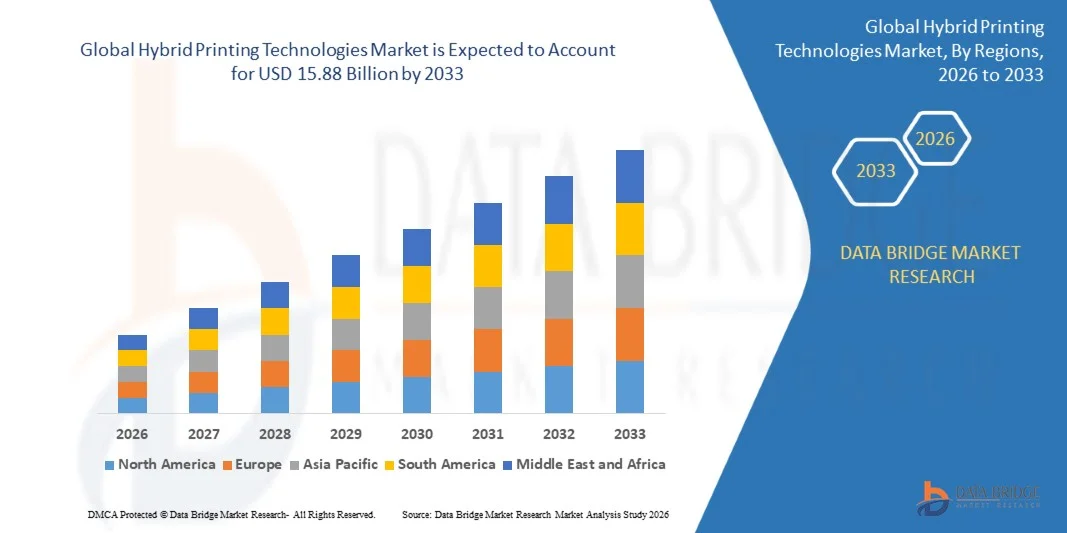
- As per Data Bridge Market Research analysis, the hybrid printing technologies market was valued at USD 5.49 billion in 2025 and is projected to reach USD 15.88 billion by 2033, growing at a CAGR of 14.20% from 2026 to 2033.
- The market is experiencing strong growth driven by rising demand for short-run and mass-customized packaging, increasing adoption of hybrid presses that combine analog speed with digital versatility, and growing investment in automation and AI-driven print workflows.
- The rising need for cost-effective, high-quality, and sustainable printing solutions, combined with brand owners' growing preference for personalized packaging and labels, is compelling converters, commercial printers, and textile manufacturers to adopt hybrid printing platforms that integrate offset, flexographic, screen, and gravure processes with inkjet digital units.
Market Size & Forecast
- Global Market Value (2025): USD 5.49 Billion
- Expected Market Value (2033): USD 15.88 Billion
- Forecast CAGR (2026–2033): 14.20%
- Leading Region in 2025: Asia-Pacific
- Fastest Growing Region: North America
What are the Major Takeaways of the Hybrid Printing Technologies Market?
- Asia-Pacific dominated the global hybrid printing technologies market with the largest revenue share of 38.46% in 2025, supported by the region's large packaging and label converting base and rising investment in printing infrastructure across China, India, and Japan.
- North America is expected to be the fastest-growing region at a CAGR of 16.5% from 2026 to 2033, fueled by early adoption of automation, rising demand for personalized packaging, and strong presence of leading hybrid press manufacturers.
- The offset-digital hybrid systems segment led the market with a 34.82% share in 2025, driven by wide use in commercial and publication printing where high analog print quality is paired with digital variable-data capability.
- Screen-digital hybrid systems are the fastest-growing technology type, projected to register a CAGR of 16.4%, reflecting rising demand for functional, textile, and industrial printing applications.
- The packaging & labels segment dominated the application category with a 42.15% revenue share in 2025, led by brand owners' growing preference for short-run, mass-customized, and track-and-trace-enabled packaging.
- The hardware component accounted for 52.30% of the market share in 2025, while the software segment is the fastest-growing component category, with a CAGR of 16.8%, driven by demand for workflow automation, color management, and AI-based print optimization tools.
Report Scope and Hybrid Printing Technologies Market Segmentation
|
Segments Covered |
|
|
Countries Covered |
North America
Europe
Asia-Pacific
Middle East and Africa
South America
|
|
Key Market Players |
|
|
Market Opportunities |
|
|
Value Added Data Infosets |
In addition to the insights on market scenarios such as market value, growth rate, segmentation, geographical coverage, and major players, the market reports curated by the Data Bridge Market Research also include in-depth expert analysis, geographically represented company-wise production and capacity, network layouts of distributors and partners, detailed and updated price trend analysis and deficit analysis of supply chain and demand. |
What is the Key Trend in the Hybrid Printing Technologies Market?
- Print service providers and converters are increasingly adopting hybrid presses that combine analog and digital print engines in a single pass, enabling short-run personalization without sacrificing the speed and cost advantages of conventional printing.
- For instance, in January 2025, BOBST showcased its DIGITAL MASTER 340/510 All-in-One and DIGITAL EXPERT 340 hybrid presses for narrow and mid-web label and packaging printing at Gulf Print & Pack 2025, highlighting continued demand for combined flexo-digital production lines.
- Embellishment and specialty-finishing capabilities are becoming a key differentiator, with press manufacturers integrating inline coating, foiling, and toner-based embellishment stations into hybrid production workflows.
- For instance, in June 2025, FUJIFILM North America highlighted the embellishment capabilities of its REVORIA PRESS series, including the SC285S with a specialty-toner station enabling five-color printing in a single pass for enhanced print effects.
- Software-driven workflow integration is emerging as a core trend, with RIP, digital front-end, and AI-based color and press-optimization tools being bundled with hybrid hardware to streamline job changeovers between analog and digital modes.
- As converters and commercial printers continue to prioritize flexibility, waste reduction, and faster turnaround, the adoption of hybrid printing platforms is expected to accelerate, reinforcing hybrid systems as a core component of next-generation packaging and commercial print production.
What are the Key Drivers of the Hybrid Printing Technologies Market?
- The rising demand for short-run, mass-customized, and versioned packaging has significantly increased demand for hybrid presses capable of combining high-speed analog printing with variable-data digital capability.
- For instance, in July 2025, Hybrid Software Group reported continued growth in OEM royalties from digital presses incorporating its Harlequin RIP and SmartDFE digital front-end software, reflecting rising integration of AI-optimized software into hybrid and digital press platforms.
- Brand owners and converters are increasingly integrating hybrid printing into their production lines to reduce changeover times, minimize material waste, and shorten time-to-market for new packaging designs and promotional print runs.
- For instance, in November 2025, Belgium-based converter Vitrapack expanded its flexographic printing capacity with a new 10-colour BOBST EXPERT CI press featuring smartGPS registration technology, reflecting continued investment in advanced, automation-enabled printing platforms across the packaging industry.
- With brand owners increasingly relying on flexible, waste-efficient, and rapidly reconfigurable production lines, hybrid printing technologies will remain central to the modernization of packaging, label, and commercial print manufacturing.
Which Factors are Challenging the Growth of the Hybrid Printing Technologies Market?
- Hybrid printing systems require significant upfront capital investment due to the integration of analog print engines, digital inkjet or toner units, inline finishing modules, and advanced workflow software.
- These high costs limit adoption among smaller commercial printers, converters, and organizations in price-sensitive and emerging markets.
- The high capital investment and recurring costs of consumables, maintenance, and software licensing associated with advanced hybrid presses continue to restrict adoption, particularly among small and medium-sized print service providers. This cost barrier slows market penetration in price-sensitive regions, limiting the widespread deployment of hybrid printing technologies despite growing demand for flexible production.
How is the Hybrid Printing Technologies Market Segmented?
The hybrid printing technologies market is segmented on the basis of technology, component, ink type, substrate, print width, application, end user, and deployment mode.
- By Technology
On the basis of technology, the global hybrid printing technologies market is segmented into offset-digital hybrid systems, flexographic-digital hybrid systems, screen-digital hybrid systems, and gravure-digital hybrid systems. The offset-digital hybrid systems segment dominated the market with a 34.82% share in 2025, owing to its widespread use in commercial and publication printing, where high-fidelity analog output is combined with digital variable-data capability for personalization and versioning.
The screen-digital hybrid systems segment is projected to register the fastest growth at a CAGR of 16.4% from 2026 to 2033, driven by rising demand for functional, textile, and industrial printing applications that require the durability of screen printing alongside digital design flexibility.
- By Component
On the basis of component, the global hybrid printing technologies market is segmented into hardware, software, and services. The hardware segment led the market with a 52.30% share in 2025, supported by continued investment in press engines, substrate-handling systems, and inline finishing modules by converters and commercial printers.
The software segment is expected to witness the fastest CAGR of 16.8% from 2026 to 2033, driven by rising adoption of workflow automation, RIP and digital front-end tools, and AI-based color-management and press-optimization software.
- By Ink Type
On the basis of ink type, the global hybrid printing technologies market is segmented into UV-curable inks, water-based inks, solvent-based inks, and latex inks. The UV-curable inks segment dominated the market with a 39.14% share in 2025, owing to fast curing, strong adhesion across substrates, and wide use in packaging and label printing.
The water-based inks segment is expected to witness the fastest CAGR of 16.1% from 2026 to 2033, driven by rising demand for sustainable, low-VOC printing solutions in food-contact packaging and textile applications.
- By Substrate
On the basis of substrate, the global hybrid printing technologies market is segmented into paper & paperboard, plastics & films, textiles, metals & foils, and glass & ceramics. The paper & paperboard segment led the market with a 33.67% share in 2025, driven by extensive use in packaging, labels, and commercial print applications.
The plastics & films segment is expected to register the fastest CAGR of 15.9% from 2026 to 2033, supported by rising demand for flexible packaging and durable label applications across the food & beverage and consumer goods industries.
- By Print Width
On the basis of print width, the global hybrid printing technologies market is segmented into narrow web, mid web, and wide web. The narrow web segment dominated the market with a 46.52% share in 2025, owing to its widespread use in label and packaging converting operations that require frequent job changeovers.
The wide web segment is expected to witness the fastest CAGR of 15.7% from 2026 to 2033, driven by rising demand for flexible packaging, industrial films, and large-format signage and display graphics.
- By Application
On the basis of application, the global hybrid printing technologies market is segmented into packaging & labels, commercial & publication printing, textile & apparel printing, industrial & functional printing, and signage & display graphics. The packaging & labels segment dominated the market with a 42.15% share in 2025, driven by growing demand for short-run, mass-customized, and track-and-trace-enabled packaging formats.
The textile & apparel printing segment is expected to witness the fastest CAGR of 16.7% from 2026 to 2033, driven by rising adoption of hybrid digital-analog platforms that combine high-volume base printing with digital design personalization.
- By End User
On the basis of end user, the global hybrid printing technologies market is segmented into packaging industry, publishing & commercial printing companies, textile & apparel manufacturers, electronics & industrial manufacturers, and retail & advertising agencies. The packaging industry segment dominated the market with a 44.28% share in 2025, supported by strong demand from food & beverage, pharmaceutical, and consumer goods brand owners for flexible, high-quality packaging production.
The electronics & industrial manufacturers segment is expected to witness the fastest CAGR of 16.3% from 2026 to 2033, driven by growing use of hybrid printing platforms in functional and printed-electronics applications such as sensors, conductive circuits, and RFID components.
- By Deployment Mode
On the basis of deployment mode, the global hybrid printing technologies market is segmented into sheet-fed and web-fed. The web-fed segment dominated the market with a 58.73% share in 2025, owing to its wide use in high-volume label and flexible-packaging converting operations that require continuous roll-to-roll production.
The sheet-fed segment is expected to witness the fastest CAGR of 15.2% from 2026 to 2033, driven by rising adoption of hybrid sheet-fed presses in short-run commercial printing, folding cartons, and specialty embellishment applications.
Which Region Holds the Largest Share of the Hybrid Printing Technologies Market?
- Asia-Pacific dominated the hybrid printing technologies market and accounted for the largest revenue share of 38.46% in 2025, supported by the region's large converting and packaging manufacturing base, rising investment in printing infrastructure, and growing adoption of digital-analog hybrid platforms across China, India, and Japan.
- The region also benefits from expanding e-commerce and consumer goods packaging demand, a strong base of press and converting-equipment manufacturers, and increasing focus on automation and sustainable printing practices, which continue to strengthen Asia-Pacific's leadership position in the global market.
China Hybrid Printing Technologies Market Insight
The China hybrid printing technologies market is growing rapidly, driven by the country's large converting and packaging manufacturing base, expanding e-commerce sector, and rising government focus on advanced manufacturing. Growing adoption of digital-analog hybrid platforms across packaging, label, and textile printing applications is significantly boosting market demand, positioning China as one of the fastest-growing markets for hybrid printing technologies globally.
India Hybrid Printing Technologies Market Insight
The India hybrid printing technologies market is witnessing consistent growth due to rising investments in packaging and label converting infrastructure, expanding consumer goods and pharmaceutical sectors, and increasing adoption of flexible, short-run printing solutions. Growing integration of digital front-end and workflow-automation software is further contributing to market growth in India.
U.S. Hybrid Printing Technologies Market Insight
The U.S. hybrid printing technologies market is experiencing steady growth, supported by rising adoption of hybrid presses among commercial printers, packaging converters, and brand owners seeking short-run personalization and faster turnaround. Increasing investment in automation, embellishment, and AI-driven workflow software is improving production efficiency, positioning the U.S. as a key innovation hub for hybrid printing platforms.
Germany Hybrid Printing Technologies Market Insight
The Germany hybrid printing technologies market is expanding steadily, supported by the country's strong printing-equipment manufacturing base and presence of leading press OEMs. Converters, publishers, and packaging manufacturers are increasingly adopting hybrid systems for commercial print, label, and packaging production, while continued advancements in press automation and inline finishing are reinforcing market growth in Germany.
Which are the Top Companies in the Hybrid Printing Technologies Market?
The hybrid printing technologies industry is primarily led by well-established companies, including:
- HP Inc. (U.S.)
- Heidelberger Druckmaschinen AG (Germany)
- Koenig & Bauer AG (Germany)
- Bobst Group SA (Switzerland)
- Durst Group AG (Italy)
- Electronics For Imaging, Inc. (EFI) (U.S.)
- Konica Minolta, Inc. (Japan)
- Canon Inc. (Japan)
- Xerox Holdings Corporation (U.S.)
- Mark Andy Inc. (U.S.)
- Gallus Ferd. Rüesch AG (Switzerland)
- Domino Printing Sciences plc (U.K.)
- SCREEN Holdings Co., Ltd. (Japan)
- FUJIFILM Holdings Corporation (Japan)
- Ricoh Company, Ltd. (Japan)
- Seiko Epson Corporation (Japan)
- MGI Digital Technology (France)
- Comexi Group Industries, S.A.U. (Spain)
- Uteco Converting S.p.A. (Italy)
- Nilpeter A/S (Denmark)
- AB Graphic International Ltd. (U.K.)
- MPS Systems B.V. (Netherlands)
What are the Latest Developments in the Hybrid Printing Technologies Market?
- In January 2025, BOBST showcased its DIGITAL MASTER 340/510 All-in-One and DIGITAL EXPERT 340 hybrid presses for narrow and mid-web label and packaging printing at Gulf Print & Pack 2025 in Riyadh, alongside live demonstrations from Konica Minolta, Ricoh, Canon, and Fujifilm, reflecting continued industry investment in combined flexo-digital and analog-digital production lines.
- In June 2025, FUJIFILM North America highlighted the embellishment capabilities of its REVORIA PRESS series at Amplify Print 2025 and the IPMA Education Conference, including the SC285S press equipped with a specialty-toner station enabling five-color printing in a single pass for enhanced print effects.
- In July 2025, Hybrid Software Group reported growing OEM royalties from digital presses incorporating its Harlequin RIP and SmartDFE, its AI-optimized digital front-end software, alongside the launch of Mako Apex, a GPU-accelerated rendering engine designed to improve performance and reduce computing costs for OEM press partners.
- In July 2025, Fujifilm further expanded its print-embellishment portfolio at IPIC 2025, showcasing REVORIA PRESS output paired with Skandacor's LAMpro Cheetah S15 Photo laminate technology to replicate traditional photographic finishes on digitally printed output.
- In October 2025, Xerox presented its end-to-end production ecosystem spanning pre-press, on-press, and finishing at PRINTING United Expo 2025, including the newly introduced IJP900 InkJet Press, underscoring continued innovation in high-speed digital and hybrid production platforms.
- In November 2025, Belgium-based converter Vitrapack expanded its flexographic printing capacity with the installation of a new 10-colour BOBST EXPERT CI press featuring smartGPS registration and impression-setting technology, reflecting continued investment in automation-enabled printing platforms across the packaging industry.

- Interactive Data Analysis Dashboard
- Company Analysis Dashboard for high growth potential opportunities
- Research Analyst Access for customization & queries
- Competitor Analysis with Interactive dashboard
- Latest News, Updates & Trend analysis
- Harness the Power of Benchmark Analysis for Comprehensive Competitor Tracking
Data collection and base year analysis are done using data collection modules with large sample sizes. The stage includes obtaining market information or related data through various sources and strategies. It includes examining and planning all the data acquired from the past in advance. It likewise envelops the examination of information inconsistencies seen across different information sources. The market data is analysed and estimated using market statistical and coherent models. Also, market share analysis and key trend analysis are the major success factors in the market report. To know more, please request an analyst call or drop down your inquiry.
The key research methodology used by DBMR research team is data triangulation which involves data mining, analysis of the impact of data variables on the market and primary (industry expert) validation. Data models include Vendor Positioning Grid, Market Time Line Analysis, Market Overview and Guide, Company Positioning Grid, Patent Analysis, Pricing Analysis, Company Market Share Analysis, Standards of Measurement, Global versus Regional and Vendor Share Analysis. To know more about the research methodology, drop in an inquiry to speak to our industry experts.
Data Bridge Market Research is a leader in advanced formative research. We take pride in servicing our existing and new customers with data and analysis that match and suits their goal. The report can be customized to include price trend analysis of target brands understanding the market for additional countries (ask for the list of countries), clinical trial results data, literature review, refurbished market and product base analysis. Market analysis of target competitors can be analyzed from technology-based analysis to market portfolio strategies. We can add as many competitors that you require data about in the format and data style you are looking for. Our team of analysts can also provide you data in crude raw excel files pivot tables (Fact book) or can assist you in creating presentations from the data sets available in the report.