What is the Global Hybrid Rice Seeds Market Size and Growth Rate?
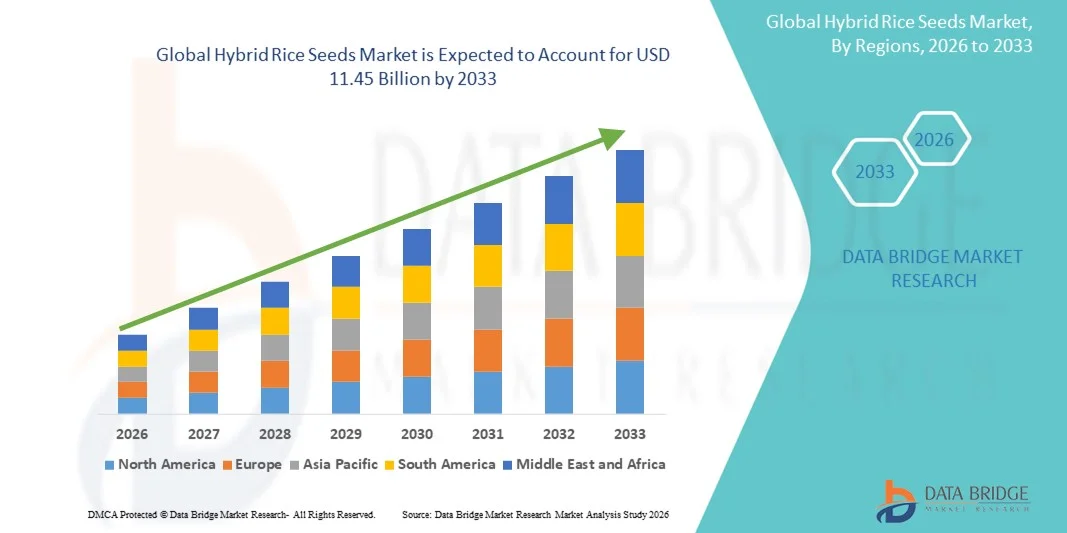
- As per Data Bridge Market Research Analysis the global hybrid rice seeds market size was valued at USD 4.40 billion in 2025 and is expected to reach USD 11.45 billion by 2033, at a CAGR of 12.70% during the forecast period
- Major factors that are expected to boost the growth of the hybrid rice seeds market in the forecast period are the rise in the seed replacement rate, enhanced varieties of hybrid seeds for rice and the growing of the rice demand across the globe
- Furthermore, the hybrid rice seeds have better tolerance for salinity provides an excellent solution for rice farmers, the increasing adoption for hybrid seeds in the advanced and developing countries, and unsuitable climatic conditions for crop production because of the global warming are some of the other factors anticipated to further propel the growth of the hybrid rice seeds market
Market Size & Forecast
- Global Market Value (2025): USD 4.40 Billion
- Expected Market Value (2033): USD 11.45 Billion
- Forecast CAGR (2026–2033): 12.70%
What are the Major Takeaways of Hybrid Rice Seeds Market?
- The low margin for industrial crops and the government guidelines on the genetic modifications are few of the factors responsible for the impeding the growth of the hybrid rice seeds market in the timeline period
- In addition, the arrival of new technologies, the molecular breeding and the rise in the export varieties will further offer growth opportunities for the hybrid rice seeds market in the coming years. However, the commercialization of fake hybrid rice seeds might further challenge the growth of the hybrid rice seeds market in the near future
- Asia-Pacific dominated the hybrid rice seeds market with a leading revenue share of 32.25% in 2025, supported by extensive rice cultivation, large-scale hybrid seed adoption, and strong governmental initiatives promoting high-yield varieties across China, India, Vietnam, the Philippines, and Indonesia
- North America is projected to record the fastest CAGR of 11.69% from 2026 to 2033, driven by rising adoption of hybrid rice varieties in the U.S., advanced breeding research, and increasing focus on water-efficient, stress-tolerant, and high-quality grain varieties
- The Long Grains segment dominated the market with a 44.7% share in 2025, driven by strong global consumer preference for slender, aromatic, and premium-quality rice varieties widely cultivated across India, China, Vietnam, and Southeast Asia
Report Scope and Hybrid Rice Seeds Market Segmentation
|
Attributes |
Hybrid Rice Seeds Key Market Insights |
|
Segments Covered |
|
|
Countries Covered |
North America
Europe
Asia-Pacific
Middle East and Africa
South America
|
|
Key Market Players |
|
|
Market Opportunities |
|
|
Value Added Data Infosets |
In addition to the insights on market scenarios such as market value, growth rate, segmentation, geographical coverage, and major players, the market reports curated by the Data Bridge Market Research also include in-depth expert analysis, pricing analysis, brand share analysis, consumer survey, demography analysis, supply chain analysis, value chain analysis, raw material/consumables overview, vendor selection criteria, PESTLE Analysis, Porter Analysis, and regulatory framework. |
What is the Key Trend in the Hybrid Rice Seeds Market?
Increasing Shift Toward High-Yield, Stress-Tolerant, and Climate-Smart Hybrid Rice Seeds
- The hybrid rice seeds market is witnessing rapid adoption of high-yield, drought-tolerant, and pest-resistant hybrid varieties designed to address climate variability, soil degradation, and rising global rice consumption
- Seed developers are introducing hybrids with shorter maturity cycles, better nitrogen-use efficiency, and stronger resilience to biotic and abiotic stresses, enabling higher productivity for farmers in Asia-Pacific, Africa, and Latin America
- Growing demand for cost-efficient, disease-resistant, and mechanization-friendly seed varieties is driving adoption among smallholder farmers and large-scale rice producers
- For instance, companies such as RiceTec, Longping High-Tech, Advanta, and BASF continue to expand their hybrid rice portfolios with improved grain quality, heat tolerance, and higher harvest index
- Increasing need for food security, consistent yields, and climate-resilient agricultural inputs is accelerating the shift toward next-generation hybrid rice
- As global population grows and environmental pressures intensify, hybrid rice seeds will remain essential for sustainable crop production, higher farm profitability, and long-term food supply stability
What are the Key Drivers of Hybrid Rice Seeds Market?
- Rising need for high-yielding, cost-effective, and disease-resistant rice varieties to meet food demand across rapidly growing economies
- For instance, in 2024–2025, leading companies such as Longping High-Tech, Nuziveedu Seeds, and SL-Agritech expanded their hybrid seed lines to improve yield stability, drought tolerance, and grain quality
- Growing adoption of hybrid rice across China, India, Vietnam, the Philippines, and Africa is driven by rising food consumption, shrinking arable land, and government-led seed distribution programs
- Advancements in breeding technologies, genomic selection, trait stacking, and hybrid purity testing are enhancing productivity, seed quality, and production efficiency
- Rising integration of climate-smart traits, pest resistance, and abiotic stress tolerance is expanding the adoption of hybrid rice in risk-prone agricultural regions
- Supported by continuous investments in agriculture R&D, seed production infrastructure, and public–private partnerships, the Hybrid Rice Seeds market is expected to experience robust long-term growth
Which Factor is Challenging the Growth of the Hybrid Rice Seeds Market?
- High prices associated with premium, high-performing, and research-intensive hybrid rice seeds limit adoption among small and marginal farmers in developing regions
- For instance, during 2024–2025, fluctuations in fertilizer costs, seed production expenses, and climatic disruptions increased cultivation and seed multiplication costs for several global producers
- Complexity in producing pure hybrid seeds, maintaining genetic stability, and ensuring quality seed certification creates operational challenges for seed companies
- Limited farmer awareness in emerging markets regarding hybrid performance, agronomic practices, and return on investment slows market penetration
- Competition from open-pollinated varieties (OPVs), low-cost traditional seeds, and subsidized public-sector seeds creates pricing pressure and affects product differentiation
- To overcome these challenges, companies are focusing on cost-optimized seed production, training programs, demonstration trials, and localized breeding strategies to expand global hybrid rice adoption
How is the Hybrid Rice Seeds Market Segmented?
The market is segmented on the basis of grain size, duration, and product.
- By Grain Size
The hybrid rice seeds market is segmented into Long Grains, Medium-sized Grains, and Short Grains. The Long Grains segment dominated the market with a 44.7% share in 2025, driven by strong global consumer preference for slender, aromatic, and premium-quality rice varieties widely cultivated across India, China, Vietnam, and Southeast Asia. Long-grain hybrids offer higher yield stability, better cooking quality, and stronger export potential, making them the leading choice for commercial-scale farmers and rice millers. Their adaptability to diverse climatic conditions and compatibility with hybrid traits such as drought tolerance and pest resistance further contribute to their leadership.
The Short Grains segment is expected to grow at the fastest CAGR from 2026 to 2033, supported by rising demand for Japonica-type rice, expanding hybrid adoption in East Asia, and government-led programs promoting high-quality short-grain hybrids for domestic consumption and processed foods.
- By Duration
The market is segmented based on crop duration into Up to 110 Days, 111–140 Days, and 140+ Days. The 111–140 Days segment dominated the market with a 49.2% share in 2025, as mid-duration hybrids achieve an optimal balance between yield potential, grain quality, and climate adaptability. These hybrids are widely preferred in major rice-producing countries due to their resilience against lodging, heat stress, and common rice diseases. Their suitability for both irrigated and rainfed ecosystems makes them a preferred choice for multi-season farming.
The Up to 110 Days segment is projected to grow at the fastest CAGR from 2026 to 2033, driven by increasing demand for short-duration hybrids that support crop intensification, allow multiple harvest cycles in a year, and help farmers reduce irrigation costs. Rising adoption in regions practicing double and triple cropping is further boosting segment growth.
- By Product
The hybrid rice seeds market is segmented into 3-line Breeding Systems (CMS-based hybrids) and 2-line Breeding Systems (TGMS/PGMS-based hybrids). The 3-line Breeding Systems segment dominated the market with a 57.4% share in 2025, supported by its long-established adoption, mature technology base, and widespread use across Asia for high-yielding hybrid production. CMS-based hybrids offer strong genetic stability, proven large-scale production efficiency, and suitability across multiple agroclimatic zones, making them the most commercially preferred hybrid type.
The 2-line Breeding Systems segment is expected to grow at the fastest CAGR from 2026 to 2033, driven by expanding R&D, simplified seed production, and rising adoption of temperature- and photoperiod-sensitive genetic male sterility mechanisms. Their ability to produce broader hybrid combinations and reduce production complexities positions them as a key growth driver in next-generation hybrid rice development.
Which Region Holds the Largest Share of the Hybrid Rice Seeds Market?
- Asia-Pacific dominated the hybrid rice seeds market with a leading revenue share of 32.25% in 2025, supported by extensive rice cultivation, large-scale hybrid seed adoption, and strong governmental initiatives promoting high-yield varieties across China, India, Vietnam, the Philippines, and Indonesia. Rising focus on food security, climate-resilient varieties, and yield enhancement continues to accelerate the adoption of hybrid technologies across both irrigated and rainfed ecosystems
- Major seed producers in Asia-Pacific are expanding R&D programs focused on drought tolerance, pest resistance, and grain quality improvement, strengthening the region’s leadership in hybrid rice innovation. Continuous investment in breeding technologies and seed production infrastructure further boosts regional expansion
- Favorable agronomic conditions, large farmer population, and strong public-private partnerships reinforce Asia-Pacific’s dominant position in the global Hybrid Rice Seeds market
China Hybrid Rice Seeds Market Insight
China is the largest global contributor, supported by world-leading hybrid rice R&D, extensive seed multiplication capacity, and strong government policies encouraging hybrid adoption for yield improvement. Continuous breeding improvements in blast resistance, drought tolerance, and grain quality enhance domestic and export market growth. China’s large-scale hybrid adoption remains central to Asia-Pacific’s dominance.
Japan Hybrid Rice Seeds Market Insight
Japan shows stable growth, driven by rising demand for high-quality Japonica hybrids, modernization of rice farming, and increasing adoption of climate-resilient varieties. Strong research capabilities, mechanized farming systems, and emphasis on grain uniformity and milling quality support long-term hybrid adoption in the region.
India Hybrid Rice Seeds Market Insight
India is emerging as one of the fastest-expanding hybrid rice markets in Asia-Pacific, driven by rising acreage, government seed distribution programs, and strong participation from private seed companies. Growing adoption in both irrigated and rainfed regions, increasing demand for high-yield long-grain hybrids, and large-scale R&D investments continue to strengthen national market performance.
South Korea Hybrid Rice Seeds Market Insight
South Korea contributes significantly through advanced research on disease-resistant, climate-resilient, and premium-quality rice varieties. Increasing focus on food security, rising adoption of efficient seed technologies, and expanding hybrid field trials support steady market growth. Strong agricultural innovation programs and collaborations with global seed companies further enhance adoption rates.
North America Hybrid Rice Seeds Market
North America is projected to record the fastest CAGR of 11.69% from 2026 to 2033, driven by rising adoption of hybrid rice varieties in the U.S., advanced breeding research, and increasing focus on water-efficient, stress-tolerant, and high-quality grain varieties. Expanding acreage in southern U.S. states and ongoing trials for hybrid long-grain and medium-grain categories support regional growth. The region benefits from strong agricultural research institutions, advanced biotechnology capabilities, and private-sector breeding programs, which accelerate commercialization of next-generation hybrid lines. Increasing consumer demand for premium long-grain rice and rising export-oriented production contribute to the region’s high-growth outlook.
U.S. Hybrid Rice Seeds Market Insight
The U.S. is the primary contributor in North America, supported by strong breeding research, growing acceptance of hybrid long-grain and aromatic varieties, and rising demand for high-yield seeds among rice growers in Arkansas, Louisiana, and Texas. Ongoing development of disease-resistant hybrids, advancements in water-efficient cultivation systems, and expansion of field trials for improved grain quality continue to strengthen market adoption. Collaboration between universities, seed companies, and government research programs is further accelerating hybrid commercialization.
Canada Hybrid Rice Seeds Market Insight
Canada contributes modestly but increasingly to regional development, driven by expanding agricultural research programs, interest in climate-resilient seed varieties, and strong investment in biotechnology-driven crop improvement. Research institutions and seed companies are increasingly exploring hybrid rice adaptability under controlled and cold-environment trials. Rising government focus on agri-innovation, seed genetics, and grain-quality enhancement supports long-term market engagement.
Which are the Top Companies in Hybrid Rice Seeds Market?
The hybrid rice seeds industry is primarily led by well-established companies, including:
- Biostadt India Limited (India)
- Yuan Longping High Tech Agriculture Co., Ltd. (China)
- RiceTec Inc. (U.S.)
- Advanta Seeds (U.A.E.)
- BASF SE (Germany)
- Nirmal Seeds Pvt. Ltd. (India)
- WUHAN COMEGA SEED CO., LTD. (China)
- Nuziveedu Seeds (India)
- CHINA NATIONAL SEED GROUP CO., LTD. (China)
- Winall Hi-TECH Seed Co., Ltd. (China)
- SL-Agritech (India)
- Zhongnongfa Seed Industry Group Co Ltd (China)
- Hainan Shennong Technology Co., Ltd. (China)
- Hefei Fengle Seed Co., Ltd. (China)
- J.K. AgriGenetics Ltd (India)
What are the Recent Developments in Global Hybrid Rice Seeds Market?
- In June 2024, RiceTec Inc. introduced the FullPage Rice Cropping Solution in collaboration with its Indian affiliate Savannah Seeds and global crop protection partner ADAMA, integrating SmartRice genetics, SQUAD seed treatment, IMI herbicide tolerance, and ADAMA’s Vezir herbicide to support high-efficiency direct-seeded rice cultivation, strengthening the company’s position in advanced hybrid rice technologies
- In May 2021, RiceTec Inc., a major U.S.-based hybrid rice seed developer, launched its Max-Ace rice crop solution system in partnership with Adama Ltd., combining herbicide-tolerant rice cultivars with Adama’s proprietary herbicide to enhance weed control efficiency, reinforcing the firm’s commitment to innovative crop management platforms
- In January 2021, the Department of Agriculture (DA) urged seed companies to promote hybrid rice technology to local farmers during the Hybrid Rice Derby Field Day, where seven companies showcased hybrid rice solutions for the wet cropping season, supporting broader national adoption of high-yield hybrid varieties
- In November 2020, Corteva Agriscience expanded its entry into the hybrid rice seed market in Bihar and Jharkhand, India, training nearly 90,000 women farmers and village leaders in hybrid farming, agronomic practices, and post-transplantation care, strengthening community-level hybrid rice adoption and agricultural capacity-building

- Interactive Data Analysis Dashboard
- Company Analysis Dashboard for high growth potential opportunities
- Research Analyst Access for customization & queries
- Competitor Analysis with Interactive dashboard
- Latest News, Updates & Trend analysis
- Harness the Power of Benchmark Analysis for Comprehensive Competitor Tracking
Data collection and base year analysis are done using data collection modules with large sample sizes. The stage includes obtaining market information or related data through various sources and strategies. It includes examining and planning all the data acquired from the past in advance. It likewise envelops the examination of information inconsistencies seen across different information sources. The market data is analysed and estimated using market statistical and coherent models. Also, market share analysis and key trend analysis are the major success factors in the market report. To know more, please request an analyst call or drop down your inquiry.
The key research methodology used by DBMR research team is data triangulation which involves data mining, analysis of the impact of data variables on the market and primary (industry expert) validation. Data models include Vendor Positioning Grid, Market Time Line Analysis, Market Overview and Guide, Company Positioning Grid, Patent Analysis, Pricing Analysis, Company Market Share Analysis, Standards of Measurement, Global versus Regional and Vendor Share Analysis. To know more about the research methodology, drop in an inquiry to speak to our industry experts.
Data Bridge Market Research is a leader in advanced formative research. We take pride in servicing our existing and new customers with data and analysis that match and suits their goal. The report can be customized to include price trend analysis of target brands understanding the market for additional countries (ask for the list of countries), clinical trial results data, literature review, refurbished market and product base analysis. Market analysis of target competitors can be analyzed from technology-based analysis to market portfolio strategies. We can add as many competitors that you require data about in the format and data style you are looking for. Our team of analysts can also provide you data in crude raw excel files pivot tables (Fact book) or can assist you in creating presentations from the data sets available in the report.