


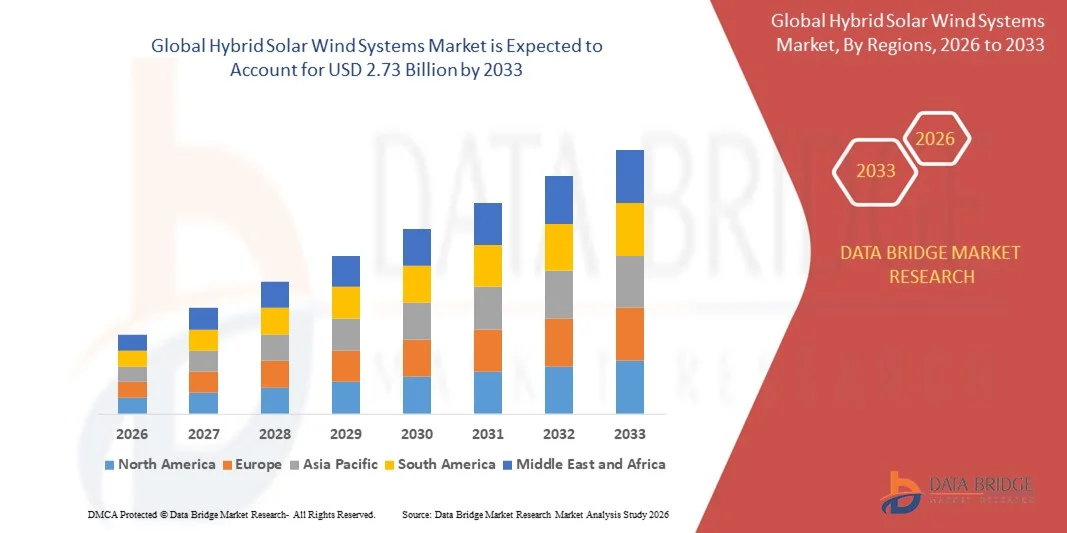
What is the Global Hybrid Solar Wind Systems Market Size and Growth Rate?
- The global hybrid solar wind systems market size was valued at USD 1.55 billion in 2025 and is expected to reach USD 2.73 billion by 2033, at a CAGR of 7.30% during the forecast period
- The growing awareness towards the use of renewable energy sources has highly influenced growth of the hybrid solar wind systems market. In line with this, the increasing public and private funding in off-grid along with increasing demand for reliable and continuous power supply associated with favorable government initiatives to conserve energy and reduce carbon footprints are also acting as a key determinant favoring the growth of the hybrid solar wind systems market
What are the Major Takeaways of Hybrid Solar Wind Systems Market?
- Strict environmental rules and regulation and technological advancement is also positively impacting the growth of the hybrid solar wind systems market. The major factor accountable for the growth of the market is the decreasing wind and solar component cost
- Beside this, the higher standard of living and rising investments in energy sector is also flourishing the growth of the hybrid solar wind systems market. However, the high initial costs and lack of awareness may act as key restraint towards hybrid solar wind systems market growth rate
- Asia-Pacific dominated the hybrid solar wind systems market with the largest revenue share of 43.5% in 2025, driven by rapid urbanization, rising population, and increasing energy demand in residential, commercial, and industrial sectors
- North America is projected to witness the fastest growth rate of 9.7% during 2026–2033, fueled by increasing adoption of hybrid energy systems in residential, commercial, and remote industrial facilities
- The Stand-Alone System segment dominated the market with the largest revenue share of 46.3% in 2025, driven by the growing demand for off-grid energy solutions in remote, rural, and industrial areas
Report Scope and Hybrid Solar Wind Systems Market Segmentation
|
Attributes |
Hybrid Solar Wind Systems Key Market Insights |
|
Segments Covered |
|
|
Countries Covered |
North America
Europe
Asia-Pacific
Middle East and Africa
South America
|
|
Key Market Players |
|
|
Market Opportunities |
|
|
Value Added Data Infosets |
In addition to the insights on market scenarios such as market value, growth rate, segmentation, geographical coverage, and major players, the market reports curated by the Data Bridge Market Research also include in-depth expert analysis, pricing analysis, brand share analysis, consumer survey, demography analysis, supply chain analysis, value chain analysis, raw material/consumables overview, vendor selection criteria, PESTLE Analysis, Porter Analysis, and regulatory framework. |
What is the Key Trend in the Hybrid Solar Wind Systems Market?
Rising Focus on Sustainable, High-Efficiency, and Integrated Renewable Energy Systems
- The Hybrid Solar Wind Systems market is witnessing a strong shift toward high-efficiency, environmentally sustainable, and integrated renewable energy solutions, driven by global commitments to reduce carbon emissions and diversify energy sources. Manufacturers are focusing on combining solar photovoltaics and wind turbines into single, hybrid systems to maximize energy output and reliability
- For instance, General Electric and Siemens Gamesa have launched hybrid solutions that integrate small- to medium-scale solar panels with wind turbines for industrial, commercial, and off-grid applications. These systems optimize energy yield while minimizing space and operational costs
- Increasing demand for decentralized and off-grid power solutions in remote, rural, and industrial regions is propelling market growth. Hybrid systems ensure uninterrupted power supply by balancing intermittent solar and wind energy production
- Manufacturers are leveraging advanced energy storage technologies, smart inverters, and IoT-enabled monitoring systems to improve system efficiency, predictive maintenance, and remote energy management. These innovations enhance overall performance while reducing downtime
- Governments and corporations are emphasizing renewable energy integration to meet climate goals, offering incentives, subsidies, and net-metering frameworks that accelerate the adoption of hybrid solar-wind systems
- As the push for reliable, clean, and cost-effective power continues, the integration of smart controls, high-efficiency turbines, and solar PV technology will remain the defining trend shaping the global Hybrid Solar Wind Systems market
What are the Key Drivers of Hybrid Solar Wind Systems Market?
- Increasing global energy demand, coupled with the rising focus on decarbonization, is driving the adoption of hybrid solar-wind systems. Industries and communities are seeking energy solutions that ensure reliability while minimizing carbon footprints
- For instance, Wärtsilä reported increased deployment of hybrid microgrids in island and remote industrial regions during 2025, highlighting the efficiency gains and reliability advantages of combining solar and wind power
- Government policies promoting renewable energy adoption, subsidies for hybrid system installations, and incentives for off-grid electrification are propelling market growth across Asia-Pacific, Europe, and North America
- Technological advancements in solar PV efficiency, vertical-axis and horizontal-axis wind turbines, energy storage, and smart grid integration are enhancing hybrid system performance and lowering lifecycle costs
- Expansion of off-grid electrification, rural industrial development, and microgrid adoption is creating demand for hybrid systems that provide consistent energy while reducing dependence on fossil fuels
- As energy providers prioritize sustainability, cost-effectiveness, and energy security, the market is expected to grow rapidly with continued innovations in hybrid system design, energy storage, and monitoring solutions globally
Which Factor is Challenging the Growth of the Hybrid Solar Wind Systems Market?
- High upfront costs associated with hybrid system installation, including turbines, solar panels, inverters, and battery storage, remain a significant barrier, limiting adoption, particularly in emerging economies
- For instance, smaller developers in South-East Asia and Africa struggle to compete with larger multinational energy providers due to capital-intensive system deployment and limited financing options
- Regulatory differences in grid connectivity, renewable energy incentives, and tariff policies across regions hinder standardization and slow widespread adoption of hybrid solar-wind systems
- Technical challenges such as balancing energy output, integrating storage solutions, and managing maintenance in remote or harsh environments restrict scalable deployment.
- Fluctuating prices of solar panels, wind turbine components, and lithium-ion batteries introduce financial uncertainty and impact project viability, especially for small-scale operators
- To overcome these challenges, key players are investing in R&D, public-private partnerships, and innovative financing solutions. Over time, modular hybrid designs, energy-as-a-service models, and improved battery technology are expected to reduce costs and accelerate global market growth
How is the Hybrid Solar Wind Systems Market Segmented?
The market is segmented on the basis of product type, power rating, and end users.
- By Product Type
On the basis of product type, the hybrid solar wind systems market is segmented into Stand-Alone Systems and On-Grid Systems. The Stand-Alone System segment dominated the market with the largest revenue share of 46.3% in 2025, driven by the growing demand for off-grid energy solutions in remote, rural, and industrial areas. These systems provide reliable power without dependency on the electricity grid and are increasingly integrated with battery storage to ensure uninterrupted energy supply. Technological innovations in smart controllers, hybrid inverters, and energy optimization algorithms have further enhanced system efficiency and adoption.
The On-Grid System segment is expected to register the fastest CAGR from 2026 to 2033, fueled by rising grid connectivity projects, government incentives, and increasing adoption in urban commercial and industrial sectors seeking to balance renewable energy integration with existing infrastructure.
- By Power Rating
On the basis of power rating, the market is categorized into Up to 10 kW, 11 kW–100 kW, and Above 100 kW segments. The 11 kW–100 kW segment dominated the market with the largest revenue share of 49.2% in 2025, supported by strong adoption in small- to medium-sized commercial and industrial facilities that require moderate energy output with high efficiency. These systems offer optimal cost-performance balance and can be scaled as demand grows.
The Above 100 kW segment is projected to grow at the fastest CAGR from 2026 to 2033, driven by increasing deployment in large-scale industrial operations, microgrids, and utility-level renewable integration projects that demand high-capacity, hybrid energy solutions for consistent power supply.
- By End Users
On the basis of end users, the hybrid solar wind systems market is segmented into Residential, Commercial, and Industrial applications. The Commercial segment dominated the market with the largest revenue share of 45.7% in 2025, due to growing energy demands in offices, hotels, retail complexes, and educational institutions. Commercial facilities are increasingly adopting hybrid solar-wind solutions to reduce electricity bills, enhance sustainability credentials, and ensure uninterrupted operations.
The Industrial segment is expected to register the fastest CAGR from 2026 to 2033, driven by the expansion of manufacturing units, warehouses, and remote processing facilities requiring high-capacity, reliable, and eco-friendly energy solutions, while regulatory support and renewable energy targets further stimulate adoption in this sector.
Which Region Holds the Largest Share of the Hybrid Solar Wind Systems Market?
- Asia-Pacific dominated the hybrid solar wind systems market with the largest revenue share of 43.5% in 2025, driven by rapid urbanization, rising population, and increasing energy demand in residential, commercial, and industrial sectors. The region’s focus on renewable energy adoption, government incentives, and supportive policies for hybrid solar-wind installations is fostering strong market growth across countries such as China, India, Japan, and South Korea
- Continuous investments in local manufacturing, technology innovation, and renewable energy infrastructure are reinforcing Asia-Pacific’s leadership in the global Hybrid Solar Wind Systems landscape
- Growing awareness of sustainable energy solutions and declining costs of solar and wind technologies are accelerating adoption across urban and rural areas, making the region a key global hub for hybrid energy systems
China Hybrid Solar Wind Systems Market Insight
China is the largest contributor in Asia-Pacific, supported by its robust renewable energy manufacturing ecosystem and large-scale adoption of hybrid systems in residential, commercial, and microgrid projects. Government policies promoting green energy, subsidies for renewable installations, and investment in smart grids are driving market expansion. Local manufacturers are also focusing on high-efficiency, cost-effective hybrid solutions, strengthening China’s dominance in the regional market.
India Hybrid Solar Wind Systems Market Insight
India is witnessing rapid growth in hybrid solar-wind systems due to expanding industrial sectors, rural electrification programs, and government initiatives such as “Make in India” and renewable energy targets. Rising disposable income, coupled with increasing awareness of sustainable energy solutions, is fueling demand in residential, commercial, and industrial segments. Cost-effective hybrid solutions are creating significant opportunities for market expansion in the country.
North America Hybrid Solar Wind Systems Market Insight
North America is projected to witness the fastest growth rate of 9.7% during 2026–2033, fueled by increasing adoption of hybrid energy systems in residential, commercial, and remote industrial facilities. The region benefits from strong technological capabilities, established renewable energy infrastructure, and favorable government incentives in the U.S. and Canada for sustainable energy adoption.
U.S. Hybrid Solar Wind Systems Market Insight
The U.S. leads North America’s market, driven by increasing integration of hybrid systems in commercial and industrial projects, coupled with rising awareness of energy efficiency and sustainability. Federal and state-level incentives, tax benefits, and renewable energy targets are encouraging adoption. Advanced energy management systems and growing investment in smart grids further accelerate growth.
Canada Hybrid Solar Wind Systems Market Insight
Canada contributes steadily, driven by rural electrification, industrial adoption, and increasing demand for off-grid renewable energy solutions. Supportive policies, government grants, and focus on carbon reduction are encouraging hybrid system deployment. Local manufacturers are investing in high-capacity, reliable solutions suitable for cold-climate applications, strengthening market penetration.
Europe Hybrid Solar Wind Systems Market Insight
Europe is witnessing stable growth, driven by stringent climate policies, renewable energy targets, and incentives for hybrid installations. Countries such as Germany, France, and the U.K. are actively adopting hybrid solar-wind solutions for industrial and commercial applications. Investments in smart grid infrastructure and subsidies for renewable energy adoption are supporting regional market expansion.
Germany Hybrid Solar Wind Systems Market Insight
Germany leads Europe with high adoption of hybrid energy solutions in industrial and commercial applications. Strict environmental regulations, focus on renewable energy integration, and government incentives are driving market growth. Manufacturers are innovating efficient, high-capacity hybrid systems to meet sustainability targets, positioning Germany as a key European hub.
U.K. Hybrid Solar Wind Systems Market Insight
The U.K. market is expanding steadily due to rising demand for sustainable energy solutions, energy security, and government incentives promoting hybrid installations. Post-Brexit regulatory flexibility has enabled domestic firms to innovate in hybrid system design and deployment. Increasing adoption across residential and commercial sectors is further boosting growth.
Which are the Top Companies in Hybrid Solar Wind Systems Market?
The hybrid solar wind systems industry is primarily led by well-established companies, including:
- Zenith Solar Systems (India)
- Unitron Energy (India)
- Blue Pac Solar Corp. (U.S.)
- UGE International Ltd. (Canada)
- Supernova Technologies (U.S.)
- Alpha Windmills (India)
- Alternate Energy Company (India)
- Spitzen Energy Solutions Pvt. Ltd (India)
- Polar Power Inc. (U.S.)
- Helio‑Navitas India Pvt Ltd. (India)
- Samartha Greentech (India)
- Vergnet (France)
- Eltek (Norway)
- Emerson Electric Co. (U.S.)
- Wärtsilä (Finland)
- GENERAL ELECTRIC (U.S.)
- Siemens Gamesa Renewable Energy, S.A. (Spain)
- Voith GmbH & Co. KGaA (Germany)
- Deepasolar (India)
What are the Recent Developments in Global Hybrid Solar Wind Systems Market?
- In March 2024, the Gujarati solar power project with a total capacity of 305 MWac was awarded to KPI Green Energy, with the order divided between ABREL (RJ) Projects for 130 MWac and Aditya Birla Renewables Subsidiary for 175 MWac, and KPI Green Energy responsible for developing the Balance of the System (BoS), marking a significant step in large-scale renewable energy deployment in India
- In March 2024, Schneider Electric and Mainspring Energy announced a strategic partnership to launch a hybrid-energy solution that integrates Schneider’s EcoStruxure Microgrid Solution with Mainspring’s Linear Generator, enabling commercial and industrial customers to generate on-site electricity and dynamically switch between low- and zero-carbon fuels, strengthening energy resilience and supporting sustainability goals globally
- In February 2024, the Government of India and the Government of Himachal Pradesh, in collaboration with SJVN Limited, issued a Request for Selection (RfS) to appoint Hybrid Power Developers (HPDs) for the establishment of 1500 MW Wind-Solar Hybrid Power Projects connected to the Inter-State Transmission System (ISTS), to be awarded through Tariff-Based Competitive Bidding (TBCB), creating significant opportunities for large-scale hybrid renewable energy development in India

- Interactive Data Analysis Dashboard
- Company Analysis Dashboard for high growth potential opportunities
- Research Analyst Access for customization & queries
- Competitor Analysis with Interactive dashboard
- Latest News, Updates & Trend analysis
- Harness the Power of Benchmark Analysis for Comprehensive Competitor Tracking
Global Hybrid Solar Wind Systems Market, Supply Chain Analysis and Ecosystem Framework
To support market growth and help clients navigate the impact of geopolitical shifts, DBMR has integrated in-depth supply chain analysis into its Global Hybrid Solar Wind Systems Market research reports. This addition empowers clients to respond effectively to global changes affecting their industries. The supply chain analysis section includes detailed insights such as Global Hybrid Solar Wind Systems Market consumption and production by country, price trend analysis, the impact of tariffs and geopolitical developments, and import and export trends by country and HSN code. It also highlights major suppliers with data on production capacity and company profiles, as well as key importers and exporters. In addition to research, DBMR offers specialized supply chain consulting services backed by over a decade of experience, providing solutions like supplier discovery, supplier risk assessment, price trend analysis, impact evaluation of inflation and trade route changes, and comprehensive market trend analysis.
Data collection and base year analysis are done using data collection modules with large sample sizes. The stage includes obtaining market information or related data through various sources and strategies. It includes examining and planning all the data acquired from the past in advance. It likewise envelops the examination of information inconsistencies seen across different information sources. The market data is analysed and estimated using market statistical and coherent models. Also, market share analysis and key trend analysis are the major success factors in the market report. To know more, please request an analyst call or drop down your inquiry.
The key research methodology used by DBMR research team is data triangulation which involves data mining, analysis of the impact of data variables on the market and primary (industry expert) validation. Data models include Vendor Positioning Grid, Market Time Line Analysis, Market Overview and Guide, Company Positioning Grid, Patent Analysis, Pricing Analysis, Company Market Share Analysis, Standards of Measurement, Global versus Regional and Vendor Share Analysis. To know more about the research methodology, drop in an inquiry to speak to our industry experts.
Data Bridge Market Research is a leader in advanced formative research. We take pride in servicing our existing and new customers with data and analysis that match and suits their goal. The report can be customized to include price trend analysis of target brands understanding the market for additional countries (ask for the list of countries), clinical trial results data, literature review, refurbished market and product base analysis. Market analysis of target competitors can be analyzed from technology-based analysis to market portfolio strategies. We can add as many competitors that you require data about in the format and data style you are looking for. Our team of analysts can also provide you data in crude raw excel files pivot tables (Fact book) or can assist you in creating presentations from the data sets available in the report.













