


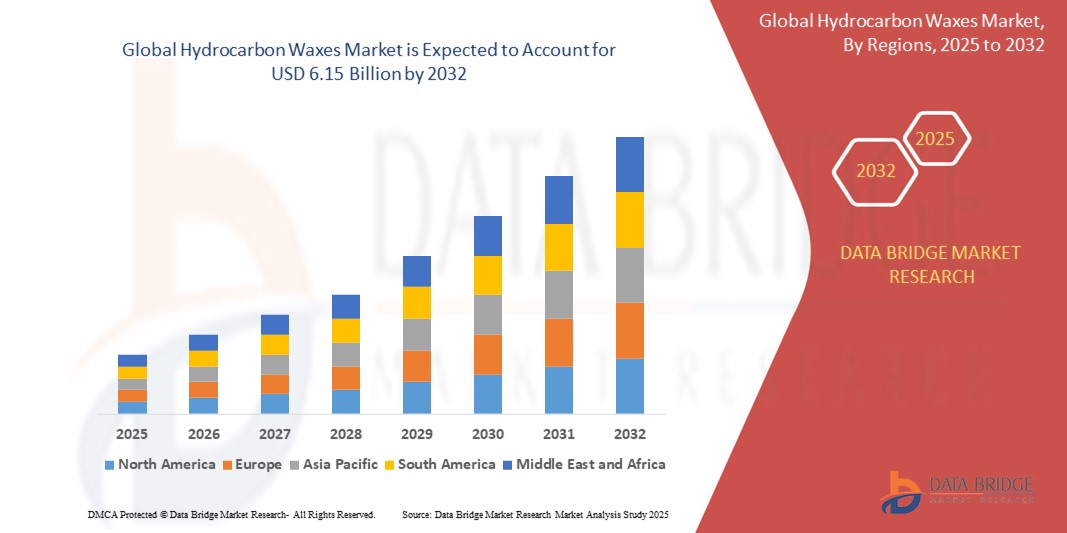
Hydrocarbon Waxes Market Size
- The global hydrocarbon waxes market size was valued at USD 4.10 billion in 2024 and is expected to reach USD 6.15 billion by 2032, at a CAGR of 5.20% during the forecast period
- The market growth is largely fuelled by the rising demand from packaging, rubber, cosmetics, and candle manufacturing industries, along with increasing applications in industrial coatings and adhesives
- Advancements in refining technologies and growing use of hydrocarbon waxes as cost-effective alternatives to natural waxes are also supporting market expansion globally
Hydrocarbon Waxes Market Analysis
- The hydrocarbon waxes market is witnessing steady growth owing to their broad utility in industries such as packaging, textiles, personal care, and construction
- These waxes offer excellent moisture barrier properties, thermal stability, and lubrication, making them valuable in applications ranging from food packaging and corrugated boxes to polishes and cosmetics
- Europe dominated the hydrocarbon waxes market with the largest revenue share of 38.9% in 2024, driven by increasing demand for sustainable, high-performance wax additives in industrial, automotive, and packaging sectors
- North America region is expected to witness the highest growth rate in the global hydrocarbon waxes market, driven by consistent demand from automotive, packaging, and industrial sectors, alongside strong R&D investment and presence of major wax producers
- The single type segment dominated the market with the largest market revenue share in 2024, driven by its high purity and consistent performance across various end-use applications such as packaging, rubber, and cosmetics. Single-type hydrocarbon waxes, such as paraffin and microcrystalline waxes, are widely preferred due to their stable chemical structure, ease of processing, and compatibility with numerous formulation systems. Their widespread availability and cost-effectiveness have made them a staple in both industrial and consumer product manufacturing
Report Scope and Hydrocarbon Waxes Market Segmentation
|
Attributes |
Hydrocarbon Waxes Key Market Insights |
|
Segments Covered |
|
|
Countries Covered |
North America
Europe
Asia-Pacific
Middle East and Africa
South America
|
|
Key Market Players |
|
|
Market Opportunities |
• Rising Demand for Sustainable and Biodegradable Wax Alternatives • Expansion Of Applications in Cosmetics and Industrial Coatings |
|
Value Added Data Infosets |
In addition to the insights on market scenarios such as market value, growth rate, segmentation, geographical coverage, and major players, the market reports curated by the Data Bridge Market Research also include import export analysis, production capacity overview, production consumption analysis, price trend analysis, climate change scenario, supply chain analysis, value chain analysis, raw material/consumables overview, vendor selection criteria, PESTLE Analysis, Porter Analysis, and regulatory framework. |
Hydrocarbon Waxes Market Trends
“Increasing Use of Hydrocarbon Waxes in Packaging and Protective Coatings”
- Growing demand for moisture-resistant and durable packaging solutions across the food, e-commerce, and retail sectors is boosting the application of hydrocarbon waxes in coatings and laminates as they help preserve product integrity, extend shelf life, and offer cost-effective alternatives to plastic-based barriers
- Hydrocarbon waxes are increasingly used in protective coatings for metal, wood, and electrical components due to their thermal stability and water-repellent characteristics, offering enhanced insulation, corrosion resistance, and longer equipment lifespan in harsh operating conditions
- Their anti-blocking, gloss-enhancing, and barrier capabilities make them ideal for coating paper and cardboard in both industrial and consumer-facing packaging, improving surface aesthetics, ensuring better printability, and preventing damage during stacking and transportation
- Rising emphasis on sustainability and cost-efficiency is leading manufacturers to replace synthetic and plastic-based coatings with wax-based alternatives that are less energy-intensive, more recyclable, and compatible with eco-certification goals across industries
- For instance, Tetra Pak uses hydrocarbon wax-coated paperboard in packaging to improve moisture resistance and structural integrity, helping maintain product quality while aligning with industry-wide moves toward greener, low-impact packaging materials
Hydrocarbon Waxes Market Dynamics
Driver
“Growing Demand from Personal Care and Cosmetics Industry”
- Hydrocarbon waxes are used as structuring agents and emollients in a variety of personal care products such as lip balms, lotions, creams, and hair waxes, helping to stabilize formulations, improve product feel, and deliver a smoother application experience
- Their consistency, long shelf life, and ability to enhance spreadability contribute to smoother formulations in skincare and cosmetic products, enabling manufacturers to create soft, uniform textures that enhance consumer satisfaction and sensory performance
- Cost-effective nature and wide availability make them attractive substitutes for natural waxes such as beeswax and carnauba wax in budget-friendly formulations, supporting large-scale production in competitive markets without compromising on product functionality
- Increasing demand for everyday grooming and beauty products across emerging markets is fuelling usage in mass-produced personal care lines as local and regional brands focus on affordability, ease of formulation, and high-volume scalability
- For instance, in South Korea, several skincare brands incorporate hydrocarbon waxes in moisturizers and lip care products to deliver texture stability and user comfort, capitalizing on consumer demand for smooth, reliable, and long-lasting product performance
Restraint/Challenge
“Environmental Concerns and Regulatory Restrictions on Petroleum-Derived Products”
- Hydrocarbon waxes, particularly paraffin-based ones, are derived from crude oil and are non-biodegradable, raising concerns around long-term environmental impact, fossil fuel dependence, and pollution from manufacturing and disposal processes
- Stringent environmental regulations in Europe and North America are limiting the use of petroleum-based substances in consumer goods and industrial products, compelling manufacturers to seek alternatives that comply with evolving sustainability standards and reduce carbon footprints
- Consumers are increasingly demanding eco-friendly and plant-based alternatives, pushing companies to explore renewable waxes such as soy, rice bran, or sugarcane-based variants that align with clean-label values, brand transparency, and environmental ethics
- Regulatory compliance requirements such as material safety testing, eco-label certification, and reformulation procedures lead to increased operational costs, longer product development timelines, and added pressure on small-to-medium manufacturers to innovate quickly
- For instance, the European Chemicals Agency (ECHA) has introduced frameworks encouraging companies to phase out non-renewable ingredients in favor of safer, plant-based options, prompting reformulations across multiple sectors including packaging, cosmetics, and coatings
Hydrocarbon Waxes Market Scope
The market is segmented on the basis of product type and application.
- By Product Type
On the basis of product type, the hydrocarbon waxes market is segmented into single type and compound. The single type segment dominated the market with the largest market revenue share in 2024, driven by its high purity and consistent performance across various end-use applications such as packaging, rubber, and cosmetics. Single-type hydrocarbon waxes, such as paraffin and microcrystalline waxes, are widely preferred due to their stable chemical structure, ease of processing, and compatibility with numerous formulation systems. Their widespread availability and cost-effectiveness have made them a staple in both industrial and consumer product manufacturing.
The compound segment is expected to witness the fastest growth rate from 2025 to 2032, fuelled by increasing demand for customized performance in specialized applications. Compound waxes, formed by blending hydrocarbon waxes with functional additives, are gaining traction in applications requiring enhanced properties such as higher melting points, improved water resistance, or lubrication. Their rising adoption in metalworking fluids, adhesives, and protective coatings is expected to drive segment growth in the coming years.
- By Application
On the basis of application, the hydrocarbon waxes market is segmented into lubricating additives, plastic additives, paints and coatings, metalworking fluids, and others. The plastic additives segment held the largest market revenue share in 2024, attributed to the growing use of hydrocarbon waxes in enhancing the processing, surface finish, and thermal stability of plastic products. These waxes improve flow properties, reduce friction, and prevent sticking during extrusion and molding processes, making them essential for the production of PVC pipes, films, and molded components across industries.
The metalworking fluids segment is expected to witness the fastest growth rate from 2025 to 2032, driven by increased manufacturing activity in the automotive, aerospace, and heavy machinery sectors. Hydrocarbon waxes are increasingly incorporated into metalworking formulations to reduce wear, improve surface finish, and enhance the lubricating efficiency of cutting and shaping operations. The segment is also supported by the shift toward high-performance, semi-synthetic, and fully synthetic fluid formulations, where wax-based additives play a vital role in ensuring consistency and performance.
Hydrocarbon Waxes Market Regional Analysis
• Europe dominated the hydrocarbon waxes market with the largest revenue share of 38.9% in 2024, driven by increasing demand for sustainable, high-performance wax additives in industrial, automotive, and packaging sectors
• Consumers and manufacturers across the region are shifting toward eco-friendly formulations, and compound waxes are gaining traction due to their ability to meet strict regulatory and performance standards
• The widespread adoption of hydrocarbon waxes in coating, textile, and lubricant applications is further supported by strong research infrastructure, advanced manufacturing capabilities, and a rising focus on environmental compliance
Germany Hydrocarbon Waxes Market Insight
The Germany hydrocarbon waxes market accounted for the largest revenue share in Europe in 2024, fuelled by robust demand from automotive, construction, and metal processing industries. German manufacturers are focusing on high-purity and customized compound waxes that offer superior lubrication, corrosion resistance, and finishing quality. The country’s emphasis on innovation, sustainability, and industrial efficiency is also promoting the adoption of waxes in high-performance applications. In addition, rising demand for emission-compliant additives in metalworking fluids is reinforcing the market’s growth trajectory.
U.K. Hydrocarbon Waxes Market Insight
The U.K. hydrocarbon waxes market is expected to witness the fastest growth rate from 2025 to 2032, supported by the country’s strong personal care, printing, and packaging sectors. Manufacturers are increasingly incorporating hydrocarbon waxes into formulations for sustainable coatings and biodegradable packaging. The growing focus on clean-label and allergen-free cosmetic products is also driving demand for stable, petroleum-derived waxes in lip care and skincare applications. U.K. producers are investing in R&D to meet both domestic and export demands for regulatory-compliant, multi-functional wax additives.
Asia-Pacific Hydrocarbon Waxes Market Insight
The Asia-Pacific hydrocarbon waxes market is expected to witness the fastest growth rate from 2025 to 2032, driven by rapid industrialization, increasing plastic consumption, and expanding manufacturing in countries such as China and India. The region’s cost-effective production capabilities and growing demand from candle, packaging, and plastic processing sectors are fuelling growth. In addition, favorable government policies, rising domestic consumption, and the emergence of synthetic wax technologies are making the region a key production and export hub.
China Hydrocarbon Waxes Market Insight
The China hydrocarbon waxes market captured the largest revenue share in Asia-Pacific in 2024, supported by large-scale manufacturing, extensive use in packaging and plastic processing, and growing exports. Chinese producers are expanding capacity in both paraffin and synthetic wax segments to meet rising domestic and global demand. The country’s integration of waxes in sectors such as rubber, textiles, and adhesives is driving consumption. In addition, China's government-backed focus on downstream chemical development is expected to further boost wax production efficiency.
Japan Hydrocarbon Waxes Market Insight
The Japan hydrocarbon waxes market is expected to witness the fastest growth rate from 2025 to 2032, supported by the country’s strong demand for precision-grade waxes in electronics, automotive, and packaging industries. Japanese manufacturers emphasize high-quality, refined waxes that meet strict performance and environmental standards. Hydrocarbon waxes are widely used in metalworking fluids, thermal interface materials, and specialty coatings due to their stability and lubricating properties. Moreover, the integration of waxes into cosmetic and personal care formulations, driven by Japan’s aging population and preference for clean, skin-friendly products, is further boosting market expansion. The country’s technological focus and innovation in material science continue to promote the development of custom wax solutions across high-value applications.
North America Hydrocarbon Waxes Market Insight
The North America hydrocarbon waxes market is expected to witness the fastest growth rate from 2025 to 2032, supported by stable demand from coatings, plastic additives, and adhesives segments. The region benefits from advanced refining infrastructure and innovation-driven product development. Hydrocarbon waxes are extensively used in PVC production, metalworking fluids, and packaging applications across the U.S. and Canada. With a growing emphasis on compound waxes and specialty blends, manufacturers are addressing demand for high-performance, application-specific additives that meet industry standards.
U.S. Hydrocarbon Waxes Market Insight
The U.S. hydrocarbon waxes market is expected to witness the fastest growth rate from 2025 to 2032, driven by widespread use in industrial applications such as lubricants, coatings, and flexible packaging. U.S. companies are focusing on producing advanced compound wax formulations that offer enhanced efficiency, thermal stability, and regulatory compliance. The country’s strong petrochemical base, combined with growing innovation in metal processing and plastics manufacturing, supports consistent growth in wax demand across various sectors.
Hydrocarbon Waxes Market Share
The Hydrocarbon Waxes industry is primarily led by well-established companies, including:
- Sasol (South Africa)
- Exxon Mobil Corporation (U.S.)
- Kerax (U.K.)
- Faith Industries Ltd. (India)
- Poth Hille (U.K.)
- Strahl & Pitsch, Inc. (U.S.)
- Blended Waxes Inc. (U.S.)
- CALWAX (U.S.)
- Goyel Chemical Corporation (India)
- AF Suter (U.K.)
- King Honor International Ltd. (China)
- China Petrochemical Corporation (China)
- The International Group, Inc. (Canada)
- Honeywell International Inc. (U.S.)
- Columbia Petrochemicals (India)
- Numaligarh Refinery Limited (India)
- Repsol (Spain)
- Indian Oil Corporation Ltd (India)
- Gandhar Oil Refinery (India) Limited. (India)
Latest Developments in Global Hydrocarbon Waxes Market
- In April 2024, ExxonMobil Corporation introduced a new product brand, Prowaxx, as part of its continued commitment to the wax industry. This strategic product launch aims to offer enhanced performance, consistency, and versatility across a range of industrial and consumer applications. With over 125 years of expertise, the company’s latest innovation is expected to strengthen its position in the global hydrocarbon waxes market. The introduction of Prowaxx will benefit end-users by delivering high-quality solutions tailored to evolving application needs. This development is likely to boost customer confidence and drive greater adoption of premium wax products, thereby positively impacting market competitiveness and growth.

- Interactive Data Analysis Dashboard
- Company Analysis Dashboard for high growth potential opportunities
- Research Analyst Access for customization & queries
- Competitor Analysis with Interactive dashboard
- Latest News, Updates & Trend analysis
- Harness the Power of Benchmark Analysis for Comprehensive Competitor Tracking
Global Hydrocarbon Waxes Market, Supply Chain Analysis and Ecosystem Framework
To support market growth and help clients navigate the impact of geopolitical shifts, DBMR has integrated in-depth supply chain analysis into its Global Hydrocarbon Waxes Market research reports. This addition empowers clients to respond effectively to global changes affecting their industries. The supply chain analysis section includes detailed insights such as Global Hydrocarbon Waxes Market consumption and production by country, price trend analysis, the impact of tariffs and geopolitical developments, and import and export trends by country and HSN code. It also highlights major suppliers with data on production capacity and company profiles, as well as key importers and exporters. In addition to research, DBMR offers specialized supply chain consulting services backed by over a decade of experience, providing solutions like supplier discovery, supplier risk assessment, price trend analysis, impact evaluation of inflation and trade route changes, and comprehensive market trend analysis.
Data collection and base year analysis are done using data collection modules with large sample sizes. The stage includes obtaining market information or related data through various sources and strategies. It includes examining and planning all the data acquired from the past in advance. It likewise envelops the examination of information inconsistencies seen across different information sources. The market data is analysed and estimated using market statistical and coherent models. Also, market share analysis and key trend analysis are the major success factors in the market report. To know more, please request an analyst call or drop down your inquiry.
The key research methodology used by DBMR research team is data triangulation which involves data mining, analysis of the impact of data variables on the market and primary (industry expert) validation. Data models include Vendor Positioning Grid, Market Time Line Analysis, Market Overview and Guide, Company Positioning Grid, Patent Analysis, Pricing Analysis, Company Market Share Analysis, Standards of Measurement, Global versus Regional and Vendor Share Analysis. To know more about the research methodology, drop in an inquiry to speak to our industry experts.
Data Bridge Market Research is a leader in advanced formative research. We take pride in servicing our existing and new customers with data and analysis that match and suits their goal. The report can be customized to include price trend analysis of target brands understanding the market for additional countries (ask for the list of countries), clinical trial results data, literature review, refurbished market and product base analysis. Market analysis of target competitors can be analyzed from technology-based analysis to market portfolio strategies. We can add as many competitors that you require data about in the format and data style you are looking for. Our team of analysts can also provide you data in crude raw excel files pivot tables (Fact book) or can assist you in creating presentations from the data sets available in the report.













