


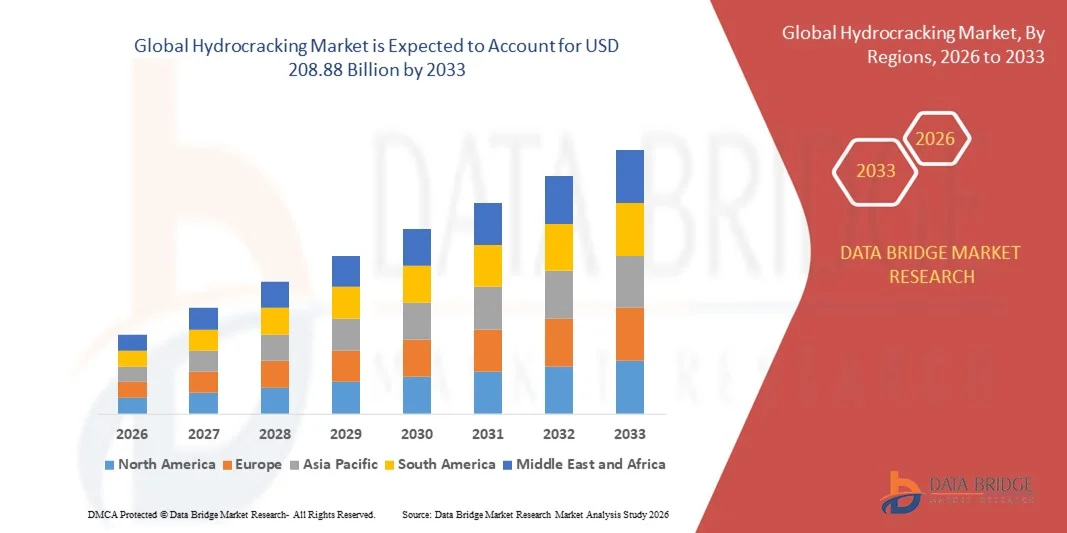
What is the Global Hydrocracking Market Size and Growth Rate?
- The global hydrocracking market size was valued at USD 81.99 billion in 2025 and is expected to reach USD 208.88 billion by 2033, at a CAGR of 12.40% during the forecast period
- Rising demand for medium and light distillates such as jet fuel, kerosene, diesel, and gasoline, especially from emerging economies is the vital factor escalating the market growth, also increasing technological advancements, rising research and development pertaining to improved hydrocracker performance and overall yield, increasing hydrocracker efficiency and overall yield, rising availability of technical expertise, rising demand for petroleum derivatives and rising automotive demand in Asia Pacific are the major factors among others driving the hydrocracking market
What are the Major Takeaways of Hydrocracking Market?
- Rising technological advancements and increasing modernization in the process will further create new opportunities for the hydrocracking market
- However, increasing capital investment and operational expenditure and increasing technical challenges related to the control of hydrocracker temperature and the catalyst replenishment system are the major factors among others acting as restraints, and will further challenge the growth of hydrocracking market
- North America dominated the hydrocracking market with the largest revenue share of 43.2% in 2025, driven by the presence of mature refining infrastructure, high adoption of advanced hydrocracking technologies, and increasing production of diesel and jet fuel from heavy crude feedstocks
- The Asia-Pacific region is projected to witness the fastest growth rate of 9.8% during 2026–2033, fueled by expanding refining capacities in China, India, South Korea, and Southeast Asia
- The Two-Stage Flow segment dominated the market with the largest revenue share of 54.1% in 2025, owing to its superior efficiency, higher conversion rates, and better selectivity toward middle distillates such as diesel and jet fuel
Report Scope and Hydrocracking Market Segmentation
|
Attributes |
Hydrocracking Key Market Insights |
|
Segments Covered |
|
|
Countries Covered |
North America
Europe
Asia-Pacific
Middle East and Africa
South America
|
|
Key Market Players |
|
|
Market Opportunities |
|
|
Value Added Data Infosets |
In addition to the insights on market scenarios such as market value, growth rate, segmentation, geographical coverage, and major players, the market reports curated by the Data Bridge Market Research also include in-depth expert analysis, pricing analysis, brand share analysis, consumer survey, demography analysis, supply chain analysis, value chain analysis, raw material/consumables overview, vendor selection criteria, PESTLE Analysis, Porter Analysis, and regulatory framework. |
What is the Key Trend in the Hydrocracking Market?
Rising Demand for Sustainable and Efficient Hydrocracking Solutions
- The hydrocracking market is witnessing a significant transformation, fueled by the global push for cleaner fuels, stricter environmental regulations, and efficiency-driven refining operations. Refiners are increasingly focusing on producing high-value, low-sulfur fuels while minimizing operational emissions, driving adoption of advanced hydrocracking technologies
- For instance, major catalyst providers such as BASF SE and Honeywell UOP have developed proprietary catalysts and hydroprocessing technologies that improve conversion rates, enhance selectivity toward middle distillates, and reduce energy consumption across refineries. These innovations are helping refineries meet stringent global fuel standards
- The integration of modular, flexible hydrocracking units is gaining traction, enabling refiners to adapt to fluctuating crude feedstocks and market demand. Countries with evolving fuel quality regulations, such as the U.S., Germany, and China, are increasingly adopting advanced hydrocracking configurations to optimize output
- Manufacturers are incorporating digital monitoring, AI-based predictive maintenance, and process automation to improve operational reliability and safety. Smart monitoring enables real-time tracking of catalyst activity, temperature control, and product quality, enhancing overall plant performance
- The growing emphasis on sustainability and energy efficiency is prompting the development of low-emission hydrocracking units and catalysts with extended lifetimes. Refiners are increasingly investing in green hydrogen integration and advanced process designs to reduce carbon intensity
- As environmental regulations tighten globally and crude oil volatility increases, the shift toward efficient, environmentally responsible, and flexible hydrocracking solutions will remain a defining trend influencing technology adoption, process optimization, and refinery profitability worldwide
What are the Key Drivers of Hydrocracking Market?
- Increasing global demand for cleaner transportation fuels and low-sulfur diesel is the primary driver for the Hydrocracking market. Expanding fuel consumption in regions such as Asia-Pacific and North America is creating substantial opportunities for advanced hydrocracking units
- For instance, in 2025, refiners in the U.S. reported higher adoption of hydrocracking units capable of producing ultra-low sulfur diesel, jet fuel, and renewable diesel blending components to meet stringent Environmental Protection Agency (EPA) standards
- Rising emphasis on refinery flexibility and product optimization is encouraging investment in hydrocracking units capable of processing a wide variety of crude oils while maximizing middle distillate yields
- Increasing focus on sustainability and regulatory compliance is driving adoption of energy-efficient hydrocracking catalysts and reactor designs. Companies are balancing performance, environmental footprint, and operational cost to meet both market and regulatory expectations
- Technological integration through process automation, real-time monitoring, and predictive maintenance is enabling improved operational efficiency, reduced downtime, and enhanced catalyst performance. These innovations are crucial for large-scale refineries targeting high-margin products
- As global energy transition and fuel quality regulations intensify, the Hydrocracking market is poised to expand, with continuous innovations in catalyst development, reactor design, and digitalization shaping the sector’s long-term growth trajectory
Which Factor is Challenging the Growth of the Hydrocracking Market?
- High capital investment and operational costs pose significant challenges for hydrocracking project implementation. Construction of new units, installation of advanced catalysts, and integration of automation systems require substantial financial outlay
- For instance, smaller refineries in emerging markets face difficulty in financing hydrocracking upgrades to meet stringent fuel specifications, limiting market penetration and technology adoption
- Volatility in crude oil quality and supply further complicates operational efficiency. Processing heavier or sour crude requires specialized catalysts and reactor configurations, increasing production complexity and costs
- Rapidly evolving environmental regulations across countries necessitate frequent technology upgrades, catalyst changes, and emissions control measures, adding financial and operational burdens for refiners
- Lack of standardized global norms for fuel quality and hydrocracking unit performance leads to inconsistent adoption strategies, particularly for international operators seeking to expand across multiple jurisdictions
- To address these challenges, market players are emphasizing modular hydrocracking units, joint ventures with technology licensors, and investment in advanced catalysts. Over time, process optimization, improved materials, and digital integration are expected to lower operational costs and enhance global market accessibility
How is the Hydrocracking Market Segmented?
The market is segmented on the basis of type and application.
- By Type
On the basis of type, the hydrocracking market is segmented into Single Stage and Two-Stage Flow systems. The Two-Stage Flow segment dominated the market with the largest revenue share of 54.1% in 2025, owing to its superior efficiency, higher conversion rates, and better selectivity toward middle distillates such as diesel and jet fuel. Two-stage hydrocracking units enable refiners to process a wide range of feedstocks, including heavy and sour crudes, while maintaining compliance with stringent environmental and fuel-quality standards. The higher operational flexibility, combined with advanced catalyst systems, ensures improved yield and product quality.
On the other hand, the Single Stage segment is expected to witness the fastest CAGR from 2026 to 2033, driven by growing adoption in small-to-mid-scale refineries, cost-conscious operations, and the demand for modular, space-efficient units that provide adequate performance for light to medium crude processing.
- By Application
On the basis of application, the hydrocracking market is categorized into Refinery, Diesel, and Jet Fuel production. The Refinery segment dominated the market with the largest revenue share of 49.8% in 2025, supported by the global expansion of refining capacities and the need to upgrade existing units to produce cleaner fuels. Refiners are increasingly leveraging hydrocracking to convert vacuum gas oils and other heavy fractions into high-value products, ensuring compliance with international sulfur regulations.
Meanwhile, the Diesel segment is projected to register the fastest growth from 2026 to 2033, driven by surging demand for low-sulfur diesel, biodiesel blending components, and stricter emission norms in regions such as Asia-Pacific and North America. Diesel-focused hydrocracking units provide high selectivity, improved cetane numbers, and fuel stability, making them a preferred choice for countries transitioning toward cleaner energy solutions.
Which Region Holds the Largest Share of the Hydrocracking Market?
- North America dominated the hydrocracking market with the largest revenue share of 43.2% in 2025, driven by the presence of mature refining infrastructure, high adoption of advanced hydrocracking technologies, and increasing production of diesel and jet fuel from heavy crude feedstocks
- The region’s focus on upgrading refineries to meet stringent environmental regulations, including low-sulfur fuel mandates, along with investments in catalyst innovation and energy-efficient operations, has strengthened market growth
- Continuous R&D efforts, technological integration in hydrocracking units, and strong industrial collaboration are supporting North America’s leadership in the global Hydrocracking market
U.S. Hydrocracking Market Insight
The U.S. accounted for the largest share in North America in 2025, supported by a well-established refining sector and growing demand for diesel, jet fuel, and petrochemical feedstocks. Investment in upgrading single-stage and two-stage hydrocracking units for higher conversion efficiency and environmental compliance is driving expansion. U.S. refiners are increasingly adopting modular and flexible hydrocracking technologies to improve output and reduce emissions, reinforcing market dominance.
Canada Hydrocracking Market Insight
Canada remains a key contributor within North America, driven by oil sands production and upgrading facilities. Hydrocracking units are used to convert heavy crude and bitumen into high-quality fuels. Investments in process optimization, sustainability, and advanced catalyst systems are fostering steady market growth, particularly in diesel and jet fuel production.
Asia-Pacific Hydrocracking Market Insight
The Asia-Pacific region is projected to witness the fastest growth rate of 9.8% during 2026–2033, fueled by expanding refining capacities in China, India, South Korea, and Southeast Asia. Rising demand for cleaner fuels, diesel, and jet fuel, coupled with increasing foreign investments in modern refining technologies, is driving hydrocracking adoption. Cost-effective manufacturing, supportive government energy policies, and rising industrial fuel consumption position Asia-Pacific as a high-growth market.
China Hydrocracking Market Insight
China is emerging as a major hub within Asia-Pacific due to rapid refinery expansions and rising investment in two-stage hydrocracking units. The country is focusing on producing low-sulfur diesel and jet fuel to meet domestic energy demand and international emission standards. Local refiners are integrating advanced catalysts and energy-efficient process technologies to boost conversion yields and reduce environmental footprint.
India Hydrocracking Market Insight
India is witnessing significant hydrocracking growth, supported by new refinery projects, upgrades of existing units, and increasing fuel demand. Government initiatives promoting cleaner fuels and investment incentives for advanced hydrocracking technologies are driving market expansion. Refineries are adopting single-stage and two-stage units to optimize diesel and jet fuel production, positioning India as a key market in Asia-Pacific.
Europe Hydrocracking Market Insight
Europe’s hydrocracking market is growing steadily, driven by stringent EU regulations on sulfur content, biofuel blending mandates, and refinery modernization. Countries such as Germany, Italy, and France are investing in two-stage hydrocracking units for diesel and jet fuel production. The focus on sustainability, energy efficiency, and emission reduction continues to support market expansion.
Germany Hydrocracking Market Insight
Germany leads Europe due to its advanced refinery network and compliance with EU fuel quality standards. Investments in high-conversion hydrocracking units for diesel and jet fuel, along with R&D in process optimization and catalyst efficiency, reinforce Germany’s strong position.
U.K. Hydrocracking Market Insight
The U.K. market is supported by ongoing refinery upgrades and the shift toward cleaner fuels. Adoption of flexible hydrocracking technologies and low-sulfur diesel production aligns with government energy policies, boosting the market.
Which are the Top Companies in Hydrocracking Market?
The hydrocracking industry is primarily led by well-established companies, including:
- Royal Dutch Shell (Netherlands)
- BASF SE (Germany)
- Honeywell International Inc (U.S.)
- Haldor Topsoe A/S (Denmark)
- Albemarle Corporation (U.S.)
- W. R. Grace & Co.-Conn. (U.S.)
- Johnson Matthey (U.K.)
- Axens (France)
- Clariant (Switzerland)
- Arkema (France)
- Exxon Mobil Corporation (U.S.)
- JGC CORPORATION (Japan)
- Kuwait Catalyst Company (Kuwait)
- N.E. CHEMCAT (U.S.)
- Porocel Corporation (U.S.)
- HCpect (China)
- TAIYO KOKO Co., Ltd. (Japan)
- Yueyang Sciensun Chemical Co., Ltd. (China)
- DuPont (U.S.)
- Magma Ceramics & Catalysts (India)

- Interactive Data Analysis Dashboard
- Company Analysis Dashboard for high growth potential opportunities
- Research Analyst Access for customization & queries
- Competitor Analysis with Interactive dashboard
- Latest News, Updates & Trend analysis
- Harness the Power of Benchmark Analysis for Comprehensive Competitor Tracking
Global Hydrocracking Market, Supply Chain Analysis and Ecosystem Framework
To support market growth and help clients navigate the impact of geopolitical shifts, DBMR has integrated in-depth supply chain analysis into its Global Hydrocracking Market research reports. This addition empowers clients to respond effectively to global changes affecting their industries. The supply chain analysis section includes detailed insights such as Global Hydrocracking Market consumption and production by country, price trend analysis, the impact of tariffs and geopolitical developments, and import and export trends by country and HSN code. It also highlights major suppliers with data on production capacity and company profiles, as well as key importers and exporters. In addition to research, DBMR offers specialized supply chain consulting services backed by over a decade of experience, providing solutions like supplier discovery, supplier risk assessment, price trend analysis, impact evaluation of inflation and trade route changes, and comprehensive market trend analysis.
Data collection and base year analysis are done using data collection modules with large sample sizes. The stage includes obtaining market information or related data through various sources and strategies. It includes examining and planning all the data acquired from the past in advance. It likewise envelops the examination of information inconsistencies seen across different information sources. The market data is analysed and estimated using market statistical and coherent models. Also, market share analysis and key trend analysis are the major success factors in the market report. To know more, please request an analyst call or drop down your inquiry.
The key research methodology used by DBMR research team is data triangulation which involves data mining, analysis of the impact of data variables on the market and primary (industry expert) validation. Data models include Vendor Positioning Grid, Market Time Line Analysis, Market Overview and Guide, Company Positioning Grid, Patent Analysis, Pricing Analysis, Company Market Share Analysis, Standards of Measurement, Global versus Regional and Vendor Share Analysis. To know more about the research methodology, drop in an inquiry to speak to our industry experts.
Data Bridge Market Research is a leader in advanced formative research. We take pride in servicing our existing and new customers with data and analysis that match and suits their goal. The report can be customized to include price trend analysis of target brands understanding the market for additional countries (ask for the list of countries), clinical trial results data, literature review, refurbished market and product base analysis. Market analysis of target competitors can be analyzed from technology-based analysis to market portfolio strategies. We can add as many competitors that you require data about in the format and data style you are looking for. Our team of analysts can also provide you data in crude raw excel files pivot tables (Fact book) or can assist you in creating presentations from the data sets available in the report.













