


Hydrophilic Coatings Market Size
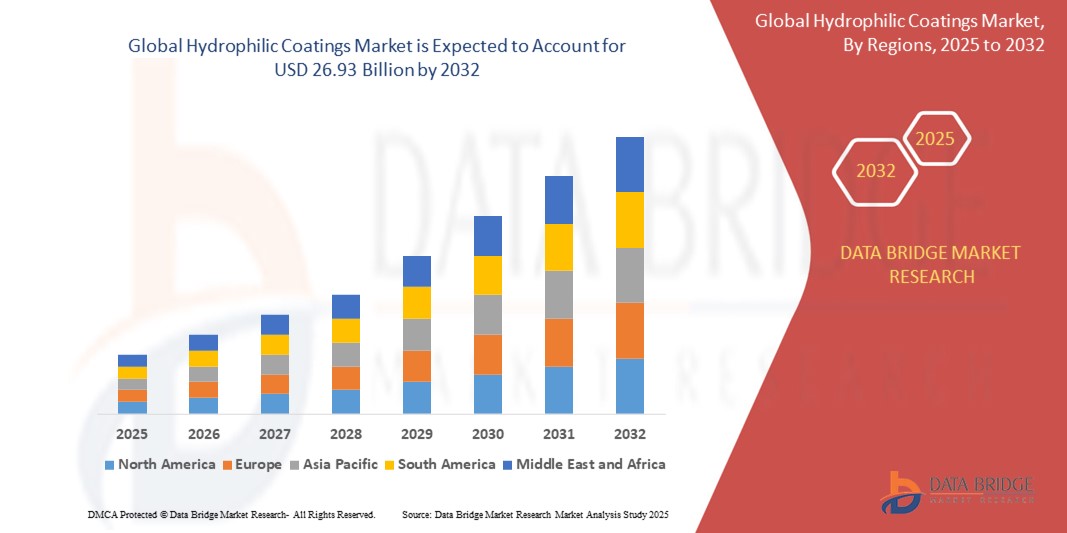
- The global hydrophilic coatings market size was valued at USD 15.67 billion in 2024 and is expected to reach USD 26.93 billion by 2032, at a CAGR of 7.00% during the forecast period
- The market growth is largely driven by the increasing adoption of hydrophilic coatings in medical devices, such as catheters, guidewires, and stents, due to their ability to reduce friction and improve patient comfort
- Furthermore, the expanding application scope in automotive and optical industries, including lenses, windshields, and display panels, supported by advancements in nanotechnology and surface chemistry, is contributing significantly to market growth
Hydrophilic Coatings Market Analysis
- Hydrophilic coatings, which reduce surface friction and improve wettability, are becoming essential in medical, automotive, and industrial applications due to their ability to enhance performance, reduce contamination, and improve user experience
- The rising demand for minimally invasive medical procedures is a key driver, as hydrophilic coatings are widely used in devices such as catheters and guidewires to improve patient comfort and procedural efficiency
- North America dominates the hydrophilic coatings market with the largest revenue share of 38.6% in 2025, owing to a strong medical device manufacturing base, supportive healthcare infrastructure, and high investments in research and innovation across biomedical applications
- Asia-Pacific is expected to be the fastest growing region in the hydrophilic coatings market during the forecast period, driven by expanding healthcare infrastructure, increasing adoption of advanced medical technologies, and a growing automotive sector in countries such as China, India, and Japan
- The medical devices segment is expected to dominate the hydrophilic coatings market with a market share of 46.3% in 2025, fueled by product innovations, increased procedural volumes, and the introduction of advanced coatings designed to improve biocompatibility and reduce infection risk
Report Scope and Hydrophilic Coatings Market Segmentation
|
Attributes |
Hydrophilic Coatings Key Market Insights |
|
Segments Covered |
|
|
Countries Covered |
North America
Europe
Asia-Pacific
Middle East and Africa
South America
|
|
Key Market Players |
|
|
Market Opportunities |
|
|
Value Added Data Infosets |
In addition to the insights on market scenarios such as market value, growth rate, segmentation, geographical coverage, and major players, the market reports curated by the Data Bridge Market Research also include in-depth expert analysis, pricing analysis, brand share analysis, consumer survey, demography analysis, supply chain analysis, value chain analysis, raw material/consumables overview, vendor selection criteria, PESTLE Analysis, Porter Analysis, and regulatory framework. |
Hydrophilic Coatings Market Trends
“Nanotechnology and Surface Engineering Driving Functional Advancements”
- A significant and accelerating trend in the global hydrophilic coatings market is the integration of nanotechnology and advanced surface engineering, which is enhancing coating functionality, durability, and application-specific performance across various sectors including medical, automotive, and electronics
- For instance, Biocoat Incorporated has been focusing on nanocoating technologies that improve lubricity and biocompatibility in catheter-based procedures, allowing for smoother insertion and reduced trauma. Similarly, Surmodics, Inc. offers hydrophilic coatings with nano-scale modifications to improve adhesion and minimize particulates in cardiovascular applications
- In the automotive and consumer electronics industries, companies are deploying anti-fogging and self-cleaning hydrophilic coatings using nano-structured layers. FSI Coating Technologies, for example, has commercialized advanced hydrophilic formulations for touchscreens and optical lenses that maintain clarity under humid or wet conditions
- The integration of nanomaterials also facilitates customizable wettability and controlled drug delivery in biomedical applications. Recent developments include coatings that respond to temperature or pH changes, expanding the potential use cases in advanced medical devices and diagnostics
- This move toward multi-functional, durable, and bioresponsive coatings is reshaping innovation pipelines across the industry. Companies such as Harland Medical Systems and Hydromer are investing in R&D to create next-generation hydrophilic coatings that provide extended wear resistance, antimicrobial properties, and tailored responses to biological environments
- As regulatory standards tighten and healthcare systems demand higher performance materials, the market is witnessing a surge in demand for smart and multifunctional hydrophilic coatings. These advancements are not only improving clinical outcomes but also enabling cost savings through longer-lasting, high-performing coated products
Hydrophilic Coatings Market Dynamics
Driver
“Growing Demand from the Medical Sector Due to Minimally Invasive Procedures”
- The increasing global shift toward minimally invasive medical procedures and the growing number of interventional surgeries are significant drivers of demand for hydrophilic coatings, particularly in catheters, guidewires, and other intravascular devices
- For instance, in March 2024, Harland Medical Systems, Inc. expanded its hydrophilic coatings services, aiming to support OEMs in launching next-generation coated medical devices. This expansion is part of a broader trend to enhance device performance through surface coating innovations
- As hospitals and healthcare providers continue to focus on improving patient outcomes and reducing procedural complications, hydrophilic coatings offer critical advantages such as reduced friction, improved biocompatibility, and enhanced ease of insertion—making them essential in modern clinical settings
- Furthermore, the aging global population and rising prevalence of chronic conditions such as cardiovascular disease and urinary disorders are driving increased use of coated medical devices in diagnostics and treatment, further boosting market demand
- In parallel, technological innovations in coating application techniques and materials are enabling more durable, longer-lasting coatings with tailored properties. This has expanded their applicability across complex and high-performance device designs. Regulatory approvals for new coated devices are also accelerating commercial adoption
- With regulatory bodies emphasizing safety, performance, and biocompatibility, the use of high-quality hydrophilic coatings is becoming a competitive differentiator for medical device manufacturers—fueling further investment and innovation in the sector
Restraint/Challenge
“Performance Limitations and Regulatory Compliance Hurdles”
- One of the primary challenges restraining the growth of the hydrophilic coatings market is the performance degradation over time, particularly in harsh or variable environmental conditions. Exposure to moisture, chemicals, or repeated use can lead to the breakdown of the coating’s hydrophilic properties, limiting their effectiveness in long-term applications
- For instance, several medical device manufacturers have reported coating delamination or particulate shedding issues during extended catheter use, raising concerns about patient safety and device reliability. These performance limitations have prompted more stringent evaluation standards and increased scrutiny from regulatory agencies such as the U.S. FDA
- Furthermore, the market faces regulatory hurdles and complex compliance requirements, especially in the medical and healthcare sectors. Manufacturers must adhere to rigorous standards for biocompatibility, sterility, and durability, which can prolong product development timelines and increase costs
- Companies such as Surmodics and DSM have had to invest heavily in clinical testing, quality control, and documentation to meet these regulatory standards for their hydrophilic coatings used in intravascular and implantable devices
- In addition, coating application processes require specialized equipment and expertise, which can be capital-intensive for small and mid-sized medical device OEMs. This acts as a barrier to entry and slows broader adoption, particularly in emerging markets or among cost-sensitive manufacturers
- Overcoming these challenges will depend on continued advancements in coating durability, the development of cost-effective application technologies, and clearer regulatory guidance to streamline compliance efforts without compromising safety or quality
Hydrophilic Coatings Market Scope
The market is segmented on the basis substrate, end users, formulation, and resin type.
By Substrate
On the basis of substrate, the hydrophilic coatings market is segmented into polymers, glass/ceramics, metals, nanoparticles, and others. The polymers segment is expected to dominate the largest market revenue share in 2025, driven by the high usage of polymeric materials in medical devices such as catheters and guidewires. Polymers offer flexibility, biocompatibility, and excellent adhesion to coatings, making them ideal for healthcare applications
The nanoparticles segment is anticipated to witness the fastest growth rate from 2025 to 2032 due to advancements in nanotechnology that enable enhanced hydrophilicity, durability, and surface functionality. Their use in precision medical and optical applications is growing due to their performance advantages in terms of uniformity and reactivity at the nanoscale
By End Users
On the basis of end users, the market is segmented into medical devices, automotive, optics, aerospace, marine, optical lenses, electronic devices, and others. The medical devices segment held the largest revenue share in 2025, driven by the widespread use of hydrophilic coatings in minimally invasive surgical tools, catheters, and implants. The need for reduced friction, biocompatibility, and patient comfort has made these coatings essential in healthcare
The automotive segment is expected to witness the fastest CAGR from 2025 to 2032, fueled by increasing demand for anti-fog and anti-fouling coatings for windshields, sensors, and rearview mirrors to improve visibility and safety in various driving conditions
By Formulation
On the basis of formulation, the hydrophilic coatings market is segmented into water-based, UV-cured, and others. The water-based segment dominated the market in 2025, owing to its environmentally friendly nature, ease of application, and regulatory compliance. These coatings are widely used in medical and consumer electronics applications where low VOC content and smooth performance are required
The UV-cured segment is projected to exhibit the fastest growth during the forecast period due to its rapid curing time, energy efficiency, and superior resistance to wear and abrasion. UV-cured hydrophilic coatings are increasingly adopted in optical lenses and industrial surfaces for enhanced longevity
• By Resins Type
On the basis of resins type, the market is segmented into polyurethane, high-density polyethylene (HDPE), silicone, nylon, polyvinyl chloride (PVC), and others. The polyurethane segment held the largest revenue share in 2025 due to its high flexibility, chemical resistance, and excellent adhesion to various substrates. Polyurethane-based hydrophilic coatings are widely used in medical and industrial applications.
The silicone segment is expected to grow at the fastest rate from 2025 to 2032, driven by its superior water repellency, temperature stability, and biocompatibility. Silicone hydrophilic coatings are particularly suitable for advanced healthcare and microfluidic device applications.
Hydrophilic Coatings Market Regional Analysis
- North America holds a significant share in the hydrophilic coatings market with an estimated revenue share of 38.6% in 2024, driven by strong demand in medical devices, electronics, and automotive industries
- The region benefits from advanced healthcare infrastructure and stringent regulations requiring enhanced performance of medical equipment, which propels the adoption of hydrophilic coatings in diagnostic and surgical tools
- In addition, rising consumer awareness about product durability and performance, combined with high investment in research and development by key manufacturers, supports widespread application of hydrophilic coatings across various sectors
U.S. Hydrophilic Coatings Market Insight
The U.S. hydrophilic coatings market is expected to dominate North America with a revenue share of approximately 81% in 2025, driven by the growing adoption of medical devices and electronics requiring enhanced surface wettability and biocompatibility. Increasing demand in diagnostic equipment, surgical tools, and wearable sensors is a significant growth driver. The country’s focus on advanced healthcare infrastructure, combined with high R&D investments by coating manufacturers, supports rapid market expansion. Furthermore, growing environmental regulations promote the use of eco-friendly hydrophilic coatings, enhancing the market outlook
Europe Hydrophilic Coatings Market Insight
The European hydrophilic coatings market is projected to expand at a substantial CAGR during the forecast period, primarily due to stringent environmental regulations and the rising need for improved product functionality in medical and industrial applications. Increasing urbanization and technological advancement foster adoption across water treatment, anti-fogging solutions, and consumer electronics sectors. Key markets such as Germany, France, and the UK show strong growth, driven by sustainability initiatives and regulatory emphasis on safer chemical formulations in coatings
U.K. Hydrophilic Coatings Market Insight
The U.K. hydrophilic coatings market is anticipated to grow at a notable CAGR through the forecast period, supported by rising demand in healthcare devices and automotive applications. Increasing focus on product performance and durability, along with the government’s push for greener technologies, stimulates market growth. Additionally, the strong presence of research institutions and coating manufacturers enables the development of advanced hydrophilic formulations tailored for diverse industrial uses
Germany Hydrophilic Coatings Market Insight
Germany’s hydrophilic coatings market is expected to experience considerable growth, driven by the country’s emphasis on innovation and sustainability. The well-established automotive and healthcare industries demand high-quality coatings for improved surface properties such as anti-fogging, anti-fouling, and corrosion resistance. Growing consumer preference for eco-friendly and technologically advanced solutions further propels market expansion, with a rising trend in integrating hydrophilic coatings into smart devices and industrial equipment
Asia-Pacific Hydrophilic Coatings Market Insight
The Asia-Pacific hydrophilic coatings market is poised to grow at the fastest CAGR exceeding 24% in 2025, fueled by rapid industrialization, urbanization, and expanding electronics and medical device manufacturing hubs in China, Japan, India, and South Korea. Increasing government support for digitalization and green technologies accelerates adoption. The region’s growing middle class and rising disposable incomes boost demand for consumer goods featuring hydrophilic coatings, while affordability due to local production strengthens market penetration
Japan Hydrophilic Coatings Market Insight
Japan’s hydrophilic coatings market is gaining momentum owing to the country’s advanced technological landscape and aging population demanding user-friendly medical devices with superior surface performance. The market benefits from integration with IoT devices and smart healthcare solutions. High consumer awareness regarding product safety and functionality further drives growth, particularly in diagnostics and wearable health monitoring devices
China Hydrophilic Coatings Market Insight
China holds the largest market revenue share in Asia-Pacific in 2025 for hydrophilic coatings, driven by the expanding manufacturing base for electronics, automotive, and medical devices. The country’s rapid urbanization, rising middle class, and government initiatives toward smart cities and sustainable manufacturing practices are key factors propelling growth. The availability of cost-effective hydrophilic coating solutions and a strong network of domestic manufacturers contribute to China’s dominant position in the regional market
Hydrophilic Coatings Market Share
The hydrophilic coatings industry is primarily led by well-established companies, including:
- Eternal Materials Co., Ltd. (Taiwan)
- Wacker Chemie AG (Japan)
- DIC CORPORATION (Japan)
- Aculon. (U.S.)
- Biocoat Incorporated. (U.S.)
- Harland Medical Systems, Inc. (U.S.)
- Hydromer (U.S.)
- AdvanSource Biomaterials Corporation (U.S.)
- Surmodics, Inc. (U.S.)
- DSM (Netherlands)
- AST Products, Inc. (U.S.)
- Abbott. (U.S.)
- Dow (U.S.)
- Sono-Tek Corporation. (U.S.)
- FSI Coating Technologies, Inc. (FSI) (U.S.)
- APPLIED MEDICAL COATINGS (U.S.)
- Precision Coating Company, Inc (U.S.)
Latest Developments in Global Hydrophilic Coatings Market
-
In November 2024, Medeologix, a leading medical device manufacturer, expanded its catheter solutions by integrating in-house hydrophilic coating services. This strategic development is strengthened by its partnership with Biocoat, a top provider of hydrophilic coating materials. The collaboration reflects the industry's shift toward vertically integrated solutions, aiming to enhance efficiency, quality, and accelerate time-to-market. By bringing coating services in-house, Medeologix streamlines production and regulatory approvals, offering a comprehensive one-stop solution for catheter development
- In March 2024, Mitsui Chemicals, Inc. collaborated with COTEC GmbH and CADIS Engineering GmbH to develop a hydrophobic coating printer for automotive displays. This innovative technology leverages vision care expertise to enhance surface modification, improving water repellency and ease of cleaning. The printer enables continuous production under normal pressure, reducing environmental impact and material consumption. This advancement reflects a broader trend in automotive functionality, where hydrophilic applications also play a role
- In October 2023, Surmodics, a leader in medical device coating technologies, introduced Preside hydrophilic coatings to enhance lubricity and durability across complex medical device applications. These coatings complement Surmodics’ existing Serene hydrophilic coatings, offering improved performance for neurovascular procedures and other challenging interventions. Preside coatings are designed to reduce friction and particulate generation, ensuring smoother distal access and better crossing for coronary lesions. This launch underscores ongoing innovation in medical coatings, aiming to improve patient outcomes and streamline device functionality
- In April 2022, Biocoat, Inc. introduced EMERSE, a specialized coating equipment business unit designed for medical device manufacturers needing an in-house hydrophilic dip coating system. This expansion positions Biocoat as one of the few companies offering a full-service solution for hydrophilic coatings, streamlining production and enhancing efficiency. EMERSE systems are available in thermal heat and ultraviolet (UV) cure models, catering to diverse industry needs. The launch underscores Biocoat’s commitment to innovation in medical coatings, ensuring high-quality and scalable solutions for device manufacturers
- In April 2022, Harland Medical Systems, Inc., a global leader in medical device coatings, introduced the CTS1100 Coating Thickness Testing System. This innovative technology allows manufacturers to accurately measure coating thickness on medical devices, addressing critical variables in catheter and guidewire design. The CTS1100 uses a precision LED micrometer to assess part diameter before coating, dry, and hydrated, providing a comprehensive view of coating effects. With automated dryout testing and customizable reporting, this system streamlines quality control for medical device makers

- Interactive Data Analysis Dashboard
- Company Analysis Dashboard for high growth potential opportunities
- Research Analyst Access for customization & queries
- Competitor Analysis with Interactive dashboard
- Latest News, Updates & Trend analysis
- Harness the Power of Benchmark Analysis for Comprehensive Competitor Tracking
Global Hydrophilic Coatings Market, Supply Chain Analysis and Ecosystem Framework
To support market growth and help clients navigate the impact of geopolitical shifts, DBMR has integrated in-depth supply chain analysis into its Global Hydrophilic Coatings Market research reports. This addition empowers clients to respond effectively to global changes affecting their industries. The supply chain analysis section includes detailed insights such as Global Hydrophilic Coatings Market consumption and production by country, price trend analysis, the impact of tariffs and geopolitical developments, and import and export trends by country and HSN code. It also highlights major suppliers with data on production capacity and company profiles, as well as key importers and exporters. In addition to research, DBMR offers specialized supply chain consulting services backed by over a decade of experience, providing solutions like supplier discovery, supplier risk assessment, price trend analysis, impact evaluation of inflation and trade route changes, and comprehensive market trend analysis.
Data collection and base year analysis are done using data collection modules with large sample sizes. The stage includes obtaining market information or related data through various sources and strategies. It includes examining and planning all the data acquired from the past in advance. It likewise envelops the examination of information inconsistencies seen across different information sources. The market data is analysed and estimated using market statistical and coherent models. Also, market share analysis and key trend analysis are the major success factors in the market report. To know more, please request an analyst call or drop down your inquiry.
The key research methodology used by DBMR research team is data triangulation which involves data mining, analysis of the impact of data variables on the market and primary (industry expert) validation. Data models include Vendor Positioning Grid, Market Time Line Analysis, Market Overview and Guide, Company Positioning Grid, Patent Analysis, Pricing Analysis, Company Market Share Analysis, Standards of Measurement, Global versus Regional and Vendor Share Analysis. To know more about the research methodology, drop in an inquiry to speak to our industry experts.
Data Bridge Market Research is a leader in advanced formative research. We take pride in servicing our existing and new customers with data and analysis that match and suits their goal. The report can be customized to include price trend analysis of target brands understanding the market for additional countries (ask for the list of countries), clinical trial results data, literature review, refurbished market and product base analysis. Market analysis of target competitors can be analyzed from technology-based analysis to market portfolio strategies. We can add as many competitors that you require data about in the format and data style you are looking for. Our team of analysts can also provide you data in crude raw excel files pivot tables (Fact book) or can assist you in creating presentations from the data sets available in the report.













