


Hydrophobic Agents Market Size
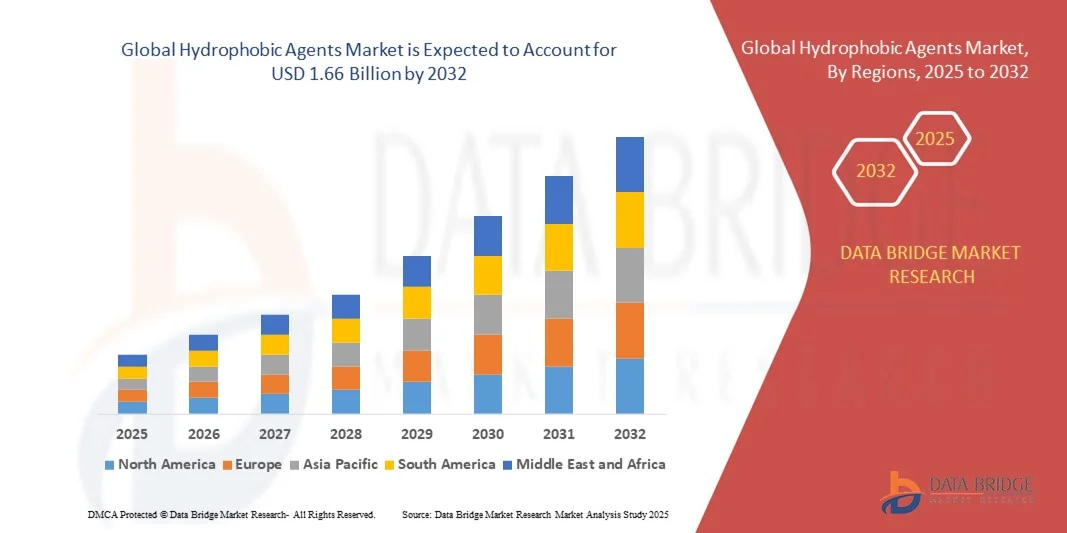
- The global hydrophobic agents market size was valued at USD 1.24 billion in 2024 and is expected to reach USD 1.66 billion by 2032, at a CAGR of 3.7% during the forecast period
- The market growth is largely fueled by the increasing demand for durable, water-repellent, and long-lasting construction and industrial materials, driven by rapid urbanization, infrastructure development, and industrial expansion across emerging and developed economies
- Furthermore, rising focus on sustainability, building resilience against moisture-related damage, and adoption of advanced construction chemicals is encouraging manufacturers and end-users to integrate hydrophobic agents into concrete, mortar, fiber-based materials, and coatings. These converging factors are accelerating the uptake of hydrophobic solutions, thereby significantly boosting the industry’s growth
Hydrophobic Agents Market Analysis
- Hydrophobic agents, providing water-repellent properties and protection against moisture ingress, are increasingly essential in construction, industrial coatings, and fiber-based materials due to their ability to enhance durability, reduce maintenance costs, and extend the lifespan of structures and materials
- The escalating demand for hydrophobic agents is primarily driven by growing construction activity, rising adoption of sustainable and high-performance building materials, and increasing awareness of moisture damage prevention across residential, commercial, and industrial applications
- Asia-Pacific dominated the hydrophobic agents market with a share of 48.65% in 2024, due to rapid construction growth, increasing demand for durable and water-resistant materials, and a strong presence of chemical manufacturing hubs
- North America is expected to be the fastest growing region in the hydrophobic agents market during the forecast period due to increasing construction activity, rising demand for durable and eco-friendly building materials, and growing adoption of advanced hydrophobic technologies
- Silanes segment dominated the market with a market share of 43% in 2024, due to its superior water-repellent properties, high chemical stability, and excellent compatibility with a wide range of construction materials. Silanes are widely preferred in industrial and commercial construction projects to enhance durability and prevent moisture ingress, making them a trusted choice among contractors and engineers. Their ability to penetrate deeply into substrates ensures long-lasting protection, while also contributing to reduced maintenance costs and improved structural longevity. The growing emphasis on sustainable and weather-resistant construction solutions further drives the adoption of silane-based hydrophobic agents
Report Scope and Hydrophobic Agents Market Segmentation
|
Attributes |
Hydrophobic Agents Key Market Insights |
|
Segments Covered |
|
|
Countries Covered |
North America
Europe
Asia-Pacific
Middle East and Africa
South America
|
|
Key Market Players |
|
|
Market Opportunities |
|
|
Value Added Data Infosets |
In addition to the insights on market scenarios such as market value, growth rate, segmentation, geographical coverage, and major players, the market reports curated by the Data Bridge Market Research also include import export analysis, production capacity overview, production consumption analysis, price trend analysis, climate change scenario, supply chain analysis, value chain analysis, raw material/consumables overview, vendor selection criteria, PESTLE Analysis, Porter Analysis, and regulatory framework. |
Hydrophobic Agents Market Trends
Adoption of High-Performance, Water-Repellent Construction Materials
- The hydrophobic agents market is growing steadily as the construction and building materials industries increasingly adopt high-performance, water-repellent technologies to enhance structure longevity and durability. These agents—used in concrete, mortar, paints, and coatings—help reduce water absorption, prevent moisture-related damage, and improve overall maintenance efficiency in infrastructure and residential projects
- For instance, Wacker Chemie AG has expanded its portfolio of silicone-based hydrophobic agents for use in concrete protection and façade coatings. The company’s development of high-efficiency silane and siloxane emulsions reflects the rising industry preference for long-lasting hydrophobic treatments that combine performance with environmental compatibility
- Hydrophobic agents are gaining traction due to their ability to protect materials against water ingress, corrosion, and biological growth, which are common challenges in modern construction environments. Their application extends to cementitious building materials, industrial coatings, and waterproofing systems, offering long-term performance benefits and cost savings through reduced maintenance frequency
- In addition, increasing awareness of sustainable building practices is driving demand for hydrophobic solutions that enhance energy efficiency and structural integrity without compromising ecological standards. Water-repellent additives are being incorporated into low-VOC and solvent-free coating formulations, aligning with green construction mandates worldwide
- Advancements in nano-enabled surface treatments and microemulsion technologies have further improved the functionality of hydrophobic coatings. These innovations provide superior penetration depth and self-cleaning properties, boosting their adoption across infrastructure segments exposed to harsh climatic conditions and environmental pollutants
- As the global focus on infrastructure resilience and sustainability intensifies, the use of advanced hydrophobic agents in building materials is expected to accelerate. Their integration into next-generation construction systems underscores a shift toward smart, high-performance materials designed to extend service life and minimize maintenance costs across long-term urban development projects
Hydrophobic Agents Market Dynamics
Driver
Rising Demand for Durable and Moisture-Resistant Solutions
- Increasing demand for durable and moisture-resistant materials across construction, automotive, and textile industries is a major driver for the hydrophobic agents market. With rising concerns over water damage, corrosion, and mold formation, manufacturers and end-users are prioritizing protective materials that ensure surface integrity and extend product lifespan
- For instance, BASF SE offers high-performance hydrophobic agents designed to enhance the water repellency of concrete, plasters, and façade coatings while maintaining vapour permeability. The company’s innovation in silane-based systems demonstrates the growing attention toward improving durability and weather resistance in large-scale infrastructure applications
- These agents help minimize degradation in construction materials caused by freeze-thaw cycles, efflorescence, and microbial growth, making them crucial for enhancing long-term tensile strength and performance reliability. The increasing focus on asset protection and lifecycle cost optimization is further stimulating the adoption of such advanced moisture-resistant solutions
- In addition, hydrophobic coatings are witnessing significant uptake in industrial and consumer goods segments, including textiles, automotive components, and glass surfaces. Their role in imparting anti-fouling, self-cleaning, and stain-resistant characteristics complements industry trends emphasizing performance efficiency and aesthetic longevity
- Growing urbanization, coupled with heavy investments in infrastructure modernization, has intensified the need for technologies that reinforce structural durability under varying environmental conditions. As consumers and developers prioritize reliable and low-maintenance materials, hydrophobic agents continue to play a vital role in elevating quality and sustainability standards across industries
Restraint/Challenge
High Cost Limiting Use in Budget-Sensitive Projects
- The relatively high cost of hydrophobic agents remains a significant restraint to broader market adoption, particularly in cost-sensitive construction and manufacturing segments. Advanced formulations such as silane and fluorocarbon-based systems involve complex synthesis processes and premium raw materials, contributing to elevated overall product pricing
- For instance, Evonik Industries AG has indicated that while its organosilicon-based hydrophobic agents deliver superior durability and long-term protection, their higher cost limits usage in low-budget infrastructure projects and price-sensitive developing markets. This cost disparity often compels contractors to adopt inexpensive but less effective waterproofing alternatives
- The integration of hydrophobic treatments into construction materials also demands specialized equipment and additional processing steps, increasing manufacturing and application costs. This creates financial barriers, particularly for small-scale builders and regional producers operating within budget constraints
- In addition, limited awareness among end-users about the long-term economic benefits of hydrophobic materials—such as reduced maintenance and repair costs—further restricts adoption. Immediate budget considerations often outweigh the perceived value of durability-enhancing additives
- To address these challenges, manufacturers are focusing on optimizing production costs, developing concentrated formulations, and expanding localized manufacturing to enhance affordability. As technology matures and cost-efficiency improves, hydrophobic agents are expected to gain broader acceptance across both premium and mid-tier construction segments globally
Hydrophobic Agents Market Scope
The market is segmented on the basis of type, product, and application.
- By Type
On the basis of type, the hydrophobic agents market is segmented into silanes, sodium oleate, and stearate. The silanes segment dominated the market with the largest revenue share of 43% in 2024, owing to its superior water-repellent properties, high chemical stability, and excellent compatibility with a wide range of construction materials. Silanes are widely preferred in industrial and commercial construction projects to enhance durability and prevent moisture ingress, making them a trusted choice among contractors and engineers. Their ability to penetrate deeply into substrates ensures long-lasting protection, while also contributing to reduced maintenance costs and improved structural longevity. The growing emphasis on sustainable and weather-resistant construction solutions further drives the adoption of silane-based hydrophobic agents.
The sodium oleate segment is anticipated to witness the fastest growth rate from 2025 to 2032, fueled by its cost-effectiveness, eco-friendly nature, and ease of application across diverse materials. Sodium oleate finds increasing use in lightweight construction and fiber-based materials due to its strong surface activity and compatibility with organic and inorganic substrates. Its growing popularity in green building projects and DIY applications contributes to its rapid market expansion, while manufacturers are innovating formulations to enhance performance in extreme environmental conditions.
- By Product
On the basis of product, the hydrophobic agents market is segmented into metallic stearates, hydrophobic polymers, silicone-based, and fatty acid type. The silicone-based segment dominated the market with the largest revenue share in 2024, driven by its exceptional water-repellent efficiency, thermal stability, and resistance to UV degradation. Silicone-based hydrophobic agents are widely used in premium construction projects to improve surface longevity and minimize maintenance costs, while also being compatible with concrete, mortar, and fiber-based materials. Their ability to form a durable protective layer without affecting material breathability enhances adoption across commercial and residential construction projects.
The hydrophobic polymer segment is expected to register the fastest growth from 2025 to 2032, owing to its versatility and ease of integration into modern construction composites. Hydrophobic polymers are increasingly preferred in infrastructure and high-performance concrete applications due to their strong adhesion, flexibility, and resistance to moisture penetration. Continuous innovations in polymer formulations, offering enhanced durability and environmental resistance, are further boosting demand, especially in regions with high rainfall and humidity challenges.
- By Application
On the basis of application, the hydrophobic agents market is segmented into mortar, concrete, gypsum board, construction, and fiber-based materials. The concrete segment dominated the market with the largest revenue share in 2024, as concrete structures require effective moisture protection to prevent structural degradation and extend service life. Hydrophobic agents enhance concrete performance by reducing water absorption, preventing efflorescence, and improving resistance to freeze-thaw cycles. The rising construction of commercial and residential infrastructure, coupled with stringent building durability regulations, drives the demand for hydrophobic agents in concrete applications.
The fiber-based materials segment is projected to witness the fastest growth from 2025 to 2032, driven by the expanding use of advanced composites in construction and industrial applications. Hydrophobic treatments enhance the durability and performance of fiber-based materials, enabling lightweight, water-resistant solutions for roofing, insulation, and panels. Growing adoption of sustainable building materials and innovation in fiber-reinforced composites contribute to the rapid market expansion, particularly in regions focusing on modern and eco-friendly construction technologies.
Hydrophobic Agents Market Regional Analysis
- Asia-Pacific dominated the hydrophobic agents market with the largest revenue share of 48.65% in 2024, driven by rapid construction growth, increasing demand for durable and water-resistant materials, and a strong presence of chemical manufacturing hubs
- The region’s cost-effective production capabilities, rising investments in specialty chemicals, and growing exports of construction chemicals are accelerating market expansion
- Availability of skilled labor, supportive government policies, and ongoing urbanization in developing economies are contributing to increased consumption of hydrophobic agents across construction and industrial applications
China Hydrophobic Agents Market Insight
China held the largest share in the Asia-Pacific hydrophobic agents market in 2024, owing to its status as a global leader in construction material production and specialty chemicals. The country’s strong industrial base, favorable government policies promoting chemical manufacturing, and extensive export capabilities are major growth drivers. Demand is further bolstered by ongoing urban infrastructure development, increasing high-rise construction projects, and rising adoption of water-repellent building materials.
India Hydrophobic Agents Market Insight
India is witnessing the fastest growth in the Asia-Pacific region, fueled by rapid infrastructure expansion, increasing residential and commercial construction, and investments in specialty chemical production. Government initiatives such as "Housing for All" and "Smart Cities Mission" are driving demand for durable, water-resistant construction materials. Rising adoption of sustainable building practices and advanced hydrophobic formulations is contributing to robust market expansion.
Europe Hydrophobic Agents Market Insight
The Europe hydrophobic agents market is expanding steadily, supported by stringent building codes, high demand for long-lasting and environmentally compliant construction materials, and growing investments in specialty chemicals. The region emphasizes quality, sustainability, and advanced material performance, particularly in concrete, mortar, and fiber-based applications. Increasing adoption of water-repellent agents in renovation and green building projects is further enhancing market growth.
Germany Hydrophobic Agents Market Insight
Germany’s hydrophobic agents market is driven by its leadership in precision construction material manufacturing, strong chemical industry infrastructure, and focus on sustainable building solutions. The country benefits from well-established R&D networks and partnerships between academic institutions and chemical manufacturers, fostering innovation in hydrophobic technologies. Demand is particularly strong in high-performance concrete, industrial coatings, and specialty construction materials.
U.K. Hydrophobic Agents Market Insight
The U.K. market is supported by a mature construction and infrastructure sector, growing investments in sustainable building solutions, and high adoption of specialty chemical products. Focus on R&D, collaboration between academia and industry, and increasing use of hydrophobic agents in modern construction materials continue to drive growth. Rising renovation projects and demand for moisture-resistant materials in both residential and commercial buildings are key factors.
North America Hydrophobic Agents Market Insight
North America is projected to grow at the fastest CAGR from 2025 to 2032, driven by increasing construction activity, rising demand for durable and eco-friendly building materials, and growing adoption of advanced hydrophobic technologies. Focus on energy-efficient buildings, resilient infrastructure, and high-performance concrete solutions is boosting demand. Manufacturers are also expanding production to meet the growing need for sustainable and moisture-resistant construction chemicals.
U.S. Hydrophobic Agents Market Insight
The U.S. accounted for the largest share in the North America market in 2024, underpinned by a strong construction industry, advanced R&D infrastructure, and high investment in specialty chemicals. The country’s emphasis on sustainable, long-lasting, and high-performance building materials supports adoption of hydrophobic agents. Presence of major chemical manufacturers, technological innovation, and growing demand for moisture-resistant construction solutions further strengthen the U.S.’s leading position in the region.
Hydrophobic Agents Market Share
The hydrophobic agents industry is primarily led by well-established companies, including:
- Wacker Chemie AG (Germany)
- Nouryon (Netherlands)
- Peter Greven GmbH & Co. KG (Germany)
- MC-Bauchemie (Germany)
- Shandong Xindadi Industrial Group Co., Ltd. (China)
- Graf Chemicals (Germany)
- Framatome (France)
- KAO CORPORATION (Japan)
- Sika AG (Switzerland)
- TitanPE Technologies, Inc. (U.S.)
- Sto SEA Pte. Ltd. (Singapore)
- PCI Augsburg GmbH (Germany)
- silcona GmbH & Co. KG (Germany)
- Rudolf GmbH (Germany)
- PROTEX KOREA CO., LTD. (South Korea)
- Dow (U.S.)
- Evonik Industries AG (Germany)
- Baerlocher GmbH (Germany)
Latest Developments in Global Hydrophobic Agents Market
- In October 2025, Wacker Chemie AG unveiled advanced silicone-based hydrophobic agents designed for future-oriented applications, including e-mobility and power engineering. These high-performance silicones offer enhanced weather resistance and UV stability, making them ideal for outdoor and industrial applications. The launch underscores Wacker's commitment to providing innovative solutions that meet the growing demand for durable and sustainable materials across various industries
- In May 2024, Dow Chemical Company announced an expansion of its "Protect the Climate" targets to incorporate climate adaptation benchmarks, emphasizing water and nature. This move reflects Dow's commitment to a comprehensive approach to climate protection, addressing both mitigation and adaptation strategies. By including adaptation measures, Dow aims to enhance resilience against climate impacts and support sustainable water management and natural resource conservation
- In March 2024, BASF SE completed the acquisition of a specialty chemical company specializing in hydrophobic agents for industrial applications. This strategic move aims to broaden BASF's product offerings and strengthen its market position. The acquisition is expected to enhance BASF's capabilities in providing tailored solutions to meet the diverse needs of its global customer base and expand its reach in emerging hydrophobic technologies
- In February 2024, Evonik Industries partnered with a leading construction firm to apply its advanced hydrophobic coatings on large-scale infrastructure projects. This collaboration demonstrates the effectiveness of Evonik's coatings in enhancing the longevity and performance of construction materials exposed to harsh environmental conditions. The partnership highlights Evonik's focus on innovation, sustainability, and practical application of hydrophobic solutions in the construction industry
- In January 2024, Momentive Performance Materials introduced a new eco-friendly hydrophobic agent formulated using renewable resources. This development aligns with the increasing demand for sustainable chemical solutions in the hydrophobic agents market. The product offers superior water-repellent properties while minimizing environmental impact, catering to industries seeking green alternatives for construction, coatings, and industrial materials

- Interactive Data Analysis Dashboard
- Company Analysis Dashboard for high growth potential opportunities
- Research Analyst Access for customization & queries
- Competitor Analysis with Interactive dashboard
- Latest News, Updates & Trend analysis
- Harness the Power of Benchmark Analysis for Comprehensive Competitor Tracking
Global Hydrophobic Agents Market, Supply Chain Analysis and Ecosystem Framework
To support market growth and help clients navigate the impact of geopolitical shifts, DBMR has integrated in-depth supply chain analysis into its Global Hydrophobic Agents Market research reports. This addition empowers clients to respond effectively to global changes affecting their industries. The supply chain analysis section includes detailed insights such as Global Hydrophobic Agents Market consumption and production by country, price trend analysis, the impact of tariffs and geopolitical developments, and import and export trends by country and HSN code. It also highlights major suppliers with data on production capacity and company profiles, as well as key importers and exporters. In addition to research, DBMR offers specialized supply chain consulting services backed by over a decade of experience, providing solutions like supplier discovery, supplier risk assessment, price trend analysis, impact evaluation of inflation and trade route changes, and comprehensive market trend analysis.
Data collection and base year analysis are done using data collection modules with large sample sizes. The stage includes obtaining market information or related data through various sources and strategies. It includes examining and planning all the data acquired from the past in advance. It likewise envelops the examination of information inconsistencies seen across different information sources. The market data is analysed and estimated using market statistical and coherent models. Also, market share analysis and key trend analysis are the major success factors in the market report. To know more, please request an analyst call or drop down your inquiry.
The key research methodology used by DBMR research team is data triangulation which involves data mining, analysis of the impact of data variables on the market and primary (industry expert) validation. Data models include Vendor Positioning Grid, Market Time Line Analysis, Market Overview and Guide, Company Positioning Grid, Patent Analysis, Pricing Analysis, Company Market Share Analysis, Standards of Measurement, Global versus Regional and Vendor Share Analysis. To know more about the research methodology, drop in an inquiry to speak to our industry experts.
Data Bridge Market Research is a leader in advanced formative research. We take pride in servicing our existing and new customers with data and analysis that match and suits their goal. The report can be customized to include price trend analysis of target brands understanding the market for additional countries (ask for the list of countries), clinical trial results data, literature review, refurbished market and product base analysis. Market analysis of target competitors can be analyzed from technology-based analysis to market portfolio strategies. We can add as many competitors that you require data about in the format and data style you are looking for. Our team of analysts can also provide you data in crude raw excel files pivot tables (Fact book) or can assist you in creating presentations from the data sets available in the report.













