What is the Hydroponic Growth Medium and Nutrients Market Size and Growth Rate?
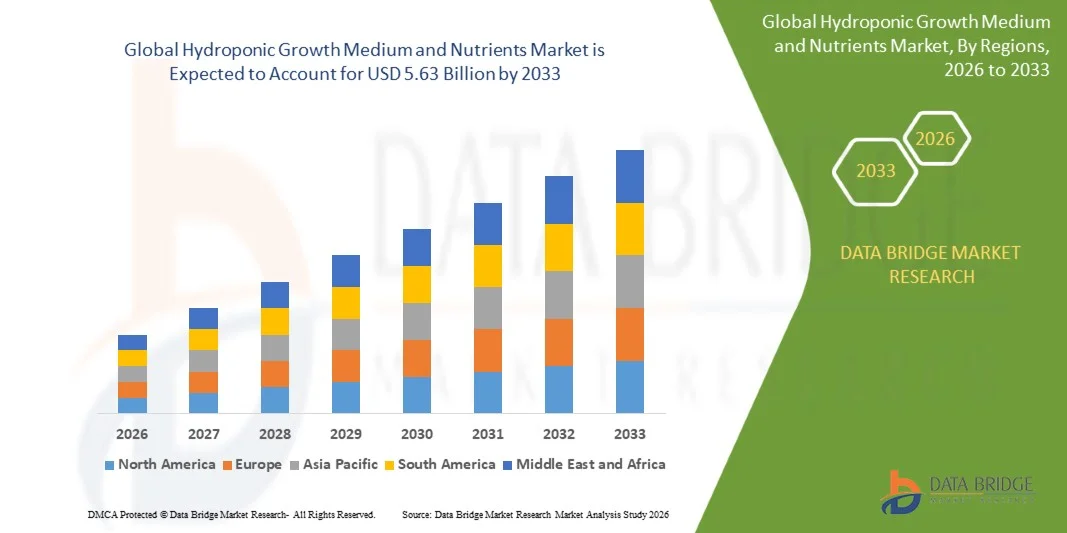
- As per Data Bridge Market Research analysis, the hydroponic growth medium and nutrients market was valued at USD 2.25 billion in 2025 and is projected to reach USD 5.63 billion by 2033, growing at a CAGR of 12.15% from 2026 to 2033.
- The market is experiencing consistent growth driven by the increasing adoption of controlled environment agriculture (CEA), vertical farming, and urban agriculture, along with rising demand for sustainable and resource-efficient crop production solutions. Hydroponic cultivation enables efficient use of water and nutrients while supporting year-round production and improved crop yields.
- The growing need for food security, limited availability of arable land, and increasing consumer preference for fresh and pesticide-free produce is encouraging commercial growers and urban farmers to adopt hydroponic cultivation. At the same time, advances in nutrient formulations, automated nutrient delivery, sustainable growth media, and smart hydroponic technologies are improving cultivation efficiency and supporting wider market adoption.
Market Size & Forecast
- Global Market Value (2025): USD 2.25 Billion
- Expected Market Value (2033): USD 5.63 Billion
- Forecast CAGR (2026–2033): 12.15%
- Leading Region in 2025: North America
- Fastest Growing Region: Asia Pacific
What are the Major Takeaways of the Hydroponic Growth Medium and Nutrients Market?
- North America dominated the hydroponic growth medium and nutrients market with the largest revenue share of 30.4% in 2025, supported by advanced agricultural technologies, strong adoption of commercial hydroponic farming, and increasing investments in controlled-environment agriculture.
- Asia-Pacific is expected to be the fastest-growing region at a CAGR of 12.1% from 2026 to 2033, fueled by rapid urbanization, increasing adoption of controlled-environment agriculture, and growing government support for hydroponic farming in China, India, and Japan.
- The nutrient solution segment led the market with a 60% share in 2025, driven by its essential role in supplying hydroponically grown crops with immediately available nutrients
- Growth enhancers are the fastest-growing product type, projected to register a CAGR of 10%, reflecting the surge in demand for products that improve plant vigor, root development, nutrient uptake, and crop quality.
- The lettuce and leafy greens segment dominated the crop type category with a 35% revenue share in 2025, led by the strong suitability of these crops for hydroponic cultivation.
- Macronutrients accounted for 60% of the market share in 2025, preferred by the fundamental importance of nitrogen, phosphorus, and potassium in hydroponic plant growth
- The LED grow light segment is the fastest-growing equipment category, with a CAGR of 12%, driven by the rapid expansion of indoor and vertical farming. LED grow lights enable growers to provide consistent light intensity and controlled light spectra regardless of outdoor weather conditions.
Report Scope and Hydroponic Growth Medium and Nutrients Market Segmentation
|
Attributes |
Hydroponic Growth Medium and Nutrients Key Market Insights |
|
Segments Covered |
|
|
Countries Covered |
North America
Europe
Asia-Pacific
Middle East and Africa
South America
|
|
Key Market Players |
|
|
Market Opportunities |
|
|
Value Added Data Infosets |
In addition to the insights on market scenarios such as market value, growth rate, segmentation, geographical coverage, and major players, the market reports curated by the Data Bridge Market Research also include import export analysis, production capacity overview, production consumption analysis, price trend analysis, climate change scenario, supply chain analysis, value chain analysis, raw material/consumables overview, vendor selection criteria, PESTLE Analysis, Porter Analysis, and regulatory framework. |
What is the Key Trend in the Hydroponic Growth Medium and Nutrients Market?
- Sustainable growth media are gaining traction as hydroponic producers seek lower-waste alternatives to conventional rockwool and perlite, while coco coir, peat moss, and biochar improve water retention, root support, and environmental performance across farms.
- In November 2024, a study published in Scientific Reports describing a new compostable hydrogel growing substrate based on polysaccharides and biochar for hydroponics and vertical farming. The development reflects the industry's shift toward sustainable alternatives to conventional growing media, particularly substrates that can improve resource efficiency while reducing environmental impact.
- Automated nutrient dosing is becoming increasingly important as growers use sensors to continuously monitor pH and electrical conductivity, enabling precise nutrient delivery, reducing manual errors, and maintaining crop-specific nutrient concentrations throughout production cycles commercially.
- Closed-loop hydroponic systems are expanding because recirculation can reduce water and fertilizer losses while supporting resource efficiency, particularly in commercial vertical farms and greenhouses where input costs and sustainability requirements increasingly influence production decisions.
- Urban and vertical farming are accelerating demand for specialized growth media and nutrient formulations because controlled environments require consistent substrates, crop-specific nutrient recipes, and reliable root-zone management for year-round production in limited urban spaces.
- For instance, in April 2024, a research article published in the South African Journal of Botany demonstrated that optimized hydroponic nutrient formulations and substrate media significantly improved strawberry growth and yield. The study found that one hydroponic nutrient formulation increased total fruit yield by 2.18 times compared with soil cultivation, while an optimized semi-hydroponic substrate treatment achieved about a 3.03-fold increase
- Organic and microbial nutrient formulations are attracting greater attention as producers pursue sustainable cultivation, with beneficial microorganisms and bio-based inputs offering opportunities to improve nutrient cycling, root development, fertilizer efficiency, and crop resilience sustainably.
What are the Key Drivers of the Hydroponic Growth Medium and Nutrients Market?
- The rising food demand and declining arable land are encouraging controlled-environment agriculture, increasing requirements for hydroponic growth media and nutrient solutions that enable intensive production, predictable yields, and efficient use of limited cultivation space overall.
- For instance, in June 2025, NITI Aayog highlighted an AI-driven hydroponics initiative in Karnataka that uses automated environmental and nutrient monitoring to address water scarcity. The system reportedly uses 95% less water than traditional farming, demonstrating how water constraints are encouraging adoption of hydroponic cultivation and, consequently, specialized growth media and nutrient solutions.
- Water scarcity is strengthening hydroponics adoption because recirculating systems can substantially reduce irrigation requirements, increasing demand for nutrient formulations and substrates designed to maintain moisture, aeration, and nutrient availability under controlled conditions more efficiently.
- Rapid expansion of vertical farming and greenhouse production is increasing demand for standardized substrates and crop-specific nutrients, as commercial growers require consistent root-zone conditions and precise nutrition to maximize productivity throughout year commercial operations.
- For instance, in December 2025, the Indian Council of Agricultural Research (ICAR) reported the launch of a low-cost hydroponic production system at Howrah Krishi Vigyan Kendra in West Bengal. The system was introduced to enable scalable soilless cultivation of green fodder, leafy vegetables and high-value crops, supporting farmers and entrepreneurs while addressing resource and land constraints.
- Advances in sensors, automated fertigation, and precision nutrient management are improving hydroponic productivity by controlling pH, electrical conductivity, and nutrient concentrations, encouraging growers to adopt higher-value specialized nutrient products and monitoring technologies advanced solutions.
Which Factors are Challenging the Growth of the Hydroponic Growth Medium and Nutrients Market?
- High initial investment remains a major restraint because commercial hydroponic operations require specialized irrigation, fertigation, lighting, climate-control, substrates, nutrient systems, and monitoring equipment, increasing capital requirements for new and smaller growers entering the market.
- For instance, in December 2025, a study published in ScienceDirect’s Ecological Modelling found that large-scale adoption of hydroponics is constrained by higher capital and production costs and inadequate technical expertise at the farm level. The research also showed that factors such as location, product quality, and service quality can affect production costs by 5–25%, highlighting the economic challenges associated with commercial hydroponic operations.
- Energy and operating costs can constrain profitability because controlled-environment hydroponics often depends on artificial lighting, pumps, climate control, and continuous monitoring, making production economics sensitive to electricity prices and equipment efficiency overall today daily.
- Complex nutrient management can limit adoption because incorrect pH, electrical conductivity, nutrient ratios, or water quality can rapidly affect plant health, requiring skilled personnel, frequent monitoring, and precise adjustment throughout cultivation cycles consistently effectively.
- For instance, in March 2024, a study published on arXiv examined the economics of indoor agriculture and reported that energy-related costs can account for a substantial portion of total operating expenses. The study highlights that electricity requirements for lighting, climate control, water circulation, and other controlled-environment systems can reduce the economic attractiveness of hydroponic farming.
- Pest and disease risks in recirculating systems can create significant production losses because water-borne pathogens such as Pythium can spread rapidly through shared nutrient solutions, making sanitation, water-quality monitoring, and disease prevention essential for maintaining crop productivity
How is the Hydroponic Growth Medium and Nutrients Market Segmented?
The hydroponic growth medium and nutrients market is segmented on the basis of product type, crop type, input type, equipment, application, and distribution channel.
- By Product Type
On the basis of product type, the hydroponic growth medium and nutrients market is segmented into growth medium, nutrient solution, additives, pH adjusters, and growth enhancers. The nutrient solution segment dominated the market with 60% share in 2025, owing to its essential role in supplying hydroponically grown crops with immediately available nutrients. Nutrient solutions provide the macronutrients and micronutrients required for plant growth without relying on conventional soil. Increasing adoption of precision nutrient management is encouraging growers to use formulations tailored to specific crops and growth stages. Commercial hydroponic farms also require continuous nutrient replenishment, creating recurring demand for these products. The growing cultivation of vegetables, fruits, and leafy greens in controlled environments is further supporting demand.
The growth enhancers segment is projected to register the fastest growth at a CAGR of 10% from 2026 to 2033, driven by increasing demand for products that improve plant vigor, root development, nutrient uptake, and crop quality. Hydroponic growers are increasingly using specialized additives and biological formulations to optimize plant performance under controlled growing conditions. These products can complement basic nutrient programs by supporting plant development during different growth stages. Rising production of high-value crops is encouraging growers to focus on maximizing yield and quality from limited cultivation areas. Increasing interest in crop-specific formulations is also creating opportunities for specialized growth-enhancing products. Advances in biostimulants and biological inputs are further broadening the product range available to hydroponic growers.
- By Crop Type
On the basis of crop type, the market is segmented into strawberry, lettuce and leafy greens, tomato, pepper, cucumber, and others. The lettuce and leafy greens segment dominated the market with 35% share in 2025, supported by the strong suitability of these crops for hydroponic cultivation. Lettuce and leafy greens have relatively short growing cycles, allowing commercial growers to achieve multiple production cycles throughout the year. Their shallow root systems are well suited to nutrient-film, deep-water, and other hydroponic systems. Increasing consumer demand for fresh and locally produced vegetables is supporting year-round production in controlled environments. These crops are also extensively cultivated in vertical farms because they can be grown efficiently in stacked systems.
The strawberry segment is projected to witness the fastest growth at a CAGR of 9% from 2026 to 2033, driven by increasing adoption of substrate-based hydroponic cultivation for high-value fruit production. Hydroponic systems allow growers to precisely manage water, nutrients, pH, and root-zone conditions for strawberries. The use of coco fiber, rock wool, and other substrates provides physical support while enabling controlled moisture and aeration. Growing demand for premium-quality berries is encouraging commercial growers to explore protected and soilless cultivation methods. Hydroponic strawberry production can also help overcome limitations associated with poor soil quality and land availability. Increasing investment in greenhouse and controlled-environment agriculture is further supporting adoption.
- By Input Type
On the basis of input type, the market is segmented into micronutrients, macronutrients, perlite and vermiculite, rock wool, coco fiber, grow rocks, and others. The macronutrients segment dominated the market with 60% share in 2025, owing to the fundamental importance of nitrogen, phosphorus, and potassium in hydroponic plant growth. These nutrients are required in relatively large quantities throughout the crop cycle and therefore represent a major recurring input for hydroponic growers. Commercial growers frequently adjust macronutrient concentrations according to crop type and plant development stage. Increasing adoption of automated fertigation systems is enabling more precise delivery and replenishment of these nutrients. The expansion of commercial greenhouses and vertical farms is further increasing consumption of macronutrient formulations.
The coco fiber segment is projected to register the fastest growth at a CAGR of 10% from 2026 to 2033, driven by increasing demand for efficient and sustainable growing substrates. Coco fiber provides a combination of moisture retention, aeration, and root support that makes it suitable for various hydroponic crops. It is increasingly used in substrate-based cultivation of strawberries, tomatoes, cucumbers, and peppers. The material can be incorporated into drip-irrigated hydroponic systems, allowing precise delivery of water and nutrients to the root zone. Increasing sustainability concerns are also encouraging growers to consider renewable substrate alternatives. Standardized and processed coco fiber products are improving consistency for commercial cultivation.
- By Equipment
On the basis of equipment, the market is segmented into irrigation systems, HVAC, control systems, communication technology, LED grow light, material handling, and others. The irrigation systems segment dominated the market with 35% share in 2025, owing to the essential role of irrigation equipment in delivering water and nutrients to hydroponically cultivated plants. Hydroponic systems require precise control over water flow, nutrient delivery, and irrigation frequency. Drip irrigation, nutrient-film systems, ebb-and-flow systems, and other technologies are widely deployed across commercial operations. Automated irrigation can improve water-use efficiency while reducing nutrient and water losses. Growing adoption of fertigation is also increasing integration between irrigation systems and nutrient management technologies. Expansion of commercial hydroponic farms and greenhouses is generating sustained demand for reliable irrigation infrastructure
The LED grow light segment is projected to witness the fastest growth at a CAGR of 12% from 2026 to 2033, driven by the rapid expansion of indoor and vertical farming. LED grow lights enable growers to provide consistent light intensity and controlled light spectra regardless of outdoor weather conditions. Modern LED systems can be adjusted according to crop type and plant growth stage, supporting more precise crop management. Improvements in energy efficiency are increasing their attractiveness for commercial controlled-environment agriculture. Integration with automated environmental control systems is also allowing growers to coordinate lighting with temperature, humidity, irrigation, and nutrient delivery. Vertical farms depend heavily on artificial lighting because crops are cultivated in enclosed and stacked environments.
- By Application
On the basis of application, the market is segmented into commercial hydroponic farming, residential hydroponics, vertical farming, greenhouses, research and development, and nurseries. The commercial hydroponic farming segment dominated the market with 50% share in 2025, supported by increasing investment in large-scale controlled-environment agriculture. Commercial growers use hydroponic systems to achieve consistent production, improve resource efficiency, and cultivate crops throughout the year. Precise control of water and nutrients allows growers to optimize crop productivity and quality. Growing demand for fresh produce near urban markets is encouraging expansion of commercial hydroponic operations. These farms also require recurring supplies of nutrient solutions, substrates, additives, and other growing inputs. Increasing automation and precision crop management are further improving the efficiency of commercial systems.
The vertical farming segment is projected to register the fastest growth at a CAGR of 13% from 2026 to 2033, driven by increasing urbanization, limited agricultural land, and demand for localized food production. Vertical farms use stacked cultivation structures to maximize crop production within limited floor space. Hydroponic systems are particularly suitable for these facilities because they provide controlled delivery of water and nutrients without conventional agricultural soil. Increasing investment in controlled-environment agriculture is encouraging deployment of automated hydroponic technologies in urban areas. Advances in LED lighting, environmental controls, sensors, and nutrient management are improving cultivation efficiency. Leafy greens and herbs are particularly suited to vertical farming because of their short production cycles and compact growth patterns
- By Distribution Channel
On the basis of distribution channel, the market is segmented into offline stores and online. The offline stores segment dominated the market with 70% share in 2025, supported by established agricultural supply stores, garden centers, specialty hydroponic retailers, and distributors. Commercial growers often purchase growing media and nutrient products through established suppliers because these channels can provide technical guidance and product recommendations. Physical stores also allow customers to inspect products and compare different formulations before purchasing. Bulk purchasing by commercial farms continues to support distributor-based sales. Established relationships between growers and agricultural input suppliers further strengthen the offline channel.
The online segment is projected to witness the fastest growth at a CAGR of 11% from 2026 to 2033, supported by increasing e-commerce adoption and the expanding availability of hydroponic products through digital platforms. Online channels provide growers with access to a wider range of nutrient solutions, additives, growing media, and specialized cultivation products. Product descriptions, technical specifications, reviews, and comparisons can make purchasing more convenient for consumers. The channel is particularly attractive to residential growers and small-scale hydroponic operators who may have limited access to specialty stores. Manufacturers and distributors can also use online channels to reach customers across geographically dispersed markets. Recurring purchases of nutrient solutions and growing media create opportunities for direct-to-consumer and subscription-based models.
Which Region Holds the Largest Share of the Hydroponic Growth Medium and Nutrients Market?
- North America dominated the hydroponic growth medium and nutrients market with the largest revenue share of 30.4% in 2025, supported by advanced agricultural technologies, strong adoption of commercial hydroponic farming, and increasing investments in controlled-environment agriculture.
- The region also benefits from increasing demand for locally produced fresh food, limited availability of arable land, water-conservation requirements, and growing investment in controlled-environment agriculture. Advancements in automation, nutrient delivery, climate control, LED lighting, and real-time crop monitoring are improving the efficiency of hydroponic operations and supporting greater consumption of specialized growth media and nutrient formulations. The presence of established commercial growers and strong distribution networks further strengthens regional demand.
U.S. Hydroponic Growth Medium and Nutrients Market Insight
The U.S. hydroponic growth medium and nutrients market is witnessing strong growth due to rising investments in controlled-environment agriculture, commercial hydroponic farms, and vertical farming facilities. The country's established agricultural technology ecosystem, along with increasing adoption of precision nutrient management, automated irrigation, and advanced growing substrates, is driving demand for hydroponic inputs. In addition, growing consumer demand for locally produced fresh vegetables, resource-efficient cultivation, and year-round crop production is accelerating the use of specialized growth media and nutrient formulations across commercial and residential applications.
Asia-Pacific Hydroponic Growth Medium and Nutrients Market Insight
The Asia-Pacific hydroponic growth medium and nutrients market is expected to witness rapid growth, driven by increasing urbanization, limited agricultural land, and rising investments in controlled-environment agriculture across countries such as China, Japan, and India. Growing awareness regarding water-efficient farming, increasing demand for fresh produce, and adoption of vertical farming technologies are supporting regional market expansion. In addition, the growing use of coco fiber, rock wool, nutrient solutions, and precision irrigation systems is accelerating demand for specialized hydroponic inputs across commercial farms, greenhouses, and urban agriculture projects.
Japan Hydroponic Growth Medium and Nutrients Market Insight
The Japan hydroponic growth medium and nutrients market is witnessing consistent growth due to rising investments in advanced greenhouse technologies, indoor farming, and resource-efficient agricultural production. Commercial growers and agricultural technology companies are increasingly adopting hydroponic systems to address limited arable land and support stable year-round crop production. Moreover, increasing integration of automated nutrient delivery, environmental monitoring, LED lighting, and advanced growing substrates is further contributing to market growth.
China Hydroponic Growth Medium and Nutrients Market Insight
The China hydroponic growth medium and nutrients market is growing rapidly, driven by increasing urbanization, limited farmland availability, and rising government and private-sector investment in modern agricultural technologies. Growing adoption of vertical farming, greenhouse cultivation, and automated hydroponic systems is significantly boosting demand for nutrient solutions and specialized growing media. In addition, increasing demand for fresh vegetables, advancements in agricultural automation, and expanding controlled-environment agriculture infrastructure are positioning China as one of the fastest-growing markets for hydroponic growth media and nutrients globally.
U.K. Hydroponic Growth Medium and Nutrients Market Insight
The U.K. hydroponic growth medium and nutrients market is experiencing steady growth, supported by rising adoption of vertical farming, greenhouse cultivation, and controlled-environment agriculture. Increasing investments in sustainable food production and growing demand for locally cultivated fresh produce are contributing to market expansion. Furthermore, the adoption of precision irrigation, automated nutrient management, energy-efficient lighting, and sustainable growing substrates is improving hydroponic production efficiency and supporting demand for advanced growth media and nutrient formulations.
Germany Hydroponic Growth Medium and Nutrients Market Insight
The Germany hydroponic growth medium and nutrients market is expanding steadily due to the country's advanced agricultural technology capabilities, strong greenhouse sector, and increasing adoption of resource-efficient cultivation methods. Commercial growers and agricultural technology companies are increasingly utilizing hydroponic systems for controlled crop production, water conservation, and year-round cultivation. Continuous advancements in automated irrigation, nutrient dosing, climate control, and sustainable growing substrates, along with increasing focus on efficient and environmentally responsible food production, are further driving market growth in Germany.
Which are the Top Companies in Hydroponic Growth Medium and Nutrients Market?
The hydroponic growth medium and nutrients industry is primarily led by well-established companies, including:
- Advanced Nutrients (U.S.)
- General Hydroponics (U.S.)
- FoxFarm Soil & Fertilizer Co (U.S.)
- Athena Ag (U.S.)
- Bertels BV (Netherlands)
- BioBizz World Wide Organics (Spain)
- Botanicare Nutrients Official Store (U.S.)
- CANNA (Netherlands)
- CYCO PLATINUM SERIES (Australia)
- House & Garden (U.S.)
- S.J. Enterprises Pty Ltd (Australia)
- Haifa Negev technologies LTD (Israel)
- Yara International ASA (Norway)
- ICL (Israel)
- Premier Tech Ltd. (Canada)
- ROCKWOOL Group (Denmark)
- Klasmann-Deilmann GmbH (Germany)
- Pelemix Ltd. (Israel)
- Hydrofarm Holdings Group, Inc. (U.S.)
- Jiffy Group (Norway)
What are Latest Developments in Hydroponic Growth Medium and Nutrients Market?
- In September 2024, Eden Grow Systems launched MyCo, a subsidiary established to commercialize a hydroponic-based mushroom cultivation technology licensed from Purdue University's Office of Technology Commercialization. The technology uses precision nutrient delivery and customizable substrates to improve consistency and productivity in controlled mushroom cultivation. The system was designed to address limitations associated with uneven nutrient distribution and conventional disposable substrates. The launch demonstrates how customized substrate and nutrient-delivery technologies are expanding into new controlled-environment cultivation applications.
- In February 2024, Klasmann-Deilmann presented new substrate solutions at Fruit Logistica, including Growbag Advanced, a formulation using GreenFibre wood fiber and a reduced proportion of coir pith. The company also introduced Nygaia, a biodegradable substrate fiber specifically developed for hydroponic and vertical cultivation of crops such as leaf lettuce. The new substrate solutions emphasize renewable raw materials, improved root development, and more sustainable hydroponic production. This development highlights the increasing commercialization of innovative and biodegradable growing media for controlled-environment agriculture.
- In June 2023, SIPCO Innovations announced the launch of Hygroben, a new biological product developed to work synergistically with its established Hygrozyme product. The formulation was designed to support beneficial microbial activity and improve root-zone conditions, making it relevant to hydroponic growers seeking improved root health and nutrient utilization. The launch reflects increasing product innovation in biological additives and root-zone enhancement solutions for hydroponic cultivation
- In June 2023, Klasmann-Deilmann introduced Nygaia substrate fiber as a new growing-media innovation for controlled cultivation. The bio-based and biodegradable substrate was developed particularly for young plants grown in hydroponic and vertical farming systems. Nygaia is designed to retain water while supporting root development and is free from salts, making it suitable for controlled root-zone management. The product was planned for initial test quantities with pilot customers before regular production. The launch demonstrates growing industry interest in sustainable alternatives to conventional hydroponic substrates
- In December 2021, iPower Inc. announced the launch of its “Flourish” line of advanced nutrient products on Amazon. The company described Flourish as its first nutrient product line, expanding its hydroponic offering beyond equipment and into specialized plant nutrition. The products were developed for growers using hydroponic cultivation systems and were made available through the company’s online distribution strategy. This launch demonstrates the expansion of branded nutrient formulations specifically targeting the growing hydroponic cultivation market.

- Interactive Data Analysis Dashboard
- Company Analysis Dashboard for high growth potential opportunities
- Research Analyst Access for customization & queries
- Competitor Analysis with Interactive dashboard
- Latest News, Updates & Trend analysis
- Harness the Power of Benchmark Analysis for Comprehensive Competitor Tracking
Data collection and base year analysis are done using data collection modules with large sample sizes. The stage includes obtaining market information or related data through various sources and strategies. It includes examining and planning all the data acquired from the past in advance. It likewise envelops the examination of information inconsistencies seen across different information sources. The market data is analysed and estimated using market statistical and coherent models. Also, market share analysis and key trend analysis are the major success factors in the market report. To know more, please request an analyst call or drop down your inquiry.
The key research methodology used by DBMR research team is data triangulation which involves data mining, analysis of the impact of data variables on the market and primary (industry expert) validation. Data models include Vendor Positioning Grid, Market Time Line Analysis, Market Overview and Guide, Company Positioning Grid, Patent Analysis, Pricing Analysis, Company Market Share Analysis, Standards of Measurement, Global versus Regional and Vendor Share Analysis. To know more about the research methodology, drop in an inquiry to speak to our industry experts.
Data Bridge Market Research is a leader in advanced formative research. We take pride in servicing our existing and new customers with data and analysis that match and suits their goal. The report can be customized to include price trend analysis of target brands understanding the market for additional countries (ask for the list of countries), clinical trial results data, literature review, refurbished market and product base analysis. Market analysis of target competitors can be analyzed from technology-based analysis to market portfolio strategies. We can add as many competitors that you require data about in the format and data style you are looking for. Our team of analysts can also provide you data in crude raw excel files pivot tables (Fact book) or can assist you in creating presentations from the data sets available in the report.