


Hydroponics Greenhouse Market Size
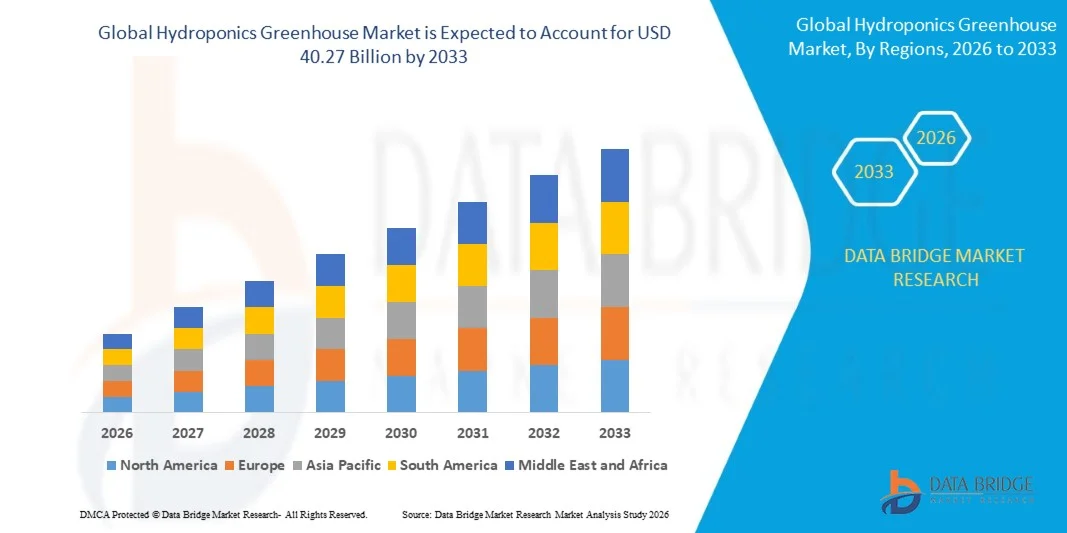
- The global hydroponics greenhouse market size was valued at USD 16.50 billion in 2025 and is expected to reach USD 40.27 billion by 2033, at a CAGR of 11.80% during the forecast period
- The market growth is largely fuelled by the increasing demand for sustainable and efficient farming practices, rising urbanization, and the need for year-round crop production
- Adoption of advanced technologies such as climate-controlled systems and automated nutrient management is further driving market expansion
Hydroponics Greenhouse Market Analysis
- The market is witnessing a shift towards precision farming techniques that optimize resource usage and increase crop yield
- Growing awareness about food security and environmental sustainability is encouraging investments in hydroponic greenhouse systems
- North America dominated the hydroponics greenhouse market with the largest revenue share of 38.45% in 2025, driven by increasing adoption of controlled-environment agriculture, rising demand for sustainable food production, and awareness of resource-efficient farming practices
- Asia-Pacific region is expected to witness the highest growth rate in the global hydroponics greenhouse market, driven by increasing population, rising demand for fresh produce, technological advancements in greenhouse systems, and the emergence of cost-effective hydroponic solutions across countries such as China, Japan, and India
- The Liquid Hydroponic Systems segment held the largest market revenue share in 2025, driven by its efficient nutrient delivery, ease of maintenance, and suitability for large-scale commercial operations. These systems allow precise control over plant nutrition and water usage, making them highly popular among commercial growers
Report Scope and Hydroponics Greenhouse Market Segmentation
|
Attributes |
Hydroponics Greenhouse Key Market Insights |
|
Segments Covered |
|
|
Countries Covered |
North America
Europe
Asia-Pacific
Middle East and Africa
South America
|
|
Key Market Players |
|
|
Market Opportunities |
|
|
Value Added Data Infosets |
In addition to the insights on market scenarios such as market value, growth rate, segmentation, geographical coverage, and major players, the market reports curated by the Data Bridge Market Research also include in-depth expert analysis, geographically represented company-wise production and capacity, network layouts of distributors and partners, detailed and updated price trend analysis and deficit analysis of supply chain and demand. |
Hydroponics Greenhouse Market Trends
“Rise of Automated And Climate-Controlled Hydroponics Systems”
• The growing adoption of automated and climate-controlled hydroponics systems is transforming the greenhouse farming landscape by enabling year-round crop production with optimized resource use. These systems regulate temperature, humidity, and nutrient delivery, resulting in higher yields and consistent crop quality. In addition, automation reduces human error and ensures precise monitoring of plant growth, leading to better product uniformity and resource efficiency
• Increasing demand for efficient food production in urban and space-constrained areas is driving the use of vertical hydroponic setups and multi-tiered greenhouses. These systems maximize space utilization while reducing water and fertilizer consumption, supporting sustainable urban agriculture. They also help meet rising consumer demand for locally grown, fresh produce and shorten supply chains, reducing carbon footprint and transportation costs
• The integration of IoT sensors and smart monitoring tools is improving operational efficiency, allowing farmers to track plant health, nutrient levels, and environmental conditions in real time. This enhances crop management and reduces labor requirements. Smart systems also generate valuable data for predictive analytics, enabling proactive decision-making and minimizing crop losses
• For instance, in 2023, several commercial greenhouses in the Netherlands implemented fully automated hydroponic systems, resulting in a 25% increase in yield and significant reductions in water and energy usage. Farmers reported improved operational workflows and the ability to expand production without additional land requirements, supporting scalability
• While automation and smart systems are boosting productivity and sustainability, their adoption depends on continued innovation, cost reduction, and user training. Manufacturers must focus on scalable and affordable solutions to meet growing global demand. Training programs and service support are essential to ensure farmers can fully utilize advanced features and maintain system longevity
Hydroponics Greenhouse Market Dynamics
Driver
“Rising Demand for Sustainable And Efficient Food Production”
• The increasing global population and urbanization are pushing governments and agricultural enterprises to adopt hydroponic greenhouse systems as a sustainable solution for high-yield crop production. These systems help address land scarcity and mitigate the environmental impact of traditional farming methods, ensuring consistent food supply in growing urban centers. The trend is also supported by increasing consumer awareness about healthy, pesticide-free produce
• Growing awareness of food security and the environmental impact of traditional agriculture is accelerating investment in hydroponics technologies, enabling year-round cultivation with minimal land and water usage. Companies are increasingly focusing on energy-efficient systems and renewable energy integration, further enhancing sustainability and reducing operational costs over time
• Public sector initiatives and subsidies for controlled-environment agriculture are encouraging adoption, especially in urban and water-scarce regions. Government programs supporting smart agriculture are facilitating technology transfer, financing options, and capacity building, which help accelerate market penetration and adoption among small- and medium-scale farmers
• For instance, in 2022, several Asian countries launched programs to support hydroponic greenhouse adoption in urban areas, driving demand for modern greenhouse systems and automation tools. These initiatives also included training sessions, grants, and technical support, helping farmers transition from traditional cultivation methods to advanced hydroponic farming
• While sustainability and efficiency are key drivers, challenges related to initial investment and technical expertise must be addressed to ensure widespread adoption. Companies are investing in modular and cost-effective systems to lower barriers and make hydroponic technology accessible to a wider range of producers
Restraint/Challenge
“High Initial Investment And Technical Complexity”
• The high cost of advanced hydroponic greenhouse systems, including climate-control units, automated nutrient delivery, and IoT-based monitoring, limits adoption among small-scale farmers and startups. Many farmers face difficulty accessing financing options, and the long payback period further discourages early adoption despite the potential for higher yields and reduced resource usage
• In many regions, farmers lack technical expertise to operate and maintain automated systems, creating barriers to effective implementation and reducing return on investment. This knowledge gap often results in underutilization of system capabilities and inconsistent crop quality, highlighting the need for comprehensive training programs and ongoing technical support from manufacturers
• Market growth is also constrained by infrastructure requirements, such as reliable electricity and water supply, which are essential for system operation. In regions with unstable utilities or limited connectivity, maintaining automated systems becomes challenging, potentially leading to operational disruptions and reduced efficiency
• For instance, in 2023, surveys in Sub-Saharan Africa revealed that over 60% of small-scale farmers could not adopt hydroponics due to high system costs and lack of technical support. Farmers also cited limited access to spare parts and maintenance services as major hurdles, underscoring the need for localized service networks and affordable solutions
• While technologies continue to evolve, addressing affordability and ease of use is critical. Stakeholders must focus on modular, cost-effective, and user-friendly solutions to expand market penetration and unlock long-term potential. Collaboration between technology providers, government agencies, and financial institutions can facilitate adoption and enable sustainable growth in the hydroponics greenhouse market
Hydroponics Greenhouse Market Scope
The market is segmented on the basis of type, equipment, input type, crop type, and end user
• By Type
On the basis of type, the hydroponics greenhouse market is segmented into Aggregate Systems and Liquid Hydroponic Systems. The Liquid Hydroponic Systems segment held the largest market revenue share in 2025, driven by its efficient nutrient delivery, ease of maintenance, and suitability for large-scale commercial operations. These systems allow precise control over plant nutrition and water usage, making them highly popular among commercial growers.
The Aggregate Systems segment is expected to witness the fastest growth rate from 2026 to 2033, driven by its versatility and adaptability for various crops and small-scale operations. Aggregate Systems are particularly valued for their ability to support multiple growing media types and improve root aeration, enhancing overall crop quality and yield.
• By Equipment
On the basis of equipment, the market is segmented into HVAC, LED Grow Light, Control Systems, Irrigation Systems, Material Handling, and Others. The LED Grow Light segment held the largest market share in 2025, driven by energy-efficient lighting, long lifespan, and ability to optimize photosynthesis across different crop types. LED grow lights also enable year-round cultivation and precise control over plant growth cycles.
The Control Systems segment is expected to witness the fastest growth from 2026 to 2033, driven by the adoption of automation and IoT-based monitoring solutions. These systems allow real-time tracking of environmental conditions, nutrient levels, and crop health, improving operational efficiency and reducing labor requirements.
• By Input Type
On the basis of input type, the market is segmented into Nutrients and Grow Media. The Nutrients segment held the largest market revenue share in 2025, fueled by the increasing demand for precise and optimized nutrient delivery for different crops. Nutrient solutions enhance plant growth, yield, and quality, making them essential for high-efficiency hydroponic systems.
The Grow Media segment is expected to witness the fastest growth rate from 2026 to 2033, driven by the development of advanced substrates that improve water retention, aeration, and root support. Innovative grow media also allow for flexibility across various hydroponic systems and crop types.
• By Crop Type
On the basis of crop type, the market is segmented into Vegetables, Fruits, Flowers, and Others. The Vegetables segment held the largest market share in 2025, driven by the high global demand for fresh, pesticide-free produce and the suitability of hydroponics systems for leafy greens, tomatoes, and cucumbers. Vegetables also offer shorter growth cycles and higher returns on investment for growers.
The Fruits segment is expected to witness the fastest growth rate from 2026 to 2033, fueled by increasing consumer preference for high-quality fruits and berries grown under controlled conditions. Hydroponic fruit cultivation allows for better flavor, yield consistency, and reduced dependency on seasonal variations.
• By End User
On the basis of end user, the market is segmented into Commercial Growers, Research and Educational Institutes, Retail Gardens, and Others. The Commercial Growers segment held the largest revenue share in 2025, driven by large-scale adoption of hydroponic greenhouses for high-efficiency, high-yield production. Commercial growers benefit from optimized resource use, consistent crop quality, and the ability to supply year-round fresh produce.
The Research and Educational Institutes segment is expected to witness the fastest growth from 2026 to 2033, fueled by increasing focus on agricultural research, sustainable farming practices, and academic programs supporting controlled-environment agriculture. These institutions are adopting hydroponic systems to study crop behavior, resource management, and technological innovations.
Hydroponics Greenhouse Market Regional Analysis
• North America dominated the hydroponics greenhouse market with the largest revenue share of 38.45% in 2025, driven by increasing adoption of controlled-environment agriculture, rising demand for sustainable food production, and awareness of resource-efficient farming practices
• Consumers and commercial growers in the region highly value the ability to produce fresh, high-quality crops year-round while optimizing water and nutrient usage, supporting sustainable urban and rural farming initiatives
• This widespread adoption is further supported by technological advancements, strong government support, and high investment in agricultural infrastructure, establishing hydroponic greenhouses as a preferred solution for commercial, research, and retail applications
U.S. Hydroponics Greenhouse Market Insight
The U.S. hydroponics greenhouse market captured the largest revenue share in 2025 within North America, fueled by the increasing focus on precision agriculture, urban farming, and sustainable crop production. Growers are adopting advanced automated systems, climate-controlled environments, and IoT-based monitoring tools to optimize yield and reduce operational costs. Government initiatives promoting sustainable agriculture, coupled with rising consumer demand for pesticide-free produce, are further propelling market growth.
Europe Hydroponics Greenhouse Market Insight
The Europe hydroponics greenhouse market is expected to witness the fastest growth rate from 2026 to 2033, primarily driven by the adoption of energy-efficient and smart greenhouse technologies, stringent regulations on sustainable agriculture, and increasing urbanization. European growers are focusing on maximizing crop yield while reducing water and nutrient consumption. The region is also experiencing growth in commercial, retail, and research applications, with hydroponics being integrated into both new and renovated greenhouse facilities.
U.K. Hydroponics Greenhouse Market Insight
The U.K. hydroponics greenhouse market is expected to witness the fastest growth rate from 2026 to 2033, driven by the growing trend of urban and vertical farming, coupled with the need for sustainable, high-quality food production. Concerns over food security and climate impact are encouraging growers to adopt hydroponic systems. The U.K.’s robust agricultural research infrastructure and adoption of smart farming solutions are expected to continue stimulating market growth.
Germany Hydroponics Greenhouse Market Insight
The Germany hydroponics greenhouse market is expected to witness the fastest growth rate from 2026 to 2033, fueled by technological advancements in automated systems and smart monitoring, as well as a strong emphasis on sustainable and eco-friendly farming practices. Germany’s well-developed infrastructure and innovation-driven agriculture sector are promoting the adoption of hydroponic greenhouses for vegetables, fruits, and ornamental plants. Integration with energy-efficient solutions and precision agriculture tools is becoming increasingly prevalent
Asia-Pacific Hydroponics Greenhouse Market Insight
The Asia-Pacific hydroponics greenhouse market is expected to witness the fastest growth rate from 2026 to 2033, driven by rapid urbanization, rising disposable incomes, and increasing adoption of modern farming technologies in countries such as China, Japan, and India. The region’s focus on smart agriculture, government initiatives promoting controlled-environment farming, and the availability of cost-effective hydroponic solutions are driving adoption. Furthermore, APAC is emerging as a manufacturing hub for hydroponic equipment, increasing accessibility to growers.
Japan Hydroponics Greenhouse Market Insight
The Japan hydroponics greenhouse market is expected to witness strong growth from 2026 to 2033 due to the country’s high-tech agricultural infrastructure, urban population density, and demand for efficient, high-yield farming solutions. Adoption is driven by precision farming, smart monitoring systems, and integration with other IoT-enabled farm technologies. Japan’s aging farming population is also encouraging the use of automated and easy-to-manage hydroponic systems in both commercial and research applications.
China Hydroponics Greenhouse Market Insight
The China hydroponics greenhouse market accounted for the largest revenue share in Asia-Pacific in 2025, attributed to rapid urbanization, government support for controlled-environment agriculture, and rising demand for fresh produce. China is one of the largest markets for hydroponic technology, with commercial, retail, and research applications expanding rapidly. The development of cost-effective, scalable greenhouse systems and strong domestic manufacturing capabilities are key factors driving market growth.
Hydroponics Greenhouse Market Share
The Hydroponics Greenhouse industry is primarily led by well-established companies, including:
- Signify Holding (Netherlands)
- Heliospectra AB (Sweden)
- The Scotts Company LLC (U.S.)
- Argus Control Systems Limited (Canada)
- LOGIQS B.V. (Netherlands)
- LumiGrow (U.S.)
- Hydroponic Systems International (Spain)
- Hydrodynamics International (U.S.)
- American Hydroponics (U.S.)
- Advanced Nutrients (U.S.)
- Emerald Harvest (U.S.)
- Grobo (U.S.)
- AeroFarms (U.S.)
- Terra Tech Corp. (U.S.)
- Triton Foodworks (India)
- Freight Farms, Inc. (U.S.)
- Green Sense Farms Holdings, Inc. (U.S.)
- Emirates Hydroponics Farms (U.A.E.)
- Gotham Greens (U.S.)
- Nature's Miracle (India)
- BrightFarms (U.S.)

- Interactive Data Analysis Dashboard
- Company Analysis Dashboard for high growth potential opportunities
- Research Analyst Access for customization & queries
- Competitor Analysis with Interactive dashboard
- Latest News, Updates & Trend analysis
- Harness the Power of Benchmark Analysis for Comprehensive Competitor Tracking
Global Hydroponics Greenhouse Market, Supply Chain Analysis and Ecosystem Framework
To support market growth and help clients navigate the impact of geopolitical shifts, DBMR has integrated in-depth supply chain analysis into its Global Hydroponics Greenhouse Market research reports. This addition empowers clients to respond effectively to global changes affecting their industries. The supply chain analysis section includes detailed insights such as Global Hydroponics Greenhouse Market consumption and production by country, price trend analysis, the impact of tariffs and geopolitical developments, and import and export trends by country and HSN code. It also highlights major suppliers with data on production capacity and company profiles, as well as key importers and exporters. In addition to research, DBMR offers specialized supply chain consulting services backed by over a decade of experience, providing solutions like supplier discovery, supplier risk assessment, price trend analysis, impact evaluation of inflation and trade route changes, and comprehensive market trend analysis.
Data collection and base year analysis are done using data collection modules with large sample sizes. The stage includes obtaining market information or related data through various sources and strategies. It includes examining and planning all the data acquired from the past in advance. It likewise envelops the examination of information inconsistencies seen across different information sources. The market data is analysed and estimated using market statistical and coherent models. Also, market share analysis and key trend analysis are the major success factors in the market report. To know more, please request an analyst call or drop down your inquiry.
The key research methodology used by DBMR research team is data triangulation which involves data mining, analysis of the impact of data variables on the market and primary (industry expert) validation. Data models include Vendor Positioning Grid, Market Time Line Analysis, Market Overview and Guide, Company Positioning Grid, Patent Analysis, Pricing Analysis, Company Market Share Analysis, Standards of Measurement, Global versus Regional and Vendor Share Analysis. To know more about the research methodology, drop in an inquiry to speak to our industry experts.
Data Bridge Market Research is a leader in advanced formative research. We take pride in servicing our existing and new customers with data and analysis that match and suits their goal. The report can be customized to include price trend analysis of target brands understanding the market for additional countries (ask for the list of countries), clinical trial results data, literature review, refurbished market and product base analysis. Market analysis of target competitors can be analyzed from technology-based analysis to market portfolio strategies. We can add as many competitors that you require data about in the format and data style you are looking for. Our team of analysts can also provide you data in crude raw excel files pivot tables (Fact book) or can assist you in creating presentations from the data sets available in the report.













