


What is the Hydrostatic Transmission Market Size and Growth Rate?
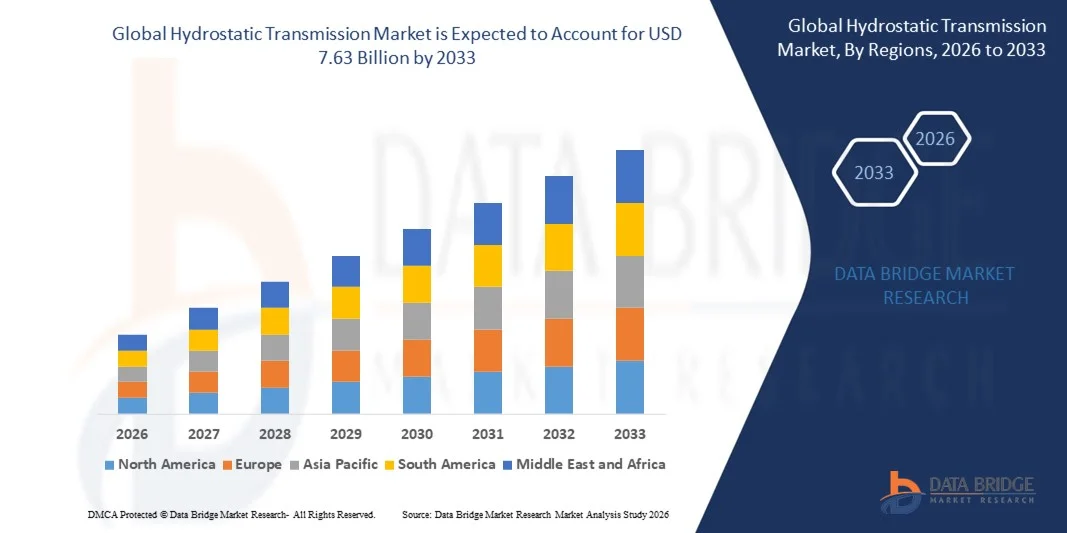
- As per Data Bridge Market Research Analysis the global hydrostatic transmission market size was valued at USD 5.60 billion in 2025 and is expected to reach USD 7.63 billion by 2033, at a CAGR of 3.94% during the forecast period
- The market growth is largely driven by the increasing adoption of hydrostatic transmission systems in construction, agriculture, and industrial machinery, where their superior precision, smooth operation, and fuel efficiency are highly valued
- Furthermore, rising demand for low-maintenance, durable, and energy-efficient equipment is encouraging manufacturers to integrate hydrostatic systems into tractors, loaders, and material handling machinery. These converging factors are accelerating the uptake of hydrostatic transmissions, thereby significantly boosting the industry’s expansion
Market Size & Forecast
- Global Market Value (2025): USD 5.60 billion
- Expected Market Value (2033): USD 7.63 billion
- Forecast CAGR (2026–2033): 3.94%
Hydrostatic Transmission Market Analysis
- Hydrostatic transmissions, providing variable speed control and high torque at low speeds, are becoming essential in modern heavy-duty machinery and off-highway vehicles due to their operational flexibility and reliability
- The escalating demand for hydrostatic systems is primarily fueled by mechanization trends in agriculture and construction, increasing fleet modernization efforts, and the need for enhanced equipment performance, efficiency, and operator comfort
- North America dominated the hydrostatic transmission market with a share of 46.4% in 2025, due to strong demand from construction, agriculture, and material handling equipment sectors
- Asia-Pacific is expected to be the fastest growing region in the hydrostatic transmission market during the forecast period due to rapid urbanization, expanding infrastructure projects, and rising agricultural mechanization in countries such as China, Japan, and India
- Variable displacement pump-constant displacement motor segment dominated the market with a market share of 46.8% in 2025, due to its high efficiency, precise speed control, and widespread use in mobile machinery. This configuration enables smooth acceleration and deceleration, improved fuel efficiency, and better adaptability to varying load conditions. It is extensively utilized in construction and agricultural equipment where consistent performance and controllability are critical. The simplicity of system design combined with reliable output enhances its preference among OEMs
Report Scope and Hydrostatic Transmission Market Segmentation
|
Attributes |
Hydrostatic Transmission Key Market Insights |
|
Segments Covered |
|
|
Countries Covered |
North America
Europe
Asia-Pacific
Middle East and Africa
South America
|
|
Key Market Players |
|
|
Market Opportunities |
|
|
Value Added Data Infosets |
In addition to the market insights such as market value, growth rate, market segments, geographical coverage, market players, and market scenario, the market report curated by the Data Bridge Market Research team includes in-depth expert analysis, import/export analysis, pricing analysis, production consumption analysis, and pestle analysis. |
What is the Key Trend in the Hydrostatic Transmission Market?
Growing Use of Hydrostatic Systems in Construction and Agriculture
- A key trend in the hydrostatic transmission market is the increasing deployment of hydrostatic systems in construction machinery and agricultural equipment, driven by the need for precise motion control, improved fuel efficiency, and enhanced operational reliability. These systems are enabling machinery to perform with smoother power delivery, variable speed control, and better adaptability across different terrains and workloads
- For instance, Bosch Rexroth and Danfoss supply advanced hydrostatic drive systems for tractors and excavators, enhancing performance in precision agriculture and heavy construction operations. Their systems contribute to lower fuel consumption and reduced mechanical wear, strengthening long-term operational efficiency
- The adoption of hydrostatic transmissions is rising in compact and medium-sized construction equipment where continuous variable speed control and maneuverability are critical. These applications are positioning hydrostatic systems as integral for productivity optimization in urban construction sites and flexible agricultural operations
- Agricultural machinery manufacturers are increasingly integrating hydrostatic drives into tractors, harvesters, and sprayers to provide smoother speed transitions and easier handling under varying load conditions. This trend is improving operator comfort and reducing fatigue while supporting higher field efficiency
- Construction and forestry equipment are incorporating hydrostatic systems to achieve precise torque distribution, enhanced traction, and seamless operation in challenging environments. This is driving broader acceptance of hydrostatic transmissions in industries where operational precision and equipment longevity are essential
- The market is witnessing steady growth in mobile equipment segments where hydrostatic transmissions facilitate advanced mobility, compact design integration, and simplified maintenance. These advantages are reinforcing the role of hydrostatic drives as key enablers for sustainable and efficient machinery performance
Hydrostatic Transmission Market Dynamics
Driver
Rising Demand for Fuel-Efficient and Low-Maintenance Equipment
- The growing need for equipment that reduces fuel consumption while minimizing maintenance frequency is driving demand for hydrostatic transmissions. Their ability to provide continuous variable speed control, reduced mechanical complexity, and smoother operation makes them ideal for both construction and agricultural applications
- For instance, Caterpillar and John Deere have integrated hydrostatic drives into their tractors and excavators, enabling better fuel efficiency, reduced operational costs, and simplified maintenance procedures. These implementations support productivity gains and operational sustainability across large-scale operations
- Operators are increasingly favoring hydrostatic systems for their ability to optimize engine output, reduce energy losses, and prolong equipment life. This is pushing manufacturers to expand hydrostatic transmission offerings to meet the evolving requirements of industrial machinery
- The adoption of hydrostatic systems allows equipment manufacturers to provide models with lower emissions and compliance with stringent environmental regulations. These benefits align with global sustainability targets and industry initiatives promoting greener machinery
- The emphasis on machine uptime, lower lifecycle costs, and simplified servicing is encouraging the replacement of conventional mechanical drives with hydrostatic alternatives. This trend is further strengthening the market for advanced hydrostatic transmissions across multiple mobile equipment sectors
Restraint/Challenge
High Initial Cost and Complex System Maintenance
- The hydrostatic transmission market faces challenges due to the high upfront costs associated with advanced hydrostatic systems and the complexity involved in their maintenance. Specialized components, precision engineering, and sophisticated control mechanisms elevate both procurement and servicing expenses
- For instance, Danfoss hydrostatic units require skilled technicians for troubleshooting and calibration, and replacement parts are cost-intensive, making maintenance more challenging for operators. These factors can limit adoption in cost-sensitive applications and smaller operations
- The complexity of system integration and the need for proper hydraulic fluid management increase operational risks if maintenance is not performed correctly. This is adding pressure on manufacturers to provide training and support for effective system upkeep
- Replacement and repair cycles for high-performance hydrostatic transmissions are longer compared to conventional mechanical drives, contributing to higher lifecycle costs. This can discourage small and medium-sized enterprises from adopting hydrostatic solutions despite their operational advantages
- The market continues to encounter barriers associated with balancing performance benefits against higher acquisition and servicing costs. These challenges collectively influence purchasing decisions and slow widespread adoption in segments with tight budget constraints
Hydrostatic Transmission Market Scope
The market is segmented on the basis of capacity type, operation type, and end use.
- By Capacity Type
On the basis of capacity type, the hydrostatic transmission market is segmented into light duty, medium duty, and heavy duty. The heavy duty segment dominated the market with the largest revenue share in 2025, driven by its extensive application in high-load and high-power equipment across construction, mining, and large-scale agricultural machinery. Heavy duty hydrostatic transmissions are preferred for their ability to deliver high torque at low speeds, improved load control, and enhanced durability under harsh operating conditions. Their superior performance in earthmoving equipment, loaders, and excavators strengthens their adoption in infrastructure development projects. In addition, increasing investments in large-scale construction and mining operations globally continue to reinforce demand for heavy duty systems due to their reliability and operational efficiency.
The medium duty segment is anticipated to witness the fastest growth rate from 2026 to 2033, fueled by rising demand for versatile machinery across agriculture, material handling, and compact construction equipment. Medium duty systems provide an optimal balance between power output and cost efficiency, making them suitable for mid-sized tractors, skid steer loaders, and utility vehicles. Growing mechanization in emerging economies and expanding use of compact equipment in urban projects are supporting segment growth. Manufacturers are focusing on improving efficiency and reducing energy losses in medium capacity systems, further accelerating their adoption across diverse applications.
- By Operation Type
On the basis of operation type, the hydrostatic transmission market is segmented into variable displacement motor-constant displacement pump, variable displacement pump-constant displacement motor, and variable displacement motor-variable displacement pump. The variable displacement pump-constant displacement motor segment dominated the market with the largest share of 46.8% in 2025 owing to its high efficiency, precise speed control, and widespread use in mobile machinery. This configuration enables smooth acceleration and deceleration, improved fuel efficiency, and better adaptability to varying load conditions. It is extensively utilized in construction and agricultural equipment where consistent performance and controllability are critical. The simplicity of system design combined with reliable output enhances its preference among OEMs.
The variable displacement motor-variable displacement pump segment is projected to register the fastest growth during the forecast period due to its superior flexibility and advanced control capabilities. This configuration allows dynamic adjustment of both pump and motor displacement, delivering optimized performance, higher energy efficiency, and enhanced torque control. Increasing demand for advanced machinery with improved productivity and reduced fuel consumption is driving adoption of this segment. Technological advancements in electronic control systems are further enabling more precise operation, supporting rapid growth across high-performance applications.
- By End Use
On the basis of end use, the hydrostatic transmission market is segmented into mining, construction, transportation, agricultural, and others. The construction segment dominated the market with the largest revenue share in 2025 driven by extensive deployment of hydrostatic drives in loaders, excavators, compact track loaders, and paving equipment. Hydrostatic transmissions offer superior maneuverability, smooth speed variation, and enhanced operational control, which are essential in complex construction environments. Rapid urbanization, infrastructure expansion projects, and increasing investment in residential and commercial development are strengthening demand in this segment. The ability of hydrostatic systems to operate efficiently under variable load conditions further supports their widespread use in construction machinery.
The agricultural segment is expected to witness the fastest growth rate from 2026 to 2033 owing to rising farm mechanization and increasing adoption of advanced tractors and harvesting equipment. Hydrostatic transmissions provide precise speed control, ease of operation, and improved productivity, making them suitable for modern farming applications. Growing emphasis on efficient land utilization and higher crop yield is encouraging farmers to adopt technologically advanced machinery. In addition, government support programs promoting agricultural mechanization in developing regions are contributing to accelerated growth of this segment.
Hydrostatic Transmission Market Regional Analysis
- North America dominated the hydrostatic transmission market with the largest revenue share of 46.4% in 2025, driven by strong demand from construction, agriculture, and material handling equipment sectors
- Equipment manufacturers in the region prioritize hydrostatic transmission systems for their superior speed control, smooth operation, and improved fuel efficiency in heavy machinery applications
- This widespread adoption is further supported by advanced mechanization practices, high replacement rates of off-highway vehicles, and the presence of leading equipment manufacturers, establishing hydrostatic transmission as a preferred solution for compact loaders, tractors, and excavators
U.S. Hydrostatic Transmission Market Insight
The U.S. hydrostatic transmission market captured the largest revenue share within North America in 2025, fueled by rising investments in infrastructure development and large-scale farming operations. Increasing demand for skid steer loaders, compact track loaders, and agricultural tractors is accelerating the integration of hydrostatic systems. Strong emphasis on equipment productivity, operator comfort, and reduced maintenance requirements further supports market growth. Moreover, the presence of major OEMs and continuous advancements in hydraulic component technologies are significantly contributing to industry expansion.
Europe Hydrostatic Transmission Market Insight
The Europe hydrostatic transmission market is projected to expand at a substantial CAGR throughout the forecast period, primarily driven by stringent emission norms and the growing focus on energy-efficient machinery. Increasing modernization of agricultural equipment and construction fleets is fostering adoption across the region. European manufacturers emphasize precision control and environmental compliance, encouraging the use of hydrostatic systems in compact and mid-sized equipment. The market is witnessing steady growth across industrial, agricultural, and municipal applications, supported by technological innovation and sustainability goals.
U.K. Hydrostatic Transmission Market Insight
The U.K. hydrostatic transmission market is anticipated to grow at a noteworthy CAGR during the forecast period, driven by infrastructure upgrades and increasing mechanization in agriculture. Demand for compact construction equipment and turf maintenance machinery is supporting the integration of hydrostatic drives. The country’s focus on operational efficiency and low-emission equipment is encouraging fleet modernization. In addition, rising investments in public infrastructure projects are expected to stimulate market growth.
Germany Hydrostatic Transmission Market Insight
The Germany hydrostatic transmission market is expected to expand at a considerable CAGR during the forecast period, fueled by the country’s strong engineering base and advanced manufacturing ecosystem. Germany’s leadership in agricultural and construction machinery production promotes widespread integration of hydrostatic systems. Emphasis on automation, efficiency, and environmentally compliant equipment aligns with the advantages offered by hydrostatic transmission technology. Increasing adoption in industrial vehicles and specialized machinery further strengthens market prospects.
Asia-Pacific Hydrostatic Transmission Market Insight
The Asia-Pacific hydrostatic transmission market is poised to grow at the fastest CAGR during the forecast period of 2026 to 2033, driven by rapid urbanization, expanding infrastructure projects, and rising agricultural mechanization in countries such as China, Japan, and India. Growing investments in smart cities and industrial development are accelerating demand for compact and heavy construction machinery. The region’s expanding manufacturing base and cost-effective production capabilities are enhancing system accessibility. Furthermore, increasing government support for farm modernization is boosting adoption across emerging economies.
Japan Hydrostatic Transmission Market Insight
The Japan hydrostatic transmission market is gaining momentum due to high adoption of advanced machinery and strong demand for precision-controlled equipment. The country’s focus on compact construction equipment and technologically advanced agricultural machinery is driving market expansion. Integration of hydrostatic systems in mini excavators and specialized tractors is becoming increasingly prevalent. Moreover, continuous innovation in hydraulic components and automation technologies is supporting sustained growth.
China Hydrostatic Transmission Market Insight
The China hydrostatic transmission market accounted for the largest market revenue share in Asia Pacific in 2025, attributed to rapid infrastructure expansion and large-scale agricultural transformation. China’s strong domestic manufacturing capabilities and growing construction equipment production are key growth drivers. Increasing deployment of wheel loaders, excavators, and tractors equipped with hydrostatic systems is strengthening market penetration. The push toward modernization of industrial and rural equipment continues to propel the hydrostatic transmission industry in the country.
Hydrostatic Transmission Market Share
The Hydrostatic transmission industry is primarily led by well-established companies, including:
- KANZAKI KOKYUKOKI MFG. CO., LTD. (Japan)
- Dana Limited (U.S.)
- PARKER HANNIFIN CORP (U.S.)
- Danfoss A/S (Denmark)
- Eaton (U.S.)
- Carraro HQ (Italy)
- Tuff Torq Corporation (Canada)
- Komatsu America Corp. (U.S.)
- Kawasaki Heavy Industries, Ltd. (Japan)
- Hydro-Gear (U.S.)
- PMC Hydraulics Group AB (Sweden)
- Hydrostatic Transmission Service, LLC (U.S.)
- Sundstrand Hydraulics (U.S.)
- Linde Hydraulics GmbH & Co. KG (Germany)
- POCLAIN HYDRAULICS (France)
- Bosch Rexroth AG (Germany)
- HANSA-TMP (Germany)
- Perea Maritima S.A. (Spain)
- ZF Friedrichshafen AG (Germany)
- Komatsu Ltd. (Japan)
Latest Developments in Global Hydrostatic Transmission Market
- In April 2024, ZF Friedrichshafen AG introduced a next-generation hydrostatic transmission system featuring smart hydraulic controls and AI-based torque optimization. The system uses intelligent sensors and predictive algorithms to continuously adjust torque distribution based on load conditions, terrain, and duty cycles. This significantly enhances fuel efficiency, operational precision, and drivetrain responsiveness in heavy-duty commercial vehicles and off-highway machinery. By integrating AI-driven torque management, ZF enables reduced energy consumption, lower wear and tear, and minimized downtime, strengthening its competitive position in the industrial and commercial machinery segment
- In March 2024, Kubota Corporation unveiled an advanced compact hydrostatic transmission tailored for small tractors and utility vehicles. The new design focuses on smoother speed variation, simplified control architecture, and improved hydraulic sealing technology to reduce leakage and maintenance frequency. This development enhances maneuverability and operator comfort, particularly in precision farming and landscaping applications. By addressing the growing demand for efficient, mechanized, and user-friendly agricultural equipment, Kubota’s innovation is expected to accelerate adoption across both developed and emerging farming markets
- In February 2024, Allison Transmission announced the launch of a hydrostatic-electric hybrid drivetrain designed for public transportation and logistics vehicles. The system combines hydrostatic drive efficiency with electric propulsion support, enabling regenerative energy capture during braking and deceleration. This configuration improves fuel economy, reduces emissions, and ensures smoother acceleration in stop-and-go urban operations. The hybrid solution reinforces Allison’s presence in sustainable transit and commercial vehicle segments, aligning with global efforts to decarbonize transportation fleets
- In January 2024, Liebherr Group developed a high-efficiency hydrostatic drive system for mining and construction machinery, incorporating regenerative braking and advanced thermal management. The innovation enhances load-handling capability while optimizing power output under extreme operating conditions. Improved energy recovery and reduced fuel consumption contribute to lower total cost of ownership for heavy-duty equipment operators. This advancement positions Liebherr to capture increasing demand in sectors prioritizing durability, high performance, and environmentally responsible operations
- In January 2023, Dana Incorporated announced plans to launch a modular hydrostatic driveline for telehandlers in North America. The architecture is engineered to support seamless integration with hydrogen fuel cell systems and battery-electric platforms, enabling manufacturers to transition toward alternative energy solutions without major redesigns. Its scalable configuration improves flexibility for OEMs targeting diverse equipment classes. This forward-looking development strengthens Dana’s competitiveness in the construction and material handling equipment market while supporting the broader shift toward low-emission machinery

- Interactive Data Analysis Dashboard
- Company Analysis Dashboard for high growth potential opportunities
- Research Analyst Access for customization & queries
- Competitor Analysis with Interactive dashboard
- Latest News, Updates & Trend analysis
- Harness the Power of Benchmark Analysis for Comprehensive Competitor Tracking
Data collection and base year analysis are done using data collection modules with large sample sizes. The stage includes obtaining market information or related data through various sources and strategies. It includes examining and planning all the data acquired from the past in advance. It likewise envelops the examination of information inconsistencies seen across different information sources. The market data is analysed and estimated using market statistical and coherent models. Also, market share analysis and key trend analysis are the major success factors in the market report. To know more, please request an analyst call or drop down your inquiry.
The key research methodology used by DBMR research team is data triangulation which involves data mining, analysis of the impact of data variables on the market and primary (industry expert) validation. Data models include Vendor Positioning Grid, Market Time Line Analysis, Market Overview and Guide, Company Positioning Grid, Patent Analysis, Pricing Analysis, Company Market Share Analysis, Standards of Measurement, Global versus Regional and Vendor Share Analysis. To know more about the research methodology, drop in an inquiry to speak to our industry experts.
Data Bridge Market Research is a leader in advanced formative research. We take pride in servicing our existing and new customers with data and analysis that match and suits their goal. The report can be customized to include price trend analysis of target brands understanding the market for additional countries (ask for the list of countries), clinical trial results data, literature review, refurbished market and product base analysis. Market analysis of target competitors can be analyzed from technology-based analysis to market portfolio strategies. We can add as many competitors that you require data about in the format and data style you are looking for. Our team of analysts can also provide you data in crude raw excel files pivot tables (Fact book) or can assist you in creating presentations from the data sets available in the report.













