


What is the Hyper Car Market Size and Growth Rate?
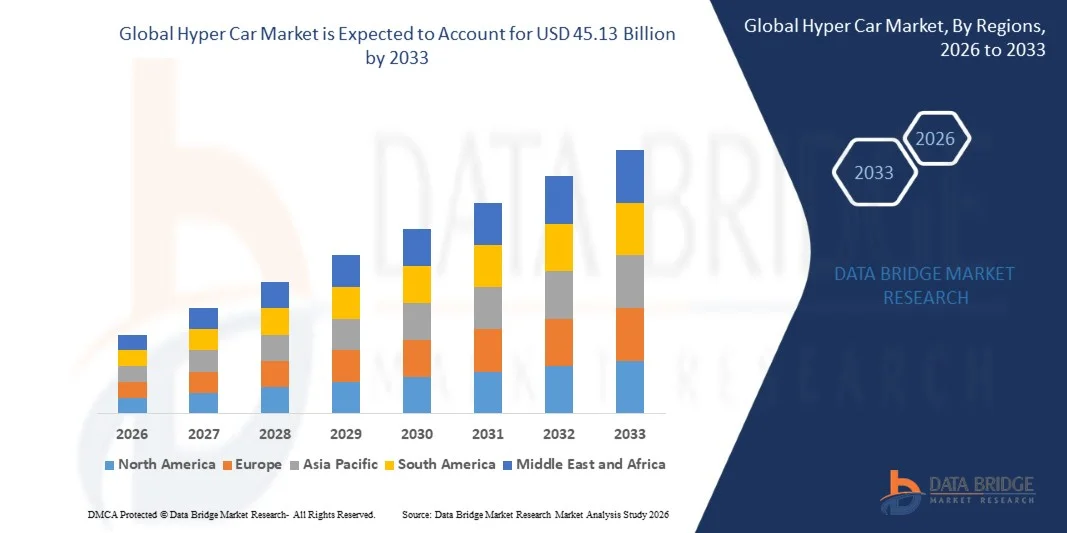
- As per Data Bridge Market Research analysis, the hyper car market was valued at USD 23.50 billion in 2025 and is projected to reach USD 45.13 billion by 2033, growing at a CAGR of 8.50% from 2026 to 2033.
- The market is experiencing consistent growth driven by rising consumer demand for high-performance and exclusive vehicles, rapid advancements in electrified powertrains and lightweight materials, and increasing investments by manufacturers in advanced aerodynamics, vehicle control systems, and limited-production hypercars.
- The increasing preference among high-net-worth consumers for technologically advanced, customized, and exclusive vehicles, combined with manufacturers' focus on hybrid and electric powertrains, carbon-fiber structures, and high-performance engineering, is supporting the adoption of hypercars globally. Advanced propulsion technologies and distinctive vehicle designs are further strengthening demand for premium hypercars across major automotive markets
Market Size & Forecast
- Global Market Value (2025): USD 23.50 Billion
- Expected Market Value (2033): USD 45.13 Billion
- Forecast CAGR (2026–2033): 8.50%
- Leading Region in 2025: North America
- Fastest Growing Region: Asia Pacific
What are the Major Takeaways of the Hyper Car Market?
- North America dominated the hyper car market with the largest revenue share of 38.5% in 2025, supported by high consumer spending on ultra-luxury vehicles, strong demand for high-performance automobiles, and the presence of leading automotive manufacturers.
- Asia-Pacific is expected to be the fastest-growing region at a CAGR of 9.6% from 2026 to 2033, fueled by rising disposable incomes, increasing demand for luxury and performance vehicles, and growing interest in technologically advanced hypercars across China, Japan, and India.
- The internal combustion engine segment led the market with a 53.8% share in 2025, driven by the continued preference for high-performance combustion powertrains among hypercar manufacturers and collectors.
- Fully electric are the fastest-growing propulsion type, projected to register a CAGR of 8.3%, reflecting the surge in adoption of high-performance electric propulsion technologies.
- The coupe segment dominated the vehicle type category with a 67.9% revenue share in 2025, led by the strong suitability of fixed-roof designs for high-performance applications.
- Carbon fiber accounted for 84.9% of the market share in 2025, preferred by its exceptional strength-to-weight characteristics and extensive application in high-performance vehicle construction
- The racing segment is the fastest-growing application category, with a CAGR of 8.5%, driven by increasing integration of motorsport technologies into hypercar development
Report Scope and Hyper Car Market Segmentation
|
Attributes |
Hyper Car Key Market Insights |
|
Segments Covered |
|
|
Countries Covered |
North America
Europe
Asia-Pacific
Middle East and Africa
South America
|
|
Key Market Players |
|
|
Market Opportunities |
|
|
Value Added Data Infosets |
In addition to the market insights such as market value, growth rate, market segments, geographical coverage, market players, and market scenario, the market report curated by the Data Bridge Market Research team includes in-depth expert analysis, import/export analysis, pricing analysis, production consumption analysis, and pestle analysis. |
What is the Key Trend in the Hyper Car Market?
- Hypercar manufacturers are increasingly integrating hybrid powertrains, advanced electric motors, and lightweight carbon-fiber structures to deliver extreme performance while improving efficiency and reducing emissions, strengthening demand for next-generation hypercars.
- For instance, in June 2025, Bugatti highlighted the Tourbillon’s hybrid powertrain, combining an 8.3-liter V16 engine with a 250-kilowatt electric motor as part of its next-generation hypercar development.
- Automakers are increasingly combining high-output combustion engines with electric propulsion to achieve greater acceleration, power, and driving performance while maintaining the exclusivity associated with hypercars.
- Advanced electric powertrain technology is enabling hypercar manufacturers to deliver exceptionally high power, instant torque, and sophisticated torque-vectoring capabilities.
- Hypercar manufacturers are increasingly developing exclusive customer track-car programs that transfer technologies and experiences from professional motorsport into ultra-limited production vehicles.
- Motorsports programs are increasingly being used to develop and demonstrate next-generation hypercar technologies, strengthening the connection between racing innovation and limited-production road and track vehicles.
- For instance, in June 2025, McLaren launched its McLaren United AS WEC Hypercar Team, confirming its planned 2027 FIA WEC entry with a V6 twin-turbo Hypercar developed for endurance racing.
- As manufacturers continue prioritizing electrification, lightweight engineering, advanced aerodynamics, and motorsport-derived technologies, the development of increasingly powerful and exclusive hypercars is expected to accelerate, reinforcing technological innovation as a core component of the global hypercar market.
What are the Key Drivers of the Hyper Car Market?
- The rapid advancement of hybrid and electric propulsion technologies has significantly increased demand for high-performance hypercars capable of delivering exceptional acceleration, power, and driving dynamics while meeting increasingly stringent efficiency and emissions requirements.
- For instance, in April 2025, Bugatti disclosed that the Tourbillon combines a naturally aspirated 8.3-liter V16 engine with three electric motors, generating a combined 1,800 HP and demonstrating the performance potential of advanced hybrid powertrains.
- High-net-worth consumers and automotive collectors are increasingly seeking exclusive vehicles offering extreme performance, personalization, limited production, and access to unique driving experiences, encouraging manufacturers to expand ultra-premium hypercar programs.
- For instance, in May 2026, McLaren introduced Project: Endurance alongside the MCL-HY GTR, offering customers an exclusive track-car program with professional driver coaching, dedicated engineering support, and a six-event international track-driving experience.
- With automotive manufacturers increasingly relying on electrification, lightweight materials, advanced aerodynamics, and motorsport-derived engineering to differentiate ultra-performance vehicles, these technologies will remain indispensable for the development of next-generation hypercars.
What Factors are Challenging the Growth of the Hyper Car Market?
- Hypercar development requires substantial investment due to the integration of specialized powertrains, carbon-fiber structures, advanced aerodynamics, bespoke components, and extensive testing programs, increasing development complexity and production costs.
- For instance, in August 2024, Rimac CEO Mate Rimac stated that developing the Nevera had required building the technology, team, factory, equipment, and broader manufacturing capabilities over a 15-year period, highlighting the substantial resources required to develop an advanced hypercar platform.
- These high costs limit production volumes and restrict access primarily to high-net-worth consumers, collectors, and specialized performance-car buyers, reducing the addressable customer base in comparison with conventional luxury vehicles.
- The high development costs, specialized manufacturing requirements, limited production volumes, and extensive validation programs associated with hypercars continue to restrict broader market penetration, particularly among price-sensitive consumers.
- For instance, in July 2022, TechCrunch reported that Rimac's USD 2.5 million Nevera had entered production with a limited 150-unit production run, illustrating how the extremely high vehicle price and specialized production model constrain the addressable customer base and overall production volumes.
- These barriers keep hypercars concentrated within niche luxury and collector markets, limiting mass-market adoption despite growing interest in high-performance and technologically advanced vehicles.
How is the Hyper Car Market Segmented?
The hyper car market is segmented on the basis of propulsion type, vehicle type, material, and application.
- By Propulsion Type
On the basis of propulsion type, the hyper car market is segmented into internal combustion engine, hybrid, and fully electric. The internal combustion engine segment dominated the market with a 53.8% share in 2025, driven by the continued preference for high-performance combustion powertrains among hypercar manufacturers and collectors. Internal combustion engines deliver high power output and strong acceleration characteristics required for ultra-high-performance vehicles. Manufacturers continue to develop advanced V8 and V12 engines with improved power delivery and efficiency. The segment also benefits from established engineering expertise, extensive performance heritage, and strong consumer recognition. Traditional combustion powertrains remain particularly attractive to enthusiasts seeking distinctive engine sound and driving characteristics.
The fully electric segment is projected to register the fastest growth at a CAGR of 8.3% from 2026 to 2033, supported by increasing adoption of high-performance electric propulsion technologies. Electric motors provide instant torque and rapid power delivery, making them highly suitable for hypercar applications. Advancements in battery technology are improving the performance and driving capabilities of electric hypercars. Manufacturers are increasingly introducing electric models with sophisticated multi-motor systems, advanced torque vectoring, and high-performance battery architectures. Growing investment in electrification is also encouraging established luxury and specialist manufacturers to expand their electric hypercar portfolios.
- By Vehicle Type
On the basis of vehicle type, the hyper car market is segmented into coupe, convertible, roadster, and sedan. The coupe segment dominated the market with a 67.9% share in 2025, driven by the strong suitability of fixed-roof designs for high-performance applications. Coupes provide greater structural rigidity, allowing manufacturers to optimize handling and high-speed stability. The fixed roof also supports efficient aerodynamic design and integration of performance-oriented body components. Most flagship hypercars continue to use coupe configurations because of their emphasis on speed, track performance, and driving dynamics. Coupes also provide manufacturers with greater flexibility when integrating lightweight structures and advanced aerodynamic systems.
The roadster segment is projected to register the fastest growth at a CAGR of 8.4% from 2026 to 2033, supported by increasing demand for open-top high-performance vehicles. Roadsters combine extreme performance with an immersive open-air driving experience. Advances in lightweight construction are helping manufacturers reduce the performance penalties traditionally associated with convertible architectures. Improved chassis engineering is also enabling roadsters to achieve high levels of rigidity, handling, and stability. Premium consumers are increasingly attracted to the exclusivity and distinctive character of limited-production open-top hypercars. Manufacturers are expanding the use of advanced materials and aerodynamic technologies in roadster configurations to maintain high performance
- By Material
On the basis of material, the hyper car market is segmented into carbon fiber, aluminum, steel, and others. The carbon fiber segment dominated the market with 84.9% share in 2025, owing to its exceptional strength-to-weight characteristics and extensive application in high-performance vehicle construction. Carbon fiber enables manufacturers to reduce vehicle weight while maintaining the structural strength required for demanding driving conditions. Lower vehicle weight contributes to improved acceleration, braking, handling, and overall vehicle dynamics. The material is widely incorporated into vehicle structures, body panels, monocoques, aerodynamic components, and other performance-critical parts. Increasing emphasis on lightweight vehicle engineering is encouraging manufacturers to expand their use of carbon-fiber-reinforced materials.
The aluminum segment is projected to witness the fastest growth at 9% CAGR from 2026 to 2033, supported by increasing demand for lightweight and structurally efficient vehicle components. Aluminum offers a favorable combination of low weight, strength, corrosion resistance, and manufacturing flexibility. It can be used in structural components where manufacturers seek to reduce weight without relying exclusively on carbon fiber. Increasing adoption of multi-material vehicle architectures is encouraging manufacturers to combine aluminum with carbon fiber and other advanced materials. Improvements in aluminum alloys and manufacturing processes are further enhancing its suitability for high-performance applications. The material also provides manufacturers with an alternative for controlling production complexity and material costs.
- By Application
On the basis of application, the hyper car market is segmented into private & collectors, racing, showcasing technology, and others. The private & collectors segment dominated the market with an 73.37% share in 2025, driven by strong demand from high-net-worth individuals seeking exclusive and limited-production performance vehicles. Hypercars are frequently produced in restricted quantities, which enhances their exclusivity and attractiveness to collectors. Buyers are also attracted by bespoke personalization, premium materials, advanced engineering, and distinctive vehicle designs. Limited production runs can increase the desirability of individual models among automotive enthusiasts and collectors. Private ownership also allows customers to use hypercars for exclusive driving experiences, private events, and track activities.
The racing segment is projected to register the fastest growth at a CAGR of 8.5% from 2026 to 2033, supported by increasing integration of motorsport technologies into hypercar development. Racing programs provide manufacturers with demanding environments for testing advanced powertrains, aerodynamics, lightweight materials, braking systems, and vehicle-control technologies. Technologies developed through racing can subsequently be transferred to road-going hypercars, strengthening the connection between motorsport and commercial vehicle development. Increasing manufacturer participation in endurance racing and specialized hypercar racing programs is supporting demand for advanced performance technologies. Racing activities also provide manufacturers with an important platform for demonstrating engineering capabilities and strengthening brand visibility. The continued transfer of motorsport-derived technologies into limited-production hypercars is expected to accelerate growth in this application segment.
Which Region Holds the Largest Share of the Hyper Car Market?
- North America dominated the hyper car market with the largest revenue share of 38.5% in 2025, supported by high consumer spending on ultra-luxury vehicles, strong demand for high-performance automobiles, and the presence of leading automotive manufacturers
- The region also benefits from growing interest in high-performance electric and hybrid hypercars, strong motorsport culture, advanced automotive technology, and increasing investments in vehicle customization and performance engineering. Rising demand from private collectors and high-net-worth consumers, combined with expanding manufacturer presence, continues to strengthen North America's leadership position in the global market.
U.S. Hyper Car Market Insight
The U.S. hyper car market is witnessing strong growth due to rising demand for ultra-luxury performance vehicles, high purchasing power, and growing interest in advanced automotive technologies. The country’s mature luxury automotive ecosystem, along with a strong motorsport culture and expanding adoption of hybrid and electric hypercars, is driving demand among affluent consumers and collectors. In addition, increasing interest in limited-production vehicles, personalized automotive experiences, and high-performance engineering is accelerating hypercar adoption across the country.
Asia-Pacific Hyper Car Market Insight
The Asia-Pacific hyper car market is expected to witness rapid growth, driven by rising disposable incomes, expanding luxury vehicle markets, and increasing demand for high-performance automobiles across countries such as China, Japan, and India. Growing interest in premium automotive brands, increasing presence of affluent consumers, and rising investments in advanced vehicle technologies are supporting regional market expansion. Additionally, growing adoption of electric and hybrid performance vehicles and increasing motorsport activities are accelerating hypercar demand across the region.
Japan Hyper Car Market Insight
The Japan hyper car market is witnessing consistent growth due to rising demand for technologically advanced performance vehicles, automotive innovation, and premium mobility solutions. Automotive manufacturers and specialist performance brands are increasingly developing high-performance vehicles incorporating advanced powertrains, lightweight materials, and sophisticated aerodynamic technologies. Moreover, increasing consumer interest in hybrid and electric hypercars and the country’s strong engineering capabilities are further contributing to market growth.
China Hyper Car Market Insight
The China hyper car market is growing rapidly, driven by increasing disposable incomes, expanding luxury automotive demand, and rising consumer interest in high-performance vehicles. Growing adoption of electric and hybrid powertrains, advanced battery technologies, and intelligent vehicle systems is significantly boosting market demand. In addition, increasing investments in domestic automotive innovation, expanding premium vehicle offerings, and growing interest among affluent consumers are positioning China as one of the fastest-growing markets for hypercars globally.
U.K. Hyper Car Market Insight
The U.K. hyper car market is experiencing steady growth, supported by strong motorsport heritage, established luxury automotive manufacturing, and rising demand for exclusive high-performance vehicles. Increasing investments in advanced powertrains, lightweight materials, and aerodynamic technologies are contributing to market growth. Furthermore, the presence of specialist automotive manufacturers, engineering companies, and a strong collector community is supporting innovation and strengthening the U.K.’s position in the hypercar industry.
Germany Hyper Car Market Insight
The Germany hyper car market is expanding steadily due to the country’s strong automotive manufacturing base, advanced engineering capabilities, and increasing development of next-generation performance vehicles. Automotive manufacturers and specialist performance divisions are increasingly utilizing advanced propulsion systems, lightweight materials, and sophisticated vehicle technologies in hypercar development. Continuous advancements in hybrid and electric powertrains, along with Germany’s strong motorsport and premium automotive ecosystem, are further driving market growth in the country.
Which are the Top Companies in Hyper Car Market?
The hyper car industry is primarily led by well-established companies, including:
- Bugatti Automobiles S.A.S. (France)
- KOENIGSEGG AUTOMOTIVE AB (Sweden)
- Pagani Automobili S.p.A. (Italy)
- Ferrari S.p.A. (Italy)
- Automobili Lamborghini S.p.A. (Italy)
- Aston Martin Lagonda Limited (U.K.)
- McLaren Automotive Limited (U.K.)
- Maserati S.p.A. (Italy)
- Mercedes-AMG GmbH (Germany)
- Zenvo Automotive A/S (Denmark)
- SSC North America (U.S.)
- Hennessey Performance Engineering Inc. (U.S.)
- Czinger Vehicles, Inc. (U.S.)
- Gordon Murray Automotive Limited (U.K.)
- Automobili Pininfarina GmbH (Germany)
- W Motors (UAE)
- De Tomaso Automobili (U.S.)
- Praga Cars (Czech Republic)
- Delage Automobiles (France)
- Apollo Automobil GmbH (Germany)
What are Latest Developments in Hyper Car Market?
- In April 2025, Bugatti revealed further development details of its new naturally aspirated V16 powertrain, highlighting the engineering work behind the Tourbillon and its hybrid-assisted performance architecture. The development reflects Bugatti’s continued focus on combining traditional high-performance combustion engineering with electrification in its next-generation hyper sports cars.
- In October 2024, Ferrari unveiled the F80, its new limited-production high-performance model, featuring a V6 hybrid powertrain and advanced carbon-fiber construction. The F80 incorporates advanced aerodynamic technologies, active suspension, and hybrid powertrain engineering, demonstrating Ferrari’s continued development of high-performance hybrid vehicles.
- In June 2024, Bugatti unveiled the Tourbillon at its headquarters in Molsheim, introducing a new-generation hyper sports car developed under the Bugatti Rimac partnership. The model combines a naturally aspirated V16 engine with hybrid technology and represents a major technological transition for the brand while maintaining its focus on high-performance engineering and luxury
- In April 2023, Bugatti announced that the Bolide had entered its next phase of development testing as the track-only hyper sports car progressed toward production. The testing program focused on transforming the lightweight, track-focused concept into a production-ready vehicle while validating its performance, aerodynamics, and engineering systems.
- In February 2021, Ferrari announced the development of its Le Mans Hypercar program for entry into the FIA World Endurance Championship. The manufacturer began design and simulation work on its new LMH race car, marking its return to the top class of endurance racing and strengthening the transfer of advanced motorsport technologies into high-performance vehicle development.

- Interactive Data Analysis Dashboard
- Company Analysis Dashboard for high growth potential opportunities
- Research Analyst Access for customization & queries
- Competitor Analysis with Interactive dashboard
- Latest News, Updates & Trend analysis
- Harness the Power of Benchmark Analysis for Comprehensive Competitor Tracking
Data collection and base year analysis are done using data collection modules with large sample sizes. The stage includes obtaining market information or related data through various sources and strategies. It includes examining and planning all the data acquired from the past in advance. It likewise envelops the examination of information inconsistencies seen across different information sources. The market data is analysed and estimated using market statistical and coherent models. Also, market share analysis and key trend analysis are the major success factors in the market report. To know more, please request an analyst call or drop down your inquiry.
The key research methodology used by DBMR research team is data triangulation which involves data mining, analysis of the impact of data variables on the market and primary (industry expert) validation. Data models include Vendor Positioning Grid, Market Time Line Analysis, Market Overview and Guide, Company Positioning Grid, Patent Analysis, Pricing Analysis, Company Market Share Analysis, Standards of Measurement, Global versus Regional and Vendor Share Analysis. To know more about the research methodology, drop in an inquiry to speak to our industry experts.
Data Bridge Market Research is a leader in advanced formative research. We take pride in servicing our existing and new customers with data and analysis that match and suits their goal. The report can be customized to include price trend analysis of target brands understanding the market for additional countries (ask for the list of countries), clinical trial results data, literature review, refurbished market and product base analysis. Market analysis of target competitors can be analyzed from technology-based analysis to market portfolio strategies. We can add as many competitors that you require data about in the format and data style you are looking for. Our team of analysts can also provide you data in crude raw excel files pivot tables (Fact book) or can assist you in creating presentations from the data sets available in the report.













