


Hyper Hybrid Automobiles Market Size
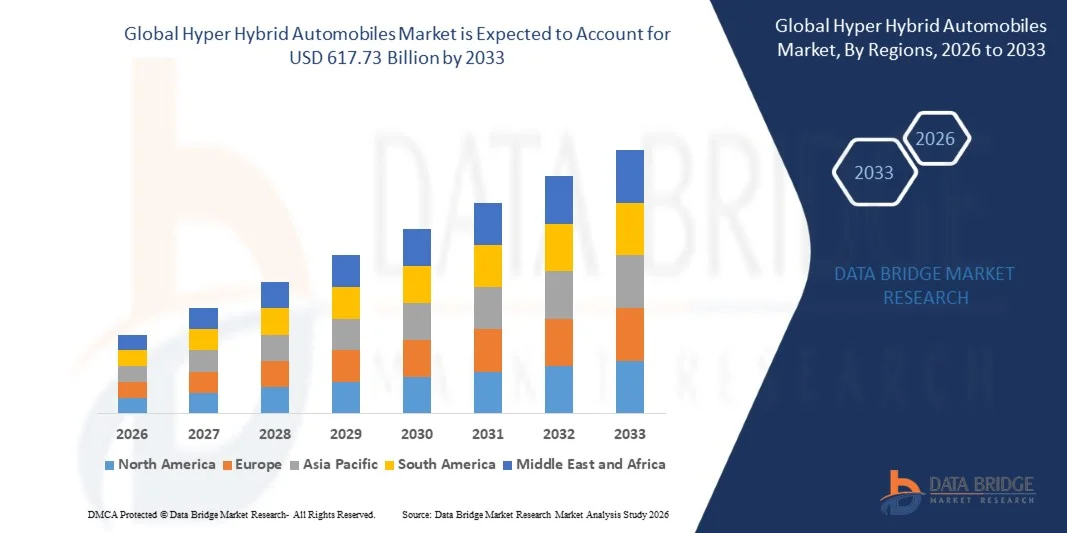
- The global hyper hybrid automobiles market size was valued at USD 333.74 billion in 2025 and is expected to reach USD 617.73 billion by 2033, at a CAGR of 8.00% during the forecast period
- The market growth is largely fuelled by the increasing demand for fuel-efficient and low-emission vehicles along with the rising adoption of advanced hybrid propulsion technologies in the automotive industry
- Growing government regulations on vehicle emissions and strong incentives for electrified mobility are encouraging manufacturers to invest in hyper hybrid vehicle development
Hyper Hybrid Automobiles Market Analysis
- The market is experiencing steady growth due to continuous technological advancements in battery systems, electric drivetrains, and hybrid control systems that improve vehicle performance and energy efficiency
- Increasing investments by automotive manufacturers in electrification strategies, along with expanding charging infrastructure and supportive government policies, are expected to strengthen the adoption of hyper hybrid automobiles globally
- North America dominated the hyper hybrid automobiles market with the largest revenue share in 2025, driven by strong demand for high-performance vehicles integrated with advanced hybrid powertrain technologies and growing interest in sustainable mobility solutions
- Asia-Pacific region is expected to witness the highest growth rate in the global hyper hybrid automobiles market, driven by expanding automotive manufacturing capabilities, rising investments in electric and hybrid vehicle technologies, and strong government initiatives promoting low-emission transportation systems
- The hybrid vehicles segment held the largest market revenue share in 2025 driven by the increasing demand for vehicles that combine internal combustion engine performance with electric efficiency. Hybrid propulsion systems allow automakers to optimize fuel consumption, reduce emissions, and deliver high-performance driving capabilities, making them a preferred choice among performance-focused and environmentally conscious consumers
Report Scope and Hyper Hybrid Automobiles Market Segmentation
|
Attributes |
Hyper Hybrid Automobiles Key Market Insights |
|
Segments Covered |
|
|
Countries Covered |
North America
Europe
Asia-Pacific
Middle East and Africa
South America
|
|
Key Market Players |
• Porsche AG (Germany) |
|
Market Opportunities |
• Expansion Of Advanced Hybrid Powertrain Technologies |
|
Value Added Data Infosets |
In addition to the market insights such as market value, growth rate, market segments, geographical coverage, market players, and market scenario, the market report curated by the Data Bridge Market Research team includes in-depth expert analysis, import/export analysis, pricing analysis, production consumption analysis, and pestle analysis. |
Hyper Hybrid Automobiles Market Trends
“Rising Demand for High-Performance Low-Emission Vehicles”
• The growing emphasis on reducing vehicle emissions while maintaining high performance is significantly shaping the hyper hybrid automobiles market, as consumers increasingly prefer vehicles that combine the efficiency of electric propulsion with the power of internal combustion engines. Hyper hybrid systems integrate advanced battery technologies, electric motors, and optimized combustion engines to deliver improved fuel economy and performance. This trend is encouraging automotive manufacturers to invest in next-generation hybrid platforms that offer both sustainability and driving efficiency
• Increasing environmental awareness and stricter government emission regulations are accelerating the adoption of hyper hybrid vehicles across global automotive markets. Consumers and fleet operators are seeking vehicles that reduce carbon emissions without compromising speed, reliability, or driving experience. As a result, automotive companies are focusing on integrating lightweight materials, advanced powertrain architectures, and energy recovery technologies to enhance overall vehicle efficiency
• Sustainability initiatives and electrification strategies are influencing purchasing decisions, with manufacturers highlighting the environmental benefits and technological advancements of hybrid propulsion systems. Automakers are emphasizing lower fuel consumption, reduced greenhouse gas emissions, and improved energy management systems to differentiate their vehicles in a competitive automotive market. Marketing strategies increasingly highlight these advantages to attract environmentally conscious consumers and performance-oriented buyers
• For instance, in 2024, Toyota Motor Corporation in Japan and Porsche AG in Germany expanded their hybrid vehicle portfolios with advanced hyper hybrid models designed to deliver higher fuel efficiency and improved acceleration. These vehicles incorporate enhanced battery systems and intelligent energy management technologies, allowing manufacturers to meet stricter emission regulations while maintaining strong performance capabilities. The launches also strengthened the companies’ positions in the premium and performance hybrid vehicle segments
• While demand for hyper hybrid automobiles is growing, sustained market expansion depends on continuous technological advancements, improved battery efficiency, and the development of cost-effective hybrid powertrain systems. Manufacturers are focusing on increasing battery energy density, enhancing power management software, and optimizing manufacturing processes to ensure wider adoption and long-term market growth
Hyper Hybrid Automobiles Market Dynamics
Driver
“Increasing Adoption of Electrified Powertrain Technologies”
• Rising demand for fuel-efficient and environmentally friendly vehicles is a major driver for the hyper hybrid automobiles market. Governments and regulatory bodies worldwide are introducing stricter emission standards and encouraging the transition toward electrified mobility solutions. Hyper hybrid vehicles provide an effective balance between performance and sustainability, enabling automakers to meet regulatory requirements while delivering powerful driving capabilities
• Expanding applications of hybrid powertrains across passenger cars, luxury vehicles, and performance automobiles are supporting market growth. Hyper hybrid systems combine electric propulsion with advanced combustion engines, improving fuel economy while maintaining strong acceleration and vehicle performance. This combination makes hyper hybrid vehicles attractive for consumers seeking environmentally responsible yet high-performance transportation options
• Automotive manufacturers are actively investing in research and development of advanced hybrid technologies, including high-capacity lithium-ion batteries, regenerative braking systems, and intelligent energy management software. These innovations improve vehicle efficiency and reliability while reducing operational emissions. Industry partnerships between automakers, battery manufacturers, and technology providers are further accelerating the development of advanced hybrid mobility solutions
• For instance, in 2023, BMW Group in Germany and Honda Motor Co., Ltd. in Japan announced expanded investments in hybrid powertrain technologies to support the development of high-efficiency electrified vehicles. These initiatives aim to improve vehicle performance, extend battery life, and enhance overall energy management systems. The investments also demonstrate the growing commitment of major automotive companies toward electrified vehicle innovation
• Although electrified mobility trends support market growth, large-scale adoption of hyper hybrid automobiles depends on continued technological improvements, infrastructure development, and cost optimization of advanced hybrid components. Investments in battery innovation, energy management software, and vehicle electrification platforms will be essential to ensure long-term competitiveness and market expansion
Restraint/Challenge
“High Development Costs and Complex Hybrid System Integration”
• The high cost associated with developing advanced hybrid powertrain systems remains a key challenge for the hyper hybrid automobiles market. Designing vehicles that integrate multiple propulsion technologies, including electric motors, high-capacity batteries, and internal combustion engines, requires significant investment in research, engineering, and manufacturing. These factors contribute to higher vehicle prices, which can limit adoption among price-sensitive consumers
• Technical complexity in integrating hybrid powertrain components also presents operational challenges for automotive manufacturers. Hyper hybrid vehicles require sophisticated control systems to manage energy distribution between electric and combustion engines efficiently. Ensuring seamless coordination between these components while maintaining vehicle performance and reliability increases development complexity and production costs
• Supply chain constraints related to battery materials, advanced semiconductors, and specialized components can also impact market growth. Manufacturers must secure stable supplies of lithium, nickel, and other key materials used in battery production, while also addressing challenges related to component availability and production scalability. These factors may lead to fluctuations in production capacity and pricing
• For instance, in 2024, several automotive manufacturers in South Korea and Germany reported challenges in sourcing battery components and advanced electronic modules for hybrid vehicle production. The shortages increased manufacturing costs and affected production timelines for certain hybrid models. These supply chain constraints also prompted manufacturers to invest in localized battery production and long-term supply agreements
• Overcoming these challenges will require strategic investments in battery technology, supply chain resilience, and advanced powertrain engineering. Collaboration between automakers, technology firms, and component suppliers will be essential to reduce development costs, improve production efficiency, and support the large-scale adoption of hyper hybrid automobiles in the global automotive market
Hyper Hybrid Automobiles Market Scope
The market is segmented on the basis of propulsion and application.
• By Propulsion
On the basis of propulsion, the hyper hybrid automobiles market is segmented into electric vehicles, ICE vehicles, and hybrid vehicles. The hybrid vehicles segment held the largest market revenue share in 2025 driven by the increasing demand for vehicles that combine internal combustion engine performance with electric efficiency. Hybrid propulsion systems allow automakers to optimize fuel consumption, reduce emissions, and deliver high-performance driving capabilities, making them a preferred choice among performance-focused and environmentally conscious consumers.
The electric vehicles segment is expected to witness the fastest growth rate from 2026 to 2033, driven by rapid advancements in battery technology, expanding charging infrastructure, and strong government support for zero-emission mobility. Electric-powered hyper hybrid automobiles offer enhanced acceleration, reduced operational emissions, and improved energy efficiency, making them increasingly attractive in high-performance automotive segments.
• By Application
On the basis of application, the hyper hybrid automobiles market is segmented into racing competition, entertainment, and others. The racing competition segment held the largest market revenue share in 2025 driven by the increasing use of advanced hybrid powertrain technologies in professional motorsports. Racing organizations and automotive manufacturers are integrating hyper hybrid systems to enhance speed, efficiency, and energy recovery capabilities while complying with evolving sustainability regulations in motorsport events.
The entertainment segment is expected to witness the fastest growth rate from 2026 to 2033, driven by rising consumer interest in high-performance hybrid supercars and luxury vehicles designed for recreational driving experiences. Automotive manufacturers are increasingly launching hyper hybrid models that combine extreme performance, advanced electrification technologies, and premium design, appealing to enthusiasts and collectors seeking innovative and sustainable performance vehicles.
Hyper Hybrid Automobiles Market Regional Analysis
• North America dominated the hyper hybrid automobiles market with the largest revenue share in 2025, driven by strong demand for high-performance vehicles integrated with advanced hybrid powertrain technologies and growing interest in sustainable mobility solutions
• Consumers in the region highly value the combination of superior vehicle performance, fuel efficiency, and reduced emissions offered by hyper hybrid automobiles, particularly in premium and performance vehicle segments
• This widespread adoption is further supported by advanced automotive R&D infrastructure, the presence of major performance vehicle manufacturers, and increasing investments in electrification technologies, establishing hyper hybrid vehicles as an emerging segment within the high-performance automotive market
U.S. Hyper Hybrid Automobiles Market Insight
The U.S. hyper hybrid automobiles market captured the largest revenue share in 2025 within North America, fueled by strong consumer demand for high-performance vehicles and rapid advancements in hybrid and electric propulsion technologies. Automotive manufacturers in the country are increasingly investing in electrified powertrain systems that combine internal combustion engines with high-capacity battery technologies. The presence of leading automotive innovators and motorsports culture further supports the development of hyper hybrid vehicles. Moreover, increasing consumer interest in premium performance vehicles with lower emissions is contributing significantly to market growth.
Europe Hyper Hybrid Automobiles Market Insight
The Europe hyper hybrid automobiles market is expected to witness the fastest growth rate from 2026 to 2033, primarily driven by strict emission regulations and strong government initiatives promoting vehicle electrification. European automakers are actively investing in advanced hybrid technologies to meet sustainability targets while maintaining vehicle performance standards. The region’s strong presence of luxury and performance car manufacturers is encouraging the development of hyper hybrid vehicles that deliver both efficiency and speed. In addition, rising consumer awareness regarding environmentally friendly mobility solutions is supporting market expansion.
U.K. Hyper Hybrid Automobiles Market Insight
The U.K. hyper hybrid automobiles market is expected to witness significant growth from 2026 to 2033, driven by increasing investments in automotive electrification and innovation in performance vehicle technologies. The country’s strong motorsports heritage and advanced automotive engineering capabilities are encouraging the development of high-performance hybrid vehicles. Growing environmental awareness and government policies supporting low-emission mobility are also contributing to the adoption of hyper hybrid automobiles across the U.K. automotive market.
Germany Hyper Hybrid Automobiles Market Insight
The Germany hyper hybrid automobiles market is expected to witness strong growth from 2026 to 2033, fueled by the country’s leading automotive manufacturing industry and continuous innovation in hybrid and electric powertrain technologies. Germany is home to several premium and performance vehicle manufacturers investing heavily in advanced electrification platforms. The integration of lightweight materials, high-performance battery systems, and intelligent energy management technologies is driving the development of hyper hybrid automobiles in the region.
Asia-Pacific Hyper Hybrid Automobiles Market Insight
The Asia-Pacific hyper hybrid automobiles market is expected to witness the fastest growth rate from 2026 to 2033, driven by rapid technological advancements, expanding automotive manufacturing capabilities, and rising consumer demand for innovative and environmentally friendly vehicles. Countries such as China, Japan, and South Korea are investing heavily in electrified mobility solutions and advanced vehicle technologies. The growing presence of automotive technology companies and strong government support for low-emission vehicles are further encouraging the development of hyper hybrid automobiles.
Japan Hyper Hybrid Automobiles Market Insight
The Japan hyper hybrid automobiles market is expected to witness notable growth from 2026 to 2033 due to the country’s strong expertise in hybrid vehicle technology and advanced automotive engineering. Japanese automakers are known for pioneering hybrid propulsion systems and continue to invest in next-generation electrified powertrain technologies. The increasing demand for high-performance vehicles with improved energy efficiency and lower environmental impact is supporting the expansion of hyper hybrid automobiles in Japan.
China Hyper Hybrid Automobiles Market Insight
The China hyper hybrid automobiles market accounted for the largest market revenue share in Asia-Pacific in 2025, attributed to the country’s rapidly growing automotive industry and increasing investments in electric and hybrid vehicle technologies. China has emerged as a major hub for advanced vehicle manufacturing and electrification innovation. The strong demand for high-performance vehicles combined with government support for sustainable mobility solutions is encouraging the development and adoption of hyper hybrid automobiles across the Chinese automotive market.
Hyper Hybrid Automobiles Market Share
The Hyper Hybrid Automobiles industry is primarily led by well-established companies, including:
• Porsche AG (Germany)
• Continental AG (Germany)
• BorgWarner Inc. (U.S.)
• ZF Friedrichshafen AG (Germany)
• Schaeffler AG (Germany)
• Toyota Motor Corporation (Japan)
• Ford Motor Company (U.S.)
• AB Volvo (Sweden)
• Honda Motor Co., Ltd. (Japan)
• Hyundai Motor Company (South Korea)
• Daimler AG (Germany)
• Allison Transmission Inc. (U.S.)
• Nissan Motor Co., Ltd. (Japan)
• Rimac Automobili (Croatia)
• Automobili Lamborghini S.p.A. (Italy)
• Koenigsegg Automotive AB (Sweden)
• Jaguar Land Rover Automotive plc (U.K.)
• BMW AG (Germany)

- Interactive Data Analysis Dashboard
- Company Analysis Dashboard for high growth potential opportunities
- Research Analyst Access for customization & queries
- Competitor Analysis with Interactive dashboard
- Latest News, Updates & Trend analysis
- Harness the Power of Benchmark Analysis for Comprehensive Competitor Tracking
Data collection and base year analysis are done using data collection modules with large sample sizes. The stage includes obtaining market information or related data through various sources and strategies. It includes examining and planning all the data acquired from the past in advance. It likewise envelops the examination of information inconsistencies seen across different information sources. The market data is analysed and estimated using market statistical and coherent models. Also, market share analysis and key trend analysis are the major success factors in the market report. To know more, please request an analyst call or drop down your inquiry.
The key research methodology used by DBMR research team is data triangulation which involves data mining, analysis of the impact of data variables on the market and primary (industry expert) validation. Data models include Vendor Positioning Grid, Market Time Line Analysis, Market Overview and Guide, Company Positioning Grid, Patent Analysis, Pricing Analysis, Company Market Share Analysis, Standards of Measurement, Global versus Regional and Vendor Share Analysis. To know more about the research methodology, drop in an inquiry to speak to our industry experts.
Data Bridge Market Research is a leader in advanced formative research. We take pride in servicing our existing and new customers with data and analysis that match and suits their goal. The report can be customized to include price trend analysis of target brands understanding the market for additional countries (ask for the list of countries), clinical trial results data, literature review, refurbished market and product base analysis. Market analysis of target competitors can be analyzed from technology-based analysis to market portfolio strategies. We can add as many competitors that you require data about in the format and data style you are looking for. Our team of analysts can also provide you data in crude raw excel files pivot tables (Fact book) or can assist you in creating presentations from the data sets available in the report.













