


What is the Global Hyper-Personalized Technology Market Size and Growth Rate?
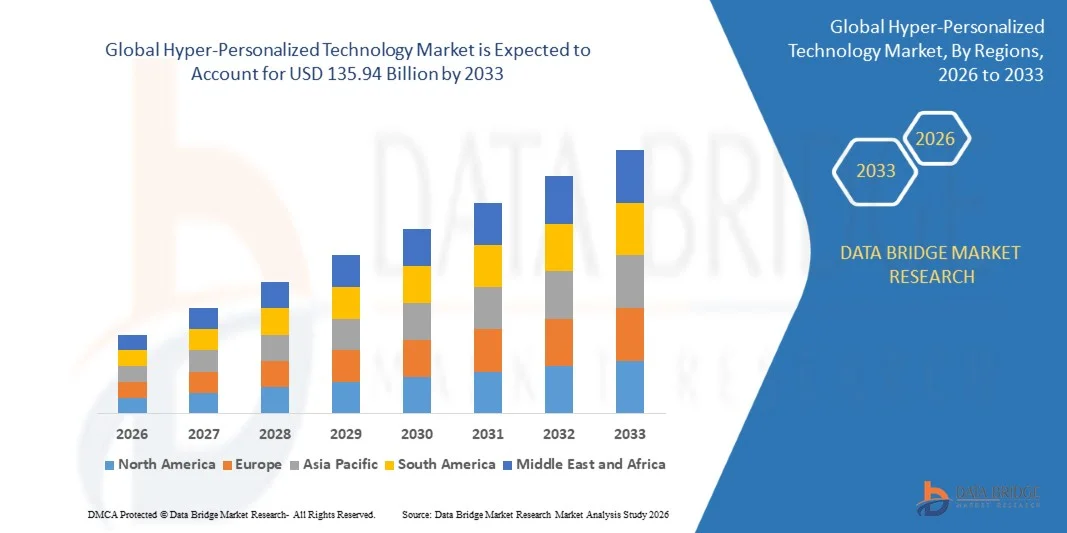
- The global hyper-personalized technology market size was valued at USD 28.91 billion in 2025 and is expected to reach USD 135.94 billion by 2033, at a CAGR of21.35% during the forecast period
- Increasing adoption of AI-driven customer engagement platforms, real-time recommendation engines, predictive analytics tools, and data-driven personalization solutions across retail, healthcare, BFSI, media, and e-commerce sectors are some of the major as well as vital factors which will such asly augment the growth of the Hyper-Personalized Technology market
- Rising use of customer data platforms, behavioral analytics, machine learning algorithms, and omnichannel engagement systems is further strengthening long-term market expansion
What are the Major Takeaways of Hyper-Personalized Technology Market?
- Growing demand for personalized digital experiences across e-commerce platforms, streaming services, healthcare solutions, and financial applications, along with rising investments in AI, big data, and customer intelligence solutions, will further contribute by generating massive opportunities that will lead to the growth of the hyper-personalized technology market
- Concerns related to data privacy, cybersecurity risks, lack of skilled AI professionals, and integration complexities across legacy enterprise systems will such asly act as market restraint factors for the growth of the hyper-personalized technology market
- Increasing enterprise focus on customer retention, conversion optimization, and personalized engagement strategies is expected to remain a key long-term growth driver for the market
- North America dominated the hyper-personalized technology market with a 38.65% revenue share in 2025, driven by rapid adoption of AI-powered customer analytics platforms, advanced recommendation engines, and strong investments in digital transformation across the U.S. and Canada
- Asia-Pacific is projected to register the fastest CAGR of 9.43% from 2026 to 2033, driven by rapid digitalization, strong e-commerce growth, 5G expansion, and rising adoption of AI-based customer engagement solutions across China, Japan, India, South Korea, and Southeast Asia
- The Consumer Goods and Retail segment dominated the market with a 34.8% share in 2025, driven by rising adoption of AI-powered recommendation engines, personalized shopping experiences, real-time customer analytics, and omnichannel engagement platforms
Report Scope and Hyper-Personalized Technology Market Segmentation
|
Attributes |
Hyper-Personalized Technology Key Market Insights |
|
Segments Covered |
|
|
Countries Covered |
North America
Europe
Asia-Pacific
Middle East and Africa
South America
|
|
Key Market Players |
|
|
Market Opportunities |
|
|
Value Added Data Infosets |
In addition to the insights on market scenarios such as market value, growth rate, segmentation, geographical coverage, and major players, the market reports curated by the Data Bridge Market Research also include in-depth expert analysis, pricing analysis, brand share analysis, consumer survey, demography analysis, supply chain analysis, value chain analysis, raw material/consumables overview, vendor selection criteria, PESTLE Analysis, Porter Analysis, and regulatory framework. |
What is the Key Trend in the Hyper-Personalized Technology Market?
“Increasing Shift Toward AI-Driven, Real-Time, and Omnichannel Hyper-Personalization Platforms”
- The hyper-personalized technology market is witnessing strong adoption of AI-powered recommendation engines, real-time customer data platforms, and predictive personalization tools designed to support tailored user experiences across retail, healthcare, BFSI, media, and e-commerce sectors
- Technology providers are introducing machine learning-based analytics platforms, behavior tracking engines, and cloud-enabled personalization suites that offer real-time segmentation, automated decisioning, and seamless integration with modern enterprise ecosystems
- Growing demand for cost-efficient, scalable, and insight-driven customer engagement solutions is driving usage across digital commerce platforms, marketing teams, customer experience centers, and enterprise CRM environments
- For instance, companies such as IBM, Salesforce, Adobe, Oracle, and SAP have upgraded their personalization platforms with enhanced AI capabilities, customer journey mapping, sentiment analysis, and predictive recommendation features
- Increasing need for real-time engagement, dynamic content delivery, and multi-device personalization is accelerating the shift toward intelligent, data-driven personalization ecosystems
- As customer expectations become more sophisticated and digitally connected, Hyper-Personalized Technology solutions will remain vital for customer retention, conversion optimization, and long-term brand loyalty
What are the Key Drivers of Hyper-Personalized Technology Market?
- Rising demand for accurate, scalable, and AI-driven personalization tools to support customer engagement, demand forecasting, and intelligent recommendation workflows across industries
- For instance, in 2025, leading companies such as Salesforce, Adobe, and Microsoft expanded their AI-powered customer intelligence platforms with advanced analytics, automation, and personalization features
- Growing adoption of e-commerce platforms, digital banking, healthcare apps, streaming services, and omnichannel retail systems is boosting demand for hyper-personalized solutions across the U.S., Europe, and Asia-Pacific
- Advancements in AI algorithms, natural language processing, cloud computing, and customer data analytics have strengthened personalization accuracy, speed, and scalability
- Rising use of real-time behavioral analytics, predictive insights, and customer journey orchestration is creating demand for advanced hyper-personalization platforms
- Supported by steady investments in digital transformation, AI innovation, and customer experience technologies, the Hyper-Personalized Technology market is expected to witness strong long-term growth
Which Factor is Challenging the Growth of the Hyper-Personalized Technology Market?
- High costs associated with advanced AI infrastructure, enterprise software integration, and premium personalization platforms restrict adoption among SMEs and resource-constrained organizations
- For instance, during 2024–2025, rising concerns around data privacy regulations, cybersecurity compliance, and cloud infrastructure costs increased deployment complexity for several global vendors
- Complexity in managing large-scale customer datasets, cross-platform integrations, and real-time decision models increases the need for skilled professionals and technical expertise
- Limited awareness in emerging markets regarding AI-driven personalization capabilities and customer analytics best practices slows adoption
- Competition from traditional CRM platforms, basic marketing automation tools, and in-house personalization engines creates pricing pressure and reduces product differentiation
- To address these issues, companies are focusing on cost-optimized AI solutions, privacy-first architectures, cloud-based analytics, and enhanced platform interoperability to increase global adoption of Hyper-Personalized Technology solutions
How is the Hyper-Personalized Technology Market Segmented?
The market is segmented on the basis of industry vertical, platform type, and enterprise size.
• By Industry Vertical
On the basis of industry vertical, the hyper-personalized technology market is segmented into Aerospace and Defense, Financial Services and Insurance, Construction and Real Estate, Consumer Goods and Retail, Education, Energy and Utilities, Government and Public Sector, Telecommunication, Healthcare and Life Sciences, and Others. The Consumer Goods and Retail segment dominated the market with a 34.8% share in 2025, driven by rising adoption of AI-powered recommendation engines, personalized shopping experiences, real-time customer analytics, and omnichannel engagement platforms. Retailers are extensively deploying hyper-personalized technologies to improve product recommendations, customer retention, and conversion rates across digital and physical channels. Growing e-commerce penetration and rising customer demand for customized experiences continue to strengthen segment dominance.
The Healthcare and Life Sciences segment is expected to grow at the fastest CAGR from 2026 to 2033, driven by increasing use of personalized treatment pathways, patient engagement tools, predictive diagnostics, and AI-enabled health monitoring solutions. Rising investment in precision healthcare and digital patient experience platforms is further accelerating growth.
• By Platform Type
On the basis of platform type, the market is segmented into Mobile, Laptop, Desktop and Tablets, and Others. The Mobile segment dominated the market with a 46.3% share in 2025, supported by the growing use of smartphones for e-commerce, streaming services, banking applications, and personalized content delivery. Mobile-first customer engagement strategies, app-based behavioral analytics, and location-based personalization tools are driving widespread adoption. The high volume of real-time user interactions on mobile devices makes this platform the leading channel for hyper-personalized technology deployment.
The Laptop, Desktop and Tablets segment is projected to grow at the fastest CAGR from 2026 to 2033, driven by increasing enterprise usage, personalized workplace solutions, and rising demand for AI-enabled customer service dashboards and business intelligence platforms.
• By Enterprise Size
On the basis of enterprise size, the hyper-personalized technology market is segmented into Large Enterprises and SMEs. The Large Enterprises segment dominated the market with a 61.7% share in 2025, driven by higher digital transformation budgets, access to advanced AI infrastructure, and large-scale customer data ecosystems. These organizations extensively use hyper-personalized technologies for customer journey orchestration, predictive analytics, and real-time marketing automation across multiple business units.
The SMEs segment is expected to grow at the fastest CAGR from 2026 to 2033, propelled by increasing availability of cloud-based AI tools, subscription-based personalization platforms, and affordable analytics solutions. Rising adoption among startups and growing digital commerce activities are further driving segment growth.
Which Region Holds the Largest Share of the Hyper-Personalized Technology Market?
- North America dominated the hyper-personalized technology market with a 38.65% revenue share in 2025, driven by rapid adoption of AI-powered customer analytics platforms, advanced recommendation engines, and strong investments in digital transformation across the U.S. and Canada. High penetration of cloud computing, big data analytics, omnichannel retail systems, and enterprise AI solutions continues to fuel demand for hyper-personalized technologies across retail, BFSI, healthcare, telecom, and media sectors
- Leading companies in North America are introducing advanced personalization platforms with real-time behavioral analytics, predictive insights, AI-driven customer journey mapping, and cloud-enabled engagement tools, strengthening the region’s technological advantage. Continuous investment in AI infrastructure, customer intelligence, and enterprise software platforms drives long-term market expansion
- Strong concentration of technology leaders, robust startup ecosystems, and sustained investments in AI innovation further reinforce regional market leadership
U.S. Hyper-Personalized Technology Market Insight
The U.S. is the largest contributor in North America, supported by strong AI software development, rapid enterprise digitalization, and extensive use of customer intelligence tools across retail, financial services, healthcare, and telecom sectors. Increasing deployment of recommendation engines, predictive marketing platforms, and AI-powered customer support systems intensifies demand for hyper-personalized technology solutions. Presence of major technology providers such as IBM, Salesforce, Microsoft, Adobe, and Oracle further drive market growth.
Canada Hyper-Personalized Technology Market Insight
Canada contributes significantly to regional growth, driven by expanding AI research ecosystems, rising adoption of customer analytics platforms, and growing investments in retail technology and fintech solutions. Enterprises and digital service providers increasingly utilize hyper-personalized technologies for customer retention, loyalty programs, and experience optimization.
Asia-Pacific Hyper-Personalized Technology Market
Asia-Pacific is projected to register the fastest CAGR of 9.43% from 2026 to 2033, driven by rapid digitalization, strong e-commerce growth, 5G expansion, and rising adoption of AI-based customer engagement solutions across China, Japan, India, South Korea, and Southeast Asia. High-volume digital transactions and increasing smartphone penetration continue to accelerate demand for personalized technology platforms.
China Hyper-Personalized Technology Market Insight
China is the largest contributor to Asia-Pacific due to massive investments in AI innovation, world-leading e-commerce ecosystems, and strong government support for digital transformation. Rising development of smart retail, AI-driven fintech, and personalized digital media platforms drives market adoption.
Japan Hyper-Personalized Technology Market Insight
Japan shows steady growth supported by advanced digital infrastructure, precision AI deployment, and continuous modernization of retail, healthcare, and telecom ecosystems. Strong focus on high-quality customer experience tools reinforces long-term market expansion.
India Hyper-Personalized Technology Market Insight
India is emerging as a major growth hub, driven by expanding digital commerce platforms, rising startup activity, and government-backed digital infrastructure initiatives. Growing demand for personalized apps, fintech services, and AI-based customer engagement tools accelerates market penetration.
South Korea Hyper-Personalized Technology Market Insight
South Korea contributes significantly due to strong demand for AI-driven retail platforms, advanced mobile ecosystems, and high-performance digital engagement solutions. Technological innovation, strong digital infrastructure, and growing AI adoption support sustained market growth.
Which are the Top Companies in Hyper-Personalized Technology Market?
The hyper-personalized technology industry is primarily led by well-established companies, including:
- IBM Corporation (U.S.)
- Salesforce.com Inc. (U.S.)
- Oracle Corporation (U.S.)
- Adobe Inc. (U.S.)
- SAP SE (Germany)
- Microsoft Corporation (U.S.)
- Amazon Web Services Inc. (U.S.)
- Google LLC (U.S.)
- Accenture PLC (Ireland)
- Capgemini SE (France)
- Infosys Limited (India)
- Cognizant Technology Solutions (U.S.)
- Tata Consultancy Services (India)
- Wipro Limited (India)
- HCL Technologies (India)
- Teradata Corporation (U.S.)
- SAS Institute Inc. (U.S.)
- Pegasystems Inc. (U.S.)
- Informatica LLC (U.S.)
- QlikTech International AB (Sweden)
What are the Recent Developments in Global Hyper-Personalized Technology Market?
- In December 2025, Apple Inc. announced its largest expansion of Fitness+ across 28 new markets, introducing AI-generated Custom Plans along with generative AI voice dubbing technology to deliver more tailored fitness experiences for users worldwide. This launch is expected to strengthen the company’s position in the hyper-personalized wellness and digital fitness market
- In December 2025, World Health Organization-backed fitness technology company WHOOP introduced Advanced Labs and Healthspan metrics, including WHOOP Age and Pace of Aging, powered by nine physiological markers to deliver highly personalized health insights. This development is such asly to accelerate the adoption of AI-driven personalized health monitoring solutions
- In October 2025, Peloton Interactive, Inc. launched its Pro Series, featuring AI-powered Peloton IQ software integrated with the Precor support network to enhance personalized fitness guidance and equipment performance. This launch is anticipated to improve user engagement and strengthen AI-led fitness personalization capabilities
- In September 2025, Chrysalis announced the launch of “Co-Thinker,” an AI-powered solution developed to personalize school learning by delivering actionable insights for educators. The platform helps teachers understand individual learning behaviors, tailor study material, and create more meaningful classroom engagement. This innovation is expected to drive growth in hyper-personalized education technology solutions
- In July 2025, D2L Corporation introduced new AI-powered experiences under its D2L Lumi platform, aimed at advancing hyper-personalized learning for students and educators. The update uses machine learning to improve adaptability, content recommendations, and learner engagement across digital education platforms. This development is such asly to strengthen personalized learning ecosystems and support wider edtech adoption

- Interactive Data Analysis Dashboard
- Company Analysis Dashboard for high growth potential opportunities
- Research Analyst Access for customization & queries
- Competitor Analysis with Interactive dashboard
- Latest News, Updates & Trend analysis
- Harness the Power of Benchmark Analysis for Comprehensive Competitor Tracking
Data collection and base year analysis are done using data collection modules with large sample sizes. The stage includes obtaining market information or related data through various sources and strategies. It includes examining and planning all the data acquired from the past in advance. It likewise envelops the examination of information inconsistencies seen across different information sources. The market data is analysed and estimated using market statistical and coherent models. Also, market share analysis and key trend analysis are the major success factors in the market report. To know more, please request an analyst call or drop down your inquiry.
The key research methodology used by DBMR research team is data triangulation which involves data mining, analysis of the impact of data variables on the market and primary (industry expert) validation. Data models include Vendor Positioning Grid, Market Time Line Analysis, Market Overview and Guide, Company Positioning Grid, Patent Analysis, Pricing Analysis, Company Market Share Analysis, Standards of Measurement, Global versus Regional and Vendor Share Analysis. To know more about the research methodology, drop in an inquiry to speak to our industry experts.
Data Bridge Market Research is a leader in advanced formative research. We take pride in servicing our existing and new customers with data and analysis that match and suits their goal. The report can be customized to include price trend analysis of target brands understanding the market for additional countries (ask for the list of countries), clinical trial results data, literature review, refurbished market and product base analysis. Market analysis of target competitors can be analyzed from technology-based analysis to market portfolio strategies. We can add as many competitors that you require data about in the format and data style you are looking for. Our team of analysts can also provide you data in crude raw excel files pivot tables (Fact book) or can assist you in creating presentations from the data sets available in the report.













