


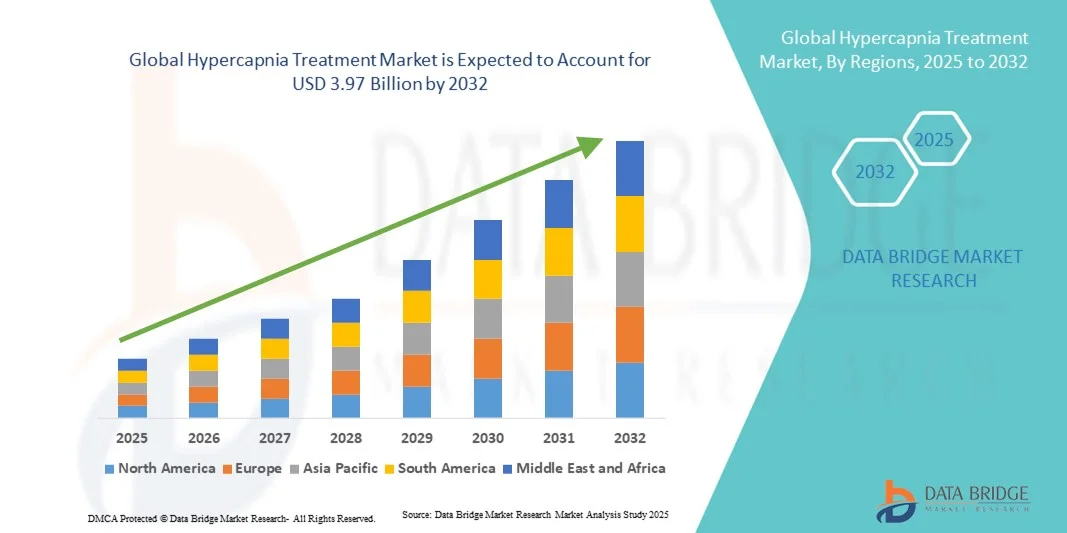
Hypercapnia Treatment Market Size
- The global hypercapnia treatment market size was valued at USD 2.71 billion in 2024 and is expected to reach USD 3.97 billion by 2032, at a CAGR of 4.90% during the forecast period
- The market growth is largely fueled by the increasing prevalence of respiratory disorders and advancements in critical care technologies, leading to a higher demand for efficient Hypercapnia Treatment solutions across healthcare settings
- Furthermore, the growing adoption of non-invasive ventilation systems, rising awareness about respiratory care, and continuous innovation in CO₂ monitoring and removal technologies are accelerating the uptake of Hypercapnia Treatment solutions, thereby significantly boosting the industry's growth
Hypercapnia Treatment Market Analysis
- Hypercapnia Treatment, which focuses on managing elevated levels of carbon dioxide (CO₂) in the blood, is becoming increasingly vital in the management of respiratory failure, chronic obstructive pulmonary disease (COPD), and sleep-related breathing disorders due to the rising global burden of respiratory illnesses
- The escalating demand for hypercapnia treatment solutions is primarily fueled by the growing incidence of chronic respiratory diseases, technological advancements in ventilatory support systems, and the increasing use of non-invasive ventilation (NIV) and extracorporeal CO₂ removal therapies in intensive care settings
- North America dominated the hypercapnia treatment market with the largest revenue share of 39.5% in 2024, attributed to the strong presence of advanced healthcare infrastructure, favorable reimbursement policies, and high awareness about early respiratory care. The U.S. remains the key contributor, driven by ongoing clinical research, early adoption of next-generation ventilatory devices, and the growing prevalence of COPD and obesity hypoventilation syndrome
- Asia-Pacific is expected to be the fastest-growing region in the hypercapnia treatment market during the forecast period, registering a CAGR, owing to increasing healthcare expenditure, expanding access to critical care facilities, and rising prevalence of respiratory disorders in rapidly urbanizing countries such as China, India, and Japan
- The bronchodilators segment held the largest market revenue share of 42.5% in 2024, as these drugs are frontline therapies for managing hypercapnia associated with chronic obstructive pulmonary disease (COPD) and asthma
Report Scope and Hypercapnia Treatment Market Segmentation
|
Attributes |
Hypercapnia Treatment Key Market Insights |
|
Segments Covered |
|
|
Countries Covered |
North America
Europe
Asia-Pacific
Middle East and Africa
South America
|
|
Key Market Players |
|
|
Market Opportunities |
|
|
Value Added Data Infosets |
In addition to the insights on market scenarios such as market value, growth rate, segmentation, geographical coverage, and major players, the market reports curated by the Data Bridge Market Research also include in-depth expert analysis, patient epidemiology, pipeline analysis, pricing analysis, and regulatory framework. |
Hypercapnia Treatment Market Trends
Advances in CO₂-Management Therapeutics and Monitoring Technologies
- A significant and accelerating trend in the global hypercapnia treatment market is the growing focus on innovative CO₂-management therapies and digital respiratory monitoring solutions aimed at reducing carbon dioxide retention in patients with chronic lung disorders such as COPD and obesity-hypoventilation syndrome
- For instance, in June 2023, ResMed launched its new Astral Life Support ventilator with cloud-based CO₂ monitoring analytics to enhance patient safety and care continuity in home and hospital environments
- The development of non-invasive ventilation (NIV), advanced capnography systems, and portable transcutaneous CO₂ monitors has revolutionized early detection and management of hypercapnia in both hospital and home-care settings
- Artificial intelligence (AI) is increasingly being integrated into ventilatory devices for real-time patient data analysis, enabling personalized ventilation adjustments and predictive maintenance of respiratory devices
- Remote monitoring platforms connected to digital ventilators are facilitating improved adherence, early intervention, and reduced hospital readmissions in chronic hypercapnia patients
- The convergence of personalized medicine, connected health, and respiratory therapy innovation is significantly reshaping the hypercapnia management landscape, promoting better patient outcomes and treatment efficiency
Hypercapnia Treatment Market Dynamics
Driver
Increasing Prevalence of Respiratory Failure and Improving Monitoring Technologies
- The growing global burden of respiratory diseases such as chronic obstructive pulmonary disease (COPD), neuromuscular disorders, and sleep-related hypoventilation syndromes is driving the need for effective hypercapnia management
- For instance, in March 2024, Philips Healthcare introduced the BiPAP A40 EFL ventilator specifically designed to address hypercapnia in COPD patients, offering automatic detection of expiratory flow limitation for personalized treatment
- According to the World Health Organization (WHO), COPD affected over 390 million people globally in 2024, with a large proportion exhibiting chronic CO₂ retention
- Technological advancements in respiratory care, such as portable non-invasive ventilation systems and real-time CO₂ monitoring devices, have significantly improved diagnostic accuracy and treatment outcomes
- Rising awareness among clinicians about the long-term consequences of untreated hypercapnia and increased government healthcare spending are accelerating adoption of advanced therapies
- The availability of telehealth-enabled ventilators and integration of AI-based analytics are further strengthening the market growth outlook during the forecast period
Restraint/Challenge
High Device Cost, Limited Access, and Clinical Complexity
- The high cost associated with advanced hypercapnia management devices, such as non-invasive ventilators and continuous capnography monitors, remains a major restraint, especially in low- and middle-income countries
- The lack of reimbursement frameworks for long-term respiratory support therapies limits patient accessibility and adoption
- Clinical complexity in managing patients with overlapping conditions like obesity-hypoventilation syndrome, COPD, and neuromuscular disorders creates challenges in standardized care pathways
- For instance, in August 2022, a report by the U.S. Centers for Medicare & Medicaid Services (CMS) highlighted delayed reimbursements and limited coverage for home-based non-invasive ventilation in chronic hypercapnia patients, slowing market expansion
- In addition, limited awareness in developing regions and shortage of skilled respiratory therapists further hinder market penetration
- Addressing these issues through favorable reimbursement policies, affordable device development, and expanded healthcare training programs will be critical for sustainable growth of the Hypercapnia Treatment market
Hypercapnia Treatment Market Scope
The market is segmented on the basis of symptoms and medications.
- By Symptoms
On the basis of symptoms, the Hypercapnia Treatment market is segmented into flushed skin, drowsiness or inability to focus, mild headaches, feeling disoriented or dizzy, feeling short of breath, being abnormally tired or exhausted, and others. The feeling short of breath segment dominated the market with the largest revenue share of 36.8% in 2024, as dyspnea is one of the earliest and most common clinical signs of hypercapnia, frequently observed in patients with COPD, sleep apnea, or neuromuscular respiratory failure. Increasing hospital visits related to respiratory distress and growing awareness of chronic pulmonary conditions are major contributors to this segment’s dominance. Additionally, the rising adoption of advanced ventilatory support systems and improved emergency response for breathlessness management further strengthen the segment’s growth. Growing public health programs focusing on respiratory screening and awareness have also contributed to better recognition and diagnosis of hypercapnia-related symptoms, reinforcing its leadership position.
The drowsiness or inability to focus segment is projected to witness the fastest CAGR of 18.9% from 2025 to 2032, driven by increasing clinical attention to neurological manifestations of CO₂ retention. Fatigue and cognitive impairment are becoming significant diagnostic markers for early-stage hypercapnia detection, especially in patients with sleep-disordered breathing or obesity-hypoventilation syndrome. The adoption of continuous capnography and home-based monitoring devices capable of detecting cognitive and concentration decline is fueling growth in this area. Moreover, ongoing clinical studies investigating CO₂-related neurocognitive effects are helping healthcare professionals better understand and manage such symptoms. Growing recognition of the systemic effects of hypercapnia is expected to propel this segment’s expansion over the forecast period.
- By Medications
On the basis of medications, the Hypercapnia Treatment market is segmented into bronchodilators, inhaled or oral corticosteroids, and antibiotics for respiratory infections. The bronchodilators segment held the largest market revenue share of 42.5% in 2024, as these drugs are frontline therapies for managing hypercapnia associated with chronic obstructive pulmonary disease (COPD) and asthma. The increasing prescription of short-acting β₂-agonists and long-acting bronchodilators to improve airway patency and ventilation efficiency has been a key growth factor. Furthermore, rising disease prevalence and broader access to combination inhaler therapies have strengthened this segment’s market position. For instance, in May 2023, AstraZeneca and Avillion announced positive Phase III results for PT027 (albuterol/budesonide), a rescue therapy for hypercapnic COPD patients, highlighting ongoing innovation in bronchodilator-based treatments. Increased availability of cost-effective generics and improved patient adherence through smart inhaler systems further enhance market expansion for this segment.
The inhaled or oral corticosteroids segment is anticipated to register the fastest CAGR of 20.4% from 2025 to 2032, driven by the growing use of corticosteroids in managing inflammation-induced CO₂ retention in chronic respiratory disorders. The widespread clinical acceptance of combination therapies integrating corticosteroids and bronchodilators has significantly improved patient outcomes and reduced hospitalization rates. Increased focus on personalized medicine and optimized dosage regimens for chronic hypercapnia management are propelling demand. In addition, recent studies highlighting the anti-inflammatory benefits of corticosteroids in reducing acute exacerbations have accelerated their adoption. The introduction of novel inhalation devices and formulation improvements ensuring better lung deposition are also fueling segment growth. The trend toward integrating corticosteroid therapy within long-term ventilatory management programs is expected to drive its market share during the forecast period.
Hypercapnia Treatment Market Regional Analysis
- North America dominated the hypercapnia treatment market with the largest revenue share of 39.5% in 2024, attributed to the strong presence of advanced healthcare infrastructure, favorable reimbursement policies, and high awareness about early respiratory care. The region’s focus on developing advanced ventilatory support technologies, such as non-invasive ventilation systems and intelligent monitoring devices, has further boosted market growth
- Patients and healthcare providers in North America increasingly prefer portable and home-based respiratory systems for managing chronic hypercapnia, particularly among COPD and obesity hypoventilation syndrome patients
- This trend is supported by collaborations between medical device companies and hospitals to enhance patient outcomes and reduce ICU burden. For instance, in March 2023, Philips Respironics launched its Trilogy Evo platform expansion across U.S. healthcare facilities, supporting long-term ventilation in both acute and home settings
U.S. Hypercapnia Treatment Market Insight
The U.S. hypercapnia treatment market captured the largest revenue share in 2024 within North America, fueled by the growing prevalence of chronic respiratory disorders and the rising demand for non-invasive ventilation therapies. Increasing adoption of advanced monitoring systems for blood gas levels, integration of AI-based ventilation adjustments, and early diagnosis initiatives contribute to the dominance of the U.S. market. Moreover, government support for reducing readmissions and improving respiratory care outcomes continues to enhance device penetration across hospitals and long-term care facilities.
Europe Hypercapnia Treatment Market Insight
The Europe hypercapnia treatment market is projected to expand at a substantial CAGR throughout the forecast period, driven by stringent healthcare regulations promoting respiratory monitoring and the rising adoption of home-care ventilation devices. The growing geriatric population and increased incidence of sleep apnea and COPD are major factors supporting demand. Additionally, strong emphasis on cost-effective and sustainable respiratory care solutions has encouraged regional manufacturers to innovate in compact ventilator designs. For instance, in October 2022, ResMed introduced its AirSense 11 CPAP series across European markets, expanding options for non-invasive respiratory management.
U.K. Hypercapnia Treatment Market Insight
The U.K. hypercapnia treatment market is anticipated to grow at a noteworthy CAGR during the forecast period, driven by the national emphasis on home-based care and reduced hospital readmission rates. The NHS’s strategic partnerships with medtech firms to deploy remote patient monitoring systems are enhancing early detection of hypercapnia-related complications. Growing investments in connected ventilator systems and AI-driven monitoring are expected to sustain market expansion across both private and public healthcare facilities.
Germany Hypercapnia Treatment Market Insight
The Germany hypercapnia treatment market is expected to expand at a considerable CAGR during the forecast period, fueled by advancements in digital healthcare and precision medicine. Germany’s healthcare infrastructure promotes the integration of ventilatory devices with hospital IT systems for continuous monitoring and patient safety. Increasing adoption of hybrid ventilation devices and supportive reimbursement structures strengthen market growth. In May 2023, Löwenstein Medical launched a next-generation non-invasive ventilator tailored for patients with chronic respiratory insufficiency, underscoring the country’s leadership in innovation.
Asia-Pacific Hypercapnia Treatment Market Insight
The Asia-Pacific hypercapnia treatment market is poised to grow at the fastest CAGR from 2025 to 2032, driven by increasing healthcare expenditure, rising prevalence of respiratory diseases, and improved access to intensive care facilities in countries like China, Japan, and India. Rapid urbanization and pollution-related respiratory issues have amplified demand for non-invasive ventilation devices. Local manufacturing capabilities and government health reforms are making treatment more affordable and accessible.
Japan Hypercapnia Treatment Market Insight
The Japan hypercapnia treatment market is gaining traction due to the aging population, high healthcare standards, and widespread adoption of advanced respiratory monitoring systems. The country’s integration of AI and IoT in medical devices supports early detection and intervention for respiratory failure. Hospitals and home-care setups increasingly favor compact, energy-efficient ventilators to enhance patient comfort.
China Hypercapnia Treatment Market Insight
The China hypercapnia treatment market accounted for the largest market revenue share in the Asia-Pacific region in 2024, driven by strong domestic manufacturing, rising healthcare investments, and an increasing burden of chronic respiratory illnesses. Initiatives under “Healthy China 2030” have accelerated deployment of non-invasive ventilation and remote respiratory monitoring systems. The introduction of cost-effective ventilatory devices by local players such as Mindray and Aeonmed has strengthened market penetration, particularly in secondary hospitals and home-care environments.
Hypercapnia Treatment Market Share
The Hypercapnia Treatment industry is primarily led by well-established companies, including:
- Philips Healthcare (Netherlands)
- Medtronic (Ireland)
- ResMed Inc. (U.S.)
- GE HealthCare Technologies Inc. (U.S.)
- Drägerwerk AG & Co. KGaA (Germany)
- Smiths Medical (U.K.)
- Fisher & Paykel Healthcare Corporation Limited (New Zealand)
- Hamilton Medical AG (Switzerland)
- BD (U.S.)
- Vyaire Medical, Inc. (U.S.)
- Allied Healthcare Products, Inc. (U.S.)
- Teleflex Incorporated (U.S.)
- Hillrom Holdings, Inc. (U.S.)
- Air Liquide Healthcare (France)
- Koninklijke Philips N.V. (Netherlands)
- Inogen, Inc. (U.S.)
- Nihon Kohden Corporation (Japan)
- Linde Healthcare (Germany)
- Beijing Aeonmed Co., Ltd. (China)
- Getinge AB (Sweden)
Latest Developments in Global Hypercapnia Treatment Market
- In July 2023, a clinical study conducted by Taccone FS et al. demonstrated that the dedicated extracorporeal carbon dioxide removal (ECCO₂R) device, CO2RESET, achieved a significantly high rate of CO₂ removal with a favorable safety profile in critically ill patients suffering from hypercapnic acidosis. This development reinforced the growing clinical relevance of advanced ECCO₂R systems in managing severe respiratory insufficiency associated with hypercapnia
- In June 2025, a comprehensive review by Lassola S. emphasized major technological innovations in ECCO₂R systems, including advanced catheter designs, active blood–gas mixing mechanisms, and improved biochemical interfaces. These improvements are expected to enhance treatment efficiency and safety while expanding hypercapnia therapy applications from intensive care units to potential home-care settings in the future
- In August 2025, market research reported that the extracorporeal CO₂ removal (ECCO₂R) devices market is projected to grow at a CAGR of 6.4% from 2024 to 2031, reaching an estimated USD 184.36 million by 2031. This forecast highlights the increasing adoption of hypercapnia treatment solutions, driven by technological advancement, greater awareness among clinicians, and rising prevalence of chronic respiratory disorders globally
- In January 2025, a clinical trial (NCT05316532) investigating novel ECCO₂R devices for treating hypercapnic respiratory failure entered its expanded access phase. This development marks an important step toward offering more effective therapeutic options for patients with persistent or acute hypercapnia who do not adequately respond to conventional ventilation methods

- Interactive Data Analysis Dashboard
- Company Analysis Dashboard for high growth potential opportunities
- Research Analyst Access for customization & queries
- Competitor Analysis with Interactive dashboard
- Latest News, Updates & Trend analysis
- Harness the Power of Benchmark Analysis for Comprehensive Competitor Tracking
Data collection and base year analysis are done using data collection modules with large sample sizes. The stage includes obtaining market information or related data through various sources and strategies. It includes examining and planning all the data acquired from the past in advance. It likewise envelops the examination of information inconsistencies seen across different information sources. The market data is analysed and estimated using market statistical and coherent models. Also, market share analysis and key trend analysis are the major success factors in the market report. To know more, please request an analyst call or drop down your inquiry.
The key research methodology used by DBMR research team is data triangulation which involves data mining, analysis of the impact of data variables on the market and primary (industry expert) validation. Data models include Vendor Positioning Grid, Market Time Line Analysis, Market Overview and Guide, Company Positioning Grid, Patent Analysis, Pricing Analysis, Company Market Share Analysis, Standards of Measurement, Global versus Regional and Vendor Share Analysis. To know more about the research methodology, drop in an inquiry to speak to our industry experts.
Data Bridge Market Research is a leader in advanced formative research. We take pride in servicing our existing and new customers with data and analysis that match and suits their goal. The report can be customized to include price trend analysis of target brands understanding the market for additional countries (ask for the list of countries), clinical trial results data, literature review, refurbished market and product base analysis. Market analysis of target competitors can be analyzed from technology-based analysis to market portfolio strategies. We can add as many competitors that you require data about in the format and data style you are looking for. Our team of analysts can also provide you data in crude raw excel files pivot tables (Fact book) or can assist you in creating presentations from the data sets available in the report.












