


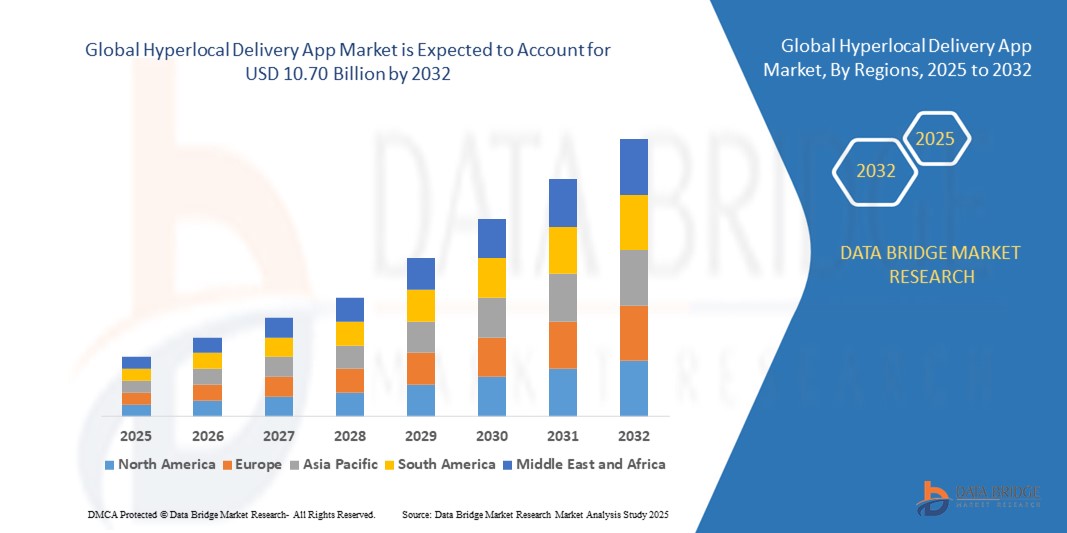
Hyperlocal Delivery App Market Size
- The global hyperlocal delivery app market size was valued at USD 2.09 billion in 2024 and is expected to reach USD 10.70 billion by 2032, at a CAGR of 22.6% during the forecast period
- The market growth is largely fueled by the increasing adoption of on-demand services and advancements in digital logistics technologies, leading to faster, more efficient, and reliable hyperlocal deliveries in urban and semi-urban areas
- Furthermore, rising consumer demand for instant, convenient, and app-based delivery of groceries, meals, medicines, and other essentials is establishing hyperlocal delivery platforms as a preferred solution for everyday needs. These converging factors are accelerating the adoption of hyperlocal delivery apps, thereby significantly boosting the industry's growth
Hyperlocal Delivery App Market Analysis
- Hyperlocal delivery apps are digital platforms that connect consumers with local merchants, restaurants, and service providers to facilitate quick, same-day, or real-time deliveries. These apps use AI-powered routing, real-time tracking, and automated logistics to ensure timely and efficient order fulfillment
- The escalating demand for hyperlocal delivery services is primarily fueled by increasing smartphone penetration, evolving urban lifestyles, rising e-commerce adoption, and growing preference for contactless and convenient delivery solutions
- North America dominated the hyperlocal delivery app market with a share of 42.4% in 2024, due to mature e-commerce adoption, high smartphone penetration, and dense last-mile logistics networks
- Asia-Pacific is expected to be the fastest growing region in the hyperlocal delivery app market during the forecast period due to rapid urbanization, digital wallets and UPI-style rails, and super-app ecosystems that bundle food, grocery, pharmacy, and parcel in one interface
- Mobile-based hyperlocal delivery apps segment dominated the market with a market share of 72.9% in 2024, due to the rapid penetration of smartphones and increasing internet affordability across both urban and semi-urban regions. Consumers prefer mobile-based apps due to their convenience, real-time tracking, push notifications, and integration with mobile payment gateways, making them the go-to platform for on-demand services. In addition, the growing popularity of app-based loyalty programs, personalized recommendations, and multilingual interfaces further strengthen mobile apps’ dominance in catering to diverse consumer needs
Report Scope and Hyperlocal Delivery App Market Segmentation
|
Attributes |
Hyperlocal Delivery App Key Market Insights |
|
Segments Covered |
|
|
Countries Covered |
North America
Europe
Asia-Pacific
Middle East and Africa
South America
|
|
Key Market Players |
|
|
Market Opportunities |
|
|
Value Added Data Infosets |
In addition to the market insights such as market value, growth rate, market segments, geographical coverage, market players, and market scenario, the market report curated by the Data Bridge Market Research team includes in-depth expert analysis, import/export analysis, pricing analysis, production consumption analysis, and pestle analysis. |
Hyperlocal Delivery App Market Trends
Rising Technological Advancements
- The hyperlocal delivery app market is rapidly evolving with advancements in AI, real-time tracking, route optimization, and integrated payment platforms that streamline delivery efficiency and customer experience. Technology is increasingly at the core of competitive differentiation in crowded urban markets
- For instance, Swiggy has implemented advanced machine learning algorithms and real-time driver tracking features in its hyperlocal delivery platform, resulting in reduced delivery times and higher customer satisfaction across major Indian cities
- Automation of order allocation, predictive analytics for demand forecasting, and dynamic pricing models are enhancing operational performance and profitability for delivery app operators
- In addition, cloud-based platforms and scalable microservices architectures enable rapid rollout of new features, geographic expansion, and robust system uptime for high-volume urban delivery environments
- Growing integration of eco-friendly delivery options such as electric vehicles, bicycles, and green packaging is influencing app adoption, as platforms address environmental concerns among urban consumers
- Contactless delivery models and safety protocols established during recent health crises are continuing to shape technology deployment and app features for convenient, secure urban delivery
Hyperlocal Delivery App Market Dynamics
Driver
Rapid Urbanization Across Various Regions
- Accelerating urbanization globally is driving demand for hyperlocal delivery apps as city dwellers increasingly seek quick, reliable access to food, groceries, and daily essentials. Population density and diverse consumption habits create ideal conditions for high-frequency hyperlocal delivery services
- For instance, Zomato has scaled its hyperlocal delivery operations in expanding metropolitan regions, leveraging app-driven networks to connect local merchants and logistics providers with a growing base of online urban consumers
- The proliferation of smartphones and internet penetration in urban centers enables convenient on-demand access to products and services directly through mobile platforms
- Increased number of small businesses and retailers in dense urban markets provides broad product variety, supporting the need for efficient hyperlocal logistics and app-mediated store-to-door connections
- In addition, urban migration and concentration of economic activities increase pressure on traditional retail and supply chain infrastructure, accelerating the shift to app-based delivery models. Large-scale commercial complexes, office hubs, and residential developments fuel early adoption and expansion of hyperlocal delivery apps in new regions
Restraint/Challenge
Rising Logistical Challenges
- Rapid market expansion presents significant logistical challenges including congested traffic, last-mile delivery optimization, variable demand patterns, and workforce management across sprawling urban areas. These factors can directly impact performance and profitability for delivery platforms
- For instance, Dunzo has faced operational hurdles in scaling its service due to unpredictable peak-hour traffic, real-time route changes, and localized delivery bottlenecks in Indian megacities
- Adapting to sudden spikes in order volume and optimizing routes while maintaining delivery speed remains difficult, especially in densely populated zones with poor road infrastructure. In addition, coordination of large fleets of delivery partners requires robust management tools and adaptive scheduling to minimize idle time and maximize service level consistency
- Ensuring security, trust, and reliability in cash/online payment collection, parcel handling, and customer communication adds operational complexity and risks. Cost management for fuel, incentives, maintenance, and delivery operations impacts margins, with fierce market competition and regulatory variations introducing further uncertainties
- Coverage gaps in suburban and peri-urban areas, along with challenges scaling operations to new urban regions, limit potential growth and efficiency for many hyperlocal platforms
Hyperlocal Delivery App Market Scope
The market is segmented on the basis of type and industry.
- By Type
On the basis of type, the hyperlocal delivery app market is segmented into web-based hyperlocal delivery apps and mobile-based hyperlocal delivery apps. The mobile-based segment dominated the largest market revenue share of 72.9% in 2024, supported by the rapid penetration of smartphones and increasing internet affordability across both urban and semi-urban regions. Consumers prefer mobile-based apps due to their convenience, real-time tracking, push notifications, and integration with mobile payment gateways, making them the go-to platform for on-demand services. In addition, the growing popularity of app-based loyalty programs, personalized recommendations, and multilingual interfaces further strengthen mobile apps’ dominance in catering to diverse consumer needs.
The web-based hyperlocal delivery app segment is anticipated to witness the fastest growth rate from 2025 to 2032, fueled by increasing adoption among small retailers, local businesses, and desktop-first users. Web platforms provide scalability for businesses that may not have the resources to invest in mobile app development but still want to access the benefits of hyperlocal delivery. The segment’s growth is further supported by the rising trend of progressive web apps (PWAs), which bridge the gap between mobile and desktop experiences by offering app-like features without downloads. Growing enterprise usage in managing logistics, supply chain workflows, and real-time order tracking also positions web-based platforms as a cost-effective and efficient alternative.
- By Industry
On the basis of industry, the hyperlocal delivery app market is segmented into retail & CPG, medical & healthcare, food & beverages, courier express & parcel, and others. The food & beverages segment accounted for the largest revenue share in 2024, driven by the surge in online food ordering and the increasing preference for doorstep delivery from restaurants, cloud kitchens, and quick-service outlets. Platforms in this segment benefit from high order frequency, bundled offers, and partnerships with a wide network of eateries, which enhance consumer engagement. The integration of AI-powered recommendation engines, instant delivery models, and contactless payment options further boosts growth by improving customer experience and retention.
The medical & healthcare segment is projected to grow at the fastest CAGR from 2025 to 2032, propelled by the rising demand for hyperlocal delivery of medicines, diagnostic kits, and healthcare essentials. Factors such as increasing chronic disease prevalence, the shift toward telemedicine, and the need for quick access to pharmaceuticals post-pandemic are key drivers for this segment. Hyperlocal apps in this domain provide same-day or even instant medicine delivery, which is critical for patient compliance and urgent care scenarios. In addition, regulatory support for e-pharmacies and collaborations with healthcare providers are creating strong growth opportunities, positioning this segment as the most dynamic within the market.
Hyperlocal Delivery App Market Regional Analysis
- North America dominated the hyperlocal delivery app market with the largest revenue share of 42.4% in 2024, driven by mature e-commerce adoption, high smartphone penetration, and dense last-mile logistics networks
- Consumers value real-time tracking, rapid fulfillment windows, and seamless digital payments integrated with retailer POS systems and loyalty programs
- Growth is supported by higher disposable incomes, urban concentration in major metros, and strong venture investment that scales courier fleets and dark-store footprints
U.S. Hyperlocal Delivery App Market Insight
The U.S. market captured the largest share within North America in 2024, driven by widespread on-demand consumption, deep restaurant and grocery partnerships, and pervasive subscription models that lock in repeat usage. Robust integration with wallets and BNPL, curbside plus doorstep options, and data-driven dispatch optimization continue to expand use across food, pharmacy, and convenience categories. The rise of retailer-owned apps and white-label logistics further accelerates omnichannel adoption across national and regional banners.
Europe Hyperlocal Delivery App Market Insight
Europe is projected to expand at a substantial CAGR through 2025–2032, underpinned by urbanization, strong click-and-collect ecosystems extending into rapid delivery, and improving cross-border logistics. Consumers prioritize reliability, transparent ETAs, and flexible returns, while retailers deploy micro-fulfillment and rider networks to compress lead times. Data protection standards and interoperable payments foster trusted, repeat transactions across food, retail, and healthcare drops.
U.K. Hyperlocal Delivery App Market Insight
The U.K. is anticipated to grow at a noteworthy CAGR as grocery rapid-delivery, pharmacy fulfillment, and SME retail onboarding scale across cities and suburbs. High digital wallet usage, open-banking rails, and route-dense courier networks support quick turnarounds and stable unit economics. Retailers leverage hyperlocal to extend store catchments, reduce stockouts with store-to-door fulfillment, and boost loyalty via time-slot precision.
Germany Hyperlocal Delivery App Market Insight
Germany is expected to expand at a considerable CAGR, anchored by privacy-centric platforms, efficient logistics, and high purchasing power in urban corridors. Retailers emphasize sustainability with bike and EV fleets, consolidated drops, and reusable packaging. Strong B2B demand for scheduled intra-city runs complements consumer groceries, pharmacy, and specialty retail deliveries, improving asset utilization and margins.
Asia-Pacific Hyperlocal Delivery App Market Insight
Asia-Pacific is poised to grow at the fastest CAGR during 2025–2032, fueled by rapid urbanization, digital wallets and UPI-style rails, and super-app ecosystems that bundle food, grocery, pharmacy, and parcel in one interface. MSME digitization, local-language experiences, and rider supply depth broaden access beyond tier-1 cities. Cost-effective dark stores and AI-assisted batching shorten delivery times and expand category coverage.
Japan Hyperlocal Delivery App Market Insight
Japan is gaining momentum as convenience culture and high service expectations align with precise ETAs and reliable handoffs. An aging population increases demand for doorstep delivery of groceries and medicines, while densely populated neighborhoods enable efficient routing. Integrations with smart lockers and building access systems streamline secure, contactless drops in residential and mixed-use properties.
China Hyperlocal Delivery App Market Insight
China accounted for the largest market revenue share within Asia-Pacific in 2024, supported by super-app penetration, extensive courier networks, and rapid-commerce formats spanning food, grocery, and convenience. Competitive pricing, subscription tiers, and merchant tools for inventory visibility drive high order frequency. Expansion into tier-2 and tier-3 cities, plus pharmacy and same-day parcel services, sustains scale and adoption across consumer and SME segments.
Hyperlocal Delivery App Market Share
The hyperlocal delivery app industry is primarily led by well-established companies, including:
- Jungleworks (India)
- Fareye (India)
- Bringg (Israel)
- Shippo (U.S.)
- Loginext (India)
- Shipstation (U.S.)
- Anchanto (Singapore)
- Stamps (U.S.)
- Skedulo (U.S.)
Latest Developments in Global Hyperlocal Delivery App Market
- In August 2025, Reliance Industries wrote off its US $200 million investment in Dunzo, reflecting the financial challenges faced by the hyperlocal delivery sector. This move highlighted the rising operational and profitability pressures within the industry, as companies struggle to maintain rapid growth while balancing delivery costs and sustainability. The write-off also signaled to investors that the hyperlocal delivery market, despite its potential, remains highly competitive and volatile, creating the need for stronger financial discipline and innovative business models
- In June 2025, BigBasket announced the launch of its 10-minute food delivery service in Bengaluru, initially featuring well-known brands such as Tata Starbucks and Qmin. This expansion marked BigBasket’s entry into the ultra-fast commerce space, leveraging dark stores and localized inventory management to meet increasing consumer demand for instant delivery. By offering premium food products within minutes, BigBasket positioned itself as a strong competitor to existing quick-commerce players and demonstrated its intent to extend this model across other major Indian cities
- In June 2025, Magicpin’s logistics arm, magicFleet, revealed its target of achieving 2 million monthly deliveries by the end of fiscal 2026. Having launched in September 2024, magicFleet rapidly scaled by onboarding over 100,000 delivery riders across seven major metro cities, including Delhi NCR, Bengaluru, Pune, Hyderabad, Chennai, Kolkata, and Mumbai. This rapid growth highlights the increasing importance of logistics platforms in strengthening hyperlocal delivery capabilities and enabling retailers to expand their reach while meeting consumer expectations for faster and more reliable service
- In October 2023, Zomato introduced its hyperlocal delivery service called ‘Xtreme’, which focused on facilitating the delivery of small parcels for merchants. This initiative represented Zomato’s strategic diversification beyond food delivery, tapping into the growing demand from businesses for reliable last-mile solutions. By broadening its service portfolio, Zomato aimed to capture additional revenue streams while strengthening relationships with merchants and improving its competitive position in the wider hyperlocal delivery ecosystem
- In January 2022, Borzo, an India-based hyperlocal delivery service provider, acquired U.S.-based NOW Delivery for an undisclosed amount. The acquisition was intended to enhance Borzo’s presence in the Indian market while also strengthening its operational efficiency. By bringing in NOW Delivery’s capabilities, Borzo expanded its network and improved its service offerings, allowing it to cater to the rising demand for fast and localized deliveries across multiple industries
- In June 2020, Flipkart announced the integration of the last-mile delivery capabilities of Shadowfax, a logistics startup in which it had invested US $60 million. This strategic move enhanced Flipkart’s delivery efficiency and network reach, allowing the company to fulfill orders more reliably and at greater speed. By leveraging Shadowfax’s expertise in hyperlocal delivery, Flipkart strengthened its e-commerce operations, ensuring timely service to customers while reinforcing its competitive advantage in India’s rapidly growing online retail market

- Interactive Data Analysis Dashboard
- Company Analysis Dashboard for high growth potential opportunities
- Research Analyst Access for customization & queries
- Competitor Analysis with Interactive dashboard
- Latest News, Updates & Trend analysis
- Harness the Power of Benchmark Analysis for Comprehensive Competitor Tracking
Data collection and base year analysis are done using data collection modules with large sample sizes. The stage includes obtaining market information or related data through various sources and strategies. It includes examining and planning all the data acquired from the past in advance. It likewise envelops the examination of information inconsistencies seen across different information sources. The market data is analysed and estimated using market statistical and coherent models. Also, market share analysis and key trend analysis are the major success factors in the market report. To know more, please request an analyst call or drop down your inquiry.
The key research methodology used by DBMR research team is data triangulation which involves data mining, analysis of the impact of data variables on the market and primary (industry expert) validation. Data models include Vendor Positioning Grid, Market Time Line Analysis, Market Overview and Guide, Company Positioning Grid, Patent Analysis, Pricing Analysis, Company Market Share Analysis, Standards of Measurement, Global versus Regional and Vendor Share Analysis. To know more about the research methodology, drop in an inquiry to speak to our industry experts.
Data Bridge Market Research is a leader in advanced formative research. We take pride in servicing our existing and new customers with data and analysis that match and suits their goal. The report can be customized to include price trend analysis of target brands understanding the market for additional countries (ask for the list of countries), clinical trial results data, literature review, refurbished market and product base analysis. Market analysis of target competitors can be analyzed from technology-based analysis to market portfolio strategies. We can add as many competitors that you require data about in the format and data style you are looking for. Our team of analysts can also provide you data in crude raw excel files pivot tables (Fact book) or can assist you in creating presentations from the data sets available in the report.













