


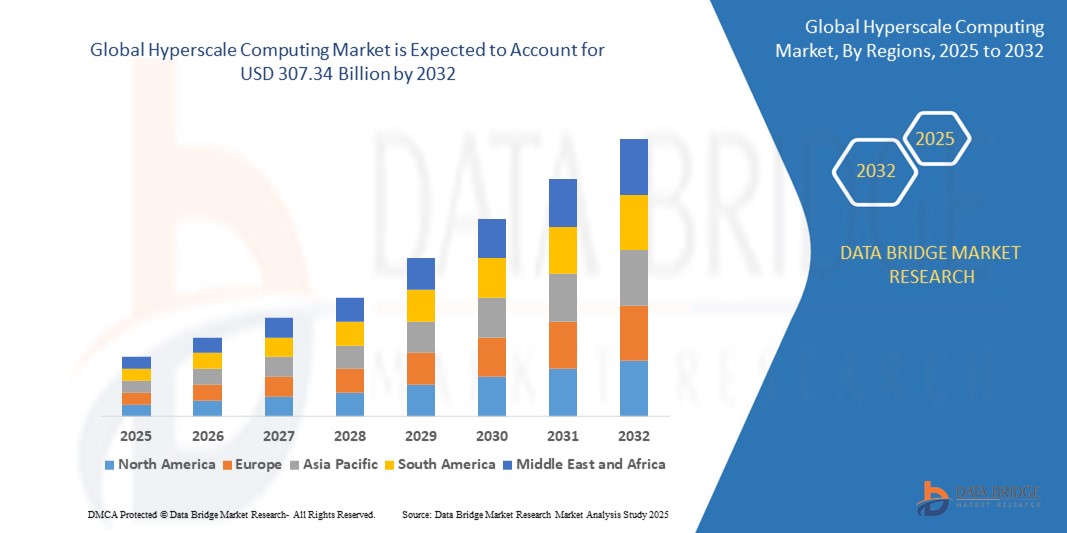
Hyperscale Computing Market Size
- The global hyperscale computing market size was valued at USD 66.01 billion in 2024 and is expected to reach USD 307.34 billion by 2032, at a CAGR of 21.20% during the forecast period
- The market growth is Market growth is primarily driven by the increasing demand for cloud-based services, rapid digital transformation across industries, and the rising adoption of big data analytics and artificial intelligence (AI)
- In addition, the need for scalable, high-performance computing infrastructure to support growing data volumes and complex workloads is positioning hyperscale computing as a cornerstone of modern digital ecosystems
Hyperscale Computing Market Analysis
- Hyperscale computing, characterized by massive-scale, highly efficient, and flexible computing infrastructure, is becoming a critical enabler for cloud services, AI, and data-intensive applications across industries
- The surge in demand is fueled by the proliferation of cloud-native applications, increasing enterprise adoption of AI and machine learning, and the need for cost-efficient, scalable data center solutions
- North America dominated the hyperscale computing market with the largest revenue share of 42.5% in 2024, driven by early adoption of cloud technologies, significant investments in data centers, and the presence of major tech giants in the U.S., with innovations in AI-driven infrastructure and edge computing further accelerating growth
- Asia-Pacific is expected to be the fastest-growing region during the forecast period, propelled by rapid urbanization, increasing internet penetration, and growing investments in cloud infrastructure in countries such as China, India, and Singapore
- The solutions segment dominated the largest market revenue share of 77.8% in 2024, driven by the widespread adoption of hyperscale computing solutions to meet high-performance application requirements across industries
Report Scope and Hyperscale Computing Market Segmentation
|
Attributes |
Hyperscale Computing Key Market Insights |
|
Segments Covered |
|
|
Countries Covered |
North America
Europe
Asia-Pacific
Middle East and Africa
South America
|
|
Key Market Players |
|
|
Market Opportunities |
|
|
Value Added Data Infosets |
In addition to the market insights such as market value, growth rate, market segments, geographical coverage, market players, and market scenario, the market report curated by the Data Bridge Market Research team includes in-depth expert analysis, import/export analysis, pricing analysis, production consumption analysis, and pestle analysis. |
Hyperscale Computing Market Trends
“Increasing Integration of AI and Big Data Analytics”
- The global hyperscale computing market is experiencing a significant trend toward integrating Artificial Intelligence (AI) and Big Data analytics to handle massive data volumes efficiently
- These technologies enable advanced data processing, providing deeper insights into system performance, user behavior, and predictive maintenance for data centers
- AI-powered hyperscale solutions facilitate proactive issue resolution, identifying potential system failures or inefficiencies before they result in downtime or performance degradation
- For instances, companies are leveraging AI-driven platforms to optimize data center operations, such as predictive workload management or energy-efficient resource allocation based on real-time demand and environmental factors
- This trend enhances the value of hyperscale computing systems, making them critical for enterprises and cloud service providers seeking scalable, high-performance infrastructure
- AI algorithms analyze vast datasets, including system usage patterns, network traffic, and resource consumption, to optimize performance and reduce operational costs
Hyperscale Computing Market Dynamics
Driver
“Rising Demand for Cloud Computing and Advanced Data Processing”
- The increasing demand for cloud-based services, such as Infrastructure as a Service (IaaS), Platform as a Service (PaaS), and Software as a Service (SaaS), is a major driver for the hyperscale computing market
- Hyperscale computing enhances data processing capabilities by providing scalable infrastructure for applications such as big data analytics, AI, machine learning, and IoT, which require significant computational power
- Government initiatives and investments in digital infrastructure, particularly in regions such as North America, are contributing to the widespread adoption of hyperscale computing
- The proliferation of 5G technology and IoT devices is further driving the need for hyperscale data centers, offering faster data transmission and lower latency for real-time applications
- Major cloud providers, such as Amazon Web Services (AWS), Microsoft Azure, and Google Cloud Platform (GCP), are increasingly deploying hyperscale infrastructure to meet enterprise demands for scalable and reliable computing resources
Restraint/Challenge
“High Implementation Costs and Data Security Concerns”
- The significant upfront investment required for building and maintaining hyperscale data centers, including hardware, software, and cooling systems, poses a barrier to adoption, particularly in cost-sensitive regions
- Integrating hyperscale computing solutions into existing IT infrastructure can be complex and costly, requiring specialized expertise and resources
- Data security and privacy concerns are a major challenge, as hyperscale systems process and store vast amounts of sensitive data, raising risks of breaches or misuse
- The fragmented regulatory landscape across countries, with varying data protection laws, complicates compliance for global hyperscale operators and service providers
- These factors may deter adoption in regions with high cost sensitivity or stringent data privacy regulations, potentially limiting market growth
Hyperscale Computing market Scope
The market is segmented on the basis of Component, Application, and Industry Vertical.
- By Component
On the basis of components, the hyperscale computing market is segmented into Solutions and Services. The solutions segment dominated the largest market revenue share of 77.8% in 2024, driven by the widespread adoption of hyperscale computing solutions to meet high-performance application requirements across industries. These solutions, including servers, storage, and networking infrastructure, provide the scalability and efficiency needed for data-intensive workloads.
The Services segment is expected to witness the fastest growth rate of 23.2% from 2025 to 2032. This growth is fueled by the increasing demand for consulting, maintenance, and managed services to optimize hyperscale infrastructure, enhance energy efficiency, and support digital transformation initiatives.
- By Application
On the basis of application, the hyperscale computing market is segmented into Cloud Computing, Big Data Analytics, AI & Machine Learning, and IoT. The Cloud Computing segment dominated the market with a revenue share of 30.6% in 2024, driven by the rising adoption of cloud-native platforms and scalable infrastructure to support vast data volumes and dynamic workloads. Major cloud providers such as AWS, Microsoft Azure, and Google Cloud are expanding their hyperscale data centers to meet enterprise demands.
The AI & Machine Learning segment is anticipated to experience the fastest growth rate from 2025 to 2032, propelled by the increasing complexity of AI models and the need for high-performance computing to support real-time analytics, natural language processing, and generative AI applications. The proliferation of IoT devices and edge computing further accelerates the demand for hyperscale architectures to process large-scale data.
- By Industry Vertical
On the basis of industry vertical, the hyperscale computing market is segmented into IT & Telecom, BFSI (Banking, Financial Services, and Insurance), Government and Defense, Research and Academics, Healthcare and Life Sciences, Manufacturing, Retail and Consumer Goods, Media and Entertainment, and Others. The IT & Telecom segment accounted for the largest market revenue share of 23.5% in 2024, driven by its reliance on hyperscale computing for simplified management, scalability, and operational efficiency in managing vast data flows from cloud platforms and IoT devices.
The Healthcare and Life Sciences segment is expected to witness the fastest growth rate from 2025 to 2032. The increasing adoption of hyperscale computing for data-intensive applications such as telemedicine, electronic health records, and genomic research, combined with the need for real-time data processing and analytics, is driving rapid growth in this vertical.
Hyperscale Computing Market Regional Analysis
- North America dominated the hyperscale computing market with the largest revenue share of 42.5% in 2024, driven by early adoption of cloud technologies, significant investments in data centers, and the presence of major tech giants in the U.S., with innovations in AI-driven infrastructure and edge computing further accelerating growth
- Enterprises prioritize hyperscale computing for scalability, cost efficiency, and enhanced performance in applications such as cloud computing, AI, and big data analytics, particularly in industries with high computational demands
- Growth is fueled by advancements in hardware solutions, including high-performance servers and storage systems, alongside increasing demand for managed services in both enterprise and public sector segments
U.S. Hyperscale Computing Market Insight
The U.S. hyperscale computing market captured the largest revenue share of 83.6% in 2024 within North America, fueled by strong demand from technology giants and enterprises adopting cloud and AI-driven solutions. Growing investments in data centers and increasing focus on digital transformation across industries such as IT, BFSI, and healthcare boost market expansion. The presence of major hyperscale providers and supportive government policies further accelerates growth.
Europe Hyperscale Computing Market Insight
The Europe hyperscale computing market is expected to witness significant growth, supported by regulatory focus on data sovereignty and digital infrastructure development. Enterprises seek scalable solutions to support cloud computing, AI, and IoT applications while ensuring compliance with GDPR. Countries such as Germany and the U.K. show strong adoption due to increasing investments in green data centers and smart city initiatives.
U.K. Hyperscale Computing Market Insight
The U.K. market for hyperscale computing is expected to witness rapid growth, driven by demand for cloud-based services and AI applications in urban and industrial settings. Increased focus on digital economy initiatives and sustainability in data center operations encourages adoption. Evolving regulations around data privacy and cybersecurity influence enterprise choices, balancing performance with compliance.
Germany Hyperscale Computing Market Insight
Germany is expected to witness significant growth in hyperscale computing, attributed to its advanced IT infrastructure and high enterprise focus on AI, big data, and Industry 4.0. German businesses prefer hyperscale solutions that optimize operational efficiency and support sustainable computing. The integration of these solutions in manufacturing and BFSI sectors, alongside government-backed digital initiatives, drives sustained market growth.
Asia-Pacific Hyperscale Computing Market Insight
The Asia-Pacific region is expected to witness the fastest growth rate, driven by rapid digitalization, expanding IT infrastructure, and rising adoption of cloud and AI technologies in countries such as China, India, and Japan. Increasing internet penetration and government initiatives promoting smart cities and digital economies further boost demand for hyperscale computing solutions.
Japan Hyperscale Computing Market Insight
Japan’s hyperscale computing market is expected to witness rapid growth due to strong enterprise preference for high-performance, scalable computing solutions that support AI, IoT, and cloud applications. The presence of major technology firms and integration of hyperscale infrastructure in smart manufacturing accelerate market penetration. Growing interest in hybrid cloud solutions also contributes to expansion.
China Hyperscale Computing Market Insight
China holds the largest share of the Asia-Pacific hyperscale computing market, propelled by rapid urbanization, increasing enterprise cloud adoption, and government support for AI and big data initiatives. The country’s expanding digital economy and focus on smart infrastructure drive demand for hyperscale solutions. Strong domestic hyperscale providers and competitive pricing enhance market accessibility.
Hyperscale Computing Market Share
The hyperscale computing industry is primarily led by well-established companies, including:
- Amazon Web Services (AWS) (U.S.)
- Microsoft Azure (U.S.)
- Google Cloud (U.S.)
- Alibaba Cloud (China)
- IBM (U.S.)
- Oracle (U.S.)
- Dell Technologies (U.S.)
- Hewlett Packard Enterprise (HPE) (U.S.)
- Cisco Systems (U.S.)
- Lenovo (China)
- Huawei Technologies (China)
- Equinix (U.S.)
- Digital Realty (U.S.)
- NTT Communications (Japan)
- Tencent Cloud (China)
- SAP (Germany)
- VMware (U.S.)
- Rackspace Technology (U.S.)
- OVHcloud (France)
What are the Recent Developments in Global Hyperscale Computing Market?
- In July 2025, OpenAI and Oracle unveiled a landmark $30 billion cloud infrastructure deal under the Stargate initiative. The agreement secures 4.5 gigawatts of data center power—roughly a quarter of the U.S.'s current operational capacity—to support OpenAI’s growing AI workloads and future AGI ambitions. Oracle will build and expand data centers across multiple U.S. states, including Texas, Michigan, and Pennsylvania, to meet this demand. The Stargate project, backed by SoftBank and MGX, aims to invest $500 billion in AI infrastructure. This move marks a major shift in OpenAI’s cloud strategy, diversifying beyond Microsoft Azure
- In June 2025, EdgeMode Inc. signed a Memorandum of Understanding with BlackBerry AIF (BAIF) to merge and accelerate its growth in the high-performance computing (HPC) data center sector across Europe. The deal will see EdgeMode acquire 100% of BAIF’s share capital, with BAIF stakeholders receiving 50% of EdgeMode’s equity. The combined entity will control a 4.4 GW pipeline of hyperscale-ready sites, including 23 development locations across Spain and Europe. Initial construction is set to begin in Q4 2025, with 1 GW ready-to-build and an additional 1.2 GW targeted by Q4 2027
- In June 2025, Bain Capital finalized the merger of ChinData and Bridge Data Centres to create ChinData Group, a major pan-Asian data center platform. ChinData, known for its hyperscale campus-style facilities in China, and Bridge, which specializes in wholesale and custom-built centers across Southeast Asia and India, will continue operating under their respective brands. The combined entity aims to deliver a full spectrum of data center solutions—hyperscale, wholesale, and custom-build—across China, India, and Southeast Asia
- In June 2025, Ericsson introduced Ericsson On-Demand, a fully managed core-as-a-service platform developed in partnership with Google Cloud. Designed to help telecom providers deploy and scale 5G core network services with agility, the platform leverages Google Cloud’s AI infrastructure and Google Kubernetes Engine (GKE) for autoscaling. It enables rapid provisioning, elastic scaling, and consumption-based pricing—allowing telcos to pay only for what they use. With built-in security, geo-restricted deployments, and AI-assisted operations, Ericsson On-Demand offers a flexible, cloud-native solution to meet evolving network demands
- In May 2025, Microsoft launched its first hyperscale cloud data center region in Mexico, located in the Querétaro Metropolitan area. This new region, named Mexico Central, includes multiple data centers offering scalable, secure, and high-performance cloud services with local data residency and reduced latency. It marks Microsoft’s first such deployment in Spanish-speaking Latin America, joining over 60 global cloud regions

- Interactive Data Analysis Dashboard
- Company Analysis Dashboard for high growth potential opportunities
- Research Analyst Access for customization & queries
- Competitor Analysis with Interactive dashboard
- Latest News, Updates & Trend analysis
- Harness the Power of Benchmark Analysis for Comprehensive Competitor Tracking
Data collection and base year analysis are done using data collection modules with large sample sizes. The stage includes obtaining market information or related data through various sources and strategies. It includes examining and planning all the data acquired from the past in advance. It likewise envelops the examination of information inconsistencies seen across different information sources. The market data is analysed and estimated using market statistical and coherent models. Also, market share analysis and key trend analysis are the major success factors in the market report. To know more, please request an analyst call or drop down your inquiry.
The key research methodology used by DBMR research team is data triangulation which involves data mining, analysis of the impact of data variables on the market and primary (industry expert) validation. Data models include Vendor Positioning Grid, Market Time Line Analysis, Market Overview and Guide, Company Positioning Grid, Patent Analysis, Pricing Analysis, Company Market Share Analysis, Standards of Measurement, Global versus Regional and Vendor Share Analysis. To know more about the research methodology, drop in an inquiry to speak to our industry experts.
Data Bridge Market Research is a leader in advanced formative research. We take pride in servicing our existing and new customers with data and analysis that match and suits their goal. The report can be customized to include price trend analysis of target brands understanding the market for additional countries (ask for the list of countries), clinical trial results data, literature review, refurbished market and product base analysis. Market analysis of target competitors can be analyzed from technology-based analysis to market portfolio strategies. We can add as many competitors that you require data about in the format and data style you are looking for. Our team of analysts can also provide you data in crude raw excel files pivot tables (Fact book) or can assist you in creating presentations from the data sets available in the report.













