


What is the Hypersonic Missile Market Size and Growth Rate?
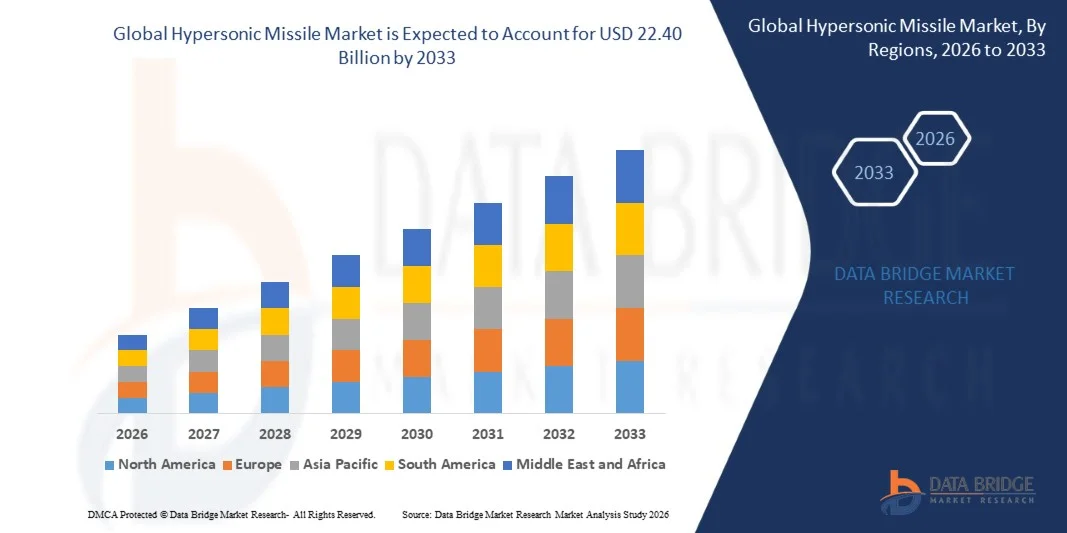
- As per Data Bridge Market Research analysis the hypersonic missile market was valued at USD 9.10 billion in 2025 and is projected to reach USD 22.40 billion by 2033, growing at a CAGR of 13.90% from 2026 to 2033.
- The market is witnessing robust growth driven by increasing defense modernization programs, rising investments in advanced missile technologies, and the growing need for rapid-response strike capabilities amid evolving geopolitical tensions and security challenges.
- Continuous advancements in propulsion systems, guidance and navigation technologies, and hypersonic glide vehicle development are accelerating the deployment of next-generation hypersonic weapons across major military powers, strengthening the market's long-term growth prospects.
Market Size & Forecast
- Market Value (2025): USD 9.10 Billion
- Expected Market Value (2033): USD 22.40 Billion
- Forecast CAGR (2026–2033): 13.90%
- Leading Region in 2025: North America
- Fastest Growing Region: Asia-Pacific
What are the Major Takeaways of the Hypersonic Missile Market?
- North America dominated the hypersonic missile market with the largest revenue share in 2025, supported by substantial defense spending, advanced research and development capabilities, and ongoing investments in next-generation strike systems.
- Asia-Pacific hypersonic missile market is expected to witness the fastest growth rate from 2026 to 2033, supported by increasing defense expenditures, military modernization programs, and rising geopolitical competition across the region.
- The hypersonic glide vehicle segment held the largest market revenue share in 2025, driven by extensive investments from the U.S., China, and Russia in strategic long-range strike systems. Their ability to maneuver unpredictably at hypersonic speeds while evading conventional missile defense systems has accelerated procurement and deployment activities. The growing deployment of systems such as Avangard and DF-17 has further strengthened segment dominance. Defense agencies are increasingly prioritizing glide vehicle technologies due to their superior survivability and penetration capabilities. Continuous investments in advanced thermal protection materials and maneuvering technologies are expected to support long-term segment growth.
- The hypersonic cruise missile segment is projected to register the fastest growth at a CAGR from 2026 to 2033, driven by advancements in scramjet propulsion technology and increasing military demand for precision-guided, high-speed strike capabilities. Growing investments in air-breathing propulsion systems and next-generation missile programs are supporting segment expansion. The ability to sustain hypersonic speeds throughout flight while maintaining high maneuverability makes these missiles attractive for future combat operations.
- The land-launched segment accounted for the largest market share in 2025 due to the ongoing deployment of ground-based hypersonic weapon systems by major military powers and their strategic deterrence role. Land-based systems offer operational flexibility, rapid deployment capability, and cost-effective integration with existing military infrastructure. Several countries are expanding long-range strike programs utilizing mobile launcher platforms. Increased investments in strategic missile brigades are further supporting segment growth.
- The air-launched segment is expected to witness the fastest CAGR during the forecast period, supported by increasing integration of hypersonic missiles with advanced fighter aircraft and strategic bombers to improve operational flexibility and rapid-response capabilities. Air-launched systems enable extended engagement ranges while reducing launch preparation times. Rising investments in next-generation combat aircraft programs are expected to accelerate segment adoption.
Report Scope and Hypersonic Missile Market Segmentation
|
Attributes |
Hypersonic Missile Key Market Insights |
|
Segments Covered |
|
|
Countries Covered |
North America
Europe
Asia-Pacific
Middle East and Africa
South America
|
|
Key Market Players |
|
|
Market Opportunities |
|
|
Value Added Data Infosets |
In addition to the market insights such as market value, growth rate, market segments, geographical coverage, market players, and market scenario, the market report curated by the Data Bridge Market Research team includes in-depth expert analysis, import/export analysis, pricing analysis, production consumption analysis, and pestle analysis. |
What is the Key Trend in the Hypersonic Missile Market?
- Defense agencies and missile manufacturers are increasingly focusing on the development of hypersonic glide vehicles (HGVs), advanced propulsion systems, and integrated tracking architectures to enhance long-range precision strike capabilities while overcoming modern air and missile defense systems.
- For instance, in March 2025, Lockheed Martin’s Aegis Combat System successfully demonstrated its capability to detect, track, and engage a simulated hypersonic threat during the U.S. Navy’s Flight Test Other-40 (FTX-40), highlighting the growing emphasis on hypersonic threat detection and engagement technologies.
- Governments are increasingly investing in space-based missile tracking networks, advanced sensors, and command-and-control systems to improve early warning and targeting capabilities for hypersonic weapons.
- For instance, in February 2025, Lockheed Martin continued development of the Space Development Agency’s Tracking Layer satellites designed to provide persistent tracking and identification of advanced missile threats, including hypersonic glide vehicles.
- The integration of artificial intelligence, advanced simulation environments, and digital engineering tools is enabling faster design validation, mission planning, and operational effectiveness for next-generation hypersonic missile systems.
- As major military powers continue prioritizing rapid-strike capabilities, survivability, and strategic deterrence, investment in hypersonic missile technologies is expected to accelerate, reinforcing their role as a critical component of future warfare and national defense strategies.
What are the Key Drivers of the Hypersonic Missile Market?
- Rising geopolitical tensions, military modernization initiatives, and increasing competition among major defense powers are significantly driving investments in hypersonic missile development programs worldwide.
- For instance, in June 2025, the U.S. Army formally designated its Long-Range Hypersonic Weapon (LRHW) system as “Dark Eagle,” advancing deployment of a strategic strike capability designed to engage high-value and time-sensitive targets at long ranges.
- Defense organizations are increasingly investing in hypersonic missiles due to their ability to travel at speeds exceeding Mach 5 while maintaining maneuverability, making them difficult to detect and intercept using conventional missile defense systems.
- For instance, in December 2025, Lockheed Martin opened a new hypersonics system integration laboratory in Huntsville, Alabama, to accelerate the development, testing, and integration of next-generation hypersonic weapon systems.
- Growing demand for rapid-response precision strike capabilities, combined with advancements in propulsion technologies, thermal protection systems, and guidance mechanisms, is encouraging governments to expand procurement and R&D investments.
- As nations seek to strengthen strategic deterrence and maintain technological superiority, hypersonic missile programs are expected to remain a key priority within global defense modernization efforts.
Which Factors are Challenging the Growth of the Hypersonic Missile Market?
- Hypersonic missile development requires substantial investment in advanced propulsion technologies, thermal protection materials, testing infrastructure, guidance systems, and specialized manufacturing capabilities.
- The complexity of sustaining stable flight at hypersonic speeds while ensuring accuracy, maneuverability, and survivability significantly increases development costs and technical risks.
- Extensive testing, advanced computational modeling, and specialized research facilities are required to address aerodynamic heating, material degradation, and flight control challenges associated with hypersonic vehicles.
- In addition, stringent export controls, technology restrictions, and the limited availability of specialized materials and components can slow development timelines and international collaboration efforts.
- The high costs associated with research, testing, production, and deployment continue to create barriers for emerging defense manufacturers and smaller nations seeking to develop indigenous hypersonic missile capabilities.
- These technological complexities and capital-intensive development requirements remain significant challenges for market expansion, potentially limiting widespread adoption despite growing global demand for advanced strategic strike systems.
How is the Hypersonic Missile Market Segmented?
The market is segmented on the basis of missile type, launch platform, propulsion system, speed, range, guidance & navigation system, warhead type, end user, application, component, and distribution channel.
- By Missile Type
On the basis of missile type, the hypersonic missile market is segmented into hypersonic glide vehicle, hypersonic cruise missile, boost-glide missile, and air-breathing hypersonic missile. The hypersonic glide vehicle segment held the largest market revenue share in 2025, driven by extensive investments from the U.S., China, and Russia in strategic long-range strike systems. Their ability to maneuver unpredictably at hypersonic speeds while evading conventional missile defense systems has accelerated procurement and deployment activities. The growing deployment of systems such as Avangard and DF-17 has further strengthened segment dominance. Defense agencies are increasingly prioritizing glide vehicle technologies due to their superior survivability and penetration capabilities. Continuous investments in advanced thermal protection materials and maneuvering technologies are expected to support long-term segment growth.
The hypersonic cruise missile segment is projected to register the fastest growth at a CAGR from 2026 to 2033, driven by advancements in scramjet propulsion technology and increasing military demand for precision-guided, high-speed strike capabilities. Growing investments in air-breathing propulsion systems and next-generation missile programs are supporting segment expansion. The ability to sustain hypersonic speeds throughout flight while maintaining high maneuverability makes these missiles attractive for future combat operations.
- By Launch Platform
On the basis of launch platform, the market is segmented into air-launched, land-launched, sea-launched, and submarine-launched. The land-launched segment accounted for the largest market share in 2025 due to the ongoing deployment of ground-based hypersonic weapon systems by major military powers and their strategic deterrence role. Land-based systems offer operational flexibility, rapid deployment capability, and cost-effective integration with existing military infrastructure. Several countries are expanding long-range strike programs utilizing mobile launcher platforms. Increased investments in strategic missile brigades are further supporting segment growth.
The air-launched segment is expected to witness the fastest CAGR during the forecast period, supported by increasing integration of hypersonic missiles with advanced fighter aircraft and strategic bombers to improve operational flexibility and rapid-response capabilities. Air-launched systems enable extended engagement ranges while reducing launch preparation times. Rising investments in next-generation combat aircraft programs are expected to accelerate segment adoption.
- By Propulsion System
On the basis of propulsion system, the market is segmented into solid rocket propulsion, liquid rocket propulsion, scramjet propulsion, and dual-propulsion ramjet propulsion. The solid rocket propulsion segment dominated the market with a share in 2025 owing to its reliability, operational simplicity, and widespread use in boost-glide hypersonic weapon programs. These systems offer high thrust generation, proven performance, and lower maintenance requirements compared to alternative technologies. Most operational hypersonic weapon systems currently rely on solid-fuel booster technologies. The segment continues to benefit from extensive military procurement activities globally.
The scramjet propulsion segment is anticipated to grow at the fastest CAGR from 2026 to 2033 due to increasing investments in sustained hypersonic flight technologies and next-generation air-breathing missile development programs. Scramjet engines provide improved range and sustained high-speed flight compared to conventional propulsion systems. Ongoing defense research programs are accelerating commercialization opportunities within this segment.
- By Speed
On the basis of speed, the market is segmented into Mach 5 to Mach 7, Mach 7 to Mach 10, and above Mach 10. The Mach 5 to Mach 7 segment held the largest revenue share in 2025 due to the current operational maturity of several hypersonic missile systems within this speed range. Many deployed and near-deployment programs operate within this category due to technological feasibility and mission effectiveness. These systems provide a balance between speed, maneuverability, and operational reliability. Growing defense modernization initiatives continue to drive demand for this segment.
The above Mach 10 segment is projected to register the fastest growth at a CAGR during the forecast period, driven by ongoing research programs focused on ultra-high-speed strike capabilities and advanced propulsion technologies. Military organizations are investing heavily in technologies capable of reducing enemy response times. The strategic advantages associated with extreme velocity are expected to accelerate future adoption.
- By Range
On the basis of range, the market is segmented into short range, medium range, intermediate range, and long range. The intermediate range segment accounted for the largest market share in 2025 due to its strategic importance in regional deterrence and long-distance precision strike missions. Intermediate-range systems provide an effective balance between operational reach and deployment flexibility. They are increasingly being integrated into regional defense strategies across Asia-Pacific and Europe. Growing geopolitical tensions continue to support procurement activities in this segment.
The long-range segment is expected to grow at the fastest CAGR from 2026 to 2033, supported by increasing military requirements for deep-strike capabilities against high-value targets. Governments are prioritizing long-range precision engagement systems capable of operating across vast geographical areas. Enhanced propulsion and navigation technologies are expected to drive future segment growth.
- By Guidance & Navigation System
On the basis of guidance & navigation system, the market is segmented into inertial navigation system, satellite navigation, terrain reference navigation, and terminal guidance. The inertial navigation system segment dominated the market with a share in 2025 owing to its reliability in GPS-denied environments and widespread integration into advanced missile platforms. These systems provide continuous navigation capability without external signals, making them highly suitable for contested battlefield environments. Their proven reliability and operational effectiveness have contributed significantly to market leadership.
The terminal guidance segment is anticipated to witness the fastest CAGR during the forecast period, driven by growing demand for enhanced target accuracy and precision strike effectiveness. Advanced seekers, artificial intelligence-based targeting systems, and sensor fusion technologies are increasingly being integrated into terminal guidance systems. These advancements are expected to significantly improve mission success rates.
- By Warhead Type
On the basis of warhead type, the market is segmented into conventional warhead, nuclear warhead, kinetic energy warhead, and specialized warhead. The conventional warhead segment held the largest market revenue share in 2025 due to increasing deployment of precision-guided conventional strike weapons by defense organizations worldwide. Conventional warheads provide operational flexibility while minimizing strategic escalation risks. Their compatibility with a broad range of mission profiles has strengthened their adoption across modern defense forces. Increasing focus on precision warfare continues to support segment growth.
The kinetic energy warhead segment is projected to grow at the fastest CAGR from 2026 to 2033, supported by advancements in high-speed impact technologies and non-explosive target neutralization capabilities. These systems utilize extreme velocity to achieve destructive effects without relying on explosive payloads. Rising interest in precision strike missions is expected to accelerate demand.
- By End User
On the basis of end user, the market is segmented into army, navy, air force, and joint strategic command. The army segment accounted for the largest market share in 2025 driven by extensive investments in land-based hypersonic missile deployment programs and long-range precision fires modernization initiatives. Ground forces are increasingly adopting hypersonic weapons to enhance battlefield dominance and long-range strike capabilities. Military modernization programs across major economies continue to drive procurement growth within this segment.
The air force segment is expected to register the fastest CAGR during the forecast period due to increasing procurement of air-launched hypersonic missile systems and strategic strike platforms. The ability to rapidly deploy hypersonic weapons from airborne platforms significantly enhances mission flexibility and operational reach. Expanding investments in strategic bomber modernization programs are supporting segment growth.
- By Application
On the basis of application, the market is segmented into strategic strike, tactical strike, anti-ship warfare, and anti-access area denial. The strategic strike segment dominated the market with a revenue share in 2025 owing to rising emphasis on deterrence capabilities and long-range precision engagement missions. Hypersonic missiles are increasingly viewed as critical assets for maintaining strategic military superiority. Their ability to rapidly engage high-value targets enhances deterrence effectiveness and national security preparedness.
The anti-access area denial segment is projected to witness the fastest CAGR from 2026 to 2033, supported by growing defense investments aimed at restricting adversary military operations in contested regions. Increasing geopolitical competition and maritime security concerns are encouraging governments to strengthen area-denial capabilities. The segment is expected to benefit from rising naval modernization initiatives.
- By Component
On the basis of component, the market is segmented into airframe, propulsion unit, guidance navigation and control, and seeker system. The propulsion unit segment held the largest market share in 2025 due to the high value and technological complexity associated with advanced hypersonic propulsion systems. Significant investments in engine development, thermal management, and fuel efficiency technologies contribute to the segment's dominant position. Propulsion remains a critical differentiator in hypersonic weapon performance.
The guidance navigation and control segment is anticipated to grow at the fastest CAGR during the forecast period, driven by increasing demand for precision targeting, maneuverability, and mission effectiveness. Advanced navigation algorithms, AI-enabled control systems, and real-time targeting technologies are expected to significantly enhance future hypersonic weapon capabilities.
- By Distribution Channel
On the basis of distribution channel, the market is segmented into direct sales, channel partner sales, project-based procurement, and online procurement portals. The direct sales segment accounted for the largest revenue share in 2025 owing to the government-to-contractor procurement model commonly used for strategic defense systems. Direct procurement ensures security, regulatory compliance, and customization according to military requirements. Long-standing defense contracts between governments and major contractors continue to drive segment dominance.
The project-based procurement segment is expected to witness the fastest CAGR from 2026 to 2033, supported by rising long-term defense modernization contracts and multi-year hypersonic weapon development programs. Governments are increasingly adopting milestone-based procurement models to manage costs and accelerate technological development. Growing collaboration between defense agencies and industry participants is expected to support future growth.
Which Region Holds the Largest Share of the Hypersonic Missile Market?
- North America dominated the hypersonic missile market with the largest revenue share in 2025, supported by substantial defense spending, advanced research and development capabilities, and ongoing investments in next-generation strike systems.
- The region benefits from extensive hypersonic weapon programs led by the U.S. Department of Defense, alongside strong participation from major defense contractors. Growing emphasis on strategic deterrence, missile defense modernization, and technological superiority is accelerating hypersonic missile development. Continuous testing, procurement initiatives, and government funding programs further reinforce North America's leadership position in the global market.
U.S. Hypersonic Missile Market Insight
The U.S. hypersonic missile market captured the largest revenue share in 2025 within North America, driven by extensive investments in programs such as the Long-Range Hypersonic Weapon (Dark Eagle), Conventional Prompt Strike, and Hypersonic Attack Cruise Missile initiatives. The U.S. military is prioritizing hypersonic weapons to enhance long-range precision strike capabilities and maintain strategic superiority against evolving threats. Strong support from defense agencies, advanced testing infrastructure, and collaboration with leading defense contractors continue to drive market growth. The increasing focus on counter-hypersonic capabilities and missile defense systems further supports market expansion.
Europe Hypersonic Missile Market Insight
The Europe hypersonic missile market is expected to witness significant growth from 2026 to 2033, primarily driven by increasing defense modernization programs, rising geopolitical tensions, and growing investments in advanced missile technologies. European nations are strengthening their military capabilities through collaborative defense initiatives and next-generation weapons development programs. The demand for enhanced deterrence and strategic defense capabilities is encouraging investments in hypersonic technologies. In addition, the region's strong aerospace and defense manufacturing base supports innovation and future market growth.
U.K. Hypersonic Missile Market Insight
The U.K. hypersonic missile market is expected to witness substantial growth from 2026 to 2033, driven by increasing defense investments and the country's focus on advanced military technologies. The U.K. government is actively supporting the development of future strike capabilities through partnerships with domestic and international defense organizations. Growing concerns regarding national security and evolving battlefield threats are accelerating the adoption of advanced missile systems. Continued investments in research, testing, and next-generation propulsion technologies are expected to contribute to market expansion.
Germany Hypersonic Missile Market Insight
The Germany hypersonic missile market is expected to witness notable growth from 2026 to 2033, fueled by increasing defense modernization efforts and rising investments in advanced aerospace technologies. Germany's strong engineering capabilities and defense manufacturing infrastructure support ongoing participation in collaborative European missile programs. The country's focus on strengthening military readiness and enhancing strategic defense capabilities is driving demand for advanced missile technologies. Growing investments in research and development are expected to further support market growth during the forecast period.
Asia-Pacific Hypersonic Missile Market Insight
The Asia-Pacific hypersonic missile market is expected to witness the fastest growth rate from 2026 to 2033, supported by increasing defense expenditures, military modernization programs, and rising geopolitical competition across the region. Countries such as China, India, Japan, and South Korea are significantly investing in advanced missile technologies to strengthen national security and strategic deterrence capabilities. The region is witnessing rapid advancements in indigenous hypersonic weapon development programs. Expanding defense budgets and growing emphasis on technological self-reliance continue to support market expansion across Asia-Pacific.
Japan Hypersonic Missile Market Insight
The Japan hypersonic missile market is expected to witness strong growth from 2026 to 2033 due to increasing security concerns and the government's focus on strengthening long-range strike capabilities. Japan is actively investing in hypersonic glide vehicle and advanced missile interception technologies to enhance national defense preparedness. Rising defense budgets and evolving regional security dynamics are encouraging investments in next-generation weapon systems. Continued collaboration with domestic defense manufacturers and technology providers is expected to support long-term market growth.
China Hypersonic Missile Market Insight
The China hypersonic missile market accounted for the largest market revenue share in Asia-Pacific in 2025, attributed to substantial government investments, extensive hypersonic weapon development programs, and rapid advancements in missile technology. China has emerged as one of the leading nations in hypersonic weapon deployment, supported by strong research capabilities and large-scale defense modernization initiatives. The country's emphasis on strategic deterrence, military modernization, and technological advancement continues to drive market growth. Ongoing development of advanced hypersonic glide vehicles and long-range strike systems further strengthens China's position within the regional and global market.
Which are the Top Companies in Hypersonic Missile Market?
The hypersonic missile industry is primarily led by well-established companies, including:
- Lockheed Martin Corporation (U.S.)
- BAE Systems (U.K.)
- L3Harris Technologies, Inc. (U.S.)
- Kratos (U.S.)
- Leidos Holdings, Inc. (U.S.)
- Northrop Grumman Corporation (U.S.)
- Hanwha Aerospace Co., Ltd. (South Korea)
- Bharat Dynamics Limited (India)
- Mitsubishi Heavy Industries, Ltd. (Japan)
- China Aerospace Science and Industry Corporation (China)
- China Aerospace Science and Technology Corporation (China)
- Aviation Industry Corporation of China (China)
- Thales S.A. (France)
- MBDA (France)
- General Atomics Electromagnetic Systems, Inc. (U.S.)
- BrahMos Aerospace Private Limited (India)
- Kongsberg Defence & Aerospace AS (Norway)
- Roketsan A.Ş. (Türkiye)
- Diehl Defence GmbH & Co. KG (Germany)
- Israel Aerospace Industries Ltd. (Israel)
- Rafael Advanced Defense Systems Ltd. (Israel)
- General Dynamics Ordnance and Tactical Systems, Inc. (U.S.)
- Tactical Missiles Corporation JSC (Russia)
- NPO Mashinostroyenia (Russia)
- Castelion Corporation (U.S.)
What are Latest Developments in Hypersonic Missile Market?
- In March 2026, Rocket Lab USA, Inc., Contract Award, Rocket Lab secured a USD 190 million contract from the U.S. Department of Defense to provide 20 hypersonic test flight missions over a four-year period. The program will support rapid testing and validation of next-generation hypersonic technologies using Rocket Lab’s launch and spacecraft capabilities. The contract is expected to accelerate hypersonic weapon development timelines, strengthen testing infrastructure, and enhance the overall innovation ecosystem within the hypersonic missile market.
- In March 2026, Palladyne AI Corp. (GuideTech), Defense Development Contract, GuideTech received a U.S. Navy contract to develop the Air-Launched Rapid Response Missile (ALRRM), a low-cost near-hypersonic weapon capable of ranges exceeding 350 nautical miles and speeds above Mach 4. Powered by solid-fuel ramjet propulsion, the missile is designed to provide affordable long-range strike capabilities. The development is expected to increase competition in advanced missile systems and support broader adoption of cost-effective hypersonic technologies.
- In November 2025, Raytheon (RTX Corporation) and Northrop Grumman Corporation, Program Selection, The U.S. Air Force selected Raytheon and Northrop Grumman to advance production of the Hypersonic Attack Cruise Missile (HACM) under the U.S.-Australia Southern Cross Integrated Flight Research Experiment partnership. Utilizing advanced scramjet propulsion, the missile is designed to sustain speeds above Mach 5 for rapid long-range precision strikes. The program strengthens allied hypersonic capabilities and is expected to drive technological advancement and procurement activity across the market.
- In October 2024, RTX Corporation (Raytheon), Manufacturing Expansion Contract, Raytheon received a USD 73 million U.S. Air Force contract to expand production capacity for the Hypersonic Attack Cruise Missile (HACM). The investment supports scaling of manufacturing infrastructure, supply chain readiness, and future missile production requirements under long-term defense procurement programs. This expansion is expected to accelerate commercialization and deployment of hypersonic missile systems while strengthening the industry's manufacturing base.
- In January 2024, RTX Corporation (Raytheon), Contract Modification, Raytheon secured a USD 407.6 million contract modification from the U.S. Air Force to enhance the Hypersonic Attack Cruise Missile (HACM) program, building upon the original development contract awarded in 2022. The funding supports further design refinement, testing, and integration activities aimed at improving missile performance and operational readiness. The development is expected to accelerate deployment timelines and strengthen growth opportunities within the global hypersonic missile market.

- Interactive Data Analysis Dashboard
- Company Analysis Dashboard for high growth potential opportunities
- Research Analyst Access for customization & queries
- Competitor Analysis with Interactive dashboard
- Latest News, Updates & Trend analysis
- Harness the Power of Benchmark Analysis for Comprehensive Competitor Tracking
Data collection and base year analysis are done using data collection modules with large sample sizes. The stage includes obtaining market information or related data through various sources and strategies. It includes examining and planning all the data acquired from the past in advance. It likewise envelops the examination of information inconsistencies seen across different information sources. The market data is analysed and estimated using market statistical and coherent models. Also, market share analysis and key trend analysis are the major success factors in the market report. To know more, please request an analyst call or drop down your inquiry.
The key research methodology used by DBMR research team is data triangulation which involves data mining, analysis of the impact of data variables on the market and primary (industry expert) validation. Data models include Vendor Positioning Grid, Market Time Line Analysis, Market Overview and Guide, Company Positioning Grid, Patent Analysis, Pricing Analysis, Company Market Share Analysis, Standards of Measurement, Global versus Regional and Vendor Share Analysis. To know more about the research methodology, drop in an inquiry to speak to our industry experts.
Data Bridge Market Research is a leader in advanced formative research. We take pride in servicing our existing and new customers with data and analysis that match and suits their goal. The report can be customized to include price trend analysis of target brands understanding the market for additional countries (ask for the list of countries), clinical trial results data, literature review, refurbished market and product base analysis. Market analysis of target competitors can be analyzed from technology-based analysis to market portfolio strategies. We can add as many competitors that you require data about in the format and data style you are looking for. Our team of analysts can also provide you data in crude raw excel files pivot tables (Fact book) or can assist you in creating presentations from the data sets available in the report.












