What Is The Hypotonic Drinks Market Size And Growth Rate?
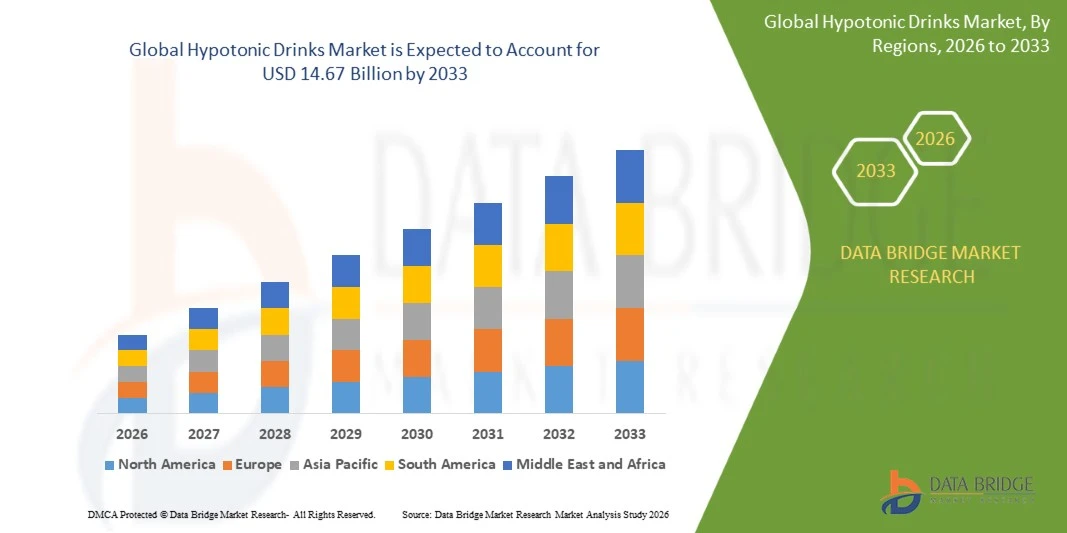
- As per Data Bridge Market Research analysis, the hypotonic drinks market was valued at USD 7.53 billion in 2025 and is projected to reach USD 14.67 billion by 2033, growing at a CAGR of 7.00% from 2026 to 2033.
- The market is expanding due to rising health and fitness awareness, increasing participation in sports and recreational activities, growing recognition of the importance of fluid and electrolyte replenishment, changing consumer lifestyles, rising demand for low-sugar and clean-label beverages, expanding middle-class populations in emerging economies, and the growing reach of supermarkets, convenience stores, and e-commerce platforms.
- Hypotonic drinks are increasingly being adopted as fast-absorbing hydration solutions across athletic, fitness, and everyday consumption occasions, supported by growing demand for rapid rehydration, reduced-sugar and natural formulations, functional ingredients, convenient formats such as powder sticks and ready-to-drink bottles, sports sponsorships, and wider availability through supermarkets, hypermarkets, convenience stores, specialty retailers, and online platforms.
Market Size & Forecast
- Global Market Value (2025): USD 7.53 billion
- Expected Market Value (2033): USD 14.67 billion
- Forecast CAGR (2026–2033): 7.00%
- Leading Region in 2025: Asia-Pacific
- Fastest Growing Region: Asia-Pacific
What Are The Major Takeaways Of The Hypotonic Drinks Market?
- Asia-Pacific dominated the global hypotonic drinks market with a share of 38.20% in 2025, supported by large consumer populations, rising disposable incomes, hot and humid climatic conditions, growing participation in sports and fitness activities, and the strong presence of established hydration beverage brands.
- Asia-Pacific is also expected to be the fastest-growing regional market at a CAGR of 8.10% from 2026 to 2033, driven by urbanization, expanding middle-class populations, growing awareness of electrolyte replenishment, and the rapid expansion of organized retail and e-commerce in China, India, and Southeast Asia.
- The sports drinks segment dominated the market by product type with a share of 42.50% in 2025, supported by strong brand recognition, athlete endorsements, sports sponsorships, and extensive retail availability.
- The electrolyte drinks segment is expected to register the fastest growth, at a CAGR of 8.20% from 2026 to 2033, driven by increasing demand for everyday hydration, reduced-sugar formulations, and functional electrolyte blends.
- The supermarkets/hypermarkets segment dominated the distribution channel category with a share of 39.40% in 2025, supported by wide product assortment, strong promotional activity, and high consumer footfall.
- The PET bottles segment dominated the packaging type category with a share of 62.50% in 2025, supported by lightweight construction, shatter resistance, portability, resealability, and cost efficiency.
- Pouches and sachets are expected to be the fastest-growing packaging format at a CAGR of 9.10% from 2026 to 2033, supported by the rising adoption of powder sticks, portability, lower transportation requirements, and compatibility with reusable bottles.
Report Scope And Hypotonic Drinks Market Segmentation
|
Attributes |
Hypotonic Drinks Key Market Insights |
|
Segments Covered |
|
|
Countries Covered |
North America
Europe
Asia-Pacific
Middle East and Africa
South America
|
|
Key Market Players |
|
|
Market Opportunities |
|
|
Value Added Data Infosets |
In addition to the insights on market scenarios such as market value, growth rate, segmentation, geographical coverage, and major players, the market reports curated by the Data Bridge Market Research also include in-depth expert analysis, pricing analysis, brand share analysis, consumer survey, demography analysis, supply chain analysis, value chain analysis, raw material/consumables overview, vendor selection criteria, PESTLE Analysis, Porter Analysis, and regulatory framework. |
What Is The Key Trend In The Hypotonic Drinks Market?
- Increasing shift toward everyday hydration beyond sports performance is becoming a major trend in the global hypotonic drinks market, as brands extend their positioning from athletes to office workers, students, and general consumers who want fluid and electrolyte replenishment in daily life. Companies are reformulating products with reduced sugar, natural colors, and cleaner ingredient lists to align with changing consumer expectations and regulatory scrutiny.
- Integration of convenient formats and functional ingredients is gaining importance as consumers look for hydration products that fit active and on-the-go lifestyles. Manufacturers are introducing functional waters, powder sticks, sparkling hydration drinks, and electrolyte blends with added functional ingredients, while powder and sachet formats are gaining traction due to portability and compatibility with reusable bottles.
- For instance, in October 2025, Coca-Cola announced Powerade Power Water, a flavored functional water with 50% more electrolytes than competitors, in four flavors. The launch was Powerade’s first product innovation in more than five years and targeted consumers beyond athletes, demonstrating the convergence of sports hydration and everyday functional water.
- Overall, the hypotonic drinks market is increasingly shaped by everyday hydration positioning, reduced-sugar and natural formulations, functional ingredients, convenient powder and sparkling formats, sustainable packaging, and omnichannel distribution. Hypotonic drink manufacturers are therefore moving toward consumer-centric product development that combines faster hydration benefits with cleaner labels, wider usage occasions, and stronger digital and modern retail presence.
What Are The Key Drivers Of The Hypotonic Drinks Market?
- Rising health consciousness, fitness participation, and awareness of dehydration risks are becoming major growth drivers in the global hypotonic drinks market, as consumers increasingly engage in running, gym training, yoga, and team sports and seek beverages that replenish fluids and electrolytes quickly. Heat waves and extreme weather events are also raising hydration awareness and extending demand beyond athletes to workers, students, and everyday consumers.
- Product innovation and expanding distribution are gaining importance as brands introduce reduced-sugar, zero-sugar, natural-color, and functional formulations across ready-to-drink and powder formats. The growth of e-commerce and direct-to-consumer sales, sports sponsorships, athlete endorsements, and rising spending power in emerging markets is further widening the consumer base.
- For instance, in July 2025, Otsuka Pharmaceutical launched its Pocari Sweat electrolyte drink in India through Otsuka Nutraceutical India Private Limited, in 350 ml and 500 ml PET bottles, citing extreme heatwaves and growing demand for beverages that support hydration during exercise and work in hot conditions.
- Overall, the hypotonic drinks market is increasingly shaped by health and fitness awareness, climate-driven hydration needs, reduced-sugar innovation, convenient formats, sports marketing, and expansion through modern retail and e-commerce channels. Hypotonic drink manufacturers are therefore moving toward broader consumer targeting, differentiated formulations, and wider geographic expansion.
What Factors Are Challenging The Growth Of The Hypotonic Drinks Market?
- Tightening regulation of sugar, sweeteners, artificial colors, and health claims is becoming a major challenge in the global hypotonic drinks market, as sugar taxes, labeling requirements, and scrutiny of ingredients increase reformulation and compliance costs. Manufacturers must maintain taste, electrolyte performance, and shelf stability while reducing sugar and removing artificial additives.
- Rising raw material, packaging, and logistics costs, together with intense competition and price pressure, are also restraining growth, as established brands, private labels, functional waters, and new electrolyte brands compete for the same consumers. Consumer skepticism about health claims and the perception of premium-priced products as expensive further limit adoption in price-sensitive markets.
- For instance, in April 2026, PepsiCo announced that Gatorade Thirst Quencher and Gatorade Zero would use colors from fruits and vegetables only from fall 2026, alongside the launch of Gatorade Lower Sugar with 75% less sugar than the classic version, reflecting the pressure on manufacturers to reformulate toward cleaner and lower-sugar products.
- Overall, the global hypotonic drinks market is increasingly shaped by regulatory pressure, reformulation requirements, input-cost volatility, and competition from alternative hydration products. Hypotonic drink manufacturers are therefore moving toward natural and low-sugar formulations, efficient sourcing, recyclable packaging, and differentiated product portfolios.
How Is The Hypotonic Drinks Market Segmented?
The global hypotonic drinks market is segmented on the basis of product type, packaging type, distribution channel, application, and end user.
- By Product Type
On the basis of product type, the global hypotonic drinks market is segmented into sports drinks, electrolyte drinks, flavored water, and others. The sports drinks segment dominated the market with a share of 42.50% in 2025, supported by strong brand recognition, athlete endorsements, sports sponsorships, and extensive retail availability.
The electrolyte drinks segment is projected to grow at a CAGR of 8.20% from 2026 to 2033, driven by increasing demand for everyday hydration, reduced-sugar formulations, and functional electrolyte blends.
- By Packaging Type
On the basis of packaging type, the global hypotonic drinks market is segmented into PET bottles, cans, glass bottles, pouches and sachets, and cartons. The PET bottles segment dominated the market with a share of 62.50% in 2025, supported by lightweight construction, shatter resistance, portability, and cost efficiency.
The pouches and sachets segment is projected to grow at a CAGR of 9.10% from 2026 to 2033, driven by the rising adoption of powder sticks, portability, lower transportation requirements, and compatibility with reusable bottles.
- By Distribution Channel
On the basis of distribution channel, the global hypotonic drinks market is segmented into supermarkets/hypermarkets, online retail, convenience stores, and others. The supermarkets/hypermarkets segment dominated the market with a share of 39.40% in 2025, supported by wide product assortment, strong promotional activity, and high consumer footfall.
The online retail segment is projected to grow at a CAGR of 9.20% from 2026 to 2033, supported by the expansion of direct-to-consumer brand websites, subscription models, marketplace platforms, and digital marketing.
- By Application
On the basis of application, the global hypotonic drinks market is segmented into athletic performance, general hydration, recovery, and others. The athletic performance segment dominated the market with a share of 41.20% in 2025, supported by consumption among athletes, sports teams, and organized sporting events.
The general hydration segment is projected to grow at a CAGR of 8.00% from 2026 to 2033, driven by rising everyday hydration awareness, hot weather conditions, and the repositioning of brands toward non-athlete consumers.
- By End User
On the basis of end user, the global hypotonic drinks market is segmented into athletes, fitness enthusiasts, general consumers, and others. The athletes segment dominated the market with a share of 38.90% in 2025, supported by sports sponsorships, professional endorsements, and performance-focused product positioning.
The fitness enthusiasts segment is projected to grow at a CAGR of 8.30% from 2026 to 2033, driven by the growing number of gym members, recreational runners, and participants in yoga and group fitness activities.
Which Region Holds The Largest Share Of The Hypotonic Drinks Market?
- Asia-Pacific accounted for the largest share of the global hypotonic drinks market, with a revenue share of 38.20% in 2025, supported by large consumer populations, rising disposable incomes, hot and humid climatic conditions, increasing participation in sports and fitness activities, and growing demand for beverages that support rapid hydration and electrolyte replenishment.
- Japan represents a mature market with established demand for functional hydration beverages, while China and India are emerging as key growth contributors, driven by expanding organized retail, e-commerce penetration, rising health awareness, and the growing availability of hypotonic drinks through diverse distribution channels.
Asia-Pacific Hypotonic Drinks Market Insight
Asia-Pacific is projected to be the fastest-growing region in the global hypotonic drinks market. The regional market is supported by rapid urbanization, rising disposable incomes, expanding middle-class populations, growing participation in sports and fitness activities, and increasing awareness of fluid and electrolyte replenishment in hot and humid conditions. Growing retail modernization, e-commerce penetration, and the expansion of international and local hydration brands are expected to further support regional growth.
China Hypotonic Drinks Market Insight
The China hypotonic drinks market is expected to witness steady expansion, supported by rising fitness participation, growing awareness of sports nutrition, expansion of modern retail, and the strong reach of online platforms. Increasing demand for electrolyte drinks, reduced-sugar formulations, and functional beverages is expected to encourage product innovation and support adoption among young and urban consumers.
India Hypotonic Drinks Market Insight
The India hypotonic drinks market is supported by hot climatic conditions, rising health and fitness awareness, growing urban populations, and expanding organized retail and e-commerce. International brands are increasing their presence, as seen in Otsuka’s July 2025 launch of Pocari Sweat in 350 ml and 500 ml PET bottles through its Mumbai-based subsidiary. Growing awareness of electrolyte replenishment during exercise and work in hot conditions is expected to support market growth.
Japan Hypotonic Drinks Market Insight
The Japan hypotonic drinks market is a mature market supported by high consumer familiarity with ion-supply and electrolyte beverages, strong convenience store and vending machine distribution, and sophisticated demand for functional products. Brands are focusing on convenient formats, as seen in Otsuka’s July 2026 launch of Pocari Sweat Ion Water powder sticks that make 500 ml of drink and suit reusable bottles, supporting everyday hydration beyond exercise occasions.
U.S. Hypotonic Drinks Market Insight
The U.S. hypotonic drinks market dominates North American consumption and is characterized by intense competition among established sports drink brands and new functional hydration entrants. Companies are expanding beyond athletes toward everyday hydration through reduced-sugar, natural-color, and functional water products, such as Gatorade Lower Sugar, Powerade Power Water, and Bodyarmor Fit. Rising heat-related health awareness, supported by initiatives such as Otsuka America’s heat illness prevention guidance, is also expected to support demand.
Germany Hypotonic Drinks Market Insight
The Germany hypotonic drinks market is supported by strong participation in fitness and sports activities and by health-conscious consumers who expect transparent ingredient sourcing. Demand for reduced-sugar, natural, and functional hydration products is increasing, while well-developed supermarket and discount retail networks and growing e-commerce support market accessibility. Sustainability expectations and private-label competition are expected to influence product and packaging strategies.
U.K. Hypotonic Drinks Market Insight
The U.K. hypotonic drinks market is supported by strong sports culture, particularly football, and by the established presence of local sports drink brands such as Lucozade Sport, which differs from the market leadership of Gatorade in North America. Demand for reduced-sugar and natural formulations is increasing in response to sugar-reduction policies and health awareness, while supermarkets, convenience stores, and online channels remain the key distribution points.
Which Are The Top Companies In The Hypotonic Drinks Market?
The hypotonic drinks industry is primarily led by well-established companies, including:
- PepsiCo, Inc. (U.S.)
- The Coca-Cola Company (U.S.)
- Otsuka Pharmaceutical Co., Ltd. (Japan)
- Suntory Holdings Limited (Japan)
- Abbott Laboratories (U.S.)
- Keurig Dr Pepper Inc. (U.S.)
- Monster Beverage Corporation (U.S.)
- Red Bull GmbH (Austria)
- Danone S.A. (France)
- Nestlé S.A. (Switzerland)
- Unilever PLC (U.K.)
- Cargill, Incorporated (U.S.)
- DyDo Group Holdings, Inc. (Japan)
- Celsius Holdings, Inc. (U.S.)
- Yakult Honsha Co., Ltd. (Japan)
What Are Latest Developments In Hypotonic Drinks Market?
- In July 2025, Otsuka Pharmaceutical launched sales of Pocari Sweat in India through Otsuka Nutraceutical India Private Limited, with 350 ml and 500 ml PET bottles supplied by its Indonesian subsidiary PT Amerta Indah Otsuka. The launch aims to raise awareness of fluid and electrolyte intake in hot climatic conditions.
- In October 2025, Coca-Cola announced Powerade Power Water, a flavored functional water with 50% more electrolytes than competitors, in four flavors. It was Powerade’s first product innovation in more than five years, with a regional retail rollout starting in October 2025 and nationwide availability in stores and on Amazon in 2026.
- In April 2026, PepsiCo announced a Gatorade refresh focused on everyday hydration, including Gatorade Lower Sugar with 75% less sugar than the classic version, colors derived only from fruits and vegetables for Gatorade Thirst Quencher and Gatorade Zero from fall 2026, and the upcoming Gatorlyte Longer Lasting with a proprietary electrolyte blend.
- In June 2026, Coca-Cola’s Bodyarmor launched Bodyarmor Fit, its first sparkling sports drink, in a 12-ounce slim can with 290 mg of electrolytes, 60 mg of naturally sourced caffeine, and no sugar, available in five flavors and positioned for daily use beyond workouts.
- In July 2026, Otsuka launched Pocari Sweat Ion Water powder stick packets in Japan, with each 14.5 g stick making 500 ml of drink, designed for convenient water and ion replenishment in daily situations and for use with reusable bottles.
- Interactive Data Analysis Dashboard
- Company Analysis Dashboard for high growth potential opportunities
- Research Analyst Access for customization & queries
- Competitor Analysis with Interactive dashboard
- Latest News, Updates & Trend analysis
- Harness the Power of Benchmark Analysis for Comprehensive Competitor Tracking
Global Hypotonic Drinks Market, Supply Chain Analysis and Ecosystem Framework
To support market growth and help clients navigate the impact of geopolitical shifts, DBMR has integrated in-depth supply chain analysis into its Global Hypotonic Drinks Market research reports. This addition empowers clients to respond effectively to global changes affecting their industries. The supply chain analysis section includes detailed insights such as Global Hypotonic Drinks Market consumption and production by country, price trend analysis, the impact of tariffs and geopolitical developments, and import and export trends by country and HSN code. It also highlights major suppliers with data on production capacity and company profiles, as well as key importers and exporters. In addition to research, DBMR offers specialized supply chain consulting services backed by over a decade of experience, providing solutions like supplier discovery, supplier risk assessment, price trend analysis, impact evaluation of inflation and trade route changes, and comprehensive market trend analysis.
Data collection and base year analysis are done using data collection modules with large sample sizes. The stage includes obtaining market information or related data through various sources and strategies. It includes examining and planning all the data acquired from the past in advance. It likewise envelops the examination of information inconsistencies seen across different information sources. The market data is analysed and estimated using market statistical and coherent models. Also, market share analysis and key trend analysis are the major success factors in the market report. To know more, please request an analyst call or drop down your inquiry.
The key research methodology used by DBMR research team is data triangulation which involves data mining, analysis of the impact of data variables on the market and primary (industry expert) validation. Data models include Vendor Positioning Grid, Market Time Line Analysis, Market Overview and Guide, Company Positioning Grid, Patent Analysis, Pricing Analysis, Company Market Share Analysis, Standards of Measurement, Global versus Regional and Vendor Share Analysis. To know more about the research methodology, drop in an inquiry to speak to our industry experts.
Data Bridge Market Research is a leader in advanced formative research. We take pride in servicing our existing and new customers with data and analysis that match and suits their goal. The report can be customized to include price trend analysis of target brands understanding the market for additional countries (ask for the list of countries), clinical trial results data, literature review, refurbished market and product base analysis. Market analysis of target competitors can be analyzed from technology-based analysis to market portfolio strategies. We can add as many competitors that you require data about in the format and data style you are looking for. Our team of analysts can also provide you data in crude raw excel files pivot tables (Fact book) or can assist you in creating presentations from the data sets available in the report.