


Integrated Circuit (IC) Temperature Sensor Market Overview
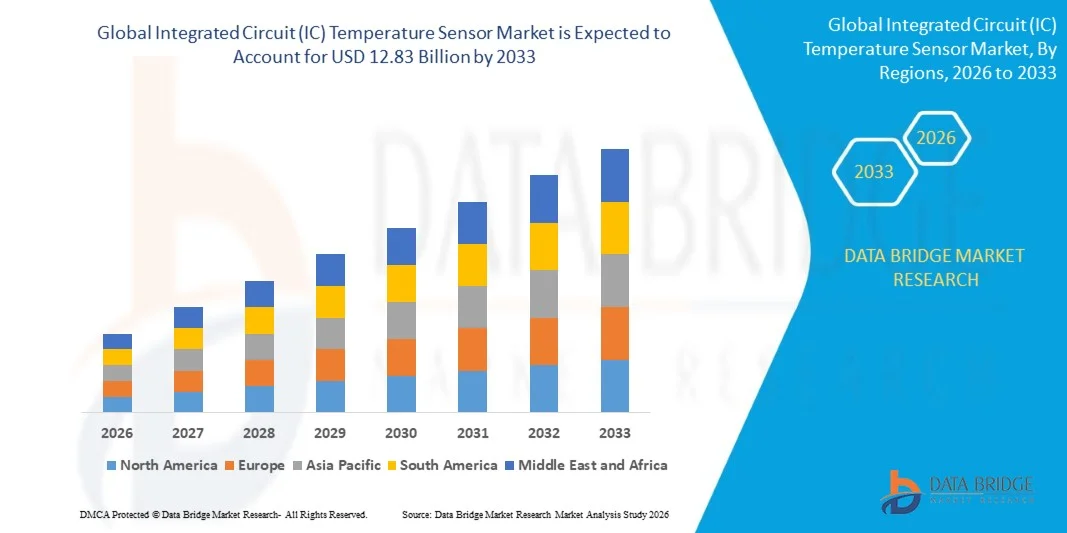
As per Data Bridge Market Research analysis the global integrated circuit (IC) temperature sensor market was valued at USD 8.05 billion in 2025 and is projected to reach USD 12.83 billion by 2033, growing at a CAGR of 6.00% from 2026 to 2033. The Integrated Circuit (IC) Temperature Sensor market is experiencing steady growth driven by increasing demand for precise temperature monitoring in consumer electronics, automotive systems, industrial automation, and healthcare devices, along with the rapid adoption of IoT-enabled and connected electronic systems.
The growing integration of electronic components with higher power densities, combined with increasing demand for energy-efficient thermal management and reliable system performance, is accelerating the adoption of IC temperature sensors across multiple industries. Manufacturers are increasingly incorporating digital and analog IC temperature sensors into smartphones, wearables, electric vehicles, battery management systems, data centers, industrial equipment, and medical devices to enable real-time temperature monitoring, prevent overheating, improve operational reliability, and optimize energy efficiency. Furthermore, continuous advancements in semiconductor technology, miniaturization of electronic devices, and the expanding deployment of AI, 5G infrastructure, and electric vehicles are creating significant growth opportunities for the Integrated Circuit (IC) Temperature Sensor market.
Market Size & Forecast
- Market Value (2025): USD 8.05 Billion
- Expected Market Value (2033): USD 12.83 Billion
- Forecast CAGR (2026–2033): 6.00%
- Leading Region in 2025: North America
- Fastest Growing Region: Asia-Pacific
Key Market Trends & Insights
- North America dominated the global integrated circuit (IC) temperature Sensor market with an estimated revenue share of 37.86% in 2025, supported by the strong presence of leading semiconductor companies, increasing adoption of IC temperature sensors in automotive and industrial automation, and rising investments in AI, data centers, and advanced electronics.
- The wired segment dominated the market with an estimated 68.37% share in 2025, owing to its superior reliability, high measurement accuracy, and widespread adoption across industrial automation, automotive electronics, consumer electronics, healthcare equipment, and energy infrastructure.
- Asia-Pacific is expected to be the fastest-growing region at an estimated CAGR of 7.8% from 2026 to 2033, fueled by expanding semiconductor fabrication capacity, increasing consumer electronics manufacturing, rapid electric vehicle production, and rising investments in industrial automation across China, Japan, South Korea, and India.
- The automotive segment is projected to register the fastest growth at an estimated CAGR of 8.8% from 2026 to 2033, driven by the increasing production of electric vehicles, hybrid vehicles, and software-defined vehicles requiring advanced thermal management.
- The platinum segment is expected to witness the fastest growth at an estimated CAGR of 8.0% from 2026 to 2033, driven by increasing demand for highly accurate and stable temperature measurement across aerospace, healthcare, precision manufacturing, laboratory instrumentation, and advanced industrial applications
Report Scope and Integrated Circuit (IC) Temperature Sensor Market Segmentation
|
Attributes |
Integrated Circuit (IC) Temperature Sensor Key Market Insights |
|
Segments Covered |
|
|
Countries Covered |
North America
Europe
Asia-Pacific
Middle East and Africa
South America
|
|
Key Market Players |
|
|
Market Opportunities |
|
|
Value Added Data Infosets |
In addition to the insights on market scenarios such as market value, growth rate, segmentation, geographical coverage, and major players, the market reports curated by the Data Bridge Market Research also include in-depth expert analysis, geographically represented company-wise production and capacity, network layouts of distributors and partners, detailed and updated price trend analysis and deficit analysis of supply chain and demand. |
Integrated Circuit (IC) Temperature Sensor Market Trends
Trend: Increasing Adoption of Digital Temperature Sensors for AI, Automotive, and Industrial Electronics
The demand for digital Integrated Circuit (IC) temperature sensors is increasing rapidly as automotive, industrial automation, data center, and consumer electronics manufacturers seek highly accurate, low-power, and compact thermal monitoring solutions. Modern IC temperature sensors are increasingly integrated with processors, power management ICs, battery management systems (BMS), and AI computing hardware to enable real-time thermal monitoring, predictive maintenance, and energy-efficient system operation. Growing deployment of electric vehicles, AI servers, IoT devices, and industrial automation equipment is further accelerating the adoption of digital temperature sensing technologies. For instance, in March 2024, Texas Instruments introduced the TMP18-Q1, an automotive-grade one-wire digital temperature sensor designed for EV battery packs and high-voltage automotive systems. The device improves thermal monitoring accuracy while reducing wiring complexity and system costs, reflecting the industry's shift toward highly integrated and intelligent temperature sensing solutions. The growing adoption of AI-enabled electronics, electric vehicles, industrial automation, and smart connected devices is accelerating the transition toward compact, high-accuracy digital IC temperature sensors, making intelligent thermal monitoring a fundamental requirement for next-generation electronic systems.
Integrated Circuit (IC) Temperature Sensor Market Dynamics
Key Market Driver: Rising Demand for Thermal Monitoring in Electric Vehicles, AI Computing, and Industrial Automation
The rapid growth of electric vehicles, artificial intelligence infrastructure, industrial automation, and high-performance computing has significantly increased the demand for accurate IC temperature sensors. These sensors enable continuous monitoring of batteries, processors, power electronics, and industrial equipment, preventing overheating, improving energy efficiency, extending component lifespan, and ensuring reliable system performance. Increasing semiconductor integration and stringent reliability requirements continue to drive the adoption of advanced digital temperature sensing technologies across multiple industries. For instance, in November 2023, Analog Devices, Inc. introduced the MAX31889, an ultra-high-accuracy digital temperature sensor designed for precision industrial, healthcare, and instrumentation applications, delivering measurement accuracy of up to ±0.25°C while minimizing power consumption. The increasing need for precise thermal monitoring across electric vehicles, AI processors, industrial automation systems, healthcare devices, and advanced electronics will continue to drive strong demand for high-performance IC temperature sensors, making thermal sensing a critical component of modern electronic system design.
Key Restraint/Challenge: Design Complexity and Cost of High-Precision Temperature Sensing Solutions
Although IC temperature sensors are becoming increasingly compact and energy efficient, achieving high measurement accuracy, long-term stability, functional safety, and automotive-grade reliability requires sophisticated semiconductor design, precision calibration, and rigorous qualification testing. These engineering requirements increase product development costs and extend time-to-market, particularly for applications requiring compliance with automotive and industrial safety standards. For instance, Microchip Technology Inc. states that its automotive-grade temperature sensors undergo extensive qualification and calibration to meet AEC-Q100 reliability requirements, highlighting the engineering complexity associated with high-precision thermal sensing devices. The need to balance measurement accuracy, reliability, functional safety, and cost-effective manufacturing continues to increase engineering complexity, making product development and qualification one of the primary challenges for IC temperature sensor manufacturers.
Key Market Opportunity: Expansion of Thermal Management in Electric Vehicles and AI Data Centers
The rapid expansion of electric vehicles, AI servers, cloud computing infrastructure, and advanced battery systems is creating substantial opportunities for IC temperature sensor manufacturers. High-accuracy digital temperature sensors are increasingly deployed to monitor battery cells, CPUs, GPUs, power modules, memory devices, and thermal management systems, enabling predictive maintenance, efficient cooling, and improved system reliability. As AI workloads and EV production continue to grow, demand for intelligent thermal sensing technologies is expected to accelerate significantly. For instance, in August 2024, Texas Instruments announced plans to receive up to USD 1.6 billion under the U.S. CHIPS and Science Act to expand semiconductor manufacturing capacity in Texas and Utah. The investment is expected to strengthen the production of analog and embedded processing semiconductors used across automotive, industrial, and thermal management applications, supporting the growing demand for advanced temperature sensing solutions. The rapid expansion of electric mobility, AI computing, advanced semiconductor devices, and intelligent industrial systems is creating significant long-term opportunities for IC temperature sensor manufacturers to develop innovative, high-precision, low-power, and automotive-grade thermal monitoring solutions.
Integrated Circuit (IC) Temperature Sensor Market Scope
The integrated circuit (IC) temperature sensor market is segmented on the basis of output, alloy used, deployment, metals, and end user.
- By Output
On the basis of output, the global integrated circuit (IC) temperature sensor market is segmented into analog and digital. The digital segment dominated the market with an estimated 64.82% share in 2025, owing to its superior accuracy, ease of integration with microcontrollers, and increasing deployment across consumer electronics, automotive systems, industrial automation, and healthcare devices. Digital IC temperature sensors provide calibrated temperature measurements, minimizing the need for external signal conditioning and reducing overall system complexity. Their compatibility with I²C, SPI, and SMBus communication protocols makes them highly suitable for modern electronic designs. The growing adoption of IoT-enabled devices, AI-based computing systems, and battery management systems is further accelerating demand for digital sensors. In automotive applications, digital sensors enable precise thermal monitoring of electric powertrains, battery packs, and electronic control units, enhancing operational reliability and safety. Furthermore, increasing semiconductor miniaturization and the integration of smart sensing technologies continue to strengthen the dominance of the digital segment within the integrated circuit (IC) temperature sensor market.
The analog segment is projected to register the fastest growth at an estimated CAGR of 8.1% from 2026 to 2033, driven by increasing demand for low-power, cost-effective temperature sensing solutions across industrial equipment, consumer appliances, and portable electronics. Analog IC temperature sensors offer rapid response times, simple circuit integration, and low latency, making them ideal for applications requiring continuous real-time thermal monitoring. Their widespread use in HVAC systems, power supplies, industrial machinery, and wearable devices continues to support market expansion. Advancements in analog semiconductor technology are improving measurement accuracy while reducing power consumption and package size. Growing investments in industrial automation and smart manufacturing are expected to further increase demand. Additionally, the expansion of emerging electronics markets in Asia-Pacific is anticipated to accelerate adoption throughout the forecast period.
- By Alloy Used
On the basis of alloy used, the global integrated circuit (IC) temperature sensor market is segmented into Type K, Type M, Type E, Type J, Type C, Type N, Type T, and others. The Type K segment dominated the market with an estimated 38.74% share in 2025, owing to its wide operating temperature range, high durability, cost-effectiveness, and extensive use across industrial process control, manufacturing, automotive testing, aerospace, and energy applications. Type K alloys offer excellent oxidation resistance and reliable thermal performance under demanding operating environments, making them the preferred choice for temperature sensing systems integrated with industrial electronics. Increasing demand for accurate thermal monitoring in process industries, semiconductor manufacturing, and power generation continues to drive segment growth. Their compatibility with digital signal conditioning circuits and industrial control systems further supports widespread adoption. Continuous industrial modernization and expansion of manufacturing facilities across emerging economies are reinforcing the leading position of the Type K segment in the integrated circuit (IC) temperature sensor market.
The Type N segment is expected to witness the fastest growth at an estimated CAGR of 7.9% from 2026 to 2033, driven by its superior long-term stability, improved resistance to oxidation, and excellent performance under high-temperature operating conditions. Industries requiring highly reliable temperature measurements, including aerospace, advanced manufacturing, petrochemicals, and power generation, are increasingly adopting Type N sensing technologies. Technological advancements in precision thermal monitoring and industrial automation are further supporting segment expansion. Growing investments in Industry 4.0, predictive maintenance, and intelligent manufacturing systems are expected to increase demand for highly stable temperature sensing materials. In addition, rising deployment of advanced thermal monitoring systems across critical industrial applications is anticipated to accelerate the growth of the Type N segment during the forecast period.
- By Deployment
On the basis of deployment, the global integrated circuit (IC) temperature sensor market is segmented into wired and wireless. The wired segment dominated the market with an estimated 68.37% share in 2025, owing to its superior reliability, high measurement accuracy, and widespread adoption across industrial automation, automotive electronics, consumer electronics, healthcare equipment, and energy infrastructure. Wired IC temperature sensors provide stable and uninterrupted data transmission with minimal signal interference, making them highly suitable for mission-critical applications requiring continuous temperature monitoring. Their seamless integration with industrial control systems, programmable logic controllers (PLCs), embedded processors, and electronic control units (ECUs) has further strengthened market demand. In addition, wired deployment offers lower latency, enhanced cybersecurity, and long-term operational stability compared to wireless alternatives, making it the preferred choice for manufacturing facilities and industrial plants. Increasing investments in factory automation, semiconductor manufacturing, and smart industrial equipment continue to support the widespread adoption of wired temperature sensing solutions. Furthermore, the growing demand for accurate thermal management in electric vehicles, medical devices, and high-performance computing systems reinforces the segment's leadership in the integrated circuit (IC) temperature sensor market.
The wireless segment is projected to register the fastest growth at an estimated CAGR of 8.6% from 2026 to 2033, driven by the rapid adoption of Industrial IoT, smart buildings, connected healthcare devices, and remote asset monitoring solutions. Wireless IC temperature sensors enable real-time temperature monitoring without extensive cabling, reducing installation costs and increasing deployment flexibility across distributed environments. Advancements in Bluetooth Low Energy (BLE), Zigbee, Wi-Fi, LoRaWAN, and 5G connectivity are improving communication reliability and battery efficiency, further accelerating market adoption. Growing demand for predictive maintenance, cloud-based monitoring platforms, and intelligent manufacturing is encouraging industries to transition toward wireless sensing technologies. In addition, increasing deployment of battery-powered IoT devices and smart consumer electronics is expected to create significant growth opportunities. Rising investments in digital transformation initiatives and connected industrial ecosystems are anticipated to further strengthen segment growth throughout the forecast period.
- By Metals
On the basis of metals, the global integrated circuit (IC) temperature sensor market is segmented into platinum, nickel, copper, tungsten, and silicon. The silicon segment dominated the market with an estimated 49.26% share in 2025, owing to its extensive use in semiconductor-based temperature sensing integrated circuits across consumer electronics, automotive systems, industrial equipment, telecommunications, and healthcare devices. Silicon-based IC temperature sensors offer excellent linearity, high sensitivity, compact size, low power consumption, and seamless integration into semiconductor manufacturing processes. Their compatibility with CMOS fabrication technologies enables cost-effective mass production while maintaining high accuracy and long-term reliability. Increasing demand for smartphones, wearable electronics, electric vehicles, battery management systems, and AI processors continues to drive widespread adoption of silicon-based sensing technologies. Furthermore, continuous advancements in semiconductor process technologies and chip miniaturization are enabling the development of highly accurate and energy-efficient temperature sensing solutions. The growing deployment of smart connected devices and edge computing platforms further reinforces the dominance of the silicon segment within the integrated circuit (IC) temperature sensor market.
The platinum segment is expected to witness the fastest growth at an estimated CAGR of 8.0% from 2026 to 2033, driven by increasing demand for highly accurate and stable temperature measurement across aerospace, healthcare, precision manufacturing, laboratory instrumentation, and advanced industrial applications. Platinum-based sensing materials offer exceptional long-term stability, corrosion resistance, and measurement precision across wide operating temperature ranges, making them suitable for critical applications where high reliability is essential. Growing investments in pharmaceutical manufacturing, scientific research, and industrial process automation are accelerating adoption of platinum-based sensing technologies. In addition, expanding use of high-performance sensing systems in aerospace engines, renewable energy facilities, and semiconductor fabrication plants is supporting market growth. Continuous technological advancements in precision sensing devices and increasing emphasis on industrial quality control are expected to further strengthen demand for platinum-based IC temperature sensing solutions during the forecast period.
- By End User
On the basis of end user, the global integrated circuit (IC) temperature sensor market is segmented into chemicals, oil and gas, consumer electronics, energy and power, healthcare, automotive, metals and mining, food and beverages, pulp and paper, advanced fuel, aerospace and defence, glass, and others. The consumer electronics segment dominated the market with an estimated 29.74% share in 2025, owing to the widespread integration of integrated circuit (IC) temperature sensors across smartphones, laptops, tablets, wearable devices, gaming consoles, smart home products, and data storage systems. As electronic devices continue to become smaller and more powerful, efficient thermal management has become essential to prevent overheating, improve battery performance, and extend product lifespan. Digital IC temperature sensors are increasingly incorporated into processors, batteries, displays, and power management integrated circuits (PMICs) to enable real-time thermal monitoring and intelligent power optimization. The rapid adoption of AI-enabled consumer devices, 5G smartphones, and IoT-connected electronics has further accelerated demand for highly accurate and compact temperature sensing solutions. Continuous advancements in semiconductor technology and increasing production of smart electronic devices across Asia-Pacific continue to reinforce the leadership of the consumer electronics segment within the integrated circuit (IC) temperature sensor market. Furthermore, growing investments in next-generation wearable technologies and edge computing devices are expected to sustain long-term segment dominance.
The automotive segment is projected to register the fastest growth at an estimated CAGR of 8.8% from 2026 to 2033, driven by the increasing production of electric vehicles, hybrid vehicles, and software-defined vehicles requiring advanced thermal management. Automotive manufacturers are integrating IC temperature sensors into battery management systems, electric motors, inverters, onboard chargers, engine control units, transmission systems, and advanced driver assistance systems (ADAS) to continuously monitor operating temperatures and enhance vehicle safety. Growing concerns regarding battery thermal runaway, power electronics reliability, and charging efficiency are significantly increasing the adoption of high-precision temperature sensing technologies. Additionally, stringent vehicle emission regulations and rising demand for fuel-efficient and electrified vehicles are encouraging OEMs to deploy intelligent thermal management solutions throughout modern vehicle architectures. Technological advancements in semiconductor packaging, miniaturized digital sensors, and high-reliability automotive-grade integrated circuits are further supporting market expansion. Increasing investments in autonomous driving technologies and connected vehicles are expected to create substantial growth opportunities for the automotive segment during the forecast period.
Integrated Circuit (IC) Temperature Sensor Market Regional Analysis
North America dominated the integrated circuit (IC) temperature sensor market and accounted for the largest revenue share of 37.86% in 2025, supported by the strong presence of leading semiconductor manufacturers, increasing adoption of integrated circuit (IC) temperature sensors in automotive electronics, industrial automation, healthcare devices, and consumer electronics, along with rising investments in artificial intelligence (AI), cloud computing, and data center infrastructure. The region also benefits from continuous technological innovation, increasing deployment of electric vehicles, and growing demand for precise thermal monitoring solutions across advanced electronic systems. The expanding use of integrated circuit (IC) temperature sensors in battery management systems, processors, and industrial equipment continues to strengthen North America's leadership position in the global market.
U.S. Integrated Circuit (IC) Temperature Sensor Market Insight
The U.S. integrated circuit (IC) temperature sensor market is witnessing robust growth due to increasing investments in semiconductor manufacturing, AI infrastructure, electric vehicles, industrial automation, and advanced healthcare technologies. The country's strong ecosystem of semiconductor companies and electronics manufacturers is driving the adoption of integrated circuit(IC) temperature sensors for thermal management in processors, battery systems, medical equipment, and industrial machinery. Furthermore, growing investments in hyperscale data centers, smart manufacturing, and next-generation automotive technologies continue to accelerate growth in the integrated circuit (IC) temperature sensor market across the United States.
Europe Integrated Circuit (IC) Temperature Sensor Market Insight
The Europe integrated circuit (IC) temperature sensor market remains a significant contributor to global revenue, driven by strong demand for integrated circuit (IC) temperature sensors across the automotive, industrial automation, renewable energy, and medical device sectors. Increasing adoption of Industry 4.0 technologies, stringent energy efficiency regulations, and the growing deployment of electric vehicles are supporting demand for high-precision temperature sensing solutions. Continuous investments in semiconductor innovation and smart manufacturing technologies are further strengthening growth in the integrated circuit (IC) temperature sensor market across Europe.
U.K. Integrated Circuit (IC) Temperature Sensor Market Insight
The U.K. integrated circuit (IC) temperature sensor market is experiencing steady growth, supported by increasing investments in semiconductor research, medical technologies, industrial automation, and smart infrastructure. Growing adoption of AI-enabled computing systems, IoT devices, and advanced manufacturing technologies is creating sustained demand for integrated circuit (IC) temperature sensors used in thermal monitoring applications. In addition, government support for semiconductor innovation and digital transformation initiatives continues to contribute to the expansion of the integrated circuit (IC) temperature sensor market.
Germany Integrated Circuit (IC) Temperature Sensor Market Insight
The Germany integrated circuit (IC) temperature sensor market is expanding steadily due to the country's strong automotive manufacturing base, advanced industrial automation sector, and leadership in precision engineering. Automotive OEMs and industrial equipment manufacturers are increasingly integrating integrated circuit (IC) temperature sensors into electric vehicles, battery management systems, factory automation equipment, and power electronics to improve safety, efficiency, and operational reliability. Continuous investments in smart manufacturing and semiconductor technologies further support the growth of the integrated circuit (IC) temperature sensor market in Germany.
Asia-Pacific Integrated Circuit (IC) Temperature Sensor Market Insight
The Asia-Pacific integrated circuit (IC) temperature sensor market is expected to witness the fastest growth, registering an estimated CAGR of 7.8% from 2026 to 2033, driven by expanding semiconductor fabrication capacity, increasing consumer electronics manufacturing, rapid electric vehicle production, and rising investments in industrial automation across China, Japan, South Korea, and India. The region's dominance in electronics manufacturing, coupled with increasing adoption of IoT devices, AI-enabled hardware, and smart appliances, continues to create strong demand for integrated circuit (IC) temperature sensors, accelerating the growth of the integrated circuit (IC) temperature sensor market.
Japan Integrated Circuit (IC) Temperature Sensor Market Insight
The Japan integrated circuit (IC) temperature sensor market is witnessing consistent growth due to its well-established semiconductor industry, strong automotive manufacturing capabilities, and increasing investments in robotics, industrial automation, and electric mobility. Growing adoption of integrated circuit (IC) temperature sensors in automotive electronics, consumer devices, factory automation, and medical equipment is supporting market expansion. Continuous innovation in semiconductor technologies further strengthens the integrated circuit (IC) temperature sensor market in Japan.
China Integrated Circuit (IC) Temperature Sensor Market Insight
The China integrated circuit (IC) temperature sensor market is growing rapidly, driven by expanding semiconductor manufacturing capacity, increasing production of consumer electronics, rapid growth of electric vehicles, and government initiatives supporting domestic semiconductor development. Rising investments in AI infrastructure, industrial automation, data centers, and smart manufacturing are significantly increasing demand for integrated circuit (IC) temperature sensors. The country's strong electronics manufacturing ecosystem and continuous technological advancements position the integrated circuit (IC) temperature sensor market in China as one of the fastest-growing globally.
Integrated Circuit (IC) Temperature Sensor Market Share
The integrated circuit (IC) temperature sensor industry is primarily led by well-established companies, including:
- Texas Instruments Incorporated (U.S.)
- Analog Devices, Inc. (U.S.)
- Microchip Technology Inc. (U.S.)
- NXP Semiconductors (Netherlands)
- Infineon Technologies AG (Germany)
- STMicroelectronics (Switzerland)
- Renesas Electronics Corporation (Japan)
- TE Connectivity (Switzerland)
- Amphenol Corporation (U.S.)
- Semiconductor Components Industries, LLC (U.S.)
- ROHM Co., Ltd. (Japan)
- Murata Manufacturing Co., Ltd. (Japan)
- TDK Corporation (Japan)
- Honeywell International Inc. (U.S.)
- Omron Corporation (Japan)
- Semitec Corporation (Japan)
Latest Developments in Integrated Circuit (IC) Temperature Sensor Market
- In August 2024, Renesas Electronics Corporation announced the launch of the RRH62000 ultra-compact environmental sensor module for smart air quality monitoring. The module integrates seven sensing functions, including temperature sensing, along with AI processing capabilities, enabling high-accuracy environmental monitoring for smart buildings, homes, schools, and industrial IoT applications
- In December 2024, Texas Instruments released the TMP118 ultra-small, high-accuracy digital IC temperature sensor. The device provides up to ±0.1°C accuracy, an I²C/SMBus-compatible interface, NIST traceability, and ultra-low power consumption, making it suitable for industrial, medical, and consumer electronics applications

- Interactive Data Analysis Dashboard
- Company Analysis Dashboard for high growth potential opportunities
- Research Analyst Access for customization & queries
- Competitor Analysis with Interactive dashboard
- Latest News, Updates & Trend analysis
- Harness the Power of Benchmark Analysis for Comprehensive Competitor Tracking
Global Ic Temperature Sensor Market, Supply Chain Analysis and Ecosystem Framework
To support market growth and help clients navigate the impact of geopolitical shifts, DBMR has integrated in-depth supply chain analysis into its Global Ic Temperature Sensor Market research reports. This addition empowers clients to respond effectively to global changes affecting their industries. The supply chain analysis section includes detailed insights such as Global Ic Temperature Sensor Market consumption and production by country, price trend analysis, the impact of tariffs and geopolitical developments, and import and export trends by country and HSN code. It also highlights major suppliers with data on production capacity and company profiles, as well as key importers and exporters. In addition to research, DBMR offers specialized supply chain consulting services backed by over a decade of experience, providing solutions like supplier discovery, supplier risk assessment, price trend analysis, impact evaluation of inflation and trade route changes, and comprehensive market trend analysis.
Data collection and base year analysis are done using data collection modules with large sample sizes. The stage includes obtaining market information or related data through various sources and strategies. It includes examining and planning all the data acquired from the past in advance. It likewise envelops the examination of information inconsistencies seen across different information sources. The market data is analysed and estimated using market statistical and coherent models. Also, market share analysis and key trend analysis are the major success factors in the market report. To know more, please request an analyst call or drop down your inquiry.
The key research methodology used by DBMR research team is data triangulation which involves data mining, analysis of the impact of data variables on the market and primary (industry expert) validation. Data models include Vendor Positioning Grid, Market Time Line Analysis, Market Overview and Guide, Company Positioning Grid, Patent Analysis, Pricing Analysis, Company Market Share Analysis, Standards of Measurement, Global versus Regional and Vendor Share Analysis. To know more about the research methodology, drop in an inquiry to speak to our industry experts.
Data Bridge Market Research is a leader in advanced formative research. We take pride in servicing our existing and new customers with data and analysis that match and suits their goal. The report can be customized to include price trend analysis of target brands understanding the market for additional countries (ask for the list of countries), clinical trial results data, literature review, refurbished market and product base analysis. Market analysis of target competitors can be analyzed from technology-based analysis to market portfolio strategies. We can add as many competitors that you require data about in the format and data style you are looking for. Our team of analysts can also provide you data in crude raw excel files pivot tables (Fact book) or can assist you in creating presentations from the data sets available in the report.













