What is the Ice Hockey Equipment Market Size and Growth Rate?
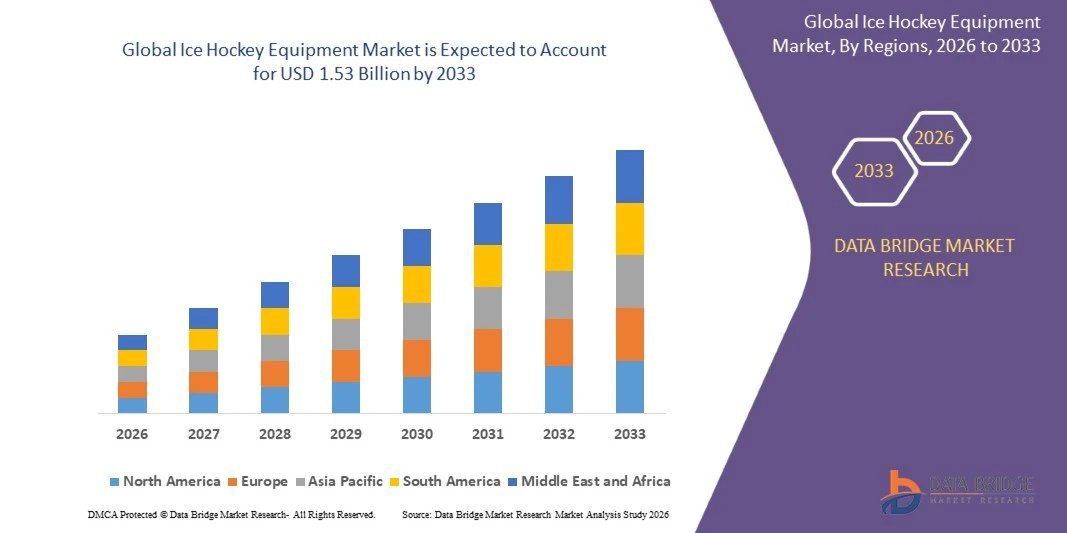
- As per Data Bridge Market Research analysis, the ice hockey equipment market was valued at USD 1.07 billion in 2025 and is projected to reach USD 1.53 billion by 2033, growing at a CAGR of 4.60% from 2026 to 2033.
- The market is experiencing consistent growth driven by rising participation in professional and recreational ice hockey, advancements in lightweight equipment materials, and increasing demand for high-performance protective gear, sticks, and skates.
- The growing emphasis on player safety, combined with expanding youth hockey programs and organized leagues, is encouraging players, clubs, and training institutions to invest in modern ice hockey equipment. Lightweight composite sticks, improved protective gear, and the increasing availability of products through online retail channels are further supporting market growth.
Market Size & Forecast
- Global Market Value (2025): USD 1.07 Billion
- Expected Market Value (2033): USD 1.53 Billion
- Forecast CAGR (2026–2033): 4.60%
- Leading Region in 2025: North America
- Fastest Growing Region: Asia Pacific
What are the Major Takeaways of the Ice Hockey Equipment Market?
- North America dominated the ice hockey equipment market with the largest revenue share of 43.3% in 2025, supported by established professional leagues, extensive ice rink infrastructure, and strong participation in the U.S. and Canada.
- Asia-Pacific is expected to be the fastest-growing region at a CAGR of 6.80% from 2026 to 2033, fueled by investments in winter sports infrastructure, expanding ice hockey training facilities, and rising participation in China and Japan.
- The protective wear segment led the market with a 52.22% share in 2025, driven by increasing awareness of player safety and the need to reduce injuries during high-speed gameplay.
- Sticks are the fastest-growing product type, projected to register a CAGR of 6.6%, reflecting the surge in demand for lightweight, durable, and high-performance equipment.
- The carbon fiber and composite materials segment dominated the material category with a 35% revenue share in 2025, led by demand for lightweight, durable, and high-performance hockey equipment.
- Professional ice hockey accounted for 40% of the market share in 2025, preferred by demand for premium equipment among elite players and professional teams
- The youth ice hockey segment is the fastest-growing application category, with a CAGR of 6.5%, driven by grassroots participation, youth development programs, and organized hockey training.
Report Scope and Ice Hockey Equipment Market Segmentation
|
Attributes |
Ice Hockey Equipment Key Market Insights |
|
Segments Covered |
|
|
Countries Covered |
North America
Europe
Asia-Pacific
Middle East and Africa
South America
|
|
Key Market Players |
|
|
Market Opportunities |
|
|
Value Added Data Infosets |
In addition to the insights on market scenarios such as market value, growth rate, segmentation, geographical coverage, and major players, the market reports curated by the Data Bridge Market Research also include in-depth expert analysis, pricing analysis, brand share analysis, consumer survey, demography analysis, supply chain analysis, value chain analysis, raw material/consumables overview, vendor selection criteria, PESTLE Analysis, Porter Analysis, and regulatory framework. |
What is the Key Trend in the Ice Hockey Equipment Market?
- Manufacturers are increasingly developing lightweight, high-performance ice hockey equipment that combines improved durability, impact resistance, and player mobility. Carbon-fiber composites, advanced foams, and reinforced polymers are becoming important materials in sticks, helmets, and protective gear.
- For instance, in March 2025, Covestro, Carnegie Mellon University, the Pittsburgh Penguins, and Bauer Hockey collaborated on the Rethink the Rink initiative, where students developed innovative hockey glove prototypes focused on improving hand protection and mobility. Preliminary testing of the winning design showed a 20% reduction in maximum finger stress, highlighting innovation in protective equipment design.
- Advanced composite materials help manufacturers reduce equipment weight while maintaining strength and durability, improving shooting performance, speed, and player comfort.
- Equipment manufacturers are also focusing on specialized product designs, including optimized stick flex profiles, enhanced skate construction, and improved protective padding to meet the needs of professional, amateur, and youth players.
- For instance, in January 2025, NHL.com reported that Warrior Sports manufactured carbon-fiber hockey sticks at its Tijuana, Mexico, facility for NHL players competing in the 4 Nations Face-Off. The sticks use aerospace-grade carbon fiber bonded with resin to deliver strength without excessive bulk, demonstrating the continued focus on lightweight, high-performance equipment.
- As players increasingly prioritize equipment that improves performance without compromising safety, continued innovation in composite materials, ergonomic design, and protective technologies is expected to strengthen product differentiation and support market growth.
What are the Key Drivers of the Ice Hockey Equipment Market?
- The growing emphasis on player safety and injury prevention is significantly increasing demand for advanced protective equipment, including helmets, face shields, neck guards, and cut-resistant apparel designed to reduce injuries during high-speed gameplay.
- For instance, in July 2024, USA Hockey announced that neck laceration protectors would become mandatory from August 1, 2024, for players in youth, girls’, high school, and junior hockey, as well as specified on-ice officials. This requirement strengthened demand for certified, cut-resistant protective equipment to improve player safety.
- Hockey equipment manufacturers are increasingly investing in safety-focused product development to comply with evolving standards and meet the requirements of professional leagues, amateur competitions, and youth hockey programs.
- For instance, in May 2024, the National Federation of State High School Associations (NFHS) announced a rule requiring all high school ice hockey players to wear neck laceration protectors during competition, effective with the 2024–25 season. The regulation reinforces the importance of protective equipment and supports demand for safety-compliant hockey gear.
- As hockey organizations strengthen protective equipment requirements and players become more conscious of injury risks, demand for certified, durable, and technologically advanced protective gear is expected to support market expansion.
What Factors are Challenging the Growth of the Ice Hockey Equipment Market?
- The high cost of ice hockey equipment remains a significant barrier to participation, as players require multiple specialized products, including skates, sticks, helmets, pads, gloves, and protective apparel.
- For instance, in January 2026, The Link reported that rising equipment prices and registration fees were making youth hockey less affordable for Canadian families. The article highlighted that hockey skates could cost more than CAD 300, while children frequently outgrow equipment, forcing families to replace gear and increasing the financial burden of participation.
- These expenses particularly affect families with growing children, recreational players, and beginners who must frequently replace equipment as their size, skill level, and playing requirements change.
- The financial burden of equipment purchases, alongside ice rink fees, coaching expenses, and travel costs, can discourage new participants and limit demand among price-sensitive consumers.
- For instance, in March 2025, RUSH Hockey Canada highlighted that equipment expenses, ice time, coaching, and tournament travel create significant financial barriers for young players. Frequent equipment replacement as children grow adds to the cost, potentially discouraging families from enrolling their children in organized hockey programs.
- As manufacturers face pressure to balance product innovation with affordability, high equipment prices and the recurring costs of participation may constrain broader market penetration, particularly among youth and recreational players.
How is the Ice Hockey Equipment Market Segmented?
The ice hockey equipment market is segmented on the basis of product type, material, application, and end user
- By Product Type
On the basis of product type, the ice hockey equipment market is segmented into protective wear, sticks, skates, and others. The protective wear segment dominated the market with 52.22% share in 2025, driven by increasing awareness of player safety and the need to reduce injuries during high-speed gameplay. Helmets, shoulder pads, elbow pads, gloves, shin guards, and neck guards are essential components of player protection. Professional leagues and youth hockey organizations emphasize the use of appropriate protective equipment during training and competition. Manufacturers are introducing impact-resistant materials, improved padding, and ergonomic designs to enhance comfort and mobility. Regular equipment replacement and evolving safety requirements further support demand.
The sticks segment is projected to register the fastest growth at CAGR of 6.6% from 2026 to 2033, supported by increasing demand for lightweight, durable, and high-performance equipment. Modern hockey sticks increasingly incorporate carbon fiber and composite materials to improve strength, responsiveness, and shooting accuracy. Players seek stick designs with optimized flex profiles, blade construction, and weight distribution to enhance puck control and shot velocity. Manufacturers are developing specialized products for different playing positions, skill levels, and shooting styles. The expansion of competitive hockey and growing consumer interest in premium equipment are supporting product innovation.
- By Material
On the basis of material, the ice hockey equipment market is segmented into carbon fiber and composite materials, fiberglass, plastic and polycarbonate, foam and synthetic padding, leather and synthetic leather, and wood. The carbon fiber and composite materials segment is estimated to account for the largest share, at 35% in 2025, driven by demand for lightweight, durable, and high-performance hockey equipment. These materials are extensively used in advanced hockey sticks and selected protective products because of their favorable strength-to-weight characteristics. Composite construction allows manufacturers to customize stick flex, blade profiles, and weight distribution according to player preferences. Continuous product innovation by leading hockey equipment brands is strengthening demand for advanced composites. Their performance advantages make them attractive to professional and competitive players.
The foam and synthetic padding segment is expected to be among the fastest-growing material categories, with CAGR of 5.5% from 2026 to 2033, supported by increasing demand for advanced protective equipment and improved impact management. Specialized foams are used in helmets, shoulder pads, elbow pads, gloves, and shin guards to absorb impacts and improve player comfort. Manufacturers are developing multi-density padding structures that balance protection, flexibility, and ventilation. Lightweight padding also allows players to maintain mobility without adding excessive equipment weight. Growing awareness of head injuries, collisions, and other contact-related risks is encouraging investments in protective technologies. Continued innovation in cushioning materials and ergonomic equipment design is expected to support adoption.
- By Application
On the basis of application, the ice hockey equipment market is segmented into professional ice hockey, amateur and recreational ice hockey, youth ice hockey, training and practice, and ice hockey leagues and tournaments. The professional ice hockey segment is estimated to account for 40% of market revenue in 2025, supported by demand for premium equipment among elite players and professional teams. Professional players require high-performance sticks, skates, helmets, gloves, and specialized protective wear. Professional leagues place considerable emphasis on equipment quality, player safety, and performance consistency. Players frequently select equipment according to their position, playing style, and individual preferences. Sponsorships and professional athlete endorsements also influence consumer purchasing decisions. The visibility of elite competitions encourages aspiring players to purchase equipment similar to that used by professional athletes.
The youth ice hockey segment is projected to register CAGR of 6.5% from 2026 to 2033, driven by grassroots participation, youth development programs, and organized hockey training. Young players require appropriately sized sticks, skates, helmets, and protective equipment to support safe participation. Frequent changes in shoe size, height, and physical development create recurring equipment replacement requirements. Schools, community clubs, and youth academies also contribute to demand through structured training and competition programs. Increasing availability of beginner equipment and second-hand purchasing options can help reduce entry barriers for families. Growing investment in youth hockey development and the expansion of organized training programs are expected to support segment growth.
- By End User
On the basis of end user, the ice hockey equipment market is segmented into individual, institutional, and promotional. The individual segment is estimated to dominate the market with 65% share in 2025, driven by purchases made by professional, amateur, recreational, and youth players. Individual consumers select products based on fit, comfort, durability, safety certification, and performance requirements. Professional and recreational players also replace worn-out equipment and upgrade to newer models as their skills develop. The availability of equipment across specialty sports retailers and online stores supports consumer access to different brands and price ranges. Personalized stick specifications, skate fitting, and specialized protective equipment further influence purchasing decisions. Individual purchases therefore remain an important component of the overall equipment market.
The institutional segment is expected to register an CAGR of 5.5% from 2026 to 2033, supported by equipment procurement by hockey clubs, schools, colleges, sports academies, training centers, and professional organizations. These buyers purchase equipment in bulk to support player development, team practices, tournaments, and replacement requirements. Institutional purchasing decisions often emphasize durability, safety compliance, standardized sizing, and cost efficiency. Youth academies and educational institutions can generate recurring demand as enrollment increases and equipment wears out through frequent use. Professional clubs may also invest in specialized equipment to meet players' performance requirements. Increasing participation in organized hockey and the expansion of training facilities are expected to support institutional demand.
Which Region Holds the Largest Share of the Ice Hockey Equipment Market?
- North America dominated the ice hockey equipment market with the largest revenue share of 43.3% in 2025, supported by established professional leagues, extensive ice rink infrastructure, and strong participation in the U.S. and Canada.
- The region also benefits from well-established youth and amateur hockey programs, strong demand for high-performance sticks and protective gear, and a broad network of specialty sports retailers. Growing participation across age groups and continued investments in player safety and advanced equipment are further strengthening North America's position in the global market.
U.S. Ice Hockey Equipment Market Insight
The U.S. ice hockey equipment market is witnessing steady growth due to strong participation in organized hockey, established professional leagues, and increasing demand for high-performance sporting equipment. The country’s extensive ice rink infrastructure and established hockey culture are driving purchases of protective wear, sticks, skates, and specialized equipment across professional, amateur, and youth categories. In addition, ongoing product innovations in lightweight composite materials, improved protective technologies, and customized skate designs are encouraging equipment upgrades and replacement purchases.
Asia-Pacific Ice Hockey Equipment Market Insight
The Asia-Pacific ice hockey equipment market is expected to witness rapid growth, driven by expanding winter sports infrastructure, increasing investments in ice hockey development, and rising participation across countries such as China, Japan, and South Korea. Growing interest in organized competitions and youth training programs is supporting demand for protective equipment, sticks, and skates. In addition, international tournaments and initiatives to strengthen regional hockey development are improving the sport’s visibility. The expansion of ice sports facilities and increasing availability of equipment are expected to support market development across the region.
Japan Ice Hockey Equipment Market Insight
The Japan ice hockey equipment market is witnessing consistent growth, supported by an established hockey community, organized competitions, and continued participation in international tournaments. The country’s ice hockey ecosystem includes senior and youth players, with demand for skates, sticks, protective wear, and specialized training equipment. Growing emphasis on youth development and women’s hockey is supporting broader participation across different player groups. Moreover, the continued organization of national and regional competitions is sustaining equipment requirements among clubs, academies, and individual players. Product improvements focused on fit, lightweight construction, and player safety are further supporting market development.
China Ice Hockey Equipment Market Insight
The China ice hockey equipment market is developing rapidly, supported by investments in winter sports infrastructure and efforts to build on the legacy of the Beijing Winter Olympics. Growing participation in youth hockey programs, increasing opportunities for competitive play, and improvements in specialized ice sports facilities are supporting demand for sticks, skates, helmets, and protective gear. Furthermore, international competitions and overseas training programs are helping improve player development and the visibility of the sport. Continued investment in hockey facilities and wider access to equipment are expected to support market expansion across China.
U.K. Ice Hockey Equipment Market Insight
The U.K. ice hockey equipment market is experiencing steady growth, supported by organized club competitions, professional hockey leagues, and demand from recreational and youth players. The market benefits from established hockey facilities and a network of clubs requiring protective equipment, sticks, skates, and training products. Increasing attention to grassroots development and player safety is encouraging purchases of appropriately fitted and protective equipment. In addition, the consolidation of the sport’s national governing structures is intended to strengthen coordination and development across the home nations, potentially supporting wider participation and longer-term equipment demand.
Germany Ice Hockey Equipment Market Insight
The Germany ice hockey equipment market is expanding steadily due to its established club system, professional leagues, and strong emphasis on youth talent development. Ice hockey clubs, training academies, and competitive teams generate demand for high-performance sticks, skates, protective wear, and specialized goalkeeper equipment. The country’s established ice rink infrastructure also supports participation and organized competition across different age groups. Furthermore, the German Ice Hockey Federation’s long-term development strategy emphasizes youth training, coaching, and stronger club structures. These initiatives, combined with ongoing demand for improved equipment performance and player protection, are expected to support market growth in Germany.
Which are the Top Companies in Ice Hockey Equipment Market?
The ice hockey equipment industry is primarily led by well-established companies, including:
- BAUER Hockey, LLC (U.S.)
- Sport Maska Inc. (Canada)
- STX, LLC (U.S.)
- Graf Skates AG (Switzerland)
- Winnwell Inc. (Canada)
- Vaughn Hockey (U.S.)
- Brian's Custom Sports (Canada)
- Eagle Hockey (Canada)
- A&R Sports (U.S.)
- Blademaster (Canada)
- HockeyShot (Canada)
- Green Biscuit (Canada)
- Passau Hockey (Canada)
- Boddam Goalie (Canada)
- McKenney Hockey (Canada)
- Kenesky Sports (Canada)
- All Black Hockey Sticks (Canada)
- TronX (U.S.)
- Howies Hockey Tape (U.S.)
- Proguard (Canada)
What are Latest Developments in Ice Hockey Equipment Market?
- In July 2025, CCM Hockey celebrated the launch of its Jetspeed FTW collection, introducing head-to-toe ice hockey equipment specifically designed for women and girls. The collection includes specialized skates, helmets, and protective gear developed to accommodate female players’ anatomical requirements while supporting comfort, fit, and performance. This launch highlights the industry's increasing focus on inclusive equipment design and the growing participation of women and girls in ice hockey.
- In December 2024, CCM Hockey announced a multi-year partnership with USA Hockey, becoming the official equipment supplier for the U.S. national teams. Under the agreement, CCM provides equipment including helmets, gloves, sticks, skates, and protective gear to support national team athletes. The partnership strengthens CCM's presence in competitive hockey and demonstrates the importance of collaborations between equipment manufacturers and national governing organizations.
- In August 2023, Bauer Hockey introduced its customized MyBauer Re-Akt helmet to selected authorized retailers, extending personalized helmet fitting beyond professional players. The system uses digital head scanning and a three-dimensional printed liner to provide an individualized fit. The development reflects growing investment in personalized protective equipment designed to improve comfort, fit, and performance for players at different skill levels.
- In November 2022, CCM Hockey launched CCM Hockey House in Toronto, creating an interactive hockey experience featuring modern equipment, player-development activities, and on-ice challenges. The initiative allowed hockey players and young participants to explore equipment technology and experience activities designed to improve their skills. The launch demonstrated how equipment manufacturers are combining product demonstrations, consumer engagement, and player development to strengthen connections with hockey communities.
- In October 2021, Bauer Hockey launched a new brand icon representing the evolution of hockey and its commitment to making the sport more inclusive and welcoming. The company announced plans to introduce the updated identity across skates, equipment, apparel, and lifestyle products. The initiative was supported by its broader efforts to expand access to hockey and engage new families and communities, reinforcing the connection between equipment branding, product development, and participation growth.
- Interactive Data Analysis Dashboard
- Company Analysis Dashboard for high growth potential opportunities
- Research Analyst Access for customization & queries
- Competitor Analysis with Interactive dashboard
- Latest News, Updates & Trend analysis
- Harness the Power of Benchmark Analysis for Comprehensive Competitor Tracking
Data collection and base year analysis are done using data collection modules with large sample sizes. The stage includes obtaining market information or related data through various sources and strategies. It includes examining and planning all the data acquired from the past in advance. It likewise envelops the examination of information inconsistencies seen across different information sources. The market data is analysed and estimated using market statistical and coherent models. Also, market share analysis and key trend analysis are the major success factors in the market report. To know more, please request an analyst call or drop down your inquiry.
The key research methodology used by DBMR research team is data triangulation which involves data mining, analysis of the impact of data variables on the market and primary (industry expert) validation. Data models include Vendor Positioning Grid, Market Time Line Analysis, Market Overview and Guide, Company Positioning Grid, Patent Analysis, Pricing Analysis, Company Market Share Analysis, Standards of Measurement, Global versus Regional and Vendor Share Analysis. To know more about the research methodology, drop in an inquiry to speak to our industry experts.
Data Bridge Market Research is a leader in advanced formative research. We take pride in servicing our existing and new customers with data and analysis that match and suits their goal. The report can be customized to include price trend analysis of target brands understanding the market for additional countries (ask for the list of countries), clinical trial results data, literature review, refurbished market and product base analysis. Market analysis of target competitors can be analyzed from technology-based analysis to market portfolio strategies. We can add as many competitors that you require data about in the format and data style you are looking for. Our team of analysts can also provide you data in crude raw excel files pivot tables (Fact book) or can assist you in creating presentations from the data sets available in the report.