


Identity as a Service (IDaaS) Market Overview
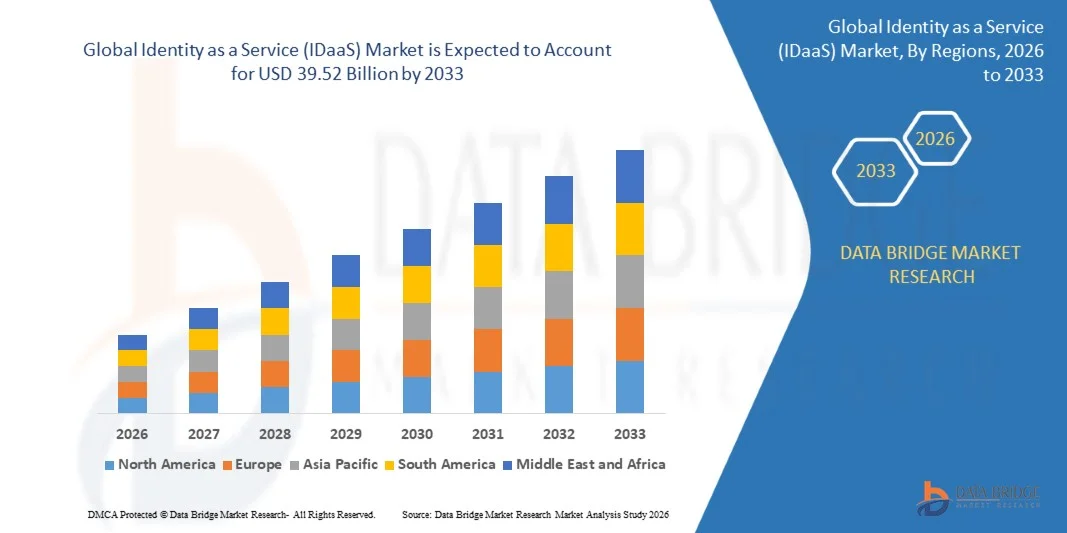
As per Data Bridge Market Research analysis, the identity as a service (IDaaS) market was valued at USD 8.16 billion in 2025 and is projected to reach USD 39.52 billion by 2033, growing at a CAGR of 21.80% from 2026 to 2033. The market is experiencing consistent growth driven by increasing cybersecurity breaches, rising identity fraud cases, growing adoption of cloud-based security services, and increasing implementation of identity and access management solutions across organizations.
The increasing number of cyber threats, data breaches, and regulatory compliance requirements, combined with rapid digital transformation and expansion of cloud computing infrastructure, is compelling enterprises across BFSI, healthcare, government, IT, and other sectors to adopt advanced identity management solutions. IDaaS platforms, including single sign-on, multi-factor authentication, provisioning, password management, and cloud-based identity governance solutions, are replacing traditional identity management approaches by offering scalable, cost-effective, and centralized access control capabilities.
Market Size & Forecast
- Global Market Value (2025): USD 8.16 Billion
- Expected Market Value (2033): USD 39.52 Billion
- Forecast CAGR (2026–2033): 21.80%
- Leading Region in 2025: North America
- Fastest Growing Region: Asia-Pacific
Key Market Trends & Insights
- North America dominated the identity as a service (IDaaS) market with the largest revenue share of 38.6% in 2025, supported by rapid digital transformation across industries, increasing adoption of cloud-based services, stringent regulatory requirements, and growing demand for secure identity management solutions
- The public segment led the market with a 45.0% share in 2025, driven by increasing adoption of cloud-based identity management solutions, lower infrastructure requirements, scalability, and reduced operational costs
- Asia-Pacific is expected to be the fastest-growing region with a CAGR of 27.4% during the forecast period, fueled by increasing adoption of cloud computing, e-commerce, digital financial services, rising cyber threats, and growing demand for secure and scalable identity management solutions
- Hybrid are the fastest-growing deployment type, projected to register a CAGR of 27.5%, reflecting the surge in demand for flexible identity architectures that combine cloud scalability with private infrastructure security
- The in-house service segment dominated the service type category with a 55.0% revenue share in 2025, led by increasing enterprise preference for greater control over identity infrastructure, security policies, and compliance management
- Large enterprises accounted for 65.0% of the market, preferred by increasing cybersecurity investments, complex organizational structures, and extensive requirements for managing workforce identities
- The document verification segment is the fastest-growing application category, with a CAGR of 28.0%, driven by increasing digital onboarding activities and rising demand for automated identity verification solutions
Report Scope and Identity as a Service (IDaaS) Market Segmentation
|
Attributes |
Identity as a Service (IDaaS) Key Market Insights |
|
Segments Covered |
|
|
Countries Covered |
North America
Europe
Asia-Pacific
Middle East and Africa
South America
|
|
Key Market Players |
|
|
Market Opportunities |
|
|
Value Added Data Infosets |
In addition to the market insights such as market value, growth rate, market segments, geographical coverage, market players, and market scenario, the market report curated by the Data Bridge Market Research team includes in-depth expert analysis, import/export analysis, pricing analysis, production consumption analysis, and pestle analysis. |
Identity as a Service (IDaaS) Market Trends
Trend: Rising Adoption of Zero Trust Security Frameworks
Organizations are increasingly adopting zero trust security frameworks, driving demand for identity as a service solutions that provide continuous authentication, access control, and identity verification across distributed digital environments. The growing shift toward remote work, cloud applications, and hybrid IT infrastructures is accelerating the use of IDaaS platforms with multi-factor authentication, single sign-on, and identity governance capabilities. Enterprises are leveraging these solutions to reduce unauthorized access risks, improve compliance management, and secure sensitive business data across interconnected networks. For instance, in July 2024, IBM’s Cost of a Data Breach Report 2024 revealed that stolen or compromised credentials remained among the most common initial attack vectors, highlighting the growing need for identity-based security solutions, stronger authentication, and access management frameworks.
The increasing implementation of Zero Trust security models is strengthening demand for IDaaS platforms as enterprises prioritize secure, scalable, and centralized identity management solutions.
Identity as a Service (IDaaS) Market Dynamics
Key Market Driver: Increasing Cybersecurity Threats and Data Breaches
The rising frequency of cyberattacks, identity theft incidents, and unauthorized access attempts is driving organizations to adopt advanced identity and access management solutions. Enterprises across BFSI, healthcare, government, and IT sectors are implementing IDaaS platforms to enhance authentication security, manage user identities, and protect critical digital assets. Cloud migration and digital transformation initiatives are further increasing the need for scalable identity solutions that support secure access across applications, devices, and remote environments. For instance, in July 2024, IBM’s Cost of a Data Breach Report 2024 stated that stolen or compromised credentials were the most common initial attack vector, accounting for 16% of data breaches, highlighting the importance of identity-based security controls.
Growing cybersecurity risks and increasing reliance on digital infrastructure are accelerating enterprise adoption of IDaaS solutions as a key security investment.
Key Restraint/Challenge: Data Privacy and Security Concerns Associated with Cloud-Based Identity Solutions
A significant challenge in the IDaaS market is the concern regarding data privacy, regulatory compliance, and security risks associated with storing identity information on cloud platforms. Organizations handling sensitive user credentials and authentication data require strong encryption, compliance frameworks, and secure identity governance to prevent unauthorized access and data exposure. In addition, varying regional regulations and dependence on third-party cloud providers create implementation challenges for enterprises, particularly in highly regulated industries. For instance, in May 2024, an IEEE Access research article on GDPR compliance challenges highlighted that organizations face significant technological and organizational changes to meet GDPR requirements, increasing the need for strong information governance, data protection practices, and secure identity management frameworks
Data privacy concerns and regulatory complexities remain key barriers, requiring IDaaS providers to strengthen security frameworks and compliance capabilities.
Key Market Opportunity: Expansion of Cloud-Based Identity Management and Digital Transformation Initiatives
The rapid adoption of cloud computing, software-as-a-service applications, and digital transformation initiatives presents significant growth opportunities for IDaaS providers. Organizations are increasingly transitioning from traditional identity management systems toward cloud-based platforms that offer scalability, centralized administration, automated provisioning, and enhanced authentication capabilities. The expansion of remote workforce models, connected devices, and enterprise applications is further creating demand for flexible identity solutions across industries and emerging markets. For instance, in April 2024, a research article published in The Journal of Information Technology and Systems highlighted that the expansion of cloud computing environments is increasing the need for identity management solutions to address authentication, authorization, security, and access control challenges.
Expanding cloud adoption and digital transformation programs are creating long-term opportunities for IDaaS providers to deliver secure and scalable identity solutions globally.
Identity as a Service (IDaaS) Market Scope
The identity as a service (IDaaS) market is segmented on the basis of deployment type, service type, enterprise size, access type, application, and end-use industry.
- By Deployment Type
On the basis of deployment type, the identity as a service (IDaaS) market is segmented into public, private, and hybrid. The public deployment segment dominated the market with approximately 45.0% share in 2025, owing to increasing adoption of cloud-based identity management solutions, lower infrastructure requirements, scalability, and reduced operational costs. Public IDaaS platforms enable organizations to access authentication, authorization, and identity governance capabilities without maintaining extensive internal infrastructure. These solutions are widely adopted by enterprises undergoing digital transformation and cloud migration initiatives. Increasing adoption of software-as-a-service applications and remote working models is further supporting demand for public deployment. Continuous security updates, automated maintenance, and flexible subscription-based pricing models are strengthening adoption. However, concerns related to data privacy, regulatory compliance, and dependency on third-party providers may limit adoption in highly regulated industries.
The hybrid deployment segment is projected to register the fastest growth at a CAGR of 27.5% from 2026 to 2033, driven by increasing demand for flexible identity architectures that combine cloud scalability with private infrastructure security. Hybrid IDaaS solutions allow organizations to maintain sensitive identity information within controlled environments while leveraging cloud-based authentication and access management capabilities. Enterprises across BFSI, healthcare, and government sectors are increasingly adopting hybrid models due to strict compliance requirements. Growing implementation of zero-trust security frameworks and multi-cloud strategies is further accelerating adoption. These solutions provide greater control, improved security, and seamless integration with existing IT environments. Rising demand for balanced security and operational flexibility is expected to support segment growth.
- By Service Type
On the basis of service type, the identity as a service (IDaaS) market is segmented into on-site and in-house. The in-house service segment dominated the market with 55.0% share in 2025, supported by increasing enterprise preference for greater control over identity infrastructure, security policies, and compliance management. Large organizations with complex IT environments continue to rely on internally managed identity solutions to customize authentication and access control processes. These solutions allow enterprises to maintain direct control over identity databases and integration with existing applications. Industries handling sensitive information, including BFSI, healthcare, and government organizations, prefer in-house capabilities due to security requirements. Strong customization and governance advantages continue to support adoption. However, higher infrastructure investment and maintenance requirements restrict adoption among smaller organizations.
The on-site service segment is expected to witness significant growth at a CAGR of 24.0% from 2026 to 2033, driven by rising demand for professional identity management support, implementation services, and cybersecurity expertise. Organizations are increasingly outsourcing identity-related operations to specialized service providers to improve security efficiency. On-site services assist enterprises in deploying authentication solutions, access management frameworks, and compliance systems. Increasing shortage of cybersecurity professionals is encouraging businesses to adopt managed identity services. These services help organizations reduce operational complexity while improving identity security capabilities. Growing adoption of managed security services is expected to create new opportunities for service providers.
- By Enterprise Size
On the basis of enterprise size, the identity as a service (IDaaS) market is segmented into small and medium enterprises (SMEs) and large enterprises. The large enterprises segment dominated the market with 65.0% share in 2025, driven by increasing cybersecurity investments, complex organizational structures, and extensive requirements for managing workforce identities. Large enterprises operate multiple applications, devices, and access points, creating strong demand for centralized identity management solutions. These organizations are increasingly adopting single sign-on, multi-factor authentication, and identity governance platforms. Growing regulatory compliance requirements are further supporting implementation. High cybersecurity budgets and digital transformation initiatives continue to strengthen adoption among large enterprises. However, complex integration with existing IT infrastructure remains a key challenge.
The small and medium enterprises (SMEs) segment is projected to register the fastest growth at a CAGR of 29.0% from 2026 to 2033, owing to increasing awareness regarding cybersecurity risks and growing adoption of affordable cloud-based identity solutions. SMEs are implementing IDaaS platforms to improve security without significant investment in internal IT infrastructure. Cloud-based subscription models are making advanced identity management technologies more accessible to smaller businesses. Increasing adoption of remote working models and SaaS applications is further accelerating demand. Rising cyber threats targeting SMEs are encouraging organizations to strengthen authentication and access controls. The need for scalable and cost-effective security solutions is expected to drive segment growth.
- By Access Type
On the basis of access type, the identity as a service (IDaaS) market is segmented into single sign-on, multi-factor authentication, compliance management, directory services, provisioning, password management, and others. The single sign-on (SSO) segment dominated the market with 28.0% share in 2025, owing to increasing demand for simplified authentication processes, improved user experience, and enhanced enterprise security. SSO enables users to access multiple applications through a single login process, reducing password dependency and improving productivity. Enterprises are increasingly adopting SSO due to growing usage of cloud applications and distributed work environments. Integration of SSO with enterprise applications and security platforms is strengthening adoption. These solutions also reduce administrative workload associated with password management. Increasing focus on seamless digital access is supporting segment dominance.
The multi-factor authentication (MFA) segment is projected to register the fastest growth at a CAGR of 30.0% from 2026 to 2033, driven by increasing cybersecurity threats, credential theft incidents, and rising demand for advanced identity verification methods. MFA provides multiple layers of security by requiring users to verify their identity through different authentication factors. Organizations across BFSI, healthcare, government, and IT sectors are rapidly implementing MFA solutions. Growing adoption of zero-trust security models is further increasing demand. Advancements in biometric authentication, adaptive authentication, and mobile verification technologies are improving solution effectiveness. Rising concerns regarding unauthorized access and identity fraud are expected to accelerate segment growth.
- By Application
On the basis of application, the identity as a service (IDaaS) market is segmented into document verification, authentication/identification, and screening. The authentication/identification segment dominated the market with 50.0% share in 2025, driven by increasing demand for secure identity verification and access management solutions. Organizations across industries are adopting authentication technologies to protect digital assets and prevent unauthorized access. Growing adoption of online banking, digital healthcare platforms, and enterprise applications is increasing demand for identity verification services. Integration of artificial intelligence and biometric technologies is improving authentication accuracy. These solutions support secure digital transactions and remote workforce management. Increasing cybersecurity concerns continue to strengthen adoption.
The document verification segment is expected to witness the fastest growth at a CAGR of 28.0% from 2026 to 2033, supported by increasing digital onboarding activities and rising demand for automated identity verification solutions. Organizations are adopting document verification technologies to improve fraud prevention and regulatory compliance. Financial institutions, government platforms, and digital service providers are increasingly utilizing automated verification systems. Artificial intelligence and machine learning technologies are improving document analysis and fraud detection capabilities. Growing demand for remote customer verification is accelerating adoption. Expansion of digital identity ecosystems is expected to create significant growth opportunities.
- By End Use Industry
On the basis of end-use industry, the identity as a service (IDaaS) market is segmented into government, retail and consumer electronics, transportation and logistics, media and entertainment, it and telecommunication, BFSI, energy and utility, healthcare, automotive, and others. The BFSI segment dominated the market with 25.0% share in 2025, driven by increasing cybersecurity threats, strict regulatory requirements, and the need to protect sensitive financial information. Banks and financial institutions are adopting IDaaS solutions to strengthen authentication, prevent fraud, and manage customer identities securely. Expansion of digital banking, online payments, and financial applications is increasing demand for identity management platforms. Multi-factor authentication and access governance solutions are becoming essential components of financial security strategies. Growing cyberattacks targeting financial institutions continue to support market adoption. Regulatory focus on data protection is further strengthening demand.
The healthcare segment is projected to register the fastest growth at a CAGR of 31.0% from 2026 to 2033, driven by increasing adoption of digital healthcare solutions, electronic health records, telemedicine, and connected medical systems. Healthcare organizations require secure identity management platforms to protect confidential patient information. Rising cybersecurity attacks against healthcare infrastructure are increasing demand for advanced authentication solutions. IDaaS platforms enable healthcare providers to manage access across multiple applications and devices securely. Increasing regulatory requirements related to patient data protection are supporting adoption. Growing digital transformation across healthcare systems is expected to accelerate segment growth.
Identity as a Service (IDaaS) Market Regional Analysis
North America dominated the identity as a service (IDaaS) market with the largest revenue share of 38.6% in 2025, supported by rapid digital transformation across industries, increasing adoption of cloud-based services, stringent regulatory requirements, and growing demand for secure identity management solutions. The region also benefits from early implementation of zero-trust security frameworks, multi-factor authentication technologies, and enterprise digital transformation initiatives across BFSI, healthcare, and IT sectors. Growing deployment of cloud applications, remote workforce security solutions, and compliance-driven identity governance platforms is accelerating market development. Increasing focus on data protection, regulatory compliance, and secure access management continues to strengthen North America's leadership position in the global market.
U.S. Identity as a Service (IDaaS) Market Insight
The U.S. identity as a service (IDaaS) market is witnessing strong growth due to increasing enterprise adoption of cloud-based identity management solutions, rising cybersecurity threats, and growing implementation of zero-trust security frameworks. The country’s mature technology ecosystem, along with the presence of leading identity and access management providers, is driving demand across BFSI, healthcare, government, and IT sectors. In addition, according to the National Cybersecurity Alliance’s Oh Behave! The Annual Cybersecurity Attitudes and Behaviors Report 2023 highlighted increasing cybersecurity concerns among users and organizations, emphasizing the need for stronger security practices, authentication controls, and identity protection measures in digital environments. Growing emphasis on data security, regulatory compliance, and secure remote access is accelerating IDaaS adoption among enterprises.
Europe Identity as a Service (IDaaS) Market Insight
The Europe identity as a service (IDaaS) market is witnessing strong growth, driven by increasing adoption of cloud-based identity management solutions, stringent data protection regulations, and rising enterprise focus on cybersecurity. Organizations across BFSI, healthcare, government, and IT sectors are increasingly implementing IDaaS platforms to strengthen authentication, access control, and identity governance. The region benefits from strict regulatory frameworks such as the General Data Protection Regulation (GDPR), which has accelerated demand for secure identity management and data protection solutions across enterprises. Growing adoption of zero-trust security frameworks, multi-factor authentication, and digital transformation initiatives is further supporting market expansion across European countries. Increasing focus on protecting sensitive information, improving compliance, and securing hybrid work environments continues to strengthen Europe’s position in the global IDaaS market
U.K. Identity as a Service (IDaaS) Market Insight
The U.K. identity as a service (IDaaS) market is experiencing steady growth, supported by increasing digital transformation initiatives, rising cybersecurity awareness, and growing adoption of cloud-based security solutions across enterprises. Financial institutions, healthcare organizations, and government agencies are increasingly implementing identity management platforms to strengthen authentication and access control. In addition, the U.K. Government’s National Cyber Strategy 2022 highlighted the importance of strengthening cyber resilience, protecting digital infrastructure, and improving cybersecurity capabilities across organizations, supporting the need for advanced identity and access management solutions. Furthermore, increasing adoption of multi-factor authentication, zero-trust security models, and regulatory compliance solutions is positioning the U.K. as a significant European market for IDaaS technologies.
Germany Identity as a Service (IDaaS) Market Insight
The Germany identity as a service (IDaaS) market is expanding steadily due to increasing enterprise digitalization, strict data protection requirements, and rising demand for secure access management solutions. Manufacturing companies, financial institutions, and technology enterprises are increasingly adopting IDaaS platforms to manage workforce identities and protect critical digital infrastructure. Germany’s Federal Office for Information Security (BSI) reported increasing cyber threat levels and emphasized the need for stronger identity and access management practices to protect organizations. Continuous adoption of cloud computing, cybersecurity frameworks, and compliance-focused identity solutions is further driving market growth in Germany.
Asia-Pacific Identity as a Service (IDaaS) Market Insight
The Asia-Pacific identity as a service (IDaaS) market is expected to witness rapid growth, driven by increasing cloud adoption, expanding digital economies, and rising cybersecurity investments across countries such as China, India, and Japan. Growing adoption of online services, digital payments, and enterprise applications is increasing demand for scalable identity authentication and access management solutions. According to the International Data Corporation (IDC), Asia-Pacific organizations are accelerating cloud adoption and digital transformation initiatives, creating significant opportunities for cloud-based security solutions including identity management platforms. In addition, increasing cyber threats, regulatory requirements, and growing adoption of zero-trust security models are accelerating IDaaS deployment across commercial and government sectors.
Japan Identity as a Service (IDaaS) Market Insight
The Japan identity as a service (IDaaS) market is witnessing consistent growth due to increasing enterprise digitalization, rising cybersecurity requirements, and adoption of cloud-based business applications. Japanese enterprises are increasingly implementing identity management solutions to secure remote access, protect business data, and improve operational efficiency. In addition, Japan’s Ministry of Economy, Trade and Industry (METI) released cybersecurity guidelines emphasizing stronger cybersecurity governance and identity management practices among organizations. Moreover, increasing adoption of multi-factor authentication, cloud security solutions, and digital transformation initiatives is further contributing to market growth in Japan.
China Identity as a Service (IDaaS) Market Insight
The China identity as a service (IDaaS) market is growing rapidly, driven by expanding cloud infrastructure, increasing digital transformation initiatives, and rising demand for cybersecurity solutions across enterprises. Growing adoption of cloud computing, online platforms, and digital financial services is significantly boosting demand for identity authentication and access management technologies. China’s Ministry of Industry and Information Technology (MIIT) released the “14th Five-Year Plan for Software and Information Technology Service Industry Development,” emphasizing the development of cloud computing, digital transformation, and information technology services, supporting increased adoption of cloud-based security technologies and identity management solutions.In addition, rising cyber risks, data protection regulations, and enterprise adoption of zero-trust frameworks are positioning China as one of the fastest-growing markets for IDaaS solutions globally.
Identity as a Service (IDaaS) Market Share
The identity as a service (IDaaS) industry is primarily led by well-established companies, including:
- Okta. (U.S.)
- Microsoft (U.S.)
- IBM (U.S.)
- Cisco Systems, Inc. (U.S.)
- Oracle (U.S.)
- Salesforce, Inc. (U.S.)
- Broadcom (U.S.)
- Ping Identity (U.S.)
- CyberArk Software Ltd. (Israel)
- SailPoint Technologies, Inc. (U.S.)
- One Identity LLC (U.S.)
- ForgeRock, Inc. (U.S.)
- JumpCloud Inc. (U.S.)
- WSO2 LLC (U.S.)
- Auth0, Inc. (U.S.)
- Entrust Corporation (U.S.)
- Thales (France)
- HID Global Corporation (U.S.)
- RSA Security LLC (U.S.)
Latest Developments in Identity as a Service (IDaaS) Market
- In April 2025, Okta announced new Okta Platform capabilities to extend its Identity Security Fabric toward non-human identities, including AI agents, API keys, and automated systems. The enhancement enables organizations to manage and secure different identity types with improved visibility, governance, automation, and access control capabilities. The development addresses growing enterprise concerns around securing AI-driven workflows and machine identities as organizations increasingly adopt generative artificial intelligence technologies
- In October 2024, Okta announced new Workforce Identity Cloud capabilities designed to address unmanaged identities, identity governance risks, and authentication challenges faced by enterprises. The enhanced capabilities provide organizations with improved visibility, stronger identity verification, and better control over access management processes. The development focuses on securing workforce identities before, during, and after authentication while supporting modern security frameworks such as zero-trust architecture
- In January 2024, Okta introduced the Okta Customer Identity Cloud, a customer identity solution powered by Auth0, designed to help organizations improve secure digital experiences while reducing identity-related security risks. The solution introduced capabilities including adaptive multi-factor authentication, passkeys support, security monitoring, and identity management features for consumer applications. The launch enables businesses to streamline customer authentication across devices and platforms while improving security and user experience
- In July 2022, IBM announced enhancements to its security portfolio with expanded identity and access management capabilities, helping organizations strengthen authentication, access governance, and protection against identity-related cyber threats. The development supported enterprises in managing digital identities across hybrid cloud environments and improving security visibility. Increasing adoption of hybrid cloud infrastructure and rising cyber risks were key factors driving demand for advanced identity management solutions
- In October 2021, WSO2 introduced Asgardeo, a next-generation identity as a service (IDaaS) solution designed to simplify customer identity and access management for application developers. The platform enabled organizations to integrate authentication, identity management, and customer access control capabilities into digital applications with reduced complexity. Asgardeo supported secure customer onboarding, authentication workflows, and improved digital user experiences across applications

- Interactive Data Analysis Dashboard
- Company Analysis Dashboard for high growth potential opportunities
- Research Analyst Access for customization & queries
- Competitor Analysis with Interactive dashboard
- Latest News, Updates & Trend analysis
- Harness the Power of Benchmark Analysis for Comprehensive Competitor Tracking
Data collection and base year analysis are done using data collection modules with large sample sizes. The stage includes obtaining market information or related data through various sources and strategies. It includes examining and planning all the data acquired from the past in advance. It likewise envelops the examination of information inconsistencies seen across different information sources. The market data is analysed and estimated using market statistical and coherent models. Also, market share analysis and key trend analysis are the major success factors in the market report. To know more, please request an analyst call or drop down your inquiry.
The key research methodology used by DBMR research team is data triangulation which involves data mining, analysis of the impact of data variables on the market and primary (industry expert) validation. Data models include Vendor Positioning Grid, Market Time Line Analysis, Market Overview and Guide, Company Positioning Grid, Patent Analysis, Pricing Analysis, Company Market Share Analysis, Standards of Measurement, Global versus Regional and Vendor Share Analysis. To know more about the research methodology, drop in an inquiry to speak to our industry experts.
Data Bridge Market Research is a leader in advanced formative research. We take pride in servicing our existing and new customers with data and analysis that match and suits their goal. The report can be customized to include price trend analysis of target brands understanding the market for additional countries (ask for the list of countries), clinical trial results data, literature review, refurbished market and product base analysis. Market analysis of target competitors can be analyzed from technology-based analysis to market portfolio strategies. We can add as many competitors that you require data about in the format and data style you are looking for. Our team of analysts can also provide you data in crude raw excel files pivot tables (Fact book) or can assist you in creating presentations from the data sets available in the report.













