


What is the Image Processing Occupancy Sensor Market Size and Growth Rate?
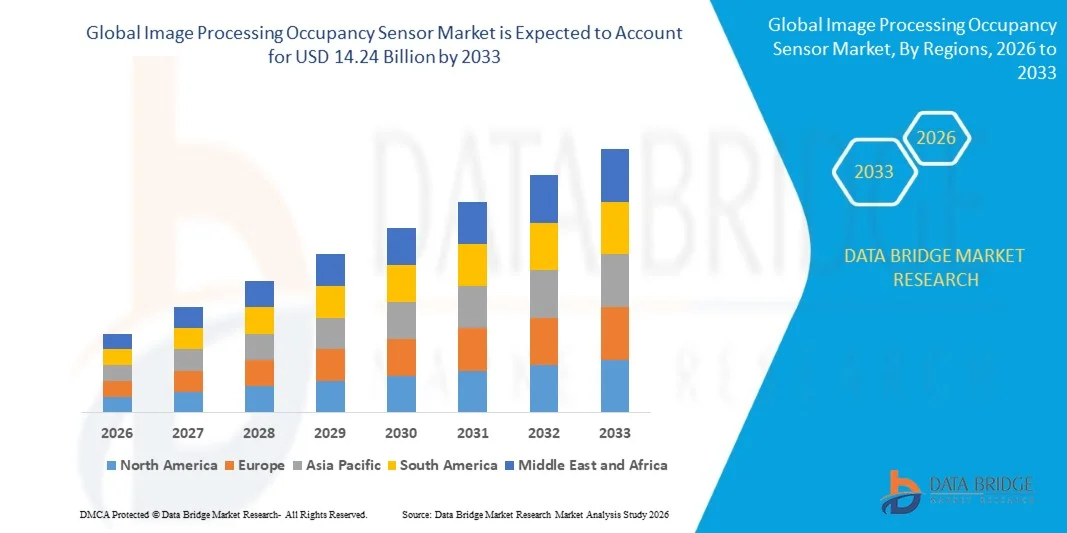
- As per Data Bridge Market Research Analysis the image processing occupancy sensor market was valued at USD 3.76 billion in 2025 and is projected to reach USD 14.24 billion by 2033, growing at a CAGR of 18.10% from 2026 to 2033.
- The market is experiencing robust growth driven by the increasing demand for energy-efficient solutions, stringent building codes mandating occupancy-based controls, and the rapid adoption of smart building technologies. These sensors, which utilize advanced image processing algorithms to detect human presence, are becoming integral to modern lighting, HVAC, and security systems, offering significant energy savings and operational efficiencies.
- The integration of these sensors with IoT platforms and AI-driven analytics is transforming building management, enabling predictive control and space utilization optimization. Commercial buildings remain the primary end-users, but residential adoption is accelerating with the proliferation of smart home ecosystems. The market's expansion is further supported by government initiatives promoting energy conservation and the development of smart cities worldwide.
What are the Major Takeaways of the Image Processing Occupancy Sensor Market?
- North America is expected to dominate the global image processing occupancy sensor market during the forecast period, supported by the early adoption of smart building technologies, increasing deployment of connected building-management systems, and growing demand for energy-efficient occupancy-based automation.
- Asia-Pacific is expected to witness the fastest growth in the image processing occupancy sensor market from 2026 to 2033, driven by rapid urbanization, expanding commercial and residential construction, increasing investments in smart buildings, and growing adoption of intelligent building infrastructure.
- The indoor operation segment is expected to hold a larger market share, supported by the widespread use of image processing occupancy sensors in offices, commercial facilities, residential buildings, retail stores, healthcare facilities, and educational institutions for occupancy detection, energy management, and space utilization.
- The outdoor operation segment is expected to witness significant growth during the forecast period, driven by increasing adoption of image-based sensing for smart surveillance, parking management, perimeter monitoring, outdoor lighting control, and other intelligent infrastructure applications.
- The commercial buildings segment is expected to dominate the image processing occupancy sensor market, supported by increasing adoption of occupancy-based automation across offices, shopping centers, hotels, healthcare facilities, educational institutions, and other commercial buildings to improve energy efficiency, space utilization, and building operations.
Market Size & Forecast
- Market Value (2025): USD 3.76 Billion
- Expected Market Value (2033): USD 14.24 Billion
- Forecast CAGR (2026–2033): 18.10%
- Leading Region in 2025: North America
- Fastest Growing Region: Asia-Pacific
Report Scope and Image Processing Occupancy Sensor Market Segmentation
|
Attributes |
Image Processing Occupancy Sensor Key Market Insights |
|
Segments Covered |
|
|
Countries Covered |
North America
Europe
Asia-Pacific
Middle East and Africa
South America
|
|
Key Market Players |
|
|
Market Opportunities |
|
|
Value Added Data Infosets |
In addition to the insights on market scenarios such as market value, growth rate, segmentation, geographical coverage, and major players, the market reports curated by the Data Bridge Market Research also include in-depth expert analysis, geographically represented company-wise production and capacity, network layouts of distributors and partners, detailed and updated price trend analysis and deficit analysis of supply chain and demand. |
What is the Key Trend in the Image Processing Occupancy Sensor Market?
- The integration of computer vision, deep learning, and privacy-conscious sensing is emerging as a key trend in the image processing occupancy sensor market, enabling more accurate occupant detection and counting for intelligent building applications. These technologies are increasingly being used to provide real-time occupancy information for HVAC, lighting, ventilation, and space-management systems.
- For instance, in 2025, researchers from Monash University published the study “An application of smart visual air conditioning controller to enhance control efficiency in office environments” in Results in Engineering. The study developed a Smart Visual Air Conditioning Controller (SVACC) using computer vision and deep-learning-based human detection to automatically adjust air-conditioning operation according to occupancy. A five-month evaluation across 10 conference rooms reported a 33.60% reduction in air-conditioning usage time.
- Privacy-preserving occupancy sensing is also gaining attention as building operators seek occupancy information without collecting conventional identifiable imagery. Companies are developing alternative sensing approaches that use thermal or other non-identifying information to detect occupancy while limiting privacy concerns.
- For instance, Butlr provides camera-free thermal occupancy sensors that use heat-based sensing to generate anonymous occupancy and activity information. The company states that its sensors do not capture personally identifiable information and are designed for applications across commercial buildings and other physical spaces.
- The increasing combination of computer vision, AI-based detection, thermal sensing, and building-management systems is transforming occupancy sensors from basic presence-detection devices into intelligent sensing platforms capable of providing real-time information for energy management and space utilization.
What are the Key Drivers of the Image Processing Occupancy Sensor Market?
- The growing emphasis on building energy efficiency is a major driver of the image processing occupancy sensor market, as accurate occupancy information enables HVAC and other building systems to respond to actual space utilization instead of operating according to fixed schedules.
- For instance, the 2025 Monash University study published in Results in Engineering developed a computer-vision-based Smart Visual Air Conditioning Controller that detected human presence in meeting rooms and dynamically controlled air-conditioning operation. The five-month evaluation across 10 conference rooms reported a 33.60% reduction in air-conditioning usage time.
- Research has also demonstrated the potential of computer vision and deep learning to provide detailed occupancy and activity information for building energy management. A study published in Energies developed a computer-vision-based occupancy and equipment-usage detection system using deep learning and tested it in an office environment at the University of Nottingham. The system achieved an overall occupancy detection accuracy of 97.32% in the reported case study and generated occupancy profiles that could be incorporated into building energy simulations and HVAC control.
- The increasing adoption of smart HVAC, lighting, and building-management systems is therefore creating demand for occupancy sensors capable of delivering real-time and detailed information on the number and location of occupants. This is particularly relevant in offices, conference rooms, healthcare facilities, educational buildings, and other spaces where occupancy patterns vary throughout the day.
Which Factors are Challenging the Growth of the Image Processing Occupancy Sensor Market?
- Privacy remains a significant challenge for image-based occupancy sensing because conventional camera systems can capture identifiable information about occupants. This concern can make organizations hesitant to deploy camera-based solutions in workplaces and other sensitive environments.
- Accuracy can also be affected by occlusion, camera positioning, field-of-view limitations, lighting conditions, and the movement of multiple occupants. These factors can reduce the reliability of occupant counting and presence detection in complex indoor environments.
- For instance, a peer-reviewed study published in Energies evaluated a computer-vision-based occupancy and equipment-usage detection system in an actual office environment at the University of Nottingham. The researchers identified the need for suitable camera positioning and processing infrastructure to support real-time occupancy and equipment detection, highlighting deployment considerations associated with vision-based sensing.
- Privacy concerns are also encouraging the development of alternative sensing approaches. For instance, Butlr's thermal occupancy sensors are designed to detect heat signatures without capturing personally identifiable images, demonstrating the industry's movement toward privacy-conscious occupancy monitoring.
- Consequently, privacy requirements, detection accuracy, camera placement, processing requirements, and integration with existing building-management systems can increase deployment complexity. The development of thermal sensing, privacy-preserving computer vision, edge processing, and more robust AI-based detection technologies is expected to help address these challenges and support broader adoption of image processing occupancy sensors.
Image Processing Occupancy Sensor Market Scope
The image processing occupancy sensor market is segmented on the basis of operation, building type, network connectivity, and application.
- By Operation
On the basis of operation, the image processing occupancy sensor market is segmented into indoor operation and outdoor operation. The indoor operation segment is expected to account for a larger market share, supported by the widespread deployment of occupancy sensors in offices, commercial buildings, residential spaces, retail stores, and institutional facilities. Image processing sensors enable accurate occupancy detection and people counting while supporting automated lighting, HVAC optimization, and energy-management systems. Increasing adoption of smart building technologies and growing emphasis on energy efficiency are further supporting demand for indoor occupancy sensing solutions.
The outdoor operation segment is projected to witness significant growth during the forecast period, driven by increasing deployment of intelligent surveillance, smart parking, perimeter monitoring, and outdoor lighting systems. Advances in image processing, edge computing, and AI-based object and occupancy detection are improving sensor performance under varying outdoor conditions, supporting their adoption across smart cities, transportation infrastructure, and commercial campuses.
- By Building Type
On the basis of building type, the image processing occupancy sensor market is segmented into residential buildings and commercial buildings. The commercial buildings segment is expected to dominate the market, owing to increasing adoption of occupancy sensing technologies across offices, shopping centers, hotels, hospitals, educational institutions, and other commercial facilities. Building operators are increasingly deploying occupancy sensors to automate lighting and HVAC systems, optimize space utilization, reduce energy consumption, and improve occupant comfort. The growing development of smart and connected buildings further supports segment growth.
The residential buildings segment is anticipated to register significant growth during the forecast period, driven by increasing adoption of smart home technologies and connected energy-management systems. Image-based occupancy detection can enable automated lighting, climate control, security, and home automation functions, while growing consumer interest in energy-efficient and intelligent homes is creating additional opportunities for sensor deployment.
- By Network Connectivity
On the basis of network connectivity, the image processing occupancy sensor market is segmented into wired network and wireless network. The Wired Network segment is expected to maintain a significant market position, particularly in newly constructed commercial and institutional buildings where occupancy sensors can be integrated directly into building automation and management systems. Wired connectivity provides reliable data transmission, consistent network performance, and integration with centralized lighting, HVAC, and security infrastructure.
The Wireless Network segment is projected to experience faster growth during the forecast period, driven by increasing demand for flexible and cost-effective smart building solutions. Wireless occupancy sensors reduce installation complexity and enable easier deployment in existing buildings without extensive rewiring. Growing adoption of IoT-enabled building management systems, Bluetooth, Wi-Fi, Zigbee, and other wireless communication technologies is further supporting segment expansion.
- By Application
On the basis of application, the image processing occupancy sensor market is segmented into lighting systems, HVAC systems, security and surveillance systems, and others. The Lighting Systems segment is expected to account for a significant market share, driven by the increasing use of occupancy detection to automatically switch, dim, or adjust lighting based on room occupancy. The technology helps building owners reduce unnecessary electricity consumption while improving lighting efficiency and occupant convenience. Growing adoption of intelligent lighting and energy-management solutions in commercial buildings is further supporting demand.
The HVAC Systems segment is projected to witness strong growth during the forecast period, driven by increasing emphasis on energy-efficient building operations and automated climate control. Occupancy information enables HVAC systems to adjust heating, ventilation, and air conditioning according to real-time space utilization, reducing energy consumption in unoccupied areas. Integration with building management systems and IoT-based automation is further accelerating adoption.
The Security and Surveillance Systems segment is also gaining traction as image processing occupancy sensors can support people counting, occupancy monitoring, restricted-area detection, and real-time security management. Increasing demand for intelligent surveillance across commercial buildings, public infrastructure, and smart-city environments is creating additional opportunities for these solutions.
Image Processing Occupancy Sensor Market Regional Analysis
- North America is expected to dominate the image processing occupancy sensor market during the forecast period, supported by early adoption of smart building technologies, advanced building automation infrastructure, and increasing demand for intelligent occupancy detection.
The region's focus on energy-efficient buildings and connected building-management systems is encouraging the integration of occupancy sensing with HVAC, lighting, security, and space-management applications.
U.S. Image Processing Occupancy Sensor Market Insight
The U.S. image processing occupancy sensor market is expected to account for a significant share of the North American market, supported by widespread adoption of smart building technologies, advanced building automation infrastructure, and increasing investments in energy-efficient building systems. Growing deployment of occupancy sensing solutions for HVAC optimization, lighting control, space utilization, and building management is supporting market expansion. In addition, the country's established technology ecosystem and increasing integration of IoT, artificial intelligence, and computer vision into building systems are creating opportunities for advanced image processing occupancy sensors.
Europe Image Processing Occupancy Sensor Market Insight
The Europe image processing occupancy sensor market is expected to witness significant growth from 2026 to 2033, supported by increasing emphasis on energy efficiency, sustainable buildings, and intelligent building automation. Building owners and facility operators are increasingly adopting occupancy sensing technologies to optimize lighting, HVAC operation, ventilation, and space utilization. The region's focus on reducing building energy consumption and improving operational efficiency is encouraging the integration of advanced occupancy detection technologies across commercial, institutional, and public buildings.
U.K. Image Processing Occupancy Sensor Market Insight
The U.K. image processing occupancy sensor market is expected to witness significant growth from 2026 to 2033, driven by increasing adoption of smart building technologies and growing demand for energy-efficient building management. Occupancy sensing is increasingly being applied across offices, commercial properties, educational facilities, and public buildings to support automated lighting, HVAC management, and space utilization. The country's focus on improving building energy performance and expanding connected infrastructure is expected to further support demand for intelligent occupancy detection solutions.
Germany Image Processing Occupancy Sensor Market Insight
The Germany image processing occupancy sensor market is expected to witness significant growth from 2026 to 2033, supported by advanced building infrastructure, increasing adoption of automation, and strong emphasis on energy efficiency. Commercial and industrial facilities are increasingly integrating occupancy sensing with building-management systems to optimize lighting, HVAC, and other building operations. Growing adoption of smart building technologies and connected sensors is further creating opportunities for image processing occupancy solutions across Germany.
Asia-Pacific Image Processing Occupancy Sensor Market Insight
The Asia-Pacific image processing occupancy sensor market is expected to witness the fastest growth from 2026 to 2033, driven by rapid urbanization, expanding construction activity, increasing investments in smart buildings, and growing adoption of intelligent infrastructure. Rising demand for automated building systems is encouraging the deployment of occupancy sensing technologies across commercial and residential facilities. China, Japan, and India are expected to contribute significantly to regional growth through expanding smart-city development, building automation, and energy-efficiency initiatives.
Japan Image Processing Occupancy Sensor Market Insight
The Japan image processing occupancy sensor market is expected to witness strong growth from 2026 to 2033, supported by advanced technology infrastructure, high adoption of automation, and increasing focus on energy-efficient buildings. Occupancy sensing technologies are increasingly being integrated with building-management and IoT systems to support automated lighting, HVAC control, and facility management. Japan's established electronics and sensor technology ecosystem is further supporting the development and adoption of advanced occupancy detection solutions.
China Image Processing Occupancy Sensor Market Insight
The China image processing occupancy sensor market is expected to account for a significant share of the Asia-Pacific market, supported by rapid urbanization, expanding commercial and residential construction, and increasing investments in smart infrastructure. The development of intelligent buildings is creating demand for occupancy sensing solutions that can support automated lighting, HVAC management, energy optimization, and space utilization. China's expanding smart-city development and strong technology and electronics ecosystem are further supporting the deployment of advanced occupancy sensing technologies.
Image Processing Occupancy Sensor Market Share
The image processing occupancy sensor industry is primarily led by well-established companies, including:
- Legrand (France)
- Schneider Electric (France)
- Eaton (Ireland)
- Johnson Controls (U.S.)
- Signify Holding (Netherlands)
- ACUITY BRANDS LIGHTING, INC. (U.S.)
- Leviton Manufacturing Co., Inc. (U.S.)
- Lutron Electronics Co., Inc. (U.S.)
- Honeywell International Inc. (U.S.)
- Hubbell. (U.S.)
- Texas Instruments Incorporated (U.S.)
- OSRAM GmbH. (Germany)
- Siemens (Germany)
- Crestron Electronics, Inc. (U.S.)
Latest Developments in Image Processing Occupancy Sensor Market
- In December 2024, The U.S. Department of Energy (DOE) released the 2024 International Energy Conservation Code (IECC) resources, encouraging adoption of advanced automatic lighting controls and occupancy sensing technologies to reduce building energy consumption.
- In September 2024, Schneider Electric highlighted that intelligent occupancy sensing systems deliver long-term energy savings but involve higher initial capital costs and integration requirements compared with conventional lighting controls.
- In October 2024, Onsemi announced intelligent vision solutions supporting occupancy monitoring, retail analytics, and smart infrastructure. It Illustrates expansion into retail analytics and smart city applications beyond conventional building automation.

- Interactive Data Analysis Dashboard
- Company Analysis Dashboard for high growth potential opportunities
- Research Analyst Access for customization & queries
- Competitor Analysis with Interactive dashboard
- Latest News, Updates & Trend analysis
- Harness the Power of Benchmark Analysis for Comprehensive Competitor Tracking
Global Image Processing Occupancy Sensor Market, Supply Chain Analysis and Ecosystem Framework
To support market growth and help clients navigate the impact of geopolitical shifts, DBMR has integrated in-depth supply chain analysis into its Global Image Processing Occupancy Sensor Market research reports. This addition empowers clients to respond effectively to global changes affecting their industries. The supply chain analysis section includes detailed insights such as Global Image Processing Occupancy Sensor Market consumption and production by country, price trend analysis, the impact of tariffs and geopolitical developments, and import and export trends by country and HSN code. It also highlights major suppliers with data on production capacity and company profiles, as well as key importers and exporters. In addition to research, DBMR offers specialized supply chain consulting services backed by over a decade of experience, providing solutions like supplier discovery, supplier risk assessment, price trend analysis, impact evaluation of inflation and trade route changes, and comprehensive market trend analysis.
Data collection and base year analysis are done using data collection modules with large sample sizes. The stage includes obtaining market information or related data through various sources and strategies. It includes examining and planning all the data acquired from the past in advance. It likewise envelops the examination of information inconsistencies seen across different information sources. The market data is analysed and estimated using market statistical and coherent models. Also, market share analysis and key trend analysis are the major success factors in the market report. To know more, please request an analyst call or drop down your inquiry.
The key research methodology used by DBMR research team is data triangulation which involves data mining, analysis of the impact of data variables on the market and primary (industry expert) validation. Data models include Vendor Positioning Grid, Market Time Line Analysis, Market Overview and Guide, Company Positioning Grid, Patent Analysis, Pricing Analysis, Company Market Share Analysis, Standards of Measurement, Global versus Regional and Vendor Share Analysis. To know more about the research methodology, drop in an inquiry to speak to our industry experts.
Data Bridge Market Research is a leader in advanced formative research. We take pride in servicing our existing and new customers with data and analysis that match and suits their goal. The report can be customized to include price trend analysis of target brands understanding the market for additional countries (ask for the list of countries), clinical trial results data, literature review, refurbished market and product base analysis. Market analysis of target competitors can be analyzed from technology-based analysis to market portfolio strategies. We can add as many competitors that you require data about in the format and data style you are looking for. Our team of analysts can also provide you data in crude raw excel files pivot tables (Fact book) or can assist you in creating presentations from the data sets available in the report.













