What is the Image Recognition AI Camera Market Size and Growth Rate?
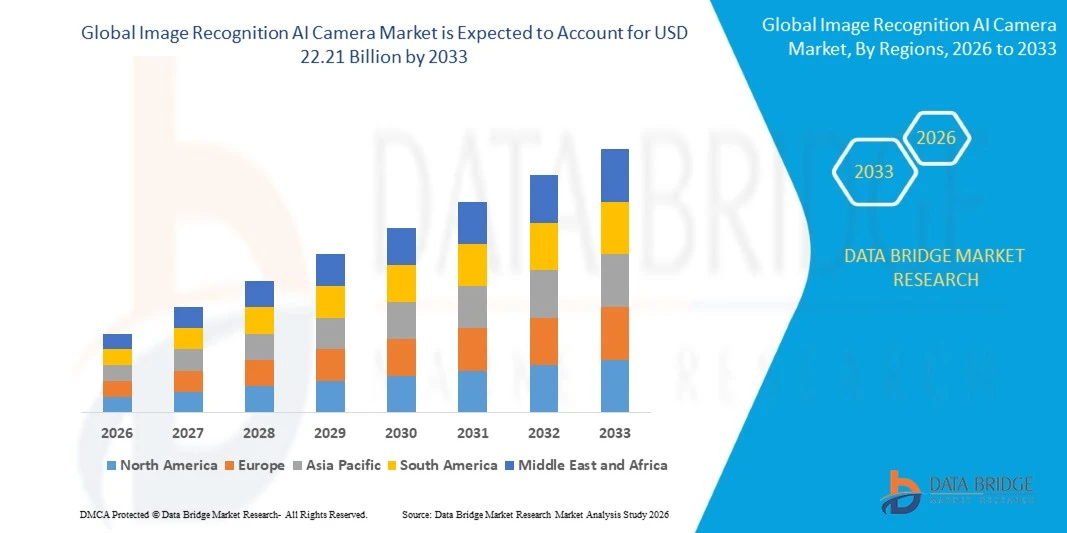
- As per Data Bridge Market Research analysis, the image recognition AI camera market was valued at USD 4.00 billion in 2025 and is projected to reach USD 22.21 billion by 2033, growing at a CAGR of 23.90% from 2026 to 2033.
- The market is experiencing consistent growth driven by rising demand for intelligent surveillance solutions, rapid advancements in artificial intelligence and computer vision technologies, and expanding applications across industrial automation, healthcare diagnostics, retail analytics, and smart transportation.
- The increasing need for real-time visual monitoring globally, combined with growing investments in security infrastructure and automated decision-making systems, is compelling enterprises, government organizations, and industrial operators to adopt advanced AI-powered cameras. Image recognition cameras equipped with facial recognition, object detection, and edge computing capabilities are increasingly supplementing traditional camera systems, offering faster image processing, improved operational efficiency, and automated threat detection.
Market Size & Forecast
- Global Market Value (2025): USD 4.00 Billion
- Expected Market Value (2033): USD 22.21 Billion
- Forecast CAGR (2026–2033): 23.90%
- Leading Region in 2025: North America
- Fastest Growing Region: Asia Pacific
What are the Major Takeaways of the Image Recognition AI Camera Market?
- North America dominated the AI camera market with the largest revenue share of 34.0% in 2025, supported by advanced technology infrastructure, strong investments in artificial intelligence, and widespread adoption of intelligent surveillance systems.
- Asia-Pacific is expected to be the fastest-growing region at a CAGR of 18.8% from 2026 to 2033, fueled by expanding smart city projects, manufacturing automation, rising surveillance investments, and increasing adoption of AI-powered camera technologies across China, India, Japan, and South Korea.
- The hardware segment led the market with a 45.12% share in 2025, driven by demand for image sensors, processors, lenses, and AI-enabled camera devices.
- Services are the fastest-growing component type, projected to register a CAGR of 14.67%, reflecting the surge in demand for system integration, AI model customization, and ongoing technical support.
- The facial recognition segment dominated the technology category with a 34.69% revenue share in 2025, led by growing demand for biometric authentication, access control, and intelligent surveillance.
- Security and surveillance accounted for 38.4% of the market share in 2025, preferred by increasing demand for intelligent monitoring across commercial buildings, transportation networks,
- The cloud segment is the fastest-growing deployment category, with a CAGR of 16.37%, driven by increasing demand for scalable image processing and centralized camera management
Report Scope and Image Recognition AI Camera Market Segmentation
|
Attributes |
Image Recognition AI Camera Key Market Insights |
|
Segments Covered |
|
|
Countries Covered |
North America
Europe
Asia-Pacific
Middle East and Africa
South America
|
|
Key Market Players |
|
|
Market Opportunities |
|
|
Value Added Data Infosets |
In addition to the insights on market scenarios such as market value, growth rate, segmentation, geographical coverage, and major players, the market reports curated by the Data Bridge Market Research also include in-depth expert analysis, geographically represented company-wise production and capacity, network layouts of distributors and partners, detailed and updated price trend analysis and deficit analysis of supply chain and demand. |
What is the Key Trend in the Image Recognition AI Camera Market?
- AI camera manufacturers are increasingly integrating advanced image recognition technologies to improve visual monitoring, automate object detection, and enhance real-time decision-making while reducing dependence on manual surveillance.
- For instance, in May 2025, NVIDIA made its AI Blueprint for video search and summarization generally available, enabling developers to analyze real-time and archived video footage through AI-powered video analytics.
- Real-time image processing enables cameras to identify objects, track individuals, detect unusual activities, and generate actionable insights across multiple applications.
- Manufacturers and technology providers are leveraging edge computing and computer vision to deliver faster image recognition across industrial automation, smart cities, and connected security systems.
- For instance, in June 2025, NVIDIA highlighted AI virtual camera applications that detect and track presenters in high-resolution video streams, automatically creating focused camera views using AI. Read the technical announcement.
- As businesses and public organizations continue prioritizing intelligent monitoring and automated visual analysis, demand for image recognition AI cameras is expected to accelerate, strengthening their role in security, industrial operations, and smart infrastructure.
What are the Key Drivers of the Image Recognition AI Camera Market?
- The rapid advancement of artificial intelligence and computer vision has significantly increased demand for image recognition AI cameras capable of identifying objects, interpreting visual information, and supporting automated decisions across diverse applications.
- For instance, in August 2025, Google introduced the Pixel 10 series with enhanced AI-powered camera capabilities, including improved image processing and computational photography features.
- Enterprises, automotive manufacturers, and technology companies are integrating image recognition into camera systems to improve operational efficiency, enhance security monitoring, and accelerate automated visual inspection.
- For instance, in July 2025, RealSense spun out from Intel and secured USD 50 million in funding to expand AI vision technologies, including depth-sensing cameras for robotics applications.
- With industries increasingly relying on intelligent visual data to improve productivity, automate inspections, and strengthen security, image recognition AI cameras will remain important for the development of smart infrastructure and next-generation automation technologies.
What Factors are Challenging the Growth of the Image Recognition AI Camera Market?
- Advanced image recognition AI cameras require substantial upfront investment due to specialized imaging sensors, high-performance processors, AI software, and infrastructure for real-time visual data processing.
- For instance, in January 2025, the U.S. Federal Trade Commission finalized an order prohibiting IntelliVision from making unsupported claims about its facial recognition software's accuracy and freedom from gender or racial bias, highlighting the challenges of validating AI camera performance
- These costs can limit adoption among smaller businesses, public institutions, and organizations operating in price-sensitive markets with restricted technology budgets.
- Privacy concerns, potential recognition errors, algorithmic bias, and the need for reliable testing continue to complicate adoption, particularly in applications involving biometric identification and sensitive personal information.
- For instance, in September 2024, the Dutch Data Protection Authority fined Clearview AI €30.5 million for illegally collecting facial images to build a facial recognition database, highlighting privacy and regulatory barriers to biometric image recognition deployment.
- These technical, regulatory, and implementation challenges can increase compliance costs and delay deployment, limiting the wider adoption of image recognition AI cameras despite growing demand for intelligent surveillance and automated visual analytics.
How is the Image Recognition AI Camera Market Segmented?
The image recognition AI camera market is segmented on the basis of component, technology, application, deployment, and end user.
- By Component
On the basis of component, the image recognition AI camera market is segmented into hardware, software, and services. The hardware segment dominated the broader AI image recognition market with 45.12% share in 2025, supported by demand for image sensors, processors, lenses, and AI-enabled camera devices. Hardware components form the foundation of image capture, image processing, and real-time recognition capabilities. Increasing deployment of intelligent surveillance systems is strengthening demand for advanced imaging equipment. Improvements in sensor resolution and edge processing are enhancing recognition accuracy and response times. Integration of dedicated AI chips is enabling faster analysis while reducing dependence on remote computing infrastructure. Growing adoption across industrial automation, transportation, retail, and security applications continues to support hardware demand.
The services segment is projected to register the fastest growth at CAGR of 14.67% during the forecast period, driven by rising demand for system integration, AI model customization, and ongoing technical support. Organizations require specialist assistance to integrate image recognition capabilities with existing camera and IT infrastructure. Professional services help businesses prepare training datasets, configure recognition models, and improve deployment performance. Demand for maintenance and algorithm optimization is increasing as AI applications become more complex. Integration with enterprise platforms also requires technical expertise and continued monitoring. Growing adoption among organizations without extensive in-house AI capabilities is expected to support service demand.
- By Technology
On the basis of technology, the image recognition AI camera market is segmented into barcode recognition, facial recognition, object recognition, and pattern recognition. The facial recognition segment dominated the broader image recognition market with 34.69% share in 2026, driven by growing demand for biometric authentication, access control, and intelligent surveillance. Facial recognition technology enables cameras to identify or verify individuals by analyzing distinctive facial features. Increasing deployment across airports, commercial buildings, banking facilities, and public infrastructure is supporting adoption. Advancements in deep learning and facial feature extraction are improving identification performance. Integration with identity management and security platforms is expanding its applications.
The object recognition segment is expected to witness strong growth at CAGR of 18.0% during the forecast period, driven by increasing demand for automated visual analysis across industrial, commercial, and transportation applications. This technology enables cameras to detect, classify, and track objects within images and video streams. Manufacturing companies use object recognition to identify product defects, monitor production lines, and improve quality control. Retailers are adopting these systems for inventory monitoring, customer behavior analysis, and automated checkout solutions. Advancements in deep learning and edge AI are enabling faster recognition with reduced processing delays. Growing applications in robotics, autonomous systems, and smart city infrastructure are further supporting segment expansion.
- By Application
On the basis of application, the image recognition AI camera market is segmented into scanning and imaging, security and surveillance, image search, augmented reality, and others. The security and surveillance segment accounted for 38.4% share in 2025 in the broader image recognition market, supported by increasing demand for intelligent monitoring across commercial buildings, transportation networks, public infrastructure, and industrial facilities. AI-enabled cameras can detect suspicious activities, recognize individuals, and identify security incidents in real time. Governments and enterprises are investing in smart surveillance infrastructure to improve public safety. Integration with access control and centralized video management systems is enhancing monitoring efficiency.
The augmented reality segment is expected to witness strong growth at CAGR of 20.0% during the forecast period, driven by increasing integration of image recognition with interactive digital experiences. AI cameras enable AR applications to identify objects, recognize surfaces, and accurately position digital information within physical environments. Retailers are using these capabilities for virtual product visualization and interactive shopping experiences. Industrial companies are adopting camera-based AR tools for equipment maintenance, assembly guidance, and employee training. Improvements in computer vision and real-time image processing are enhancing the accuracy of digital overlays.
- By Deployment
On the basis of deployment, the image recognition AI camera market is segmented into on-premises and cloud. The on-premises segment dominated the broader AI image recognition market with 67.95% share in 2025, driven by organizations requiring direct control over camera infrastructure and sensitive visual data. These deployments enable businesses to process images within their own facilities and maintain greater control over data storage. Financial institutions, government agencies, and industrial operators often prioritize local processing for security and compliance requirements. On-premises systems can reduce dependence on continuous internet connectivity and support low-latency image analysis. Integration with existing security infrastructure also supports adoption. However, installation, maintenance, and hardware upgrade costs can increase the total cost of ownership.
The cloud segment is projected to register the fastest growth at CAGR of 16.37% during the forecast period, supported by increasing demand for scalable image processing and centralized camera management. Cloud-based deployments enable organizations to analyze visual data across multiple locations without maintaining extensive local computing infrastructure. Businesses can expand storage and processing capacity according to operational requirements. Integration with cloud-based AI models allows organizations to deploy updated recognition algorithms and analytics capabilities. Remote monitoring and centralized management are particularly beneficial for distributed retail, logistics, and surveillance networks. Subscription-based services can reduce initial infrastructure requirements.
- By End User
On the basis of end user, the image recognition AI camera market is segmented into banking, financial services and insurance (BFSI), media and entertainment, and other end users. The BFSI segment accounted for 20.3% share in 2025 in the broader image recognition market, driven by increasing demand for biometric authentication, fraud prevention, and secure access management. Financial institutions are integrating AI-enabled cameras into customer verification and facility monitoring systems. Facial recognition can support identity verification alongside other authentication methods. Automated monitoring helps banks strengthen physical security and identify suspicious activities. Integration with digital banking infrastructure is expanding opportunities for camera-based identity solutions.
The media and entertainment segment is expected to witness strong growth at CAGR of 18.0% during the forecast period, driven by increasing demand for intelligent video production, content analysis, and automated visual effects. AI cameras can identify people, track movements, and recognize objects during filming and live broadcasting. These capabilities support automated camera framing, scene analysis, and more efficient content production. Media organizations are adopting AI-powered tools to streamline video indexing and make large content libraries easier to search. Integration with augmented reality and virtual production technologies is creating additional applications. Improvements in real-time processing are enabling more responsive production workflows.
Which Region Holds the Largest Share of the Image Recognition AI Camera Market?
- North America dominated the AI camera market with the largest revenue share of 34.0% in 2025, supported by advanced technology infrastructure, strong investments in artificial intelligence, and widespread adoption of intelligent surveillance systems.
- The region also benefits from the presence of leading technology companies, high adoption of computer vision solutions, and growing deployment of AI-powered cameras across security, retail, transportation, and industrial automation applications. Increasing investments in smart infrastructure and real-time visual analytics continue to strengthen North America's leadership position in the global market.
U.S. Image Recognition AI Camera Market Insight
The U.S. image recognition AI camera market is witnessing strong growth due to rising investments in artificial intelligence, intelligent surveillance systems, and advanced computer vision technologies. The country’s mature technology ecosystem, along with increasing adoption of AI-powered cameras across security, retail, healthcare, and industrial applications, is driving market demand. In addition, growing emphasis on automated threat detection, biometric authentication, and real-time visual analytics is accelerating the deployment of image recognition solutions across commercial and government organizations.
Asia-Pacific Image Recognition AI Camera Market Insight
The Asia-Pacific image recognition AI camera market is expected to witness rapid growth, driven by increasing urbanization, expanding smart city projects, and rising investments in digital infrastructure across countries such as China, India, and Japan. Growing awareness regarding public safety, rising adoption of intelligent surveillance technologies, and increasing demand for automated visual monitoring solutions are supporting regional market expansion. In addition, the growing presence of electronics manufacturers, expanding industrial automation, and advancements in AI-powered image processing are accelerating adoption across commercial and industrial sectors.
Japan Image Recognition AI Camera Market Insight
The Japan image recognition AI camera market is witnessing consistent growth due to rising investments in artificial intelligence, robotics, and advanced imaging technologies. Manufacturers, automotive companies, and research institutions are increasingly adopting AI-powered cameras for automated inspection, object recognition, quality control, and intelligent monitoring applications. Moreover, increasing integration of computer vision with industrial automation and smart infrastructure, alongside the country's focus on technological innovation and operational efficiency, is further contributing to market growth.
China Image Recognition AI Camera Market Insight
The China image recognition AI camera market is growing rapidly, driven by expanding smart city infrastructure, increasing investments in artificial intelligence, and rising demand for intelligent surveillance systems. Growing adoption of facial recognition, object detection, and AI-enabled imaging platforms across commercial, industrial, and transportation sectors is significantly boosting market demand. In addition, rising investments in domestic semiconductor development, manufacturing automation, and smart retail technologies are supporting innovation and positioning China as a major growth market for image recognition AI cameras globally.
U.K. Image Recognition AI Camera Market Insight
The U.K. image recognition AI camera market is experiencing steady growth, supported by rising adoption of computer vision technologies in security, retail analytics, healthcare, and industrial applications. Increasing investments in intelligent monitoring infrastructure and growing demand for automated visual inspection solutions are contributing to market growth. Furthermore, integration of AI algorithms, edge computing, and advanced image analytics is improving camera performance and operational efficiency, positioning the U.K. as an important market for intelligent imaging technologies.
Germany Image Recognition AI Camera Market Insight
The Germany image recognition AI camera market is expanding steadily due to the country's strong industrial manufacturing base, advanced engineering capabilities, and increasing adoption of AI-driven automation technologies. Automotive manufacturers, industrial companies, and logistics operators are increasingly utilizing image recognition cameras for quality inspection, defect detection, production monitoring, and workplace safety. Continuous advancements in computer vision, edge AI, and smart manufacturing technologies, along with growing emphasis on industrial digitalization and operational efficiency, are further driving market growth in Germany.
Which are the Top Companies in Image Recognition AI Camera Market?
The image recognition AI camera industry is primarily led by well-established companies, including:
- Axis Communications AB (Sweden)
- Hangzhou Hikvision Digital Technology Co., Ltd. (China)
- Zhejiang Dahua Technology Co., Ltd. (China)
- Hanwha Vision Co., Ltd. (South Korea)
- Bosch Sicherheitssysteme GmbH (Germany)
- Sony Semiconductor Solutions Corporation (Japan)
- Canon Inc. (Japan)
- Panasonic Connect Co., Ltd. (Japan)
- Samsung Electronics Co., Ltd. (South Korea)
- Intel Corporation (U.S.)
- NVIDIA Corporation (U.S.)
- Qualcomm Incorporated (U.S.)
- Teledyne FLIR LLC (U.S.)
- Cognex Corporation (U.S.)
- Basler AG (Germany)
- OMRON Corporation (Japan)
- Zebra Technologies Corporation (U.S.)
- Advantech Co., Ltd. (Taiwan)
- Hangzhou Hikrobot Co., Ltd. (China)
- Zhejiang Uniview Technologies Co., Ltd. (China)
What are Latest Developments in Image Recognition AI Camera Market?
- In June 2025, NVIDIA introduced AI reference applications for its Holoscan for Media platform, including an AI virtual camera that detects and tracks people in high-resolution video streams to generate multiple focused camera views. The development demonstrates how AI-based visual recognition can automate camera framing and improve live media production workflows.
- In May 2025, EverFocus announced the launch of its PHX-N1000 Series Edge AI Cameras, featuring interchangeable lenses, NVIDIA Jetson Orin processing, and real-time AI analytics. The cameras support applications such as object detection, facial recognition, crowd counting, and industrial inspection, advancing flexible, on-device image recognition for security and automation
- In September 2024, Sony Semiconductor Solutions and Raspberry Pi launched the Raspberry Pi AI Camera, powered by Sony’s IMX500 intelligent vision sensor with on-chip AI processing. The camera enables developers to build edge AI applications for object recognition and visual analysis while reducing dependence on external processing hardware, supporting accessible image recognition development.
- In March 2023, Synology announced its BC500 and TC500 AI cameras for intelligent surveillance. The cameras incorporate on-device AI features such as people and vehicle detection, intrusion detection, and instant search, helping users identify relevant events and investigate footage more efficiently. The launch strengthened the availability of integrated image recognition capabilities for business and security applications.
- In September 2021, NEC announced the development of instant object-registration technology for image recognition, targeting retail and logistics applications. The technology enables products to be registered by rotating them in front of a standard camera, automatically collecting training images and reducing manual image-editing requirements. This development addressed a key operational barrier to deploying camera-based product recognition at scale

- Interactive Data Analysis Dashboard
- Company Analysis Dashboard for high growth potential opportunities
- Research Analyst Access for customization & queries
- Competitor Analysis with Interactive dashboard
- Latest News, Updates & Trend analysis
- Harness the Power of Benchmark Analysis for Comprehensive Competitor Tracking
Global Image Recognition Ai Camera Market, Supply Chain Analysis and Ecosystem Framework
To support market growth and help clients navigate the impact of geopolitical shifts, DBMR has integrated in-depth supply chain analysis into its Global Image Recognition Ai Camera Market research reports. This addition empowers clients to respond effectively to global changes affecting their industries. The supply chain analysis section includes detailed insights such as Global Image Recognition Ai Camera Market consumption and production by country, price trend analysis, the impact of tariffs and geopolitical developments, and import and export trends by country and HSN code. It also highlights major suppliers with data on production capacity and company profiles, as well as key importers and exporters. In addition to research, DBMR offers specialized supply chain consulting services backed by over a decade of experience, providing solutions like supplier discovery, supplier risk assessment, price trend analysis, impact evaluation of inflation and trade route changes, and comprehensive market trend analysis.
Data collection and base year analysis are done using data collection modules with large sample sizes. The stage includes obtaining market information or related data through various sources and strategies. It includes examining and planning all the data acquired from the past in advance. It likewise envelops the examination of information inconsistencies seen across different information sources. The market data is analysed and estimated using market statistical and coherent models. Also, market share analysis and key trend analysis are the major success factors in the market report. To know more, please request an analyst call or drop down your inquiry.
The key research methodology used by DBMR research team is data triangulation which involves data mining, analysis of the impact of data variables on the market and primary (industry expert) validation. Data models include Vendor Positioning Grid, Market Time Line Analysis, Market Overview and Guide, Company Positioning Grid, Patent Analysis, Pricing Analysis, Company Market Share Analysis, Standards of Measurement, Global versus Regional and Vendor Share Analysis. To know more about the research methodology, drop in an inquiry to speak to our industry experts.
Data Bridge Market Research is a leader in advanced formative research. We take pride in servicing our existing and new customers with data and analysis that match and suits their goal. The report can be customized to include price trend analysis of target brands understanding the market for additional countries (ask for the list of countries), clinical trial results data, literature review, refurbished market and product base analysis. Market analysis of target competitors can be analyzed from technology-based analysis to market portfolio strategies. We can add as many competitors that you require data about in the format and data style you are looking for. Our team of analysts can also provide you data in crude raw excel files pivot tables (Fact book) or can assist you in creating presentations from the data sets available in the report.