


What is the Immunoassay Based Food and Beverage Testing Kits Market Size and Growth Rate?
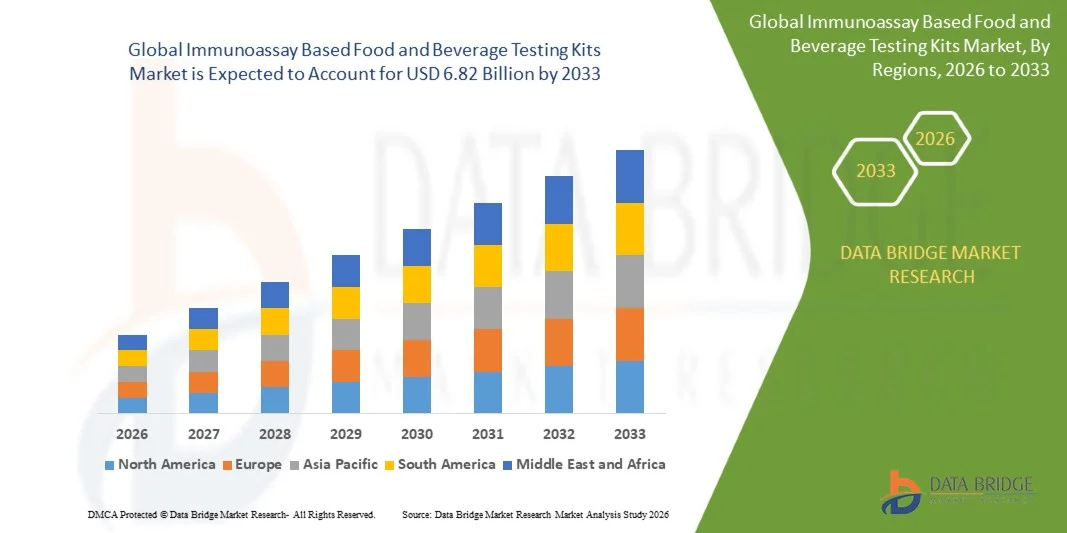
- As per market analysis, the Global Immunoassay Based Food and Beverage Testing Kits market was valued at USD 3.80 billion in 2025 and is projected to reach USD 6.82 Billion by 2033, growing at a CAGR of 7.60% from 2026 to 2033.
- The market is witnessing growth driven by the increasing focus on food safety and quality, rising prevalence of foodborne illnesses and food allergies, stringent food safety regulations, and growing demand for rapid and reliable testing solutions. Immunoassay-based food and beverage testing kits are increasingly being used for the detection of allergens, mycotoxins, pathogens, genetically modified organisms (GMOs), meat species, and other contaminants across different food samples.
- Increasing food safety expenditure, expansion of processed and packaged food production, growing concerns regarding food contamination and adulteration, and rising demand for convenient and rapid testing methods are creating further growth opportunities. Advancements in immunoassay technologies, multiplex testing capabilities, rapid detection methods, and portable testing solutions, along with increasing regulatory emphasis on food quality and traceability, are supporting market development across developed and emerging food and beverage markets..
Market Size & Forecast
- Market Value (2025): USD 3.80 billion
- Expected Market Value (2033): USD 6.82 billion
- Forecast CAGR (2026–2033): 7.60%
- Leading Region in 2025: North America
- Fastest Growing Region: Asia-Pacific
What are the Major Takeaways of the Immunoassay Based Food and Beverage Testing Kits Market?
- North America dominated the global Immunoassay Based Food and Beverage Testing Kits Market, accounting for a 38.46% hypothetical market share in 2025, supported by increasing occurrences of food allergies, established food testing infrastructure, stringent food safety requirements, and the presence of leading food testing companies.
- Asia-Pacific is expected to witness significant growth in the global Immunoassay Based Food and Beverage Testing Kits Market, growing at a hypothetical CAGR of 8.46% from 2026 to 2033, supported by improvements in living standards, expansion of food processing activities, increasing food export activities, and growing awareness regarding food safety and quality testing.
- Meat, Poultry Products represented the leading sample segment, accounting for a 31.72% hypothetical market share in 2025, supported by the increasing need to detect pathogens, allergens, meat species, and other contaminants in animal-based food products.
- Allergens represented the leading target-tested segment, accounting for a 29.64% hypothetical market share in 2025, supported by the increasing prevalence of food allergies and the growing need for rapid detection of allergenic substances in processed and packaged food products.
- Pathogens represented another significant target-tested segment, accounting for a 22.86% hypothetical market share in 2025, supported by increasing concerns regarding foodborne diseases and contamination throughout food processing and distribution chains.
- The Pathogens segment is expected to witness a hypothetical CAGR of 7.64% from 2026 to 2033, driven by increasing demand for rapid and reliable pathogen screening across food manufacturing and testing laboratories.
Report Scope Immunoassay Based Food and Beverage Testing Kits Market Segmentation
|
Attributes |
Immunoassay Based Food and Beverage Testing Kits Market Key Market Insights |
|
Segments Covered |
|
|
Countries Covered |
North America
Europe
Asia-Pacific
Middle East and Africa
South America
|
|
Key Market Players |
|
|
Market Opportunities |
|
|
Value Added Data Infosets |
In addition to the insights on market scenarios such as market value, growth rate, segmentation, geographical coverage, and major players, the market reports curated by the Data Bridge Market Research also include in-depth expert analysis, pricing analysis, brand share analysis, consumer survey, demography analysis, supply chain analysis, value chain analysis, raw material/consumables overview, vendor selection criteria, PESTLE Analysis, Porter Analysis, and regulatory framework. |
What is the Key Trend in the Immunoassay Based Food and Beverage Testing Kits Market?
- Increasing adoption of rapid, on-site, and easy-to-use immunoassay testing solutions is emerging as a key trend in the global Immunoassay Based Food and Beverage Testing Kits Market. Food manufacturers, testing laboratories, and regulatory authorities are increasingly adopting enzyme-linked immunosorbent assay (ELISA) and lateral flow immunoassay (LFIA) technologies for the rapid screening of food allergens, mycotoxins, pathogens, antibiotics, veterinary drug residues, pesticides, and adulterants.
- The trend is particularly relevant to allergen and pathogen detection, where rapid identification can support timely corrective action and reduce the risk of contaminated products entering the food supply chain. Lateral flow immunoassays are increasingly being used for on-site screening because they require limited equipment and can deliver results within minutes, while ELISA-based systems provide quantitative testing capabilities for laboratory and batch-testing applications.
- For instance, in September 2025, the Food Safety and Standards Authority of India (FSSAI) published its updated status of Rapid Analytical Food Testing (RAFT) kits and methods, including immunoassay-based solutions for food safety testing. The list included the Solus Salmonella ELISA, which was recommended as a screening kit for Salmonella spp. in dairy, meat, fish, fruit and vegetable, and egg products.
- Advancements in rapid lateral-flow formats are further supporting the trend toward decentralized food safety testing. In its current food allergen testing portfolio, Neogen provides rapid immunochromatographic lateral-flow kits that can be used with food samples, environmental swabs, and clean-in-place rinse water.
What are the Key Drivers of the Immunoassay Based Food and Beverage Testing Kits Market?
- Increasing prevalence of food allergies and growing demand for rapid allergen detection are emerging as key drivers in the global Immunoassay Based Food and Beverage Testing Kits market. Food manufacturers, testing laboratories, and regulatory authorities are increasingly adopting immunoassay-based technologies such as ELISA and lateral-flow immunoassays to detect allergens including peanut, milk, egg, soy, gluten, tree nuts, and crustaceans.
- The growing need to identify allergenic ingredients and cross-contact during food processing is supporting demand for sensitive, rapid, and easy-to-use testing kits. AOAC INTERNATIONAL has also developed validation guidance specifically for immunoassay-based food allergen methods, supporting greater standardization and reliability of these testing approaches.
- The trend is particularly relevant to rapid and onsite food safety testing, where manufacturers require faster analytical results to identify contamination and support quality-control decisions. Immunochromatographic and lateral-flow testing kits enable testing at different stages of food production without requiring complex laboratory infrastructure.
- In June 2025, the Food Safety and Standards Authority of India (FSSAI) issued validation guidelines for ELISA and lateral-flow immunoassay-based kits used for food analysis. The guidelines cover analytes including food allergens, mycotoxins, antibiotics, veterinary drug residues, pesticides, and adulterants and establish performance criteria for validating immunoassay-based testing methods.
- Expansion of immunoassay applications beyond allergen detection is also creating demand across diverse food and beverage testing applications. Immunoassay-based kits are increasingly used for the detection of mycotoxins, antibiotic and veterinary drug residues, pesticides, adulterants, pathogens, and other contaminants across food matrices.
Which Factors are Challenging the Growth of the Immunoassay Based Food and Beverage Testing Kits Market?
- Complex food matrices and matrix interference represent a major challenge for the global immunoassay based food and beverage testing kits market. Food products contain diverse ingredients such as fats, proteins, spices, colors, gums, and other compounds that can interfere with extraction and antibody-based detection. Processing methods such as heating, fermentation, hydrolysis, and other treatments can modify target proteins and affect their recognition by antibodies, potentially reducing recovery or generating inaccurate results.
- Variability in test performance across food matrices creates challenges for achieving consistent and comparable results. The same immunoassay kit may perform differently depending on whether the sample is raw, processed, fermented, oily, or highly complex. Differences in extraction efficiency, sample preparation, particle distribution, and processing conditions can contribute to variations between test results. The Food Standards Agency has also identified limited cross-evaluation data and differences between kits as an evidence gap.
- Limitations in sensitivity and detection of low-level contamination can create difficulties when testing trace amounts of allergens, toxins, antibiotics, or other target analytes. Very low concentrations require appropriate LOD and LOQ performance, while complex matrices can further affect recovery.
- For instacne, FSSAI's 2025 validation guidance specifies performance characteristics and validation requirements for ELISA and immunochromatography-based kits used for food analysis, while FDA guidance for certain food allergen testing requires confirmation using two validated ELISA kits.
- Single-analyte testing limitations can increase testing time and operational requirements when laboratories need to screen multiple contaminants or allergens. Conventional ELISA-based approaches may require separate tests for individual targets, although multiplex immunoassay technologies are being developed to address this limitation. FDA, for instance, has developed an xMAP food allergen detection assay capable of simultaneously detecting multiple allergens.
How is the Immunoassay Based Food and Beverage Testing Kits Market Segmented?
The market is segmented on the basis of Sample, Target tested.
- By technology
On the basis of sample, the global Immunoassay Based Food and Beverage Testing Kits market is segmented into Meat, Poultry, and Seafood Products, Dairy Products, Packaged Food, Fruits & Vegetables, Cereals, Grains & Pulses, Nuts, Seeds, and Spices, and Others. The Meat, Poultry, and Seafood Products segment is expected to represent a leading sample category, accounting for a 28.46% market share in 2025, supported by increasing food safety testing requirements, rising consumption of animal-based food products, and the need to detect allergens, pathogens, and meat species in complex food matrices. Immunoassay-based kits are increasingly used for rapid screening because they can support routine testing across food processing and quality-control environments.
The Packaged Food segment is expected to witness significant growth during the forecast period, growing at a CAGR of 8.21% from 2026 to 2033, supported by the expansion of processed and packaged food production, increasing requirements for allergen control, and growing emphasis on food labeling and product safety. The increasing complexity of packaged food formulations is also supporting demand for rapid testing solutions capable of screening multiple ingredients and contaminants.
- By Target Tested
On the basis of target tested, the global Immunoassay Based Food and Beverage Testing Kits market is segmented into Allergens, Mycotoxins, Pathogens, GMOs, Meat Species, and Others. The Allergens segment is expected to represent the leading target-tested category, accounting for a 31.72% market share in 2025, supported by the increasing prevalence and awareness of food allergies, stringent allergen-labeling requirements, and the need to prevent cross-contact during food manufacturing. Immunoassay-based methods such as ELISA are widely used for routine allergen screening because they offer sensitivity and suitability for testing different food matrices.
The Pathogens segment is expected to witness significant growth during the forecast period, growing at a CAGR of 8.64% from 2026 to 2033, supported by increasing concerns regarding foodborne illnesses, stringent food safety requirements, and the need for rapid detection of contaminants such as Salmonella, E. coli, and Listeria. Rapid testing solutions can help food manufacturers and laboratories identify potential contamination and support timely quality-control decisions.
Which Region Holds the Largest Share of the Immunoassay Based Food and Beverage Testing Kits Market?
- North America dominated the global Immunoassay Based Food and Beverage Testing Kits market with a 41.28% market share in 2025, supported by the increasing occurrence of food allergies, stringent food safety regulations, established food testing infrastructure, and the presence of major food testing and analytical companies. The region's strong demand for rapid testing of allergens, pathogens, mycotoxins, GMOs, and meat species is also supporting market growth.
- Asia-Pacific is expected to witness the fastest growth in the global Immunoassay Based Food and Beverage Testing Kits market during the forecast period, registering a hypothetical CAGR of 8.64% from 2026 to 2033. Growth is supported by improving food safety infrastructure, rising food exports, increasing packaged food consumption, growing awareness regarding foodborne diseases and allergens, and the expansion of food processing industries. Countries such as China, India, Japan, South Korea, and Australia are contributing to the regional expansion of the market.
U.S. Immunoassay Based Food and Beverage Testing Kits Market Insight
The U.S. Immunoassay Based Food and Beverage Testing Kits market is expanding as food manufacturers, testing laboratories, and regulatory bodies increasingly prioritize rapid and reliable detection of allergens, mycotoxins, pathogens, GMOs, and meat species. Stringent food safety regulations, rising consumer awareness regarding food allergies, and growing concerns about foodborne contamination are supporting demand for immunoassay-based testing solutions. Increasing consumption of processed and packaged foods is further creating testing requirements across diverse food matrices. Technological advancements in ELISA and rapid immunochromatographic testing kits are also supporting efficient quality control and routine food safety monitoring across the U.S. market.
Europe Immunoassay Based Food and Beverage Testing Kits Market Insight
The Europe Immunoassay Based Food and Beverage Testing Kits Market is expanding due to stringent food safety regulations, increasing concerns regarding foodborne diseases, and growing demand for rapid and reliable detection of allergens, mycotoxins, pathogens, GMOs, and meat species. Established food processing industries and advanced laboratory infrastructure are supporting the adoption of immunoassay-based testing solutions across the region. Increasing consumption of processed and packaged foods is further driving routine quality and safety testing. Germany, the United Kingdom, France, Italy, and Spain are among the key markets, supported by strong regulatory compliance, food safety awareness, and expanding analytical testing capabilities.
U.K. Immunoassay Based Food and Beverage Testing Kits Market Insight
The U.K. immunoassay based food and beverage testing kits market is witnessing steady growth, supported by stringent food safety regulations, increasing consumer awareness regarding food allergens, and rising demand for rapid and reliable contaminant detection. Food manufacturers, testing laboratories, and regulatory authorities are increasingly adopting immunoassay-based solutions for detecting allergens, mycotoxins, pathogens, and other target substances across complex food matrices. Growing consumption of packaged and processed foods is further increasing the need for routine quality testing. Advancements in ELISA and rapid immunochromatographic technologies are also supporting faster screening, improved testing efficiency, and enhanced food safety compliance across the U.K.
Germany Immunoassay Based Food and Beverage Testing Kits Market Insight
The Germany immunoassay based food and beverage testing kits market is supported by a well-established food processing industry, stringent food safety regulations, and increasing emphasis on rapid and reliable detection of allergens, mycotoxins, pathogens, GMOs, and meat species. Growing consumer awareness regarding food safety and product traceability is encouraging manufacturers and laboratories to adopt advanced testing technologies. The presence of sophisticated analytical laboratories and strong quality-control practices further supports market development. Increasing demand for processed and packaged foods is also expected to create opportunities for immunoassay-based testing kits across food manufacturing, inspection, and research applications
Asia-Pacific Immunoassay Based Food and Beverage Testing Kits Market Insight
The Asia-Pacific immunoassay based food and beverage testing kits market is experiencing steady expansion, driven by increasing food safety concerns, growing packaged food consumption, expanding food processing industries, and rising regulatory focus on contamination control. Countries such as China, India, Japan, South Korea, and Australia are strengthening food testing capabilities to address allergens, pathogens, mycotoxins, GMOs, and other contaminants. Increasing food exports and the adoption of rapid analytical technologies are further supporting market development. Improvements in laboratory infrastructure, quality-control practices, and awareness regarding foodborne illnesses are expected to create additional opportunities for immunoassay-based testing solutions across the region.
Japan Immunoassay Based Food and Beverage Testing Kits Market Insight
Japan’s immunoassay-based food and beverage testing kits market is supported by stringent food safety regulations, advanced quality-control practices, and strong consumer awareness regarding food contamination. Increasing demand for rapid detection of allergens, mycotoxins, pesticide residues, veterinary drug residues, and other contaminants is encouraging the adoption of immunoassay-based testing solutions among food manufacturers, laboratories, and inspection agencies. Japan’s well-established food processing industry and emphasis on product quality and traceability further contribute to market growth. In addition, technological advancements in rapid, sensitive, and user-friendly testing kits are supporting wider adoption across food production, processing, and distribution environments.
China Immunoassay Based Food and Beverage Testing Kits Market Insight
China’s immunoassay-based food and beverage testing kits market is expanding due to increasing food safety requirements, growing processed food consumption, and stronger regulatory monitoring across the food supply chain. Rising concerns regarding allergens, mycotoxins, veterinary drug residues, pesticides, and microbial contaminants are encouraging food manufacturers and testing laboratories to adopt rapid immunoassay-based screening solutions. Government initiatives aimed at strengthening food safety standards and traceability are further supporting market development. In addition, expanding domestic food processing, export-oriented production, and demand for faster on-site testing are contributing to the adoption of convenient, sensitive, and cost-effective immunoassay testing kits.
Which are the Top Companies in Immunoassay Based Food and Beverage Testing Kits Market?
The Immunoassay Based Food and Beverage Testing Kits market industry is primarily led by well-established companies, including:
- SGS (Switzerland)
- Bureau Veritas (France)
- Eurofins (Luxembourg)
- Intertek (U.K.)
- Mérieux NutriSciences (U.S.)
- ALS Limited (Australia)
- Neogen (U.S.)
- AsureQuality (New Zealand)
- Charm Sciences (U.S.)
- Premier Analytical Services (U.K.)
- Dairyland Laboratories (U.S.)
- Bio-Check (U.K.)
- AES Laboratories (India)
- IEH Laboratories and Consulting Group (U.S.)
- EnviroLogix Inc. (U.S.)
- EMSL Analytical, Inc. (U.S.)
- Krishgen Biosystems (U.S.)
What are Latest Developments in Immunoassay Based Food and Beverage Testing Kits Market?
- In January 2026, Morinaga BioScience launched Rapid Test Easy for Sesame introduced a rapid immunoassay-based test capable of detecting sesame protein residues on food production lines in 10 minutes, addressing growing allergen-control requirements.
- In May 2026, Morinaga BioScience launched Cashew ELISA Kit II ELISA kit was introduced for cashew allergen detection, using the same extraction solution as the company's existing Food Allergen ELISA Kit series to support streamlined laboratory workflows.
- In April 2026, Neogen announced AOAC Performance Tested Methods certification for its enrichment-free Listeria test, which provides results in about two hours and strengthens validation of rapid food-safety testing technologies.
- In January 2025, Neogen launched its Molecular Detection Assay 2 Quantitative Salmonella, combining pathogen detection with quantitative testing capabilities for poultry applications and emphasizing sensitivity, consistency, and workflow efficiency.
- In June 2025, FSSAI strengthened validation guidance for immunoassay-based food-testing kits India’s FSSAI issued validation guidelines covering ELISA and lateral-flow immunoassay methods for food allergens, mycotoxins, antibiotics, veterinary drug residues, pesticides, and adulterants.

- Interactive Data Analysis Dashboard
- Company Analysis Dashboard for high growth potential opportunities
- Research Analyst Access for customization & queries
- Competitor Analysis with Interactive dashboard
- Latest News, Updates & Trend analysis
- Harness the Power of Benchmark Analysis for Comprehensive Competitor Tracking
Global Immunoassay Based Food And Beverage Testing Kits Market, Supply Chain Analysis and Ecosystem Framework
To support market growth and help clients navigate the impact of geopolitical shifts, DBMR has integrated in-depth supply chain analysis into its Global Immunoassay Based Food And Beverage Testing Kits Market research reports. This addition empowers clients to respond effectively to global changes affecting their industries. The supply chain analysis section includes detailed insights such as Global Immunoassay Based Food And Beverage Testing Kits Market consumption and production by country, price trend analysis, the impact of tariffs and geopolitical developments, and import and export trends by country and HSN code. It also highlights major suppliers with data on production capacity and company profiles, as well as key importers and exporters. In addition to research, DBMR offers specialized supply chain consulting services backed by over a decade of experience, providing solutions like supplier discovery, supplier risk assessment, price trend analysis, impact evaluation of inflation and trade route changes, and comprehensive market trend analysis.
Data collection and base year analysis are done using data collection modules with large sample sizes. The stage includes obtaining market information or related data through various sources and strategies. It includes examining and planning all the data acquired from the past in advance. It likewise envelops the examination of information inconsistencies seen across different information sources. The market data is analysed and estimated using market statistical and coherent models. Also, market share analysis and key trend analysis are the major success factors in the market report. To know more, please request an analyst call or drop down your inquiry.
The key research methodology used by DBMR research team is data triangulation which involves data mining, analysis of the impact of data variables on the market and primary (industry expert) validation. Data models include Vendor Positioning Grid, Market Time Line Analysis, Market Overview and Guide, Company Positioning Grid, Patent Analysis, Pricing Analysis, Company Market Share Analysis, Standards of Measurement, Global versus Regional and Vendor Share Analysis. To know more about the research methodology, drop in an inquiry to speak to our industry experts.
Data Bridge Market Research is a leader in advanced formative research. We take pride in servicing our existing and new customers with data and analysis that match and suits their goal. The report can be customized to include price trend analysis of target brands understanding the market for additional countries (ask for the list of countries), clinical trial results data, literature review, refurbished market and product base analysis. Market analysis of target competitors can be analyzed from technology-based analysis to market portfolio strategies. We can add as many competitors that you require data about in the format and data style you are looking for. Our team of analysts can also provide you data in crude raw excel files pivot tables (Fact book) or can assist you in creating presentations from the data sets available in the report.













