


Immunohistochemistry Transmitter Markers Market Overview
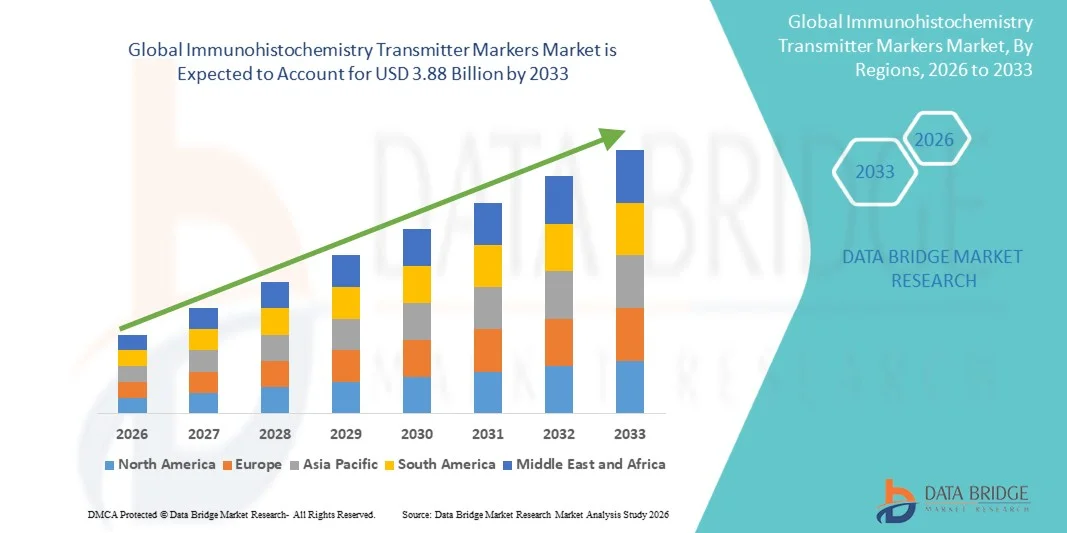
The Immunohistochemistry Transmitter Markers Market was valued at USD 2.69 billion in 2025 and is projected to reach USD 3.88 billion by 2033, growing at a CAGR of 4.70% from 2026 to 2033. The market is experiencing consistent growth driven by the rising prevalence of cancer and chronic diseases, increasing demand for precision diagnostics, and growing adoption of personalized medicine approaches across healthcare systems worldwide.
The growing burden of oncology cases, coupled with advancements in pathology and molecular diagnostics, is encouraging hospitals, diagnostic laboratories, and research institutions to adopt advanced immunohistochemistry (IHC) tumor markers for disease detection and characterization. Immunohistochemistry markers are increasingly being utilized to identify tumor origin, determine disease prognosis, and support targeted treatment decisions, offering highly accurate and reliable diagnostic insights. Furthermore, continuous advancements in biomarker discovery, increasing integration of companion diagnostics in cancer care, and expanding investments in cancer research are accelerating market growth. The rising use of automated staining platforms, digital pathology solutions, and AI-assisted diagnostic technologies is further enhancing the efficiency, reproducibility, and clinical value of immunohistochemistry tumor marker testing across both developed and emerging healthcare markets.
Key Market Trends & Insights
- North America dominated the global Immunohistochemistry Tumor Markers market with the largest revenue share of 38.45% in 2025, supported by advanced healthcare infrastructure, high cancer screening rates, widespread adoption of precision medicine, and significant investments in oncology research and diagnostic technologies.
- The Diagnostics segment dominated the market with a share of 71.36% in 2025 due to the extensive use of immunohistochemistry techniques in cancer detection, tumor classification, prognosis evaluation, and treatment planning.
- Asia-Pacific is expected to be the fastest-growing region at a CAGR of 9.1% from 2026 to 2033, fueled by increasing cancer prevalence, expanding healthcare infrastructure, rising awareness of early disease detection, and growing investments in diagnostic laboratories across China, India, and Japan.
- The CD20 segment is the fastest-growing protein detection category, projected to register a CAGR of 9.4%, reflecting the increasing utilization of immunohistochemistry in lymphoma diagnosis, targeted therapy selection, and hematological cancer research.
- The Diagnostics segment dominates the application category with a 71.36% revenue share in 2025, driven by the extensive use of immunohistochemistry tumor markers in cancer detection, tumor classification, disease staging, and personalized treatment planning.
- Hospitals and Diagnostic Centers account for 64.58% of the market in 2025, supported by growing patient volumes, increasing adoption of advanced pathology testing, and the availability of specialized oncology diagnostic services.
- The Reagents segment is anticipated to be the fastest-growing product category, with a CAGR of 8.8%, driven by rising testing volumes, increasing demand for standardized diagnostic procedures, and continuous advancements in immunohistochemistry assay technologies.
Market Size & Forecast
- Global Market Value (2025): USD 2.69 Billion
- Expected Market Value (2033): USD 3.88 Billion
- Forecast CAGR (2026–2033): 4.70%
- Leading Region in 2025: North America
- Fastest Growing Region: Asia-Pacific
Report Scope and Immunohistochemistry Transmitter Markers Market Segmentation
|
Attributes |
Immunohistochemistry Transmitter Markers Key Market Insights |
|
Segments Covered |
|
|
Countries Covered |
North America · U.S. · Canada · Mexico Europe · Germany · France · U.K. · Netherlands · Switzerland · Belgium · Russia · Italy · Spain · Turkey · Rest of Europe Asia-Pacific · China · Japan · India · South Korea · Singapore · Malaysia · Australia · Thailand · Indonesia · Philippines · Rest of Asia-Pacific Middle East and Africa · Saudi Arabia · U.A.E. · South Africa · Egypt · Israel · Rest of Middle East and Africa South America · Brazil · Argentina · Rest of South America |
|
Key Market Players |
• Agilent Technologies, Inc. (U.S.) |
|
Market Opportunities |
· Growing Adoption of Personalized Medicine and Companion Diagnostics · Expansion of Cancer Diagnostic Infrastructure in Emerging Markets · Advancements in Digital Pathology and AI-Assisted Diagnostics |
|
Value Added Data Infosets |
In addition to the insights on market scenarios such as market value, growth rate, segmentation, geographical coverage, and major players, the market reports curated by the Data Bridge Market Research also include in-depth expert analysis, geographically represented company-wise production and capacity, network layouts of distributors and partners, detailed and updated price trend analysis and deficit analysis of supply chain and demand. |
Immunohistochemistry Transmitter Markers Market Trends
Trend: Rising Adoption of Digital Pathology and AI-Enabled Cancer Diagnostics
Healthcare providers and pathology laboratories are increasingly adopting digital pathology and artificial intelligence technologies to enhance the accuracy, efficiency, and reproducibility of immunohistochemistry (IHC) tumor marker analysis. Digital slide scanners, automated image analysis software, and AI-assisted diagnostic platforms are helping pathologists identify biomarker expression patterns more rapidly and consistently. These technologies are particularly valuable in oncology, where precise biomarker assessment is critical for treatment selection and disease prognosis. The growing integration of digital pathology workflows with immunohistochemistry testing is improving diagnostic turnaround times while supporting the broader shift toward precision medicine and data-driven cancer care.
Immunohistochemistry Transmitter Markers Market Dynamics
Key Market Driver: Increasing Global Cancer Burden and Demand for Precision Oncology
The rising incidence of cancer worldwide is a major driver of the global Immunohistochemistry Tumor Markers market. Immunohistochemistry markers play a critical role in tumor identification, classification, prognosis assessment, and therapeutic decision-making. According to the World Health Organization (WHO), cancer remains one of the leading causes of death globally, with millions of new cancer cases diagnosed annually. Biomarkers such as Cytokeratins, CD20, CD34, Vimentin, and HMB-45 are increasingly utilized to differentiate tumor types and support targeted treatment strategies. Hospitals, diagnostic laboratories, and cancer research institutions are expanding the use of IHC testing to improve diagnostic accuracy and facilitate personalized medicine approaches. The growing adoption of companion diagnostics alongside targeted therapies is further strengthening market demand.
Key Restraint/Challenge: High Cost and Technical Complexity of Advanced Immunohistochemistry Testing
A significant challenge in the global Immunohistochemistry Tumor Markers market is the high cost associated with advanced testing systems, specialized reagents, and automated staining equipment. Establishing and maintaining modern pathology laboratories requires substantial investments in instruments, antibodies, reagents, quality assurance programs, and skilled personnel. In addition, variability in staining protocols, interpretation standards, and laboratory infrastructure can impact test consistency and reproducibility. Smaller healthcare facilities and laboratories in developing regions often face difficulties in adopting advanced immunohistochemistry technologies due to budget constraints and limited access to trained pathology professionals.
For instance, the growing adoption of fully automated immunohistochemistry platforms from leading diagnostics companies has improved testing efficiency but has also increased capital expenditure requirements, creating adoption challenges for resource-constrained healthcare settings.
Key Market Opportunity: Expansion of Companion Diagnostics and Biomarker-Based Cancer Therapies
The increasing use of companion diagnostics and biomarker-guided therapies presents a significant growth opportunity for the Immunohistochemistry Tumor Markers market. Pharmaceutical companies and diagnostic manufacturers are increasingly collaborating to develop targeted oncology treatments that require biomarker testing for patient selection. Immunohistochemistry remains one of the most widely used techniques for evaluating biomarker expression in cancers such as breast cancer, lung cancer, lymphoma, melanoma, and colorectal cancer.
For instance, HER2, PD-L1, and CD20 biomarker testing are increasingly used to identify patients who may benefit from specific targeted therapies and immunotherapies. The continued expansion of personalized medicine, rising investments in cancer biomarker research, and growing adoption of companion diagnostic testing across developed and emerging healthcare markets are expected to create substantial opportunities for market participants throughout the forecast period.
Immunohistochemistry Transmitter Markers Market Scope
The Global Immunohistochemistry Tumor Markers market is segmented on the basis of product, protein detection, application, and end-users.
- By Product
On the basis of product, the global Immunohistochemistry Tumor Markers market is segmented into Antibodies, Equipment, and Reagents. The Antibodies segment dominated the market with a share of 46.82% in 2025 due to its critical role in identifying and detecting specific tumor-associated antigens in tissue samples. Antibodies form the foundation of immunohistochemistry testing and are extensively utilized across cancer diagnosis, tumor classification, biomarker validation, and companion diagnostic applications. The increasing prevalence of cancer worldwide, coupled with growing adoption of precision medicine, has significantly increased demand for highly specific monoclonal and polyclonal antibodies. Continuous advancements in antibody development technologies, rising investments in oncology research, and expanding utilization of biomarker-based treatment strategies are further supporting segment growth. In addition, the growing use of antibodies in research laboratories, academic institutions, and clinical pathology settings reinforces their dominant position in the global market.
The Reagents segment is expected to witness the fastest CAGR of 8.8% from 2026 to 2033, driven by increasing testing volumes and growing demand for standardized diagnostic procedures. Reagents are essential components in staining, visualization, and antigen detection processes, making them indispensable for immunohistochemistry workflows. Rising adoption of automated staining platforms and increasing implementation of high-throughput diagnostic systems are accelerating reagent consumption globally. Furthermore, ongoing innovations in detection chemistries, chromogenic substrates, and multiplex immunohistochemistry technologies are enhancing test sensitivity and efficiency. Growing demand for accurate cancer diagnostics, coupled with expanding pathology laboratory infrastructure across emerging economies, is expected to further drive reagent market growth throughout the forecast period.
- By Protein Detection
On the basis of protein detection, the global Immunohistochemistry Tumor Markers market is segmented into Cytokeratins, Vimentin, Leukocyte Common Antigen, CD20, CD34, Smooth Muscle Actin, Desmin, S-100, and HMB-45. The Cytokeratins segment dominated the market with a share of 28.94% in 2025 due to its widespread use in identifying epithelial-origin tumors and differentiating carcinomas from other malignancies. Cytokeratin markers are routinely employed in pathology laboratories for diagnosing breast cancer, lung cancer, colorectal cancer, and several other epithelial cancers. Their high diagnostic value, broad clinical applicability, and extensive use in tumor classification have contributed significantly to market dominance. Increasing cancer incidence rates and growing demand for precise histopathological diagnosis continue to drive adoption. Furthermore, advancements in biomarker research and increasing use of cytokeratin panels in oncology diagnostics further strengthen the segment's leading position.
The CD20 segment is expected to witness the fastest CAGR of 9.4% from 2026 to 2033, driven by growing applications in lymphoma diagnosis and targeted cancer therapies. CD20 biomarkers are widely used in identifying B-cell lymphomas and determining eligibility for monoclonal antibody therapies. The increasing prevalence of hematological malignancies, expanding use of immunotherapies, and growing emphasis on personalized oncology treatment are supporting rapid segment growth. In addition, pharmaceutical companies are increasingly developing targeted therapies requiring CD20 biomarker evaluation, thereby increasing testing demand. Continuous advancements in companion diagnostics and biomarker-guided treatment approaches are expected to accelerate adoption throughout the forecast period.
- By Application
On the basis of application, the global Immunohistochemistry Tumor Markers market is segmented into Diagnostics and Drug Testing. The Diagnostics segment dominated the market with a share of 71.36% in 2025 due to the extensive use of immunohistochemistry techniques in cancer detection, tumor classification, prognosis evaluation, and treatment planning. Hospitals, pathology laboratories, and diagnostic centers rely heavily on IHC tumor markers for accurate identification of various cancers. The increasing prevalence of cancer worldwide, rising awareness regarding early disease detection, and growing demand for personalized medicine are driving segment growth. Furthermore, advancements in automated staining systems, digital pathology, and biomarker discovery are improving diagnostic accuracy and workflow efficiency. The critical role of diagnostics in clinical decision-making continues to reinforce the segment's dominant market position.
The Drug Testing segment is anticipated to witness the fastest CAGR of 8.5% from 2026 to 2033, driven by increasing pharmaceutical research and development activities focused on targeted therapies and immuno-oncology drugs. Immunohistochemistry markers play a crucial role in evaluating drug efficacy, biomarker expression, and patient selection during clinical trials. Growing investments in oncology drug development and rising adoption of companion diagnostics are accelerating demand for IHC-based drug testing applications. In addition, increasing collaboration between pharmaceutical companies and diagnostic developers is supporting biomarker-driven therapeutic strategies. These factors are expected to significantly contribute to segment expansion over the forecast period.
- By End-Users
On the basis of end-users, the global Immunohistochemistry Tumor Markers market is segmented into Hospitals and Diagnostic Centers, Research Institutes, and Other End-Users. The Hospitals and Diagnostic Centers segment dominated the market with a share of 64.58% in 2025 due to the high volume of cancer diagnostic procedures performed in these settings. Hospitals and diagnostic laboratories serve as the primary centers for immunohistochemistry testing, offering comprehensive pathology services and advanced cancer diagnostic capabilities. Growing patient populations, increasing cancer screening programs, and rising adoption of precision medicine approaches are driving demand for IHC tumor marker testing. In addition, investments in laboratory automation, digital pathology infrastructure, and advanced diagnostic technologies are improving testing efficiency and accuracy. The availability of skilled pathologists and specialized oncology services further reinforces the segment's leadership position.
The Research Institutes segment is expected to witness the fastest CAGR of 8.7% from 2026 to 2033, driven by increasing investments in cancer biomarker discovery, translational research, and precision oncology studies. Research organizations are extensively utilizing immunohistochemistry techniques to investigate disease mechanisms, validate biomarkers, and develop novel therapeutic targets. Growing funding from government agencies, academic institutions, and biotechnology companies is supporting research activities globally. In addition, advances in molecular pathology, digital imaging technologies, and multiplex biomarker analysis are expanding research applications of immunohistochemistry. These developments are expected to significantly accelerate growth within the research institute segment during the forecast period.
Immunohistochemistry Transmitter Markers Market Regional Analysis
North America dominated the Immunohistochemistry Tumor Markers market and accounted for the largest revenue share of 38.45% in 2025, supported by advanced healthcare infrastructure, high cancer screening rates, widespread adoption of precision medicine, and significant investments in oncology research and diagnostic technologies. The region benefits from a strong presence of leading diagnostic companies, well-established pathology laboratories, and favorable reimbursement frameworks. Increasing utilization of biomarker-based testing, companion diagnostics, and personalized cancer treatment approaches continues to strengthen North America's leadership position in the global market.
U.S. Immunohistochemistry Transmitter Markers Market Insight
The U.S. Immunohistochemistry Tumor Markers market is witnessing strong growth due to the rising prevalence of cancer, increasing adoption of personalized medicine, and substantial investments in oncology research. The country's advanced healthcare ecosystem, combined with widespread implementation of biomarker testing and companion diagnostics, is driving demand for immunohistochemistry tumor markers across hospitals, diagnostic laboratories, and research institutions. In addition, growing use of targeted therapies and immunotherapies is accelerating the need for accurate tumor marker identification and characterization.
Europe Immunohistochemistry Transmitter Markers Market Insight
The Europe Immunohistochemistry Tumor Markers market remains a major contributor to global revenue, driven by strong healthcare infrastructure, increasing cancer awareness, and rising investments in precision oncology. The widespread adoption of advanced pathology technologies and standardized cancer diagnostic protocols is supporting market growth across the region. Furthermore, government-backed cancer screening programs, expanding biomarker research activities, and growing demand for personalized treatment strategies continue to enhance the adoption of immunohistochemistry tumor markers throughout Europe.
U.K. Immunohistochemistry Transmitter Markers Market Insight
The U.K. Immunohistochemistry Tumor Markers market is experiencing steady growth, supported by increasing cancer incidence, strong focus on early disease detection, and growing adoption of advanced diagnostic technologies. Hospitals and pathology laboratories are increasingly implementing immunohistochemistry testing for accurate tumor classification and treatment planning. In addition, rising investments in cancer research, precision medicine initiatives, and digital pathology solutions are contributing significantly to market expansion in the country.
Germany Immunohistochemistry Transmitter Markers Market Insight
The Germany Immunohistochemistry Tumor Markers market is expanding steadily due to its advanced healthcare system, strong biomedical research capabilities, and growing emphasis on personalized cancer care. Diagnostic laboratories and healthcare providers are increasingly utilizing immunohistochemistry markers for tumor identification, prognosis evaluation, and targeted therapy selection. Continuous advancements in molecular pathology, biomarker discovery, and laboratory automation technologies are further supporting market growth across Germany.
Asia-Pacific Immunohistochemistry Transmitter Markers Market Insight
The Asia-Pacific Immunohistochemistry Tumor Markers market is expected to witness the fastest growth at a CAGR of 9.1% from 2026 to 2033, driven by increasing cancer prevalence, expanding healthcare infrastructure, and rising awareness regarding early disease detection. Growing investments in diagnostic laboratories, improving access to advanced pathology services, and increasing adoption of precision medicine are supporting market expansion across countries such as China, India, and Japan. In addition, government initiatives focused on cancer screening and healthcare modernization are accelerating the adoption of immunohistochemistry-based diagnostic solutions throughout the region.
Japan Immunohistochemistry Transmitter Markers Market Insight
The Japan Immunohistochemistry Tumor Markers market is witnessing consistent growth due to increasing investments in cancer diagnostics, expanding precision medicine initiatives, and growing adoption of advanced pathology technologies. Healthcare providers and research institutions are increasingly utilizing immunohistochemistry markers for accurate tumor diagnosis and treatment selection. Moreover, the country's strong focus on healthcare innovation and early cancer detection programs is further contributing to market growth.
China Immunohistochemistry Transmitter Markers Market Insight
The China Immunohistochemistry Tumor Markers market is growing rapidly, driven by rising cancer incidence, expanding healthcare expenditure, and increasing investments in diagnostic infrastructure. The growing adoption of advanced pathology technologies, increasing awareness regarding cancer screening, and expanding access to healthcare services are significantly boosting market demand. In addition, strong government support for healthcare modernization, increasing oncology research activities, and rising implementation of precision medicine approaches are positioning China as one of the fastest-growing markets for immunohistochemistry tumor markers globally.
Immunohistochemistry Transmitter Markers Market Share
The Immunohistochemistry Transmitter Markers industry is primarily led by well-established companies, including:
- Agilent Technologies, Inc. (U.S.)
- Danaher Corporation (Leica Biosystems) (U.S.)
- F. Hoffmann-La Roche Ltd. (Switzerland)
- Merck KGaA (Germany)
- Thermo Fisher Scientific Inc. (U.S.)
- Bio-Rad Laboratories, Inc. (U.S.)
- PerkinElmer, Inc. (U.S.)
- BioGenex Laboratories, Inc. (U.S.)
- Abcam plc (U.K.)
- Cell Signaling Technology, Inc. (U.S.)
- Vector Laboratories, Inc. (U.S.)
- GenScript Biotech Corporation (China)
- Rockland Immunochemicals, Inc. (U.S.)
- Jackson ImmunoResearch Laboratories, Inc. (U.S.)
- Sakura Finetek Japan Co., Ltd. (Japan)
- FUJIFILM Holdings Corporation (Japan)
- Biocare Medical, LLC (U.S.)
- Creative Diagnostics (U.S.)
- Boster Biological Technology Co., Ltd. (China)
- GeneTex, Inc. (U.S.)
- Proteintech Group, Inc. (U.S.)
- Bio SB, Inc. (U.S.)
- Santa Cruz Biotechnology, Inc. (U.S.)
- Novus Biologicals, LLC (U.S.)
- Sino Biological Inc. (China)
- Diagnostic BioSystems, Inc. (U.S.)
- Cell Marque Corporation (U.S.)
- PharMingen (BD Biosciences) (U.S.)
- NeoGenomics Laboratories, Inc. (U.S.)
- Quest Diagnostics Incorporated (U.S.)
- Laboratory Corporation of America Holdings (Labcorp) (U.S.)
- Sysmex Corporation (Japan)
- Shimadzu Corporation (Japan)
- Bio-Techne Corporation (U.S.)
- Takara Bio Inc. (Japan)
Latest Developments in Immunohistochemistry Transmitter Markers Market
- In April 2023, Leica Biosystems announced the European launch of BOND-PRIME, an advanced automated staining solution designed to improve immunohistochemistry (IHC) workflow efficiency and diagnostic productivity. The platform offers an average IHC slide turnaround time of approximately 90 minutes and supports continuous workflow optimization for pathology laboratories
- In April 2023, Leica Biosystems received U.S. FDA 510(k) clearance for its BOND MMR Antibody Panel, an immunohistochemistry-based mismatch repair (MMR) testing solution used to screen colorectal cancer patients for probable Lynch syndrome. The panel is compatible with the company's BOND-III and BOND-MAX automated IHC systems
- In June 2022, Agilent Technologies announced that South Korea’s Ministry of Food and Drug Safety (MFDS) approved PD-L1 IHC 22C3 pharmDx on the Dako Omnis platform as a companion diagnostic for identifying non-small cell lung cancer (NSCLC) patients eligible for first-line treatment with KEYTRUDA (pembrolizumab)
- In September 2024, Roche announced that the U.S. FDA approved Tecentriq Hybreza (atezolizumab and hyaluronidase-tqjs), expanding the use of PD-L1-related biomarker-driven cancer treatment strategies. The approval further strengthened the importance of immunohistochemistry-based PD-L1 testing in patient selection for immunotherapy
- In September 2025, Agilent Technologies introduced three new models within its Dako Omnis family of instruments—Dako Omnis 110, 165, and 165 Duo—to help pathology laboratories improve workflow flexibility, staining efficiency, and diagnostic capacity for immunohistochemistry and in situ hybridization applications
- In July 2025, Leica Biosystems launched ChromoPlex III Triple Detection RUO, a chromogenic multiplex immunohistochemistry detection system designed to simplify multiplex IHC workflows and support digital pathology and spatial biology research. The system enables reproducible multi-marker tissue analysis while reducing assay variability

- Interactive Data Analysis Dashboard
- Company Analysis Dashboard for high growth potential opportunities
- Research Analyst Access for customization & queries
- Competitor Analysis with Interactive dashboard
- Latest News, Updates & Trend analysis
- Harness the Power of Benchmark Analysis for Comprehensive Competitor Tracking
Data collection and base year analysis are done using data collection modules with large sample sizes. The stage includes obtaining market information or related data through various sources and strategies. It includes examining and planning all the data acquired from the past in advance. It likewise envelops the examination of information inconsistencies seen across different information sources. The market data is analysed and estimated using market statistical and coherent models. Also, market share analysis and key trend analysis are the major success factors in the market report. To know more, please request an analyst call or drop down your inquiry.
The key research methodology used by DBMR research team is data triangulation which involves data mining, analysis of the impact of data variables on the market and primary (industry expert) validation. Data models include Vendor Positioning Grid, Market Time Line Analysis, Market Overview and Guide, Company Positioning Grid, Patent Analysis, Pricing Analysis, Company Market Share Analysis, Standards of Measurement, Global versus Regional and Vendor Share Analysis. To know more about the research methodology, drop in an inquiry to speak to our industry experts.
Data Bridge Market Research is a leader in advanced formative research. We take pride in servicing our existing and new customers with data and analysis that match and suits their goal. The report can be customized to include price trend analysis of target brands understanding the market for additional countries (ask for the list of countries), clinical trial results data, literature review, refurbished market and product base analysis. Market analysis of target competitors can be analyzed from technology-based analysis to market portfolio strategies. We can add as many competitors that you require data about in the format and data style you are looking for. Our team of analysts can also provide you data in crude raw excel files pivot tables (Fact book) or can assist you in creating presentations from the data sets available in the report.













