


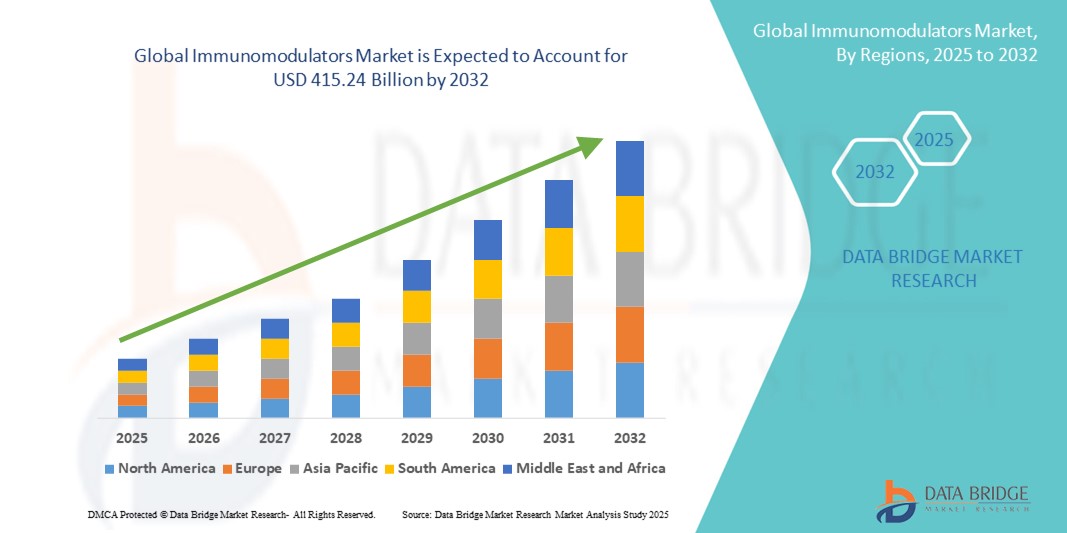
Immunomodulators Market Size
- The global immunomodulators market size was valued at USD 247.16 billion in 2024 and is expected to reach USD 415.24 billion by 2032, at a CAGR of 6.70% during the forecast period
- The market growth is largely fueled by the increasing prevalence of autoimmune diseases, cancer, and chronic inflammatory conditions, which are driving higher demand for advanced immunomodulatory therapies. Rising global disease burden has created a strong clinical need for effective treatment options, thereby accelerating market expansion
- Furthermore, ongoing technological progress in biologics, monoclonal antibodies, and cell-based therapies is enhancing the efficacy and safety of immunomodulators. Alongside this, growing patient demand for targeted, user-friendly, and integrated therapeutic solutions is establishing immunomodulators as a preferred treatment approach across multiple indications, significantly boosting the industry's growth
Immunomodulators Market Analysis
- Immunomodulators, which regulate or modify the immune system response, are increasingly vital components of therapeutic regimens across autoimmune diseases, cancers, and transplant medicine in both hospital and outpatient settings
- The escalating demand for immunomodulators is primarily fueled by rising prevalence of chronic and autoimmune diseases, advancements in drug development, and growing adoption of targeted immunotherapies offering improved efficacy and safety profiles
- North America dominated the immunomodulators market with the largest revenue share of 39.8% in 2024, driven by high healthcare expenditure, well-established pharmaceutical infrastructure, and strong presence of key biopharmaceutical companies pioneering innovative immunomodulatory treatments. The U.S. experienced substantial market growth fueled by clinical advancements and increasing approvals of novel immunomodulatory drugs
- Asia-Pacific is expected to be the fastest growing region in the Immunomodulators market during the forecast period, owing to increasing urbanization, expanding healthcare access, rising disposable incomes, and growing awareness of immunotherapy benefits in countries such as China and India
- The immunosuppressant segment dominated the immunomodulators market with the largest market revenue share of 52.8% in 2024, driven by their widespread use in organ transplantation, autoimmune diseases, and chronic inflammatory disorders
Report Scope and Immunomodulators Market Segmentation
|
Attributes |
Immunomodulators Key Market Insights |
|
Segments Covered |
|
|
Countries Covered |
North America
Europe
Asia-Pacific
Middle East and Africa
South America
|
|
Key Market Players |
|
|
Market Opportunities |
|
|
Value Added Data Infosets |
In addition to the insights on market scenarios such as market value, growth rate, segmentation, geographical coverage, and major players, the market reports curated by the Data Bridge Market Research also include in-depth expert analysis, pricing analysis, brand share analysis, consumer survey, demography analysis, supply chain analysis, value chain analysis, raw material/consumables overview, vendor selection criteria, PESTLE Analysis, Porter Analysis, and regulatory framework. |
Immunomodulators Market Trends
Expanding Role of Immunomodulators in Chronic Disease Management
- A significant and accelerating trend in the global Immunomodulators market is the increasing use of these therapies in the treatment and management of chronic diseases, including autoimmune disorders, cancer, and infectious diseases. The ability of immunomodulators to regulate or enhance immune responses makes them crucial in both life-saving treatments and long-term disease control
- For instance, in April 2023, Bristol Myers Squibb announced new clinical data supporting the use of immunomodulatory drugs in advanced multiple sclerosis and lupus patients. These developments highlight the expanding clinical utility of immunomodulators beyond traditional autoimmune disease indications
- Advances in biotechnology and molecular diagnostics are enabling more precise targeting of immune pathways, thereby improving efficacy and reducing adverse effects. This has led to an increase in both pipeline development and approvals for novel immunomodulatory therapies across oncology, rheumatology, and infectious diseases
- Furthermore, ongoing R&D efforts and collaborations between pharmaceutical companies and academic institutions are driving the introduction of next-generation immunomodulators. These innovations are expected to offer improved therapeutic outcomes, reduced treatment costs, and greater accessibility for patients worldwide
- The increasing demand for effective, durable, and safer treatment options is encouraging the adoption of immunomodulators in both developed and emerging markets. This growth is further supported by the rise in patient awareness, favorable reimbursement policies, and global government initiatives aimed at tackling chronic and infectious diseases
- This trend toward broader and more effective clinical applications of immunomodulators is fundamentally reshaping treatment paradigms across multiple therapeutic areas. Consequently, major pharmaceutical companies such as Roche, Novartis, and Pfizer are actively investing in clinical research, strategic partnerships, and product launches to strengthen their positions in the global immunomodulators market
Immunomodulators Market Dynamics
Driver
Growing Need Due to Rising Incidence of Chronic and Infectious Diseases
- The increasing prevalence of chronic conditions such as autoimmune disorders, cancer, and respiratory illnesses, along with the ongoing burden of infectious diseases, is a significant driver for the heightened demand for immunomodulators
- For instance, in 2023, the World Health Organization (WHO) highlighted that autoimmune diseases are on the rise globally, driving a greater need for advanced therapeutic solutions. Such developments are expected to fuel growth in the immunomodulators industry during the forecast period
- As patients and healthcare providers continue to seek more effective treatment options, immunomodulators provide targeted therapies that regulate immune responses, making them essential in managing conditions such as rheumatoid arthritis, multiple sclerosis, HIV, and various cancers
- Furthermore, the expanding use of biologics and biosimilars is strengthening the market, as these therapies offer higher efficacy with fewer side effects compared to conventional treatments. This, combined with growing clinical trial activity and product approvals, is significantly broadening the adoption of immunomodulators across therapeutic areas
- The increasing availability of treatment guidelines recommending immunomodulators, coupled with heightened awareness among physicians and patients, is accelerating their adoption in both developed and emerging regions. In addition, healthcare system initiatives supporting innovative therapies are expected to contribute to sustained market expansion
- The trend toward precision medicine and the integration of immunomodulators into combination therapies is further propelling the market, positioning these drugs as a cornerstone of modern treatment strategies
Restraint/Challenge
Concerns Regarding Adverse Effects and High Treatment Costs
- Despite their clinical benefits, concerns surrounding the potential adverse effects of immunomodulators pose a significant challenge to broader market penetration. Long-term use can sometimes lead to immune suppression, increasing the risk of infections, cancers, or other complications, which raises caution among both patients and healthcare providers
- For instance, studies have reported that certain immunosuppressants, while effective in disease management, can make patients more vulnerable to opportunistic infections, thereby requiring close monitoring and limiting their use in some populations
- Addressing these safety concerns through the development of next-generation therapies with improved safety profiles and targeted delivery mechanisms is crucial for increasing patient confidence and treatment uptake
- In addition, the relatively high treatment costs of advanced immunomodulators compared to traditional drugs can be a barrier to adoption, particularly in developing regions with limited healthcare budgets or among patients without robust insurance coverage
- While biosimilars are helping to reduce costs and expand accessibility, the perceived premium pricing for cutting-edge biologics and novel immunotherapies continues to hinder widespread adoption, especially in price-sensitive markets
- Overcoming these challenges through healthcare reimbursement reforms, increased production of cost-effective biosimilars, and continuous R&D for safer formulations will be vital for ensuring sustained market growth and broader patient access
Immunomodulators Market Scope
The market is segmented on the basis of Product, Application, End Users, and Distribution Channel.
- By Product
On the basis of product, the immunomodulators market is segmented into immunosuppressants, immunostimulants, and others. The immunosuppressant segment dominated the largest market revenue share of 52.8% in 2024, driven by their widespread use in organ transplantation, autoimmune diseases, and chronic inflammatory disorders. The rising incidence of conditions such as rheumatoid arthritis, multiple sclerosis, and Crohn’s disease has fueled demand for immunosuppressants as frontline therapies. In addition, advancements in biologics and the launch of novel monoclonal antibodies have significantly expanded their applications, further consolidating their market leadership. Robust clinical guidelines supporting immunosuppressant usage and their integration into long-term treatment regimens strengthen this dominance globally.
The immunostimulants segment is anticipated to witness the fastest growth rate of 14.9% CAGR from 2025 to 2032, fueled by the increasing prevalence of infectious diseases, cancer, and the growing focus on vaccine adjuvants. Immunostimulants enhance immune defense mechanisms, making them crucial in oncology treatments and preventive care. Moreover, the expanding pipeline of immuno-oncology drugs and government-funded immunization programs is accelerating adoption. The rising interest in natural immunostimulants, coupled with heightened awareness of immune health after the COVID-19 pandemic, further propels this segment’s growth trajectory.
- By Application
On the basis of application, the immunomodulators market is segmented into respiratory, human immunodeficiency virus (HIV), oncology, and others. The oncology segment accounted for the largest market revenue share of 41.3% in 2024, supported by the rising burden of cancer cases worldwide and the increasing reliance on immunotherapy as a core treatment strategy. Immunomodulators, including checkpoint inhibitors and cytokine-based therapies, play a crucial role in managing various cancers, particularly melanoma, lung cancer, and hematologic malignancies. Growing FDA and EMA approvals for novel immuno-oncology drugs, combined with heavy R&D investments by pharmaceutical companies, continue to drive this segment’s market dominance.
The human immunodeficiency virus (HIV) segment is projected to witness the fastest CAGR of 15.2% from 2025 to 2032, driven by the urgent need for effective long-term therapies to control viral replication and manage immune function. Immunomodulators are being increasingly integrated into HIV treatment regimens, particularly in cases resistant to conventional antiretroviral therapy. Ongoing clinical trials exploring therapeutic vaccines and immune-boosting drugs are also accelerating growth in this segment. In addition, global initiatives aimed at eradicating HIV, along with increasing access to advanced treatments in low- and middle-income countries, are fueling the rapid expansion of this market area.
- By End Users
On the basis of end users, the immunomodulators market is segmented into hospitals, homecare, specialty clinics, and others. The hospital segment dominated the market with a revenue share of 48.6% in 2024, owing to the high patient inflow, advanced infrastructure, and the availability of multidisciplinary care required for immunomodulator therapies. Hospitals serve as primary centers for diagnosis, treatment, and clinical trials, ensuring access to a wide range of immunomodulatory drugs. In addition, the administration of biologics and infusion therapies often requires hospital-based settings, further strengthening this segment’s market leadership.
The homecare segment is expected to record the fastest CAGR of 13.7% from 2025 to 2032, driven by the rising adoption of self-administration therapies, patient-centric care models, and the convenience of at-home treatment. Growing availability of oral and subcutaneous formulations of immunomodulators allows patients to manage chronic conditions outside clinical settings. Furthermore, the expansion of telemedicine, home infusion services, and healthcare delivery technologies is fostering faster adoption of immunomodulator therapies in homecare environments.
- By Distribution Channel
On the basis of distribution channel, the immunomodulators market is segmented into hospital pharmacy, online pharmacy, retail pharmacy, and others. The hospital pharmacy segment dominated the largest revenue share of 46.9% in 2024, supported by the centralized procurement of high-value biologics and specialty drugs, which are predominantly dispensed through hospital networks. Hospitals often serve as the primary point of access for complex immunomodulator therapies, especially for patients requiring close monitoring and infusion-based treatments. Strong collaborations between pharmaceutical companies and hospital pharmacies further consolidate this segment’s leading position.
The online pharmacy segment is expected to witness the fastest CAGR of 16.4% from 2025 to 2032, propelled by the rising adoption of e-commerce platforms, digital health initiatives, and patient preference for convenient medicine delivery. The increasing availability of prescription-based specialty drugs via online channels, supported by regulatory approvals and improved digital infrastructure, is significantly boosting growth. Furthermore, expanding internet penetration in emerging economies and the rising trend of direct-to-patient delivery models are accelerating the adoption of online pharmacies for immunomodulators.
Immunomodulators Market Regional Analysis
- North America dominated the immunomodulators market with the largest revenue share of 39.8% in 2024, supported by high healthcare expenditure, a strong biopharmaceutical ecosystem, and advanced research infrastructure
- The region benefits from the presence of leading pharmaceutical and biotechnology companies actively engaged in the development and commercialization of novel immunomodulatory therapies. Rising prevalence of autoimmune disorders, cancer, and infectious diseases has fueled demand for innovative immunotherapy solutions
- In addition, favorable regulatory frameworks and substantial investments in R&D continue to support product innovation and early adoption of advanced treatment options
U.S. Immunomodulators Market Insight
The U.S. immunomodulators market accounted for 78% of the North American market in 2024, driven by the increasing number of clinical trials, rapid regulatory approvals of breakthrough immunotherapies, and growing adoption of personalized medicine. Strong collaborations between research institutions and pharmaceutical companies have accelerated the development of next-generation immunomodulators. Furthermore, the rise in patient awareness, supportive insurance coverage, and availability of advanced healthcare facilities significantly enhance market penetration in the country.
Europe Immunomodulators Market Insight
The Europe immunomodulators market is projected to witness steady growth during the forecast period, fueled by robust healthcare infrastructure, strong government support for biologics, and rising demand for effective treatments against chronic conditions such as rheumatoid arthritis and multiple sclerosis. The region’s regulatory agencies have played a pivotal role in ensuring the timely approval of novel therapies, thereby increasing patient access. Countries such as Germany, France, and the U.K. are at the forefront of clinical adoption, with investments in biotechnology hubs further propelling growth.
U.K. Immunomodulators Market Insight
The U.K. immunomodulators market is anticipated to grow at a notable CAGR during the forecast period, driven by the country’s focus on research excellence, adoption of advanced biologics, and the rise of precision medicine. Increasing incidence of autoimmune diseases and favorable government initiatives supporting clinical research and healthcare digitization contribute to accelerated adoption of immunomodulatory treatments.
Germany Immunomodulators Market Insight
The Germany immunomodulators market is expected to experience considerable growth in the coming years, supported by strong pharmaceutical manufacturing capabilities, advanced research networks, and a high prevalence of chronic inflammatory conditions. The country’s emphasis on innovation, coupled with robust investments in clinical research, positions it as a key hub for immunomodulatory drug development and adoption across both oncology and autoimmune therapy applications.
Asia-Pacific Immunomodulators Market Insight
The Asia-Pacific immunomodulators market is expected to register the fastest CAGR from 2025 to 2032, driven by rising urbanization, growing healthcare access, and increasing disposable incomes across emerging economies. Countries such as China and India are leading the region’s adoption due to high patient populations, government-backed healthcare reforms, and increased awareness of immunotherapy benefits. In addition, rapid expansion of local pharmaceutical manufacturing and clinical trial activity supports affordability and accessibility of immunomodulatory treatments.
Japan Immunomodulators Market Insight
The Japan immunomodulators market represents a rapidly expanding market, fueled by its advanced healthcare infrastructure, aging population, and increasing prevalence of chronic diseases. The country’s focus on innovative biologics and adoption of cutting-edge treatment protocols is boosting market demand. Strong government initiatives supporting biotechnology and clinical research further accelerate the development and availability of novel immunomodulators.
China Immunomodulators Market Insight
The China immunomodulators market captured the largest share of the Asia-Pacific Immunomodulators market in 2024, underpinned by rapid urbanization, significant government investment in healthcare, and a thriving biopharmaceutical sector. The country is a key hub for clinical trials and manufacturing, supported by policies promoting innovation and expansion of access to advanced therapies. Growing awareness of immunotherapy benefits and rising incidence of cancer and autoimmune diseases continue to drive robust market expansion.
Immunomodulators Market Share
The immunomodulators industry is primarily led by well-established companies, including:
- F. Hoffmann-La Roche Ltd (Switzerland)
- Takeda Pharmaceutical Company Limited (Japan)
- Amgen Inc. (U.S.)
- Novartis AG (Switzerland)
- GSK plc (U.K.)
- Merck & Co., Inc. (U.S.)
- SquareX (U.S.)
- BioRap Technologies LTD (Israel)
- Pfizer Inc. (U.S.)
- Petrovax (Russia)
- ResoTher Pharma (Denmark)
- InDex Pharmaceuticals (India)
- Step Pharma (France)
- Johnson & Johnson and its affiliates (U.S.)
- iTeos Therapeutics (Germany)
- BioNTech SE (Germany)
- ZERIA Pharmaceutical Co., Ltd. (Japan)
Latest Developments in Global Immunomodulators Market
- In March 2024, InflaRx announced plans to advance its investigational drug INF904, targeting severe autoimmune diseases. The company revealed its development strategy and financial results during a press conference, highlighting INF904's potential in modulating the immune system to treat conditions such as systemic lupus erythematosus and dry eye disease
- In June 2025, AltruBio presented new preclinical data at the FOCIS 2025 conference, demonstrating the efficacy of its novel immunomodulator, ALTB-268, in T cell-mediated inflammatory models. This research underscores ALTB-268's potential to selectively modulate immune responses, offering a promising approach to treating autoimmune disorders
- In July 2025, the U.S. Food and Drug Administration (FDA) granted accelerated approval to sunvozertinib (Zegfrovy) for adult patients with metastatic non-small cell lung cancer (NSCLC) harboring EGFR exon 20 insertion mutations. This approval highlights the growing role of immunomodulatory therapies in oncology, particularly for targeted cancer treatments
- In June 2025, the FDA approved pembrolizumab (Keytruda) for the neoadjuvant and adjuvant treatment of resectable locally advanced head and neck squamous cell carcinoma (HNSCC) expressing PD-L1. This approval expands the use of immunomodulatory checkpoint inhibitors in early-stage cancer treatment
- In April 2025, the FDA approved penpulimab (Akeso Biopharma) for the first-line treatment of recurrent or metastatic non-keratinizing nasopharyngeal carcinoma (NPC) in combination with chemotherapy. This marks a significant advancement in immunomodulatory therapy for NPC, a cancer prevalent in certain Asian populations

- Interactive Data Analysis Dashboard
- Company Analysis Dashboard for high growth potential opportunities
- Research Analyst Access for customization & queries
- Competitor Analysis with Interactive dashboard
- Latest News, Updates & Trend analysis
- Harness the Power of Benchmark Analysis for Comprehensive Competitor Tracking
Data collection and base year analysis are done using data collection modules with large sample sizes. The stage includes obtaining market information or related data through various sources and strategies. It includes examining and planning all the data acquired from the past in advance. It likewise envelops the examination of information inconsistencies seen across different information sources. The market data is analysed and estimated using market statistical and coherent models. Also, market share analysis and key trend analysis are the major success factors in the market report. To know more, please request an analyst call or drop down your inquiry.
The key research methodology used by DBMR research team is data triangulation which involves data mining, analysis of the impact of data variables on the market and primary (industry expert) validation. Data models include Vendor Positioning Grid, Market Time Line Analysis, Market Overview and Guide, Company Positioning Grid, Patent Analysis, Pricing Analysis, Company Market Share Analysis, Standards of Measurement, Global versus Regional and Vendor Share Analysis. To know more about the research methodology, drop in an inquiry to speak to our industry experts.
Data Bridge Market Research is a leader in advanced formative research. We take pride in servicing our existing and new customers with data and analysis that match and suits their goal. The report can be customized to include price trend analysis of target brands understanding the market for additional countries (ask for the list of countries), clinical trial results data, literature review, refurbished market and product base analysis. Market analysis of target competitors can be analyzed from technology-based analysis to market portfolio strategies. We can add as many competitors that you require data about in the format and data style you are looking for. Our team of analysts can also provide you data in crude raw excel files pivot tables (Fact book) or can assist you in creating presentations from the data sets available in the report.












