


What is the Impact Investing Size and Overview?
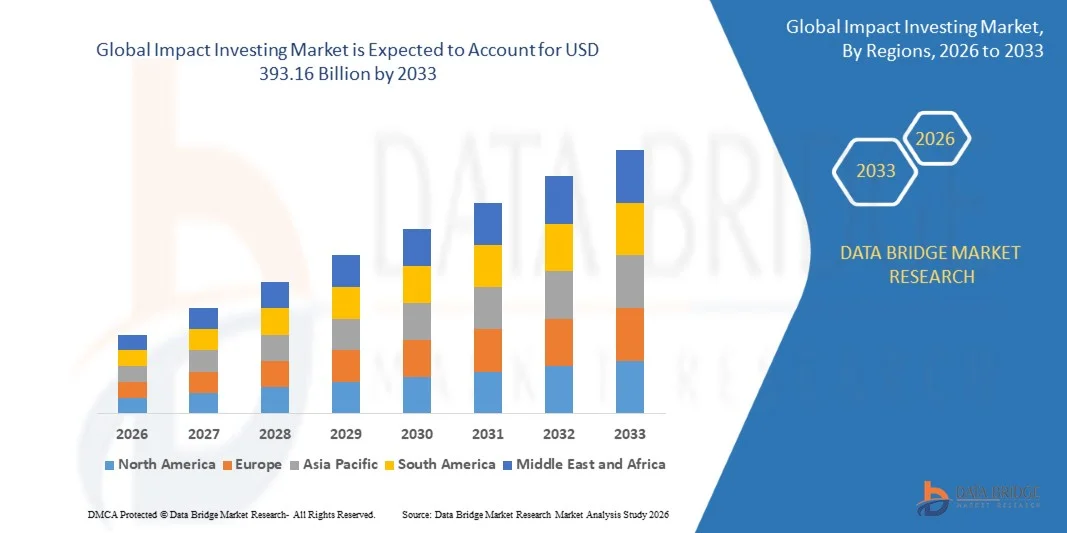
As per Data Bridge Market Research Analysis the Impact Investing Market was valued at USD 102.01 Billion in 2025 and is projected to reach USD 393.16 Billion by 2033, growing at a CAGR of 18.37% from 2026 to 2033. The market is experiencing consistent growth driven by increasing investor focus on environmental, social, and governance aligned investment strategies, rising demand for sustainable financial products, and growing institutional participation in responsible capital allocation. Expanding adoption of ESG integration frameworks and advancements in impact measurement and reporting technologies are further supporting market expansion across developed and emerging economies.
The increasing global emphasis on climate resilience, social inclusion, and sustainable economic development, combined with evolving regulatory frameworks, is encouraging investors to allocate capital toward projects and enterprises delivering measurable positive impact outcomes. Impact investing solutions are increasingly being adopted across renewable energy, affordable housing, healthcare accessibility, financial inclusion, and sustainable infrastructure sectors to generate long term financial returns alongside social and environmental benefits. Rising availability of impact focused funds, green bonds, and ESG linked investment products is further accelerating market growth globally.
Market Size & Forecast
- Global Market Value (2025): USD 102.01 Billion
- Expected Market Value (2033): USD 393.16 Billion
- Forecast CAGR (2026–2033): 18.37%
- Leading Region in 2025: North America
- Fastest Growing Region: Asia-Pacific
Key Market Trends & Insights
- North America dominated the Impact Investing Market with the largest revenue share of 37.86% in 2025, supported by strong institutional participation, advanced ESG integration practices, and increasing adoption of sustainable investment strategies across pension funds, asset managers, and insurance companies
- The institutional investors segment led the market with a 72.4% share in 2025, driven by large-scale allocations from pension funds, sovereign wealth funds, and insurance companies integrating ESG mandates
- Asia-Pacific is expected to be the fastest-growing region at a CAGR of 9.20% from 2026 to 2033, fueled by rapid economic development, rising awareness regarding sustainable finance, and increasing government support for green investment initiatives
- Retail investors are the fastest-growing investor type, projected to register a CAGR of 16.1% from 2026 to 2033, supported by rising awareness of sustainable investing and increased access to digital investment platforms
- The equity segment dominated the asset class category with a 48.83% revenue share in 2025, led by rising demand for direct exposure to high-impact companies across renewable energy, sustainable agriculture, and social enterprise sectors
- Multi-asset accounted for 41.8% of the market in 2025, preferred by increasing investor preference for diversified portfolios that balance financial returns with measurable environmental and social impact outcomes
- The hedge funds segment is the fastest-growing offerings category, with a CAGR of 15.2% from 2026 to 2033, driven by growing appetite for diversified impact strategies and higher-return sustainability-linked investments
Report Scope and Impact Investing Market Segmentation
|
Attributes |
Impact Investing Key Market Insights |
|
Segments Covered |
|
|
Countries Covered |
North America
Europe Germany
Asia-Pacific
Middle East and Africa
South America
|
|
Key Market Players |
|
|
Market Opportunities |
|
|
Value Added Data Infosets |
|
What is the Key Trend in the Impact Investing?
Trend: Rising ESG and Impact Measurement Integration
Investors are increasingly integrating ESG and measurable impact assessment frameworks into portfolio strategies to improve transparency, accountability, and long-term sustainability performance. Financial institutions and asset managers are expanding the use of impact reporting standards such as the Global Impact Investing Network’s IRIS+ system and the United Nations Sustainable Development Goals framework to evaluate investment outcomes. Growing demand for standardized sustainability disclosures and data-driven investment decision-making is accelerating adoption across institutional and retail investor groups.
Companies such as BlackRock have expanded ESG and impact analytics capabilities across investment portfolios, while the Global Impact Investing Network reported that the Impact Investing Market surpassed USD 1.5 trillion in assets under management in 2024, reflecting rising global adoption of measurable impact-focused investment strategies.
Impact Investing Market Dynamics
Key Market Driver: Growing Institutional Sustainable Investments
The increasing participation of pension funds, sovereign wealth funds, insurance companies, and asset managers in sustainable finance is significantly driving growth in the impact investing market. Institutional investors are increasingly allocating capital toward renewable energy, affordable housing, healthcare accessibility, and climate transition projects to align portfolios with long-term ESG and net-zero commitments. Regulatory pressure, stakeholder expectations, and growing awareness regarding climate-related financial risks are further accelerating institutional demand for responsible investment products.
Major firms such as Goldman Sachs Asset Management, AXA Investment Managers, and BlackRock are actively expanding sustainable and impact-focused investment offerings, while the Principles for Responsible Investment organization reported that signatories represented more than USD 120 trillion in assets under management globally in 2025.
Key Restraint/Challenge: Lack of Standardized Impact Metrics
A major challenge in the impact investing market is the lack of universally accepted standards for measuring and comparing social and environmental investment outcomes across asset classes and regions. Investors often face difficulties in evaluating actual impact performance due to inconsistent reporting methodologies, fragmented ESG data sources, and varying disclosure requirements among organizations. The absence of harmonized impact measurement frameworks creates transparency concerns and limits comparability between investment products, particularly across private markets and emerging economies.
The ongoing efforts by organizations such as the International Sustainability Standards Board and the Global Reporting Initiative to establish standardized ESG disclosure frameworks highlight the complexity and regulatory challenges associated with achieving consistency in global impact investment reporting practices.
Key Market Opportunity: Expansion of Climate Finance
The rapid expansion of climate finance initiatives is creating significant growth opportunities for the impact investing market. Increasing investments in renewable energy, carbon reduction technologies, green infrastructure, and climate resilience projects are attracting strong institutional and private capital inflows globally. Governments and financial institutions are expanding green bond programs, sustainability-linked financing, and blended finance structures to support climate transition objectives and sustainable development goals.
Organizations such as Triodos Investment Management and BlueOrchard Finance are actively increasing investments in climate-focused impact funds, while the Climate Policy Initiative estimated that global climate finance flows exceeded USD 1.3 trillion in 2024, reflecting strong long-term growth potential for climate-oriented impact investing solutions.
How is the Impact Investing Segmented?
The impact investing market is segmented on the basis of asset class, offerings, investment style, and investor type.
- By Asset Class
On the basis of asset class, the Impact Investing Market is segmented into equity, fixed income, multi-asset, and alternatives. The multi-asset segment dominated the market with the largest share of 41.8% in 2025, driven by increasing investor preference for diversified portfolios that balance financial returns with measurable environmental and social impact outcomes. Multi-asset strategies enable investors to allocate capital across equities, fixed income, and alternative investments within a single portfolio structure, improving risk management and long-term stability. Institutional investors increasingly favor these solutions to achieve broader sustainability objectives while reducing exposure to market volatility. Growing demand for flexible asset allocation strategies aligned with ESG and impact-focused mandates is further accelerating adoption across pension funds, sovereign wealth funds, and private investment firms.
The Alternatives segment is projected to register the fastest growth at a CAGR of 14.6% from 2026 to 2033, supported by rising demand for private equity, venture capital, and real asset investments aligned with sustainability goals. Increasing participation in climate-focused infrastructure and social impact funds is accelerating capital deployment into alternative assets. Limited public market opportunities for high-impact projects is pushing investors toward private markets. Strong growth in blended finance structures and thematic impact funds is further enhancing expansion across this segment.
- By Offerings
On the basis of offerings, the Impact Investing Market is segmented into equity, bond funds, ETFs/index funds, and hedge funds. The Equity segment dominated the market with a share of 48.83% in 2025, driven by rising demand for direct exposure to high-impact companies across renewable energy, sustainable agriculture, and social enterprise sectors. Investors prefer equity offerings due to stronger influence over governance and impact direction. Increasing ESG-linked equity fund launches by global asset managers is further strengthening adoption. Expanding institutional mandates for sustainable equity allocation continues to reinforce segment dominance.
The Hedge Funds segment is projected to register the fastest growth at a CAGR of 15.2% from 2026 to 2033, supported by growing appetite for diversified impact strategies and higher-return sustainability-linked investments. Expansion of private impact hedge funds targeting climate transition and social infrastructure is accelerating inflows. Investors are increasingly attracted to flexible mandates that combine financial performance with measurable impact outcomes. Rising sophistication in impact reporting standards is further improving investor confidence and driving rapid segment expansion.
- By Investment Style
On the basis of investment style, the Impact Investing Market is segmented into active and passive strategies. The Active segment dominated the market with a share of 39.2% in 2025, driven by the need for hands-on portfolio management to ensure measurable environmental and social outcomes. Active managers play a critical role in screening, engagement, and impact tracking across portfolio companies. Institutional investors prefer active strategies due to greater control over ESG integration and risk-adjusted returns. Continuous monitoring and thematic investment selection further strengthen segment leadership.
The Passive segment is projected to register the fastest growth at a CAGR of 13.9% from 2026 to 2033, driven by rising demand for low-cost, index-based ESG and sustainability-focused investment products. Expansion of impact-focused ETFs and index funds is making sustainable investing more accessible to retail investors. Increasing standardization of ESG indices is improving transparency and scalability. Strong inflows into passive sustainable funds are accelerating adoption across global markets.
- By Investor Type
On the basis of investor type, the Impact Investing Market is segmented into institutional investors and retail investors. The Institutional Investors segment dominated the market with a share of 72.4% in 2025, driven by large-scale allocations from pension funds, sovereign wealth funds, and insurance companies integrating ESG mandates. These investors prioritize long-term value creation aligned with sustainability and regulatory compliance requirements. Growing pressure from stakeholders to disclose impact performance is further reinforcing institutional participation. Strong capital deployment capacity ensures continued dominance of this segment.
The Retail Investors segment is projected to register the fastest growth at a CAGR of 16.1% from 2026 to 2033, supported by rising awareness of sustainable investing and increased access to digital investment platforms. Growth of ESG-focused mutual funds and robo-advisory services is enabling broader participation among individual investors. Younger demographics are increasingly prioritizing values-based investing aligned with environmental and social goals. Expanding financial literacy and simplified investment products are further accelerating retail adoption.
Which Region Holds the Largest Share of the Impact Investing?
North America dominated the impact investing market and accounted for the largest revenue share of 37.86% in 2025, driven by strong institutional participation, advanced ESG integration practices, and increasing adoption of sustainable investment strategies across pension funds, asset managers, and insurance companies. The region benefits from a highly developed financial ecosystem, strong regulatory support for responsible investing, and rising demand for measurable environmental and social impact outcomes. Investors are increasingly allocating capital toward renewable energy, healthcare accessibility, affordable housing, and climate resilience projects to align financial returns with sustainability goals. In addition, the presence of leading impact investment firms, well-established ESG reporting frameworks, and growing shareholder activism continues to reinforce North America’s leadership position in the global market.
U.S. Impact Investing Market Insight
The U.S. Impact Investing market is experiencing strong growth driven by rising institutional demand for ESG aligned portfolios, increasing climate focused investment strategies, and rapid expansion of sustainable finance initiatives across industries. Asset managers and pension funds are heavily investing in clean energy, social infrastructure, and diversity focused enterprises to achieve long term value creation and regulatory compliance objectives. The country’s advanced capital markets and strong presence of global investment firms are enabling large scale deployment of impact focused financial products. In addition, increasing adoption of data driven ESG analytics and shareholder engagement strategies is further accelerating market expansion across the U.S.
Canada Impact Investing Market Insight
The Canada Impact Investing market is witnessing steady growth supported by increasing government emphasis on sustainable development, growing institutional participation in responsible investing, and rising demand for climate focused investment products. Financial institutions are increasingly integrating ESG considerations into portfolio management strategies to enhance transparency and long term risk management. The country’s strong renewable energy sector and expanding green finance ecosystem are encouraging greater capital allocation toward impact oriented projects. In addition, rising awareness regarding social impact measurement and sustainable wealth management solutions is further contributing to market growth in Canada.
Europe Impact Investing Market Insight
The Europe Impact Investing market is expanding steadily due to stringent sustainability regulations, strong adoption of ESG disclosure frameworks, and increasing investments in low carbon and socially responsible projects. The region benefits from a highly regulated sustainable finance ecosystem that encourages responsible capital allocation across public and private markets. Institutional investors are increasingly focusing on renewable energy, circular economy, and social inclusion initiatives to meet sustainability targets and stakeholder expectations. Rising demand for transparent impact reporting and sustainable investment products continues to support regional market growth.
U.K. Impact Investing Market Insight
The U.K. Impact Investing market is growing steadily, driven by increasing adoption of sustainable finance practices, rising investor focus on climate transition strategies, and strong expansion of ESG focused asset management services. Financial institutions and wealth managers are increasingly offering impact investment products to meet growing demand from institutional and retail investors. The country’s mature financial services sector and strong regulatory emphasis on sustainability disclosure are further supporting market adoption. In addition, growing investments in green infrastructure and social impact enterprises are strengthening market expansion in the U.K.
Germany Impact Investing Market Insight
The Germany Impact Investing market is expanding due to rising investments in renewable energy infrastructure, strong corporate sustainability commitments, and increasing integration of ESG criteria into institutional investment strategies. Asset managers and banks are increasingly prioritizing climate focused portfolios and sustainable financing initiatives to support long term environmental objectives. The country’s strong industrial base and commitment toward carbon neutrality are driving higher demand for impact oriented capital allocation. In addition, expanding adoption of sustainable investment reporting standards is further accelerating market development in Germany.
Asia-Pacific Impact Investing Market Insight
The Asia-Pacific Impact Investing market is expected to register the fastest growth with a CAGR of 9.20% from 2026 to 2033, driven by rapid economic development, rising awareness regarding sustainable finance, and increasing government support for green investment initiatives. Expanding institutional participation and growing retail investor interest in ESG aligned products are significantly boosting regional market demand. Countries such as China, India, Japan, and Australia are witnessing strong investments in renewable energy, sustainable infrastructure, and social impact projects. In addition, increasing digital investment platforms and rising financial inclusion initiatives are further accelerating regional market expansion.
Japan Impact Investing Market Insight
The Japan Impact Investing market is witnessing steady growth supported by increasing adoption of ESG investment strategies, rising focus on corporate governance reforms, and strong government support for sustainable finance initiatives. Institutional investors are increasingly allocating capital toward renewable energy, healthcare innovation, and social welfare projects to enhance long term portfolio resilience. The country’s advanced financial ecosystem and growing emphasis on responsible corporate practices are further supporting market growth. In addition, increasing integration of sustainability metrics into investment decision making is strengthening demand in Japan.
China Impact Investing Market Insight
The China Impact Investing market is growing rapidly due to strong government support for green finance, rising investments in clean energy infrastructure, and increasing adoption of ESG focused investment strategies among institutional investors. Financial institutions are actively expanding sustainable investment offerings to support carbon neutrality and social development goals. The country’s large scale renewable energy deployment and rapid development of green bond markets are enabling significant growth opportunities for impact investing. In addition, increasing emphasis on sustainable urbanization and climate resilience projects is further driving market expansion in China.
Which are the Top Companies in Impact Investing?
The impact investing industry is primarily led by well-established companies, including:
· BlackRock (U.S.)
· TPG Rise (U.S.)
· LeapFrog Investments (U.K.)
· Triodos Investment Management (Netherlands)
· Bridges Fund Management (U.K.)
· KKR Global Impact (U.S.)
· Bain Capital Double Impact (U.S.)
· AXA Investment Managers (France)
· Goldman Sachs Asset Management (U.S.)
· BlueOrchard Finance (Switzerland)
· responsAbility Investments (Switzerland)
· Vital Capital (U.S.)
· Pacific Community Ventures (U.S.)
· Elevar Equity (India)
· Calvert Impact Capital (U.S.)
· Veris Wealth Partners (U.S.)
· Omidyar Network (U.S.)
at are Latest Developments in Impact Investing?
- In March 2025, the NAB Foundation launched a USD 50 million Impact Investment Fund aimed at strengthening social and environmental investment initiatives across Australia. The fund focuses on sectors such as Indigenous economic advancement, affordable housing, and climate transition projects, reflecting the growing importance of impact-driven capital allocation within the Impact Investing Market. The initiative is expected to encourage greater participation from institutional and philanthropic investors seeking measurable sustainability outcomes alongside long-term financial returns. The expansion of dedicated impact investment vehicles is further supporting market growth by increasing capital accessibility for high-impact development projects
- In November 2024, Triodos Investment Management launched a biodiversity restoration fund with a commitment of EUR 500 million toward nature-based carbon projects. The development highlights rising investor focus on climate resilience, ecosystem restoration, and carbon offset solutions within sustainable finance portfolios. Increasing investments in biodiversity and natural capital projects are expanding the scope of impact investing beyond traditional ESG assets. The initiative is expected to accelerate funding toward conservation-linked infrastructure and strengthen growth opportunities in environmental impact investment strategies
- In November 2024, corporate venture capital arms executed nearly USD 30 billion in secondary sales, reflecting increasing reliance on impact-focused liquidity solutions across private investment markets. The growing use of secondary transactions is improving capital recycling and enabling investors to reallocate funds toward emerging sustainability-oriented ventures. This trend is enhancing market flexibility while supporting continued investment activity in climate technology, social infrastructure, and sustainable innovation sectors. Rising liquidity options are also attracting broader institutional participation in long-term impact investment portfolios
- In October 2024, BlackRock completed the operational integration of Global Infrastructure Partners, forming a combined USD 150 billion private-markets platform with enhanced impact analytics capabilities. The integration strengthens the company’s ability to expand sustainable infrastructure and climate-focused investment strategies across global markets. Enhanced analytics and reporting capabilities are improving transparency and performance tracking for ESG and impact-oriented assets. The development is expected to accelerate institutional adoption of large-scale private market impact investment solutions
- In September 2024, Vestmark partnered with BlackRock to integrate impact screening capabilities into model portfolios available across advisory networks. The collaboration is enabling financial advisors to offer more personalized and sustainability-focused investment strategies to retail and institutional clients. Growing integration of impact analytics into digital wealth management platforms is improving accessibility and scalability of responsible investing products. The partnership is further supporting expansion of impact investing adoption within mainstream portfolio management services

- Interactive Data Analysis Dashboard
- Company Analysis Dashboard for high growth potential opportunities
- Research Analyst Access for customization & queries
- Competitor Analysis with Interactive dashboard
- Latest News, Updates & Trend analysis
- Harness the Power of Benchmark Analysis for Comprehensive Competitor Tracking
Data collection and base year analysis are done using data collection modules with large sample sizes. The stage includes obtaining market information or related data through various sources and strategies. It includes examining and planning all the data acquired from the past in advance. It likewise envelops the examination of information inconsistencies seen across different information sources. The market data is analysed and estimated using market statistical and coherent models. Also, market share analysis and key trend analysis are the major success factors in the market report. To know more, please request an analyst call or drop down your inquiry.
The key research methodology used by DBMR research team is data triangulation which involves data mining, analysis of the impact of data variables on the market and primary (industry expert) validation. Data models include Vendor Positioning Grid, Market Time Line Analysis, Market Overview and Guide, Company Positioning Grid, Patent Analysis, Pricing Analysis, Company Market Share Analysis, Standards of Measurement, Global versus Regional and Vendor Share Analysis. To know more about the research methodology, drop in an inquiry to speak to our industry experts.
Data Bridge Market Research is a leader in advanced formative research. We take pride in servicing our existing and new customers with data and analysis that match and suits their goal. The report can be customized to include price trend analysis of target brands understanding the market for additional countries (ask for the list of countries), clinical trial results data, literature review, refurbished market and product base analysis. Market analysis of target competitors can be analyzed from technology-based analysis to market portfolio strategies. We can add as many competitors that you require data about in the format and data style you are looking for. Our team of analysts can also provide you data in crude raw excel files pivot tables (Fact book) or can assist you in creating presentations from the data sets available in the report.













