


What is the In-Vehicle Computer System Market Size and Growth Rate?
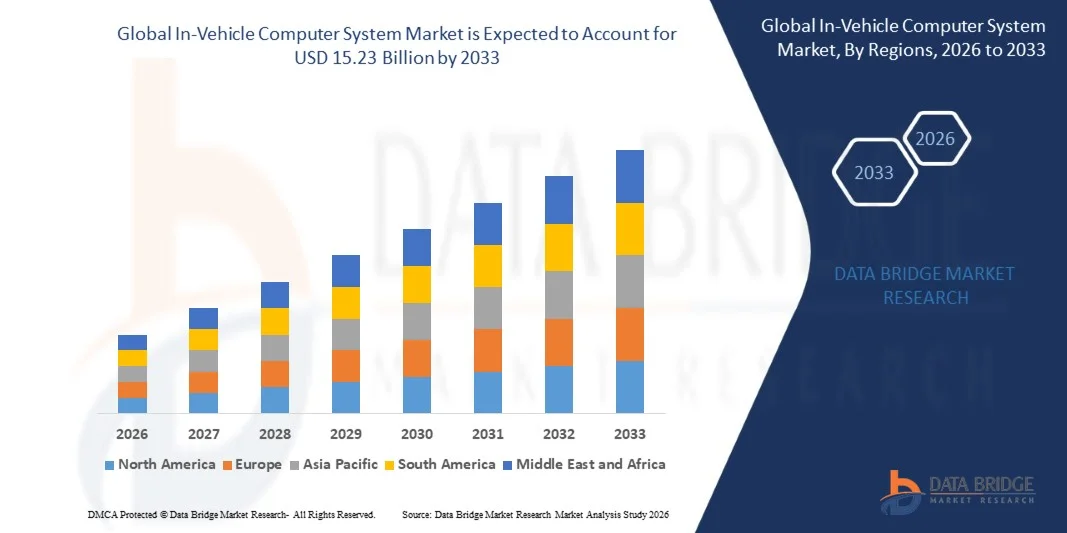
- As per Data Bridge Market Research analysis, the in-vehicle computer system market was valued at USD 5.69 billion in 2025 and is projected to reach USD 15.23 billion by 2033, growing at a CAGR of 13.10% from 2026 to 2033.
- The market is witnessing robust growth driven by the increasing adoption of connected vehicles, rapid integration of advanced driver assistance systems (ADAS), rising demand for intelligent infotainment and telematics platforms, and the ongoing transition toward software-defined and autonomous vehicles.
- The growing emphasis on vehicle safety, real-time data processing, and seamless in-vehicle connectivity, coupled with increasing production of electric and autonomous vehicles, is encouraging automotive manufacturers to deploy high-performance embedded computing platforms. Advanced in-vehicle computer systems are increasingly replacing conventional electronic control architectures by enabling centralized computing, over-the-air software updates, predictive diagnostics, and AI-powered vehicle functions, thereby supporting next-generation mobility and connected transportation ecosystems.
Market Size & Forecast
- Global Market Value (2025): USD 5.69 Billion
- Expected Market Value (2033): USD 15.23 Billion
- Forecast CAGR (2026–2033): 13.10%
- Leading Region in 2025: North America
- Fastest Growing Region: Asia-Pacific
What are the Major Takeaways of the In-Vehicle Computer System Market?
- North America dominated the in-vehicle computer system market with the largest revenue share of 35.20% in 2025, supported by the early adoption of connected vehicles, strong presence of leading automotive technology companies, and significant investments in autonomous driving and advanced driver assistance systems (ADAS).
- Asia-Pacific is expected to be the fastest-growing region at a CAGR of 14.50% from 2026 to 2033, fueled by expanding vehicle production, rising electric vehicle adoption, and increasing investments in intelligent transportation and automotive electronics across China, Japan, and India.
- The display audio system segment led the market with a 36.80% share in 2025, driven by its widespread integration across passenger and commercial vehicles as the primary interface for infotainment, navigation, smartphone connectivity, and multimedia functions.
- Head-up display are the fastest-growing product type, projected to register a CAGR of 15.80%, reflecting the surge in demand for advanced driver assistance systems (ADAS) and enhanced driving safety.
- The passenger car segment dominated the vehicle type category with a 71.40% revenue share in 2025, led by high production volumes and increasing integration of infotainment systems, digital instrument clusters, ADAS, and connected vehicle technologies.
- Hardware accounted for 61.20% of the market share in 2025, preferred by extensive deployment of processors, GPUs, memory modules, sensors, communication chipsets, and embedded controllers within modern vehicles.
- The 32 GB segment is the fastest-growing memory size category, with a CAGR of 16.30%, driven by increasing deployment of autonomous driving platforms and AI-powered centralized computing systems.
Report Scope and In-Vehicle Computer System Market Segmentation
|
Attributes |
In-Vehicle Computer System Key Market Insights |
|
Segments Covered |
|
|
Countries Covered |
North America
Europe
Asia-Pacific
Middle East and Africa
South America
|
|
Key Market Players |
|
|
Market Opportunities |
|
|
Value Added Data Infosets |
In addition to the market insights such as market value, growth rate, market segments, geographical coverage, market players, and market scenario, the market report curated by the Data Bridge Market Research team includes in-depth expert analysis, import/export analysis, pricing analysis, production consumption analysis, and pestle analysis. |
What is the Key Trend in the In-Vehicle Computer System Market?
- Automotive manufacturers are increasingly adopting centralized in-vehicle computing architectures to support software-defined vehicles, enabling multiple vehicle functions to be managed through high-performance domain and zonal controllers instead of numerous distributed electronic control units.
- For instance, in January 2025, Mercedes-Benz confirmed that the all-new CLA would debut as the first software-defined vehicle powered by its in-house MB.OS operating system, integrating centralized in-vehicle computing, AI-powered infotainment, automated driving functions, and over-the-air software updates.
- Centralized computing platforms enable seamless integration of advanced driver assistance systems, digital cockpits, connectivity services, and vehicle lifecycle software management from a unified hardware architecture.
- Vehicle manufacturers are increasingly collaborating with semiconductor and software companies to develop scalable computing platforms that support continuous feature upgrades and personalized in-vehicle experiences.
- For instance, in January 2025, BMW Group unveiled the BMW Panoramic iDrive powered by the new BMW Operating System X at CES 2025, introducing a centralized in-vehicle computing platform that integrates AI-powered interaction, infotainment, navigation, and vehicle control across future BMW models.
- As software-defined vehicles become the industry standard, demand for centralized in-vehicle computer systems is expected to accelerate, reinforcing high-performance computing as the foundation of next-generation connected and autonomous mobility.
What are the Key Drivers of the In-Vehicle Computer System Market?
- The rapid expansion of connected, electric, and autonomous vehicles has significantly increased demand for high-performance in-vehicle computer systems capable of processing massive volumes of real-time sensor, camera, radar, and vehicle network data.
- For instance, in January 2025, NVIDIA announced that Toyota Motor Corporation will adopt the NVIDIA DRIVE AGX Orin in-vehicle computer and DriveOS software for its next-generation vehicles, strengthening the adoption of AI-powered centralized vehicle computing for advanced safety and autonomous driving.
- Automotive OEMs, semiconductor companies, and software providers are integrating centralized computing platforms to reduce electronic architecture complexity, improve cybersecurity, and enable over-the-air software upgrades throughout the vehicle lifecycle.
- For instance, in September 2024, Volvo Cars expanded its collaboration with NVIDIA by adopting the NVIDIA DRIVE Thor platform for its next-generation vehicles, enabling advanced AI-powered safety, autonomous driving capabilities, and centralized in-vehicle computing.
- With automakers increasingly investing in centralized computing architectures for intelligent mobility, in-vehicle computer systems will remain essential for enabling autonomous driving, connected services, and next-generation vehicle intelligence.
Which Factors are Challenging the Growth of the In-Vehicle Computer System Market?
- Advanced in-vehicle computer systems require substantial investment owing to high-performance processors, AI accelerators, automotive-grade semiconductor components, cybersecurity technologies, and complex software integration requirements.
- For instance, in October 2024, Qualcomm introduced the Snapdragon Cockpit Elite platform featuring on-device generative AI, Qualcomm Oryon CPU, and advanced centralized computing capabilities, highlighting the increasing hardware complexity and investment required for next-generation software-defined vehicles.
- These elevated development and deployment costs limit adoption among entry-level vehicle platforms and manufacturers operating within highly cost-sensitive automotive market segments.
- The automotive industry also faces challenges associated with semiconductor supply constraints, software validation, cybersecurity compliance, and long vehicle qualification cycles before commercial deployment.
- For instance, in March 2025, NXP Semiconductors introduced the S32K5 automotive microcontroller family, emphasizing high-performance processing, functional safety, embedded cybersecurity, and zonal software-defined vehicle architectures, highlighting the increasing hardware complexity and development investment required for next-generation in-vehicle computer systems.
- The combination of high development costs, hardware complexity, and extended validation requirements continues to slow adoption among cost-sensitive manufacturers despite growing demand for software-defined and connected vehicles.
How is the In-Vehicle Computer System Market Segmented?
The in-vehicle computer system market is segmented on the basis of product type, vehicle type, offering, memory size, and application.
- By Product Type
On the basis of product type, the in-vehicle computer system market is segmented into display audio system, telematics system, cluster display, head-up display, and others. The display audio system segment dominated the market with an estimated 36.80% share in 2025, owing to its widespread integration across passenger and commercial vehicles as the primary interface for infotainment, navigation, smartphone connectivity, and multimedia functions. Automakers increasingly incorporate touchscreen-based display audio systems as standard equipment to enhance user experience and support connected vehicle ecosystems. Growing consumer demand for Android Auto, Apple CarPlay, and cloud-based services continues to strengthen adoption. Continuous advancements in display resolution, voice assistants, and AI-enabled human-machine interfaces are further improving functionality. Increasing production of connected vehicles globally is reinforcing the segment's market leadership. Its broad deployment across both premium and mass-market vehicles ensures sustained dominance.
The head-up display segment is projected to register the fastest growth at an estimated CAGR of 15.80% from 2026 to 2033, driven by increasing demand for advanced driver assistance systems (ADAS) and enhanced driving safety. Head-up displays project critical driving information directly into the driver's line of sight, minimizing distraction and improving situational awareness. Rapid adoption of augmented reality technologies is significantly enhancing display capabilities. Premium vehicle manufacturers are increasingly integrating AR-based HUDs into next-generation models. Declining hardware costs and growing consumer preference for intelligent cockpit technologies are accelerating adoption. Expanding deployment in electric and autonomous vehicles is expected to further support segment growth.
- By Vehicle Type
On the basis of vehicle type, the in-vehicle computer system market is segmented into passenger car and commercial vehicle. The passenger car segment dominated the market with an estimated 71.40% revenue share in 2025, driven by high production volumes and increasing integration of infotainment systems, digital instrument clusters, ADAS, and connected vehicle technologies. Consumer demand for enhanced safety, comfort, and personalized digital experiences continues to encourage automakers to deploy advanced in-vehicle computing platforms. Software-defined vehicle development is further increasing centralized computing requirements. Electric passenger vehicles are also driving demand for high-performance computing architectures. Continuous innovation in cockpit electronics and connectivity solutions reinforces segment leadership. Strong investments by global OEMs continue supporting market expansion.
The commercial vehicle segment is projected to witness the fastest growth at an estimated CAGR of 14.20% from 2026 to 2033, driven by increasing adoption of fleet telematics, predictive maintenance platforms, and intelligent transportation systems. Logistics operators are deploying advanced computing platforms to improve operational efficiency and vehicle uptime. Government regulations promoting commercial vehicle safety are encouraging integration of ADAS technologies. Growing electrification of buses and delivery vehicles is also increasing demand for centralized vehicle computing. Fleet digitalization and real-time diagnostics continue to accelerate technology adoption. Rising investments in connected commercial mobility solutions further support long-term growth.
- By Offering
On the basis of offering, the in-vehicle computer system market is segmented into hardware and software. The hardware segment dominated the market with an estimated 61.20% share in 2025, owing to the extensive deployment of processors, GPUs, memory modules, sensors, communication chipsets, and embedded controllers within modern vehicles. Increasing adoption of centralized computing architectures requires high-performance automotive-grade hardware capable of supporting multiple vehicle domains. Rapid advancements in semiconductor technologies continue improving computing efficiency and reliability. Growing production of electric and connected vehicles is also driving hardware demand. Continuous investment in AI-enabled automotive processors further supports market growth. Hardware remains the foundation of all vehicle computing platforms.
The software segment is projected to witness the fastest growth at an estimated CAGR of 15.60% from 2026 to 2033, driven by rising adoption of software-defined vehicles and over-the-air software update capabilities. Automotive manufacturers are increasingly developing intelligent operating systems to manage vehicle functions through centralized computing platforms. Artificial intelligence, cybersecurity, and cloud connectivity are becoming essential software components. Continuous software upgrades enable new features without hardware replacement. Increasing investments in autonomous driving software are accelerating market expansion. Growing demand for subscription-based digital services further supports software adoption.
- By Memory Size
On the basis of memory size, the in-vehicle computer system market is segmented into up to 8 GB, 16 GB, 32 GB, and above. The 16 GB segment dominated the market with an estimated 39.60% share in 2025, owing to its optimal balance between computing performance, memory capacity, and cost for mainstream connected vehicles. Most digital cockpit, infotainment, telematics, and ADAS applications operate efficiently using this configuration. Automakers continue deploying 16 GB systems across mid-range and premium vehicle models. Increasing software complexity is supporting higher memory requirements compared to previous generations. The segment also provides sufficient processing capability for AI-assisted vehicle functions. Its cost-performance advantage ensures broad industry adoption.
The 32 GB segment is projected to register the fastest growth at an estimated CAGR of 16.30% from 2026 to 2033, driven by increasing deployment of autonomous driving platforms and AI-powered centralized computing systems. Advanced sensor fusion, high-resolution graphics, and real-time data processing require significantly larger memory capacities. Premium electric vehicles increasingly rely on high-memory computing architectures. Continuous improvements in semiconductor technologies are reducing power consumption while improving performance. Growing software-defined vehicle adoption is further increasing memory requirements. Expanding deployment of Level 3 and Level 4 autonomous driving systems is expected to sustain rapid growth.
- By Application
On the basis of application, the in-vehicle computer system market is segmented into safety computers, performance computers, diagnostic computers, and convenience computers. The safety computers segment dominated the market with an estimated 34.90% revenue share in 2025, driven by increasing integration of ADAS, collision avoidance systems, lane-keeping assistance, driver monitoring, and emergency braking technologies. Governments worldwide continue strengthening vehicle safety regulations, encouraging deployment of intelligent computing platforms. Advanced sensor fusion requires high-performance computing to process camera, radar, and LiDAR data in real time. Growing consumer awareness regarding vehicle safety further supports adoption. Electric and autonomous vehicles are significantly increasing computing requirements for safety-critical applications. The segment remains central to future mobility development.
The diagnostic computers segment is projected to witness the fastest growth at an estimated CAGR of 15.10% from 2026 to 2033, driven by increasing demand for predictive maintenance, remote vehicle diagnostics, and real-time health monitoring capabilities. Connected vehicles continuously generate operational data that enables proactive fault detection and software-based maintenance. Fleet operators increasingly rely on intelligent diagnostics to reduce downtime and maintenance costs. Artificial intelligence is improving fault prediction accuracy and maintenance scheduling. Growing adoption of cloud-connected vehicle management platforms further accelerates segment growth. Expansion of software-defined vehicle architectures continues creating new opportunities for advanced diagnostic computing systems.
Which Region Holds the Largest Share of the In-Vehicle Computer System Market?
- North America dominated the in-vehicle computer system market with the largest revenue share of 35.20% in 2025, supported by the early adoption of connected vehicles, strong presence of leading automotive technology companies, and significant investments in autonomous driving and advanced driver assistance systems (ADAS).
- The region also benefits from rapid deployment of advanced driver assistance systems (ADAS), widespread integration of AI-powered digital cockpit platforms, and increasing demand for centralized vehicle computing architectures across passenger and commercial vehicles. Rising investments in intelligent mobility, vehicle electrification, and over-the-air software capabilities continue to strengthen North America's leadership position in the global market.
U.S. In-Vehicle Computer System Market Insight
The U.S. in-vehicle computer system market is witnessing strong growth due to rising investments in autonomous vehicles, connected mobility platforms, and software-defined vehicle architectures. The country’s advanced automotive technology ecosystem, presence of leading semiconductor and technology companies, and increasing deployment of AI-powered computing platforms are accelerating demand for high-performance in-vehicle computers across passenger vehicles, commercial fleets, and autonomous mobility applications. In addition, the expansion of robotaxi testing programs and autonomous driving validation activities is increasing the need for powerful onboard computing systems capable of processing real-time sensor, camera, and vehicle data. Autonomous vehicle companies such as Zoox have continued expanding driverless vehicle testing and commercialization efforts in the U.S., highlighting the growing requirement for advanced vehicle computing infrastructure.
Asia-Pacific In-Vehicle Computer System Market Insight
The Asia-Pacific in-vehicle computer system market is expected to witness rapid growth, driven by increasing electric vehicle production, expansion of intelligent connected vehicles, and rising investments in automotive artificial intelligence infrastructure across countries such as China, Japan, and South Korea. Growing adoption of advanced driver assistance systems (ADAS), smart cockpit technologies, and vehicle-road-cloud integration initiatives is creating strong demand for centralized computing platforms and high-performance vehicle processors. China is particularly accelerating intelligent connected vehicle development through government-supported vehicle-road-cloud integration pilot programs designed to advance autonomous driving technologies and connected vehicle infrastructure. In addition, China's rapid adoption of intelligent vehicles is reflected in the increasing penetration of Level-2 driving assistance vehicles and connected vehicle technologies, supporting demand for advanced in-vehicle computing solutions.
Japan In-Vehicle Computer System Market Insight
The Japan in-vehicle computer system market is witnessing consistent growth due to rising investments in autonomous mobility, automotive electronics innovation, and next-generation vehicle architectures. Japanese automotive manufacturers and technology companies are increasingly adopting centralized computing systems, AI processors, and connected vehicle platforms to support autonomous driving, advanced infotainment, and vehicle intelligence applications. Furthermore, Japan’s strong automotive R&D ecosystem and focus on developing safer and more efficient mobility solutions are accelerating adoption of high-performance in-vehicle computers. Increasing integration of AI, sensor fusion technologies, and real-time data processing capabilities is further contributing to market expansion.
China In-Vehicle Computer System Market Insight
The China in-vehicle computer system market is growing rapidly, driven by expanding electric vehicle production, increasing adoption of intelligent connected vehicles, and strong government support for autonomous driving technologies. The country’s automotive industry is transitioning toward software-defined vehicles, requiring advanced computing architectures capable of managing AI algorithms, autonomous driving functions, smart cockpit systems, and vehicle connectivity. China’s government has launched vehicle-road-cloud integration pilot initiatives from 2024–2026 to accelerate intelligent connected vehicle commercialization and improve coordination between vehicles, roads, cloud platforms, and digital infrastructure. Moreover, China has developed a broad intelligent connected vehicle ecosystem covering autonomous driving, smart cockpits, and cloud-based vehicle control systems, strengthening demand for advanced in-vehicle computing platforms.
U.K. In-Vehicle Computer System Market Insight
The U.K. in-vehicle computer system market is experiencing steady growth, supported by increasing investments in connected vehicles, autonomous driving research, and automotive software development. The country’s focus on smart mobility initiatives, electric vehicle adoption, and advanced automotive engineering is driving demand for vehicle computing platforms that enable real-time processing, cybersecurity, and intelligent vehicle functions. In addition, collaboration between automotive manufacturers, technology providers, and research institutions is accelerating development of next-generation vehicle architectures. Growing adoption of AI-based driver assistance systems and connected mobility solutions is further supporting market growth.
Germany In-Vehicle Computer System Market Insight
The Germany in-vehicle computer system market is expanding steadily due to the country’s strong automotive manufacturing base, advanced engineering capabilities, and increasing transition toward software-defined vehicles. German automotive manufacturers are investing heavily in centralized electronic architectures, high-performance computing platforms, and AI-enabled vehicle systems to support autonomous driving, digital cockpits, and connected mobility services. Germany’s automotive industry generated approximately EUR 527.6 billion in revenue and remains one of Europe’s largest automotive ecosystems, providing a strong foundation for advanced vehicle computing adoption. Furthermore, research initiatives such as Fraunhofer IPMS’ Central Car Server project demonstrate Germany’s focus on developing high-performance automotive computing platforms capable of handling complex data streams generated by automated vehicles.
Which are the Top Companies in In-Vehicle Computer System Market?
The in-vehicle computer system industry is primarily led by well-established companies, including:
- NVIDIA Corporation (U.S.)
- Qualcomm Technologies, Inc. (U.S.)
- Intel Corporation (U.S.)
- Advanced Micro Devices, Inc. (U.S.)
- Texas Instruments Incorporated (U.S.)
- Renesas Electronics Corporation (Japan)
- NXP Semiconductors (Netherlands)
- Infineon Technologies AG (Germany)
- STMicroelectronics (Switzerland)
- Robert Bosch GmbH (Germany)
- Continental AG (Germany)
- DENSO Corporation (Japan)
- PANASONIC HOLDINGS CORPORATION (Japan)
- Harman International Industries, Incorporated (U.S.)
- LG Electronics Inc. (South Korea)
- Samsung Electronics Co., Ltd. (South Korea)
- Huawei Technologies Co., Ltd. (China)
- Autoliv, Inc. (Sweden)
- Aptiv PLC (Ireland)
- Valeo SE (France)
What are Latest Developments in In-Vehicle Computer System Market?
- In January 2025, NVIDIA announced that its DRIVE Hyperion autonomous vehicle platform achieved automotive safety and cybersecurity milestones, featuring the NVIDIA DRIVE AGX Thor system-on-chip (SoC) based on the Blackwell architecture. The platform combines high-performance in-vehicle computing hardware, NVIDIA DriveOS software, sensor integration, and autonomous driving capabilities to support next-generation software-defined vehicles. The advancement highlights the growing importance of centralized vehicle computing systems capable of processing large volumes of AI, sensor, and autonomous driving data in real time
- In January 2025, Qualcomm Technologies and Hyundai Mobis announced a collaboration to develop next-generation high-performance computing (HPC) platforms for vehicles by combining Qualcomm’s Snapdragon Ride Flex System-on-Chip (SoC) with Hyundai Mobis’ software platforms and sensor technologies. The integrated solution is designed to support advanced driver assistance systems (ADAS), digital cockpit functions, and high-performance vehicle computing requirements. This development reflects the industry shift toward domain-consolidated architectures that combine multiple vehicle functions into centralized computing platforms.
- In October 2024, Qualcomm Technologies announced the launch of its Snapdragon Cockpit Elite and Snapdragon Ride Elite automotive platforms, powered by the Qualcomm Oryon CPU architecture. The new platforms are designed to deliver higher computing performance for next-generation vehicles by supporting advanced digital cockpits, artificial intelligence-based features, automated driving functions, and software-defined vehicle architectures. The launch highlights the increasing adoption of high-performance automotive processors capable of managing complex in-vehicle workloads through centralized computing systems
- In January 2024, Qualcomm Technologies and Bosch introduced a new central vehicle computer designed to integrate digital cockpit and advanced driver assistance system (ADAS) functions on a single system-on-chip (SoC). The platform, based on Qualcomm’s Snapdragon Ride Flex SoC, enables centralized computing architectures by combining infotainment, vehicle controls, and driver assistance workloads within one computing system. This development supports the automotive industry’s transition toward software-defined vehicles by reducing hardware complexity and enabling scalable high-performance in-vehicle computing solutions.
- In January 2023, Qualcomm Technologies introduced the Snapdragon Ride Flex SoC, a scalable automotive computing platform designed to simultaneously support digital cockpit, advanced driver assistance systems (ADAS), and automated driving functions on a single hardware architecture. The SoC enables mixed-criticality workloads by integrating multiple computing functions, supporting software-defined vehicle architectures and centralized vehicle computing approaches. This launch marked a significant advancement toward reducing separate electronic control units (ECUs) and increasing computing efficiency in future vehicles.

- Interactive Data Analysis Dashboard
- Company Analysis Dashboard for high growth potential opportunities
- Research Analyst Access for customization & queries
- Competitor Analysis with Interactive dashboard
- Latest News, Updates & Trend analysis
- Harness the Power of Benchmark Analysis for Comprehensive Competitor Tracking
Data collection and base year analysis are done using data collection modules with large sample sizes. The stage includes obtaining market information or related data through various sources and strategies. It includes examining and planning all the data acquired from the past in advance. It likewise envelops the examination of information inconsistencies seen across different information sources. The market data is analysed and estimated using market statistical and coherent models. Also, market share analysis and key trend analysis are the major success factors in the market report. To know more, please request an analyst call or drop down your inquiry.
The key research methodology used by DBMR research team is data triangulation which involves data mining, analysis of the impact of data variables on the market and primary (industry expert) validation. Data models include Vendor Positioning Grid, Market Time Line Analysis, Market Overview and Guide, Company Positioning Grid, Patent Analysis, Pricing Analysis, Company Market Share Analysis, Standards of Measurement, Global versus Regional and Vendor Share Analysis. To know more about the research methodology, drop in an inquiry to speak to our industry experts.
Data Bridge Market Research is a leader in advanced formative research. We take pride in servicing our existing and new customers with data and analysis that match and suits their goal. The report can be customized to include price trend analysis of target brands understanding the market for additional countries (ask for the list of countries), clinical trial results data, literature review, refurbished market and product base analysis. Market analysis of target competitors can be analyzed from technology-based analysis to market portfolio strategies. We can add as many competitors that you require data about in the format and data style you are looking for. Our team of analysts can also provide you data in crude raw excel files pivot tables (Fact book) or can assist you in creating presentations from the data sets available in the report.













