


Global In Vitro Fertilization Market
Market Size in USD Billion
CAGR :
% 
 USD
30.45 Billion
USD
63.95 Billion
2025
2033
USD
30.45 Billion
USD
63.95 Billion
2025
2033
 Forecast Period Forecast Period |
2026 –2033 |
 Market Size (Base Year) Market Size (Base Year) |
USD 30.45 Billion |
 Market Size (Forecast Year) Market Size (Forecast Year) |
USD 63.95 Billion |
 CAGR CAGR |
% |
| Major Markets Players |
|
In Vitro Fertilization Market Size
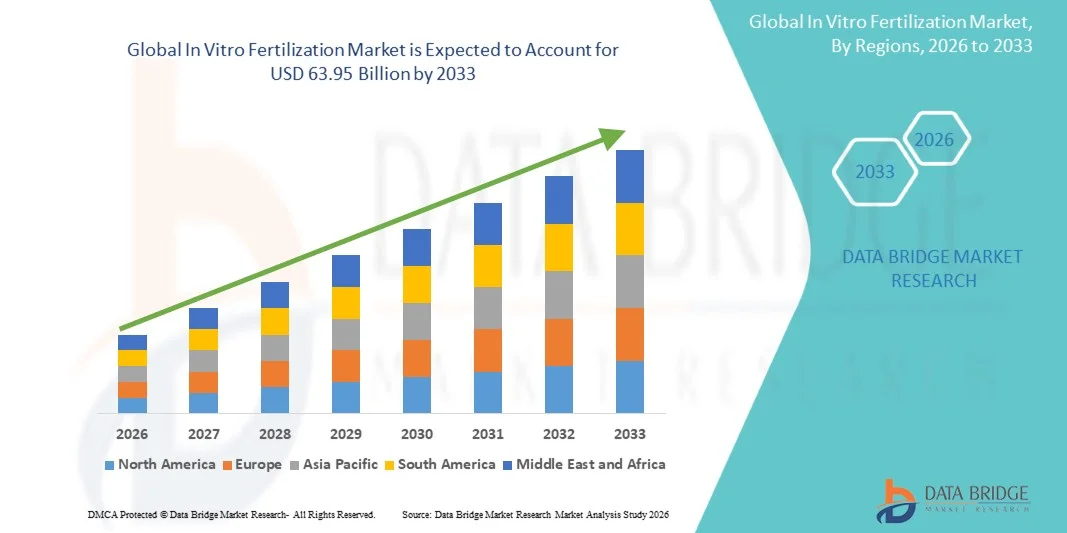
- The global In Vitro fertilization market size was valued at USD 30.45 billion in 2025 and is expected to reach USD 63.95 billion by 2033, at a CAGR of 9.72% during the forecast period
- The market growth is largely fueled by the rising prevalence of infertility, increasing maternal age, and continuous technological advancements in assisted reproductive technologies (ART), leading to higher success rates and broader treatment accessibility worldwide
- Furthermore, growing awareness regarding fertility treatments, supportive government initiatives in select countries, and expanding fertility clinics and service providers are establishing in vitro fertilization as a preferred reproductive solution. These converging factors are accelerating the adoption of IVF procedures, thereby significantly boosting the industry's growth
In Vitro Fertilization Market Analysis
- In Vitro fertilization, an assisted reproductive technology involving the fertilization of an egg with sperm outside the body followed by embryo transfer, has become an essential solution for individuals and couples facing infertility, supported by continuous advancements in laboratory techniques, embryo screening technologies, and cryopreservation methods
- The escalating demand for In Vitro fertilization services is primarily fueled by the rising prevalence of infertility, delayed parenthood due to lifestyle and career choices, increasing awareness regarding fertility treatments, and broader acceptance of assisted reproductive technologies across both developed and emerging economies
- North America dominated the In Vitro fertilization market with the largest revenue share of 39.84% in 2025, characterized by advanced healthcare infrastructure, high awareness regarding fertility treatments, favorable insurance coverage in select U.S. states, and the strong presence of leading fertility clinics and ART technology providers, with the U.S. witnessing substantial growth in IVF cycles driven by delayed pregnancies and increasing acceptance of assisted reproductive procedures
- Asia-Pacific is expected to be the fastest growing region in the In Vitro fertilization market during the forecast period due to improving healthcare infrastructure, expanding private fertility centers, rising medical tourism, and increasing disposable incomes in countries such as China and India
- Fresh non-donor IVF cycles segment dominated the In Vitro fertilization market with a market share of 41.5% in 2025, driven by higher clinical familiarity, strong patient preference, and ongoing improvements in ovarian stimulation protocols and embryo transfer success rates
Report Scope and In Vitro Fertilization Market Segmentation
|
Attributes |
In Vitro Fertilization Key Market Insights |
|
Segments Covered |
|
|
Countries Covered |
North America
Europe
Asia-Pacific
Middle East and Africa
South America
|
|
Key Market Players |
|
|
Market Opportunities |
|
|
Value Added Data Infosets |
In addition to the insights on market scenarios such as market value, growth rate, segmentation, geographical coverage, and major players, the market reports curated by the Data Bridge Market Research also include in-depth expert analysis, patient epidemiology, pipeline analysis, pricing analysis, and regulatory framework |
In Vitro Fertilization Market Trends
“Advancements in AI-Driven Embryo Selection and Genetic Screening”
- A significant and accelerating trend in the global In Vitro fertilization market is the integration of artificial intelligence (AI) and advanced genetic screening technologies such as preimplantation genetic testing (PGT). This convergence is significantly enhancing clinical decision-making and improving overall treatment success rates
- For instance, several leading fertility clinics have adopted AI-powered time-lapse imaging systems that continuously monitor embryo development, enabling embryologists to select the most viable embryos for transfer with greater precision
- AI integration in In Vitro fertilization enables features such as predictive analytics for embryo viability, optimization of ovarian stimulation protocols, and personalized treatment planning based on patient data. For instance, certain clinics utilize machine learning algorithms to assess embryo morphology and rank implantation potential, while genetic screening technologies help detect chromosomal abnormalities before transfer. Furthermore, automated laboratory systems improve workflow efficiency and reduce manual variability in embryology labs
- The seamless integration of digital health records, teleconsultation platforms, and laboratory automation facilitates centralized management of patient cycles and enhances coordination between clinicians and embryologists. Through unified digital platforms, providers can track stimulation progress, embryo grading, cryopreservation status, and follow-up care, creating a more streamlined and patient-centric fertility journey
- This trend toward more precise, data-driven, and personalized fertility treatments is fundamentally reshaping patient expectations for reproductive care. Consequently, fertility service providers are increasingly investing in AI-enabled embryo assessment tools and advanced cryopreservation technologies to strengthen clinical outcomes and competitive positioning
- The demand for technologically advanced In Vitro fertilization solutions that improve success rates and reduce time to pregnancy is growing rapidly across both developed and emerging markets, as patients increasingly prioritize efficacy, safety, and personalized reproductive care
In Vitro Fertilization Market Dynamics
Driver
“Growing Demand Due to Rising Infertility Rates and Delayed Parenthood”
- The increasing prevalence of infertility among men and women, coupled with the global trend of delayed parenthood, is a significant driver for the heightened demand for In Vitro fertilization procedures
- For instance, in recent years, multiple fertility networks have expanded their clinic footprints and laboratory capacities to address rising patient volumes and growing demand for assisted reproductive technologies. Such strategic expansions by key service providers are expected to drive the In Vitro fertilization industry growth in the forecast period
- As awareness regarding reproductive health increases and social acceptance of assisted reproductive technologies strengthens, In Vitro fertilization offers advanced solutions such as intracytoplasmic sperm injection (ICSI), donor programs, and fertility preservation, providing effective options for diverse infertility conditions
- Furthermore, supportive government initiatives in certain countries, improved reimbursement frameworks, and advancements in cryopreservation techniques are making In Vitro fertilization more accessible and clinically reliable for a broader patient population
- The convenience of structured treatment protocols, improved laboratory success rates, and the availability of comprehensive fertility services under one roof are key factors propelling the adoption of In Vitro fertilization across both urban and semi-urban populations
- Rising employer-sponsored fertility benefits, particularly in developed economies, are further encouraging individuals and couples to opt for advanced reproductive treatment
- Increasing partnerships between fertility clinics and biotechnology companies for innovation in culture media, cryopreservation solutions, and diagnostic tools are also accelerating overall market development
- The rising medical tourism for cost-effective fertility treatments and increasing investments in private fertility centers further contribute to market growth
Restraint/Challenge
“High Treatment Costs and Ethical-Regulatory Complexities”
- Concerns surrounding the high cost of In Vitro fertilization cycles and limited insurance coverage in several regions pose a significant challenge to broader market penetration. As treatment often requires multiple cycles, the cumulative financial burden can be substantial for many patients
- For instance, variations in regulatory policies regarding embryo research, donor programs, and surrogacy across different countries have created complexities for both patients and service providers, sometimes limiting cross-border reproductive care opportunities
- Addressing affordability concerns through expanded insurance mandates, financing options, and transparent pricing structures is crucial for improving accessibility. In addition, ethical debates related to embryo selection, genetic testing, and multiple embryo transfers continue to influence regulatory scrutiny and public perception, potentially impacting service adoption rates
- While technological advancements have improved success rates, emotional stress, physical demands of hormonal stimulation, and uncertainty of outcomes remain barriers for some patients considering In Vitro fertilization procedures
- Limited availability of skilled embryologists and advanced laboratory infrastructure in certain developing regions further restricts equitable access to high-quality fertility treatments
- Social stigma and cultural sensitivities associated with assisted reproductive technologies in some societies may also discourage potential patients from seeking timely medical intervention
- Overcoming these challenges through patient counseling, policy harmonization, cost-optimization strategies, workforce training, and continued clinical innovation will be vital for sustained market growth in the global In Vitro fertilization industry
In Vitro Fertilization Market Scope
The market is segmented on the basis of type, product, type of cycle, end-users, and instruments.
- By Type
On the basis of type, the In Vitro fertilization market is segmented into Conventional IVF and IVF with ICSI. The IVF with ICSI segment dominated the market with the largest revenue share in 2025, driven by its higher success rates in cases of male factor infertility and previous fertilization failure. Intracytoplasmic sperm injection (ICSI) involves the direct injection of a single sperm into an egg, significantly improving fertilization outcomes in complex infertility conditions. Fertility specialists increasingly prefer ICSI due to its precision and broader applicability across diverse patient profiles. The technique is widely adopted in advanced fertility clinics equipped with micromanipulation technology and skilled embryologists. In addition, the growing prevalence of male infertility cases globally has further strengthened the dominance of the IVF with ICSI segment.
The Conventional IVF segment is anticipated to witness the fastest growth rate from 2026 to 2033, fueled by its cost-effectiveness and suitability for patients without severe male factor infertility. Conventional IVF remains a preferred option for younger couples and those with unexplained infertility. Advancements in ovarian stimulation protocols and embryo culture techniques are improving its success rates. Increasing awareness in emerging markets and expansion of mid-tier fertility clinics are also contributing to its rapid adoption. Furthermore, supportive reimbursement policies in select countries are expected to accelerate the uptake of Conventional IVF procedures.
- By Product
On the basis of product, the In Vitro fertilization market is segmented into reagents and equipment. The Reagents segment dominated the market in 2025 due to their recurring usage across every IVF cycle, including culture media, cryopreservation solutions, and diagnostic reagents. These consumables are essential for fertilization, embryo culture, and genetic screening processes. The repetitive purchase nature of reagents by fertility clinics ensures steady revenue generation. Technological improvements in specialized media formulations have further enhanced embryo viability and implantation rates. Moreover, increasing cycle volumes worldwide continue to support sustained demand for high-quality IVF reagents.
The Equipment segment is expected to witness the fastest CAGR from 2026 to 2033, driven by continuous technological upgrades in laboratory infrastructure. Advanced incubators, micromanipulators, imaging systems, and cryosystems are increasingly being adopted to improve precision and automation. Fertility centers are investing in state-of-the-art equipment to enhance clinical outcomes and attract patients seeking high success rates. Growing establishment of new fertility clinics in developing regions is also boosting equipment procurement. In addition, integration of AI-enabled imaging and monitoring tools is accelerating the expansion of this segment.
- By Type of Cycle
On the basis of type of cycle, the In Vitro fertilization market is segmented into Fresh Non-Donor IVF Cycles, Frozen Non-Donor IVF Cycles, Frozen Donor IVF Cycles, and Fresh Donor IVF Cycles. The Fresh Non-Donor IVF Cycles segment dominated the market in 2025 with a market share of 41.5%, supported by strong patient preference and established clinical familiarity. Many fertility specialists recommend fresh cycles for specific patient groups due to favorable hormonal synchronization. The segment benefits from streamlined treatment timelines and reduced storage requirements compared to frozen cycles. Improvements in ovarian stimulation protocols have further strengthened success rates in fresh non-donor cycles. In addition, widespread availability of standard IVF infrastructure supports its leading position globally.
The Frozen Non-Donor IVF Cycles segment is projected to register the fastest growth during the forecast period, driven by advancements in vitrification and cryopreservation technologies. Frozen cycles allow better endometrial preparation and flexible scheduling, improving implantation outcomes in certain patients. Increasing adoption of “freeze-all” strategies to reduce ovarian hyperstimulation risk is accelerating segment growth. Enhanced survival rates of thawed embryos have strengthened clinician confidence in frozen transfers. Moreover, the rising use of genetic testing before implantation is further supporting the expansion of frozen non-donor cycles.
- By End-Users
On the basis of end-users, the In Vitro fertilization market is segmented into fertility clinics and surgical centers, hospitals and research laboratories, and cryobanks. The Fertility Clinics and Surgical Centers segment dominated the market in 2025, attributed to their specialization in assisted reproductive procedures and high procedural volumes. These centers offer comprehensive fertility services including diagnostics, embryo transfer, and cryopreservation under one roof. Patients often prefer dedicated fertility clinics due to personalized care and advanced laboratory facilities. Continuous expansion of private fertility networks across developed and emerging regions further reinforces segment dominance. In addition, competitive service offerings and higher success rates attract a growing patient base.
The Cryobanks segment is anticipated to witness the fastest growth rate from 2026 to 2033, fueled by increasing demand for fertility preservation services. Cryobanks play a vital role in storing gametes and embryos for future use, particularly among cancer patients and individuals opting for delayed parenthood. Rising awareness regarding elective egg and sperm freezing is contributing to expanding storage volumes. Technological advancements in cryogenic storage systems are enhancing long-term viability and safety. Furthermore, partnerships between fertility clinics and specialized cryobanking facilities are supporting rapid segment growth.
- By Instruments
On the basis of instruments, the In Vitro fertilization market is segmented into IVF Culture Media, Incubators, Cryosystem, IVF Cabinet, Ovum Aspiration Pump, Sperm Aspiration Pump, Micromanipulator, and Other Instruments. The IVF Culture Media segment dominated the market in 2025 due to its critical role in supporting embryo development under optimal laboratory conditions. Culture media are consumed in every IVF procedure, ensuring consistent demand. Continuous innovation in nutrient composition and pH stability has enhanced embryo quality and implantation success. Fertility laboratories rely heavily on high-performance culture media for improved clinical outcomes. The recurring consumption pattern significantly contributes to the segment’s revenue leadership.
The Micromanipulator segment is expected to witness the fastest CAGR from 2026 to 2033, driven by the growing adoption of ICSI and advanced embryo handling techniques. Micromanipulators enable precise sperm injection and embryo biopsy procedures, improving fertilization accuracy. Increasing preference for genetic testing and male infertility treatments is boosting demand for this sophisticated equipment. Technological advancements enhancing stability and operator control are further strengthening adoption. Moreover, expanding advanced IVF laboratories globally is accelerating the growth of the micromanipulator segment.
In Vitro Fertilization Market Regional Analysis
- North America dominated the In Vitro fertilization market with the largest revenue share of 39.84% in 2025, characterized by advanced healthcare infrastructure, high awareness regarding fertility treatments, favorable insurance coverage in select U.S. states, and the strong presence of leading fertility clinics and ART technology providers
- Patients in the region highly value advanced laboratory infrastructure, high clinical success rates, and the availability of specialized fertility clinics offering comprehensive reproductive services under one roof
- This widespread adoption is further supported by favorable insurance mandates in select U.S. states, high healthcare expenditure, the presence of leading fertility service providers, and growing acceptance of fertility preservation techniques, establishing In Vitro fertilization as a preferred reproductive solution across both urban and suburban populations
U.S. In Vitro Fertilization Market Insight
The U.S. In Vitro fertilization market captured the largest revenue share of 79% in 2025 within North America, fueled by rising infertility rates, delayed parenthood trends, and strong awareness regarding assisted reproductive technologies. Patients are increasingly prioritizing access to advanced fertility treatments supported by cutting-edge laboratory infrastructure and high clinical success rates. The growing availability of employer-sponsored fertility benefits, combined with favorable insurance mandates in select states and expanding fertility clinic networks, further propels the In Vitro fertilization industry. Moreover, continuous technological advancements in embryo screening, cryopreservation, and AI-based embryo selection are significantly contributing to the market's expansion.
Europe In Vitro fertilization Market Insight
The Europe In Vitro fertilization market is projected to expand at a substantial CAGR throughout the forecast period, primarily driven by supportive reimbursement policies in several countries and a well-established network of fertility clinics. The increase in delayed pregnancies, coupled with growing acceptance of assisted reproductive technologies, is fostering the adoption of In Vitro fertilization procedures. European patients are also drawn to the high standards of clinical practice and regulatory oversight ensuring safety and quality. The region is experiencing significant growth across public and private healthcare settings, with fertility services being expanded in both urban centers and cross-border reproductive care hubs.
U.K. In Vitro fertilization Market Insight
The U.K. In Vitro fertilization market is anticipated to grow at a noteworthy CAGR during the forecast period, driven by increasing infertility awareness and demand for advanced reproductive solutions. In addition, supportive guidelines from healthcare authorities and partial public funding for eligible patients are encouraging individuals and couples to seek treatment. The U.K.’s strong clinical research environment, alongside its established fertility clinics and growing private sector participation, is expected to continue to stimulate market growth.
Germany In Vitro fertilization Market Insight
The Germany In Vitro fertilization market is expected to expand at a considerable CAGR during the forecast period, fueled by rising maternal age and increasing awareness of fertility preservation options. Germany’s advanced healthcare infrastructure, combined with a strong regulatory framework, promotes the adoption of safe and standardized assisted reproductive procedures. The integration of advanced laboratory technologies and genetic screening methods is also becoming increasingly prevalent, with a strong preference for high-quality, ethically regulated fertility treatments aligning with local patient expectations.
Asia-Pacific In Vitro fertilization Market Insight
The Asia-Pacific In Vitro fertilization market is poised to grow at the fastest CAGR during the forecast period of 2026 to 2033, driven by rapid urbanization, improving healthcare infrastructure, and increasing disposable incomes in countries such as China, Japan, and India. The region's growing awareness regarding fertility treatment options, supported by expanding private fertility centers and medical tourism, is driving the adoption of In Vitro fertilization. Furthermore, as APAC strengthens its position as a cost-effective treatment destination with improving clinical standards, the accessibility and affordability of In Vitro fertilization services are expanding to a wider patient population.
Japan In Vitro fertilization Market Insight
The Japan In Vitro fertilization market is gaining momentum due to the country’s aging population, delayed marriage trends, and strong government support for fertility treatments. The Japanese market places significant emphasis on technological precision and clinical quality, and the adoption of In Vitro fertilization is driven by increasing treatment subsidies and advanced embryology practices. The integration of genetic screening and improved cryopreservation methods is fueling growth. Moreover, Japan’s supportive reimbursement expansions in recent years are expected to spur demand for accessible and high-quality reproductive solutions in both public and private healthcare sectors.
India In Vitro fertilization Market Insight
The India In Vitro fertilization market accounted for the largest market revenue share in Asia Pacific in 2025, attributed to the country’s expanding middle class, rising infertility awareness, and rapid growth of private fertility clinics. India stands as one of the fastest-emerging destinations for fertility tourism, and In Vitro fertilization procedures are becoming increasingly popular in metropolitan and tier-II cities. The push toward advanced reproductive healthcare infrastructure and the availability of comparatively cost-effective treatment options, alongside experienced fertility specialists, are key factors propelling the market in India.
In Vitro Fertilization Market Share
The In Vitro Fertilization industry is primarily led by well-established companies, including:
- Vitrolife AB (Sweden)
- Thermo Fisher Scientific Inc. (U.S.)
- The Cooper Companies, Inc. (U.S.)
- FUJIFILM Irvine Scientific, Inc. (U.S.)
- Cook (U.S.)
- Hamilton Thorne Ltd. (U.S.)
- IVFtech ApS (Denmark)
- Esco Medical (Singapore)
- Genea Limited (Australia)
- Progyny, Inc. (U.S.)
- AIVF Ltd. (Israel)
- US Fertility, LLC (U.S.)
- Circle Surrogacy, LLC (U.S.)
- Prelude Fertility, Inc. (U.S.)
- Indira IVF Hospital Private Limited (India)
- Boston IVF (U.S.)
- Future Fertility Inc. (Canada)
- Shivani Scientific Industries Pvt. Ltd. (India)
- Kitazato Corporation (Japan)
- Nidacon International AB (Sweden)
What are the Recent Developments in Global In Vitro Fertilization Market?
- In November 2025, the All India Institute of Medical Sciences (AIIMS), Nagpur, launched Central India’s first government-run ART/IVF centre along with an ID-NAT lab and blood irradiator unit, significantly improving affordable access to advanced infertility treatment and clinical services in the region
- In July 2025, scientists in the United Kingdom reported that eight healthy children were born using a pioneering three-person IVF technique (mitochondrial replacement therapy), designed to prevent the transmission of severe mitochondrial diseases, marking a major scientific and clinical milestone in reproductive medicine
- In June 2025, KKR-backed IVI RMA Global announced a €400–450 million acquisition of ART Fertility Clinics, expanding its global footprint and strengthening investment momentum in the infertility treatment and IVF services sector
- In April 2025, a baby was born following fertilization using a fully automated AI-operated sperm-injecting robot, showcasing breakthrough automation in the ICSI component of IVF that could reduce human variability and improve precision in fertility labs
- In September 2023, Israeli healthtech company AIVF launched the first AI-powered IVF solution at a fertility clinic in Brazil, integrating advanced machine learning into embryo selection and IVF workflow, illustrating early adoption of AI technologies in clinical practice
SKU-
Get online access to the report on the World's First Market Intelligence Cloud

- Interactive Data Analysis Dashboard
- Company Analysis Dashboard for high growth potential opportunities
- Research Analyst Access for customization & queries
- Competitor Analysis with Interactive dashboard
- Latest News, Updates & Trend analysis
- Harness the Power of Benchmark Analysis for Comprehensive Competitor Tracking
Research Methodology
Data collection and base year analysis are done using data collection modules with large sample sizes. The stage includes obtaining market information or related data through various sources and strategies. It includes examining and planning all the data acquired from the past in advance. It likewise envelops the examination of information inconsistencies seen across different information sources. The market data is analysed and estimated using market statistical and coherent models. Also, market share analysis and key trend analysis are the major success factors in the market report. To know more, please request an analyst call or drop down your inquiry.
The key research methodology used by DBMR research team is data triangulation which involves data mining, analysis of the impact of data variables on the market and primary (industry expert) validation. Data models include Vendor Positioning Grid, Market Time Line Analysis, Market Overview and Guide, Company Positioning Grid, Patent Analysis, Pricing Analysis, Company Market Share Analysis, Standards of Measurement, Global versus Regional and Vendor Share Analysis. To know more about the research methodology, drop in an inquiry to speak to our industry experts.
Customization Available
Data Bridge Market Research is a leader in advanced formative research. We take pride in servicing our existing and new customers with data and analysis that match and suits their goal. The report can be customized to include price trend analysis of target brands understanding the market for additional countries (ask for the list of countries), clinical trial results data, literature review, refurbished market and product base analysis. Market analysis of target competitors can be analyzed from technology-based analysis to market portfolio strategies. We can add as many competitors that you require data about in the format and data style you are looking for. Our team of analysts can also provide you data in crude raw excel files pivot tables (Fact book) or can assist you in creating presentations from the data sets available in the report.












