


In Vivo Preclinical Brain Imaging Devices Market Size
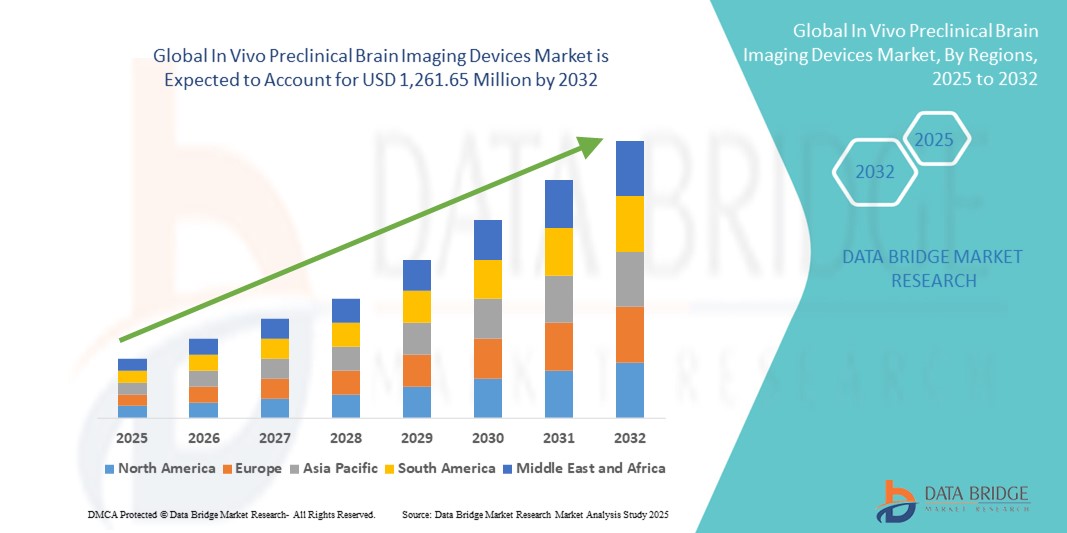
- The global In vivo preclinical brain imaging devices market size was valued at USD 797.57 million in 2024 and is expected to reach USD 1,261.65 million by 2032, at a CAGR of 5.90% during the forecast period
- The market growth is largely driven by the increasing adoption of advanced imaging technologies and continuous technological advancements in preclinical research, enabling more precise and non-invasive brain studies in animal models
- In addition, growing investment in neuroscience research, rising prevalence of neurological disorders, and the expanding use of imaging for drug discovery and development are fueling demand for in vivo preclinical brain imaging devices
In Vivo Preclinical Brain Imaging Devices Market Analysis
- Vivo Preclinical Brain Imaging Devices are advanced imaging tools used extensively in neurological research to study brain function, structure, and diseases across preclinical models, aiding drug development and disease understanding
- The growing demand for vivo preclinical brain imaging Devices is driven by increasing neurological disorder prevalence, technological advancements in imaging modalities, and rising investments in neuroscience research
- North America dominated the In vivo preclinical brain imaging devices market with the largest revenue share of 35.70% in 2024, attributed to strong research infrastructure, high healthcare expenditure, and early adoption of cutting-edge imaging technologies. The U.S. leads regional growth, supported by innovative tech companies and startup activities focused on AI-enhanced imaging solutions
- Asia-Pacific is expected to be the fastest growing region in the In vivo preclinical brain imaging devices market during the forecast period, fueled by rapid urbanization, expanding research institutions, and increasing healthcare investments, particularly in China and India
- The drug discovery segment dominated the In vivo preclinical brain imaging devices market with a revenue share of 51.2% in 2024, due to its critical role in evaluating therapeutic efficacy, pharmacodynamics, and safety profiles in preclinical models. Imaging devices enable researchers to assess novel compounds in real time, accelerating translational research and supporting regulatory submissions
Report Scope and In Vivo Preclinical Brain Imaging Devices Market Segmentation
|
Attributes |
In Vivo Preclinical Brain Imaging Devices Key Market Insights |
|
Segments Covered |
|
|
Countries Covered |
North America
Europe
Asia-Pacific
Middle East and Africa
South America
|
|
Key Market Players |
|
|
Market Opportunities |
|
|
Value Added Data Infosets |
In addition to the insights on market scenarios such as market value, growth rate, segmentation, geographical coverage, and major players, the market reports curated by the Data Bridge Market Research also include in-depth expert analysis, pricing analysis, brand share analysis, consumer survey, demography analysis, supply chain analysis, value chain analysis, raw material/consumables overview, vendor selection criteria, PESTLE Analysis, Porter Analysis, and regulatory framework. |
In Vivo Preclinical Brain Imaging Devices Market Trends
Advancements in Automation and High-Throughput Imaging Platforms
- A significant and accelerating trend in the global in vivo preclinical brain imaging devices market is the increasing adoption of automated and high-throughput imaging platforms. This integration of advanced technologies is enhancing efficiency, accuracy, and reproducibility in preclinical brain research
- For instance, modern small-animal MRI and PET imaging systems are being equipped with automated image acquisition and analysis software, allowing researchers to monitor multiple parameters simultaneously and reduce manual intervention. Similarly, state-of-the-art optical imaging devices provide high-resolution visualization of neurological processes, enabling precise and consistent data collection
- Automation in preclinical imaging facilitates standardized workflows, minimizes errors, and improves throughput, supporting large-scale studies in neuroscience, oncology, and drug discovery. Advanced platforms can track disease progression and therapeutic responses in real time, providing comprehensive insights for translational research
- The seamless integration of imaging devices with laboratory information management systems (LIMS) and data analysis software allows centralized control over experimental design, image processing, and reporting. Researchers can efficiently manage multiple experiments and datasets through a single interface, optimizing productivity and study outcomes
- This trend towards more intelligent, automated, and high-throughput imaging systems is fundamentally transforming preclinical research expectations. Consequently, companies such as Bruker, MILabs, and Mediso are developing devices with enhanced automation, high-resolution imaging, and multi-modal capabilities to meet growing research demands
- The demand for advanced preclinical brain imaging devices is growing rapidly across both academic and pharmaceutical research sectors, as institutions increasingly prioritize precise, high-throughput imaging solutions for neuroscience and drug development studies
In Vivo Preclinical Brain Imaging Devices Market Dynamics
Driver
Growing Need Due to Rising Demand for Advanced Preclinical Research
- The increasing prevalence of neurological disorders, neurodegenerative diseases, and the expanding focus on drug discovery and translational research is a significant driver for the heightened demand for In Vivo Preclinical Brain Imaging Devices
- For instance, in 2024, several leading companies, including Bruker and MILabs, announced advancements in high-resolution MRI and PET imaging platforms, enhancing imaging throughput and precision. Such innovations are expected to drive the In Vivo Preclinical Brain Imaging Devices industry growth during the forecast period
- As research institutions and pharmaceutical companies aim for more accurate and reproducible data, advanced imaging devices offer features such as multi-modal imaging, automated analysis, and real-time monitoring, providing a compelling advantage over conventional imaging methods
- Furthermore, the growing investment in preclinical research and the increasing number of clinical trials are making In Vivo Preclinical Brain Imaging Devices integral to drug development and neuroscience research, enabling comprehensive studies on disease progression and therapeutic efficacy
- The convenience of automated imaging, high-throughput data acquisition, and compatibility with advanced analysis software are key factors propelling the adoption of these devices in both academic and pharmaceutical research sectors. The trend towards modular, user-friendly imaging solutions and the increasing availability of cutting-edge instruments further contribute to market growth
Restraint/Challenge
High Costs and Technical Complexity of Imaging Systems
- The relatively high cost of advanced in vivo preclinical brain imaging devices poses a significant challenge to broader market penetration. Sophisticated MRI, PET, and optical imaging platforms require substantial investment, particularly for smaller laboratories or research facilities in developing regions
- For instance, premium multi-modal imaging systems often come with high acquisition and maintenance costs, which can restrict adoption among budget-conscious institutions
- In addition, the technical complexity of these imaging systems, including calibration, sample preparation, and data interpretation, requires trained personnel and strict laboratory protocols, limiting adoption in facilities with limited expertise
- Addressing these challenges through the development of cost-effective imaging platforms, simplified workflows, and comprehensive training programs is crucial for expanding market reach. Companies such as Mediso and Milabs are increasingly focusing on automated and modular systems to reduce operational complexity and improve accessibility
- While prices for basic preclinical imaging devices are gradually becoming more affordable, the perceived premium for high-resolution, multi-modal systems can still hinder widespread adoption, especially among smaller research institutes
- Overcoming these barriers through funding support, collaborations between academic and industrial institutions, and the introduction of flexible, scalable imaging solutions will be vital for sustained market growth
In Vivo Preclinical Brain Imaging Devices Market Scope
The market is segmented on the basis of imaging modality type, application, therapeutic area, biological variable, temporal format of use, and end user.
- By Imaging Modality Type
On the basis of imaging modality type, the in vivo preclinical brain imaging devices market is segmented into MRI, PET/SPECT, CT, Optical Miniscopes, 2 Photon Confocal, US, NIR Fluorescence, OCT, Bioluminescence, and Others. The MRI segment dominated the market with the largest revenue share of 46.7% in 2024, owing to its high-resolution anatomical imaging, non-invasive nature, and extensive use in neurological and oncological preclinical studies. MRI allows precise visualization of soft tissue, brain structures, and organ systems, supporting longitudinal studies and enabling detailed assessment of disease progression and therapeutic efficacy. The segment benefits from compatibility with multi-modal imaging platforms and automation systems, allowing researchers to perform high-throughput studies with reproducible results. It is widely adopted in pharmaceutical R&D, academic research, and contract research organizations (CROs) for longitudinal and cross-sectional studies.
The PET/SPECT segment is expected to witness the fastest CAGR of 20.9% from 2025 to 2032, driven by its exceptional sensitivity for molecular and functional imaging, enabling precise evaluation of metabolic activity, receptor binding, and pharmacokinetics. These modalities are increasingly used in drug discovery and translational research, providing dynamic, high-resolution functional data. PET/SPECT systems support multi-target imaging, longitudinal studies, and preclinical disease characterization, making them an essential tool in modern neuroscience, oncology, and cardiology research.
- By Application
On the basis of application, the market is segmented into drug discovery, disease characterization, and toxicology. The drug discovery segment dominated the market with a revenue share of 51.2% in 2024, due to its critical role in evaluating therapeutic efficacy, pharmacodynamics, and safety profiles in preclinical models. Imaging devices enable researchers to assess novel compounds in real time, accelerating translational research and supporting regulatory submissions.
The disease characterization segment is expected to register the fastest CAGR of 21.5% from 2025 to 2032, fueled by increasing investments in understanding pathophysiological mechanisms, biomarker validation, and preclinical modeling of complex diseases. In vivo imaging allows detailed analysis of organ function, cellular activity, and structural changes, providing critical data to guide therapeutic development and optimize study design.
- By Therapeutic Area
On the basis of therapeutic area, the market is segmented into Alzheimer’s Disease, Parkinson's disease, oncology, and other therapeutic areas. The oncology segment dominated the market with the largest revenue share of 47.9% in 2024, owing to the high prevalence of cancers and the need for precise tumor visualization, growth monitoring, and treatment evaluation in preclinical models. Imaging technologies provide critical insights into tumor biology, metastasis, and therapeutic response, facilitating translational research and drug development pipelines.
The Alzheimer’s disease segment is expected to witness the fastest CAGR of 22.0% from 2025 to 2032, driven by rising research funding, the growing prevalence of Alzheimer’s, and the increasing need for advanced neuroimaging to study disease progression, neuronal connectivity, and therapeutic efficacy. Researchers are leveraging high-resolution in vivo imaging modalities to perform detailed, longitudinal assessments of brain structure and function, enabling precise monitoring of neuronal loss, synaptic changes, and amyloid or tau deposition. The segment’s growth is further supported by technological advancements in MRI, PET, and optical imaging systems, which allow for comprehensive, reproducible data collection.
- By Biological Variable
On the basis of biological variable, the market is segmented into BOLD, oxygenation, blood flow, microvessels, neuronal activity, and soft tissue. The neuronal activity segment dominated the market with a revenue share of 50.1% in 2024, owing to its ability to provide functional insights into brain signaling, connectivity, and responses to experimental interventions in preclinical models. Imaging neuronal activity enables researchers to visualize real-time neural responses, map brain networks, and assess functional impacts of therapeutic agents, making it indispensable for neuroscience research, drug development, and understanding complex neurological disorders.
The blood flow segment is expected to witness the fastest CAGR of 21.7% from 2025 to 2032, driven by the growing importance of perfusion and hemodynamic imaging in studying organ function, disease progression, and therapeutic efficacy. Blood flow imaging allows non-invasive, dynamic evaluation of vascular networks, microcirculation, and tissue perfusion, supporting both longitudinal studies and short-term experiments. This capability is increasingly critical in preclinical research to assess disease pathology, monitor treatment responses, and provide quantitative functional data for translational studies.
- By Temporal Format of Use
On the basis of temporal format of use, the market is segmented into under an hour, many hours, and longitudinal. The longitudinal segment dominated the market with a revenue share of 48.3% in 2024, owing to its critical utility in monitoring disease progression, evaluating treatment responses, and capturing long-term biological changes in preclinical studies. Longitudinal imaging allows repeated measurements on the same subject over extended periods, significantly reducing inter-subject variability and enhancing the reliability and reproducibility of experimental data. This approach is especially valuable in neuroscience, oncology, and cardiovascular research, where temporal changes in anatomy and function are essential for understanding disease mechanisms and therapeutic impacts.
The many hours segment is expected to witness the fastest CAGR of 20.8% from 2025 to 2032, driven by the increasing adoption of imaging sessions requiring extended monitoring periods. This includes detailed pharmacokinetic and pharmacodynamic analysis, organ function assessment, and behavioral neuroscience studies that demand continuous observation of preclinical models. Extended temporal imaging allows researchers to capture dynamic biological processes, track subtle physiological and pathological changes, and obtain high-resolution functional and structural data.
- By End User
On the basis of end user, the market is segmented into Pharma-Inhouse, CRO, academia, and others. The Academia segment dominated the market with a revenue share of 51.5% in 2024, owing to strong government and private funding for neuroscience, oncology, and translational research, as well as the widespread utilization of preclinical imaging devices in experimental studies. Academic institutes leverage these advanced imaging technologies for longitudinal research, enabling detailed monitoring of disease progression, evaluation of novel drug candidates, and validation of innovative therapeutic strategies. The segment benefits from integration with high-resolution, multi-modal imaging systems and automated analysis platforms, allowing researchers to conduct reproducible and high-throughput studies.
The Pharma-Inhouse segment is expected to register the fastest CAGR of 21.9% from 2025 to 2032, driven by increasing internal R&D investments, adoption of high-throughput preclinical imaging platforms, and the rising need for comprehensive efficacy and safety evaluation of investigational compounds. In-house imaging enables pharmaceutical companies to accelerate the drug discovery process by providing precise, reproducible, and longitudinal data on disease models and therapeutic responses. These capabilities support optimization of study design, real-time monitoring of treatment effects, and generation of high-quality datasets for translational research and regulatory submissions..
In Vivo Preclinical Brain Imaging Devices Market Regional Analysis
- North America dominated the in vivo preclinical brain imaging devices market with the largest revenue share of 35.70% in 2024, attributed to strong research infrastructure
- high healthcare expenditure, and early adoption of cutting-edge imaging technologies
- Well-established pharmaceutical and academic research centers, along with increasing funding for neuroscience and oncology studies, are driving the demand for high-resolution, non-invasive brain imaging devices
U.S. In Vivo Preclinical Brain Imaging Devices Market Insight
The U.S. in vivo preclinical brain imaging devices captured the largest revenue share within North America, fueled by rapid adoption of advanced imaging modalities and increasing investments in drug discovery, disease characterization, and translational neuroscience research. The integration of multi-modal imaging systems and AI-based analytical tools is further enhancing research efficiency and precision, reinforcing the country’s leadership in the regional market.
Europe In Vivo Preclinical Brain Imaging Devices Market Insight
The Europe in vivo preclinical brain imaging devices is projected to grow at a substantial CAGR during the forecast period, driven by strong academic and pharmaceutical research programs, increasing focus on neurological disorders, and regulatory support for preclinical studies. Rising investments in state-of-the-art imaging infrastructure and collaborations between research institutions and industry players are accelerating adoption across residential, commercial, and multi-institutional research facilities.
U.K. In Vivo Preclinical Brain Imaging Devices Market Insight
The U.K. in vivo preclinical brain imaging devices is expected to grow steadily, supported by increasing government funding for neuroscience research, growing awareness of neurological disorders, and the adoption of AI-assisted imaging technologies. Pharmaceutical companies and academic institutions are expanding their preclinical research capabilities, contributing to the rising demand for sophisticated brain imaging devices.
Germany In Vivo Preclinical Brain Imaging Devices Market Insight
The Germany in vivo preclinical brain imaging devices is anticipated to expand at a considerable CAGR, driven by strong research infrastructure, focus on precision medicine, and high adoption of advanced imaging systems in academic and pharmaceutical research. Growing emphasis on translational studies and non-invasive imaging techniques is promoting market growth.
Asia-Pacific In Vivo Preclinical Brain Imaging Devices Market Insight
The Asia-Pacific in vivo preclinical brain imaging devices is expected to be the fastest-growing region in the In Vivo Preclinical Brain Imaging Devices market during the forecast period, fueled by rapid urbanization, expanding research institutions, and increasing healthcare investments, particularly in China and India. Rising government support for scientific research, development of new preclinical facilities, and growing focus on drug discovery and disease characterization are driving the adoption of advanced brain imaging devices.
Japan In Vivo Preclinical Brain Imaging Devices Market Insight
The Japan in vivo preclinical brain imaging devices is gaining momentum due to advanced research infrastructure, high-tech culture, and increasing demand for non-invasive, high-resolution imaging solutions in drug discovery and disease modeling. The country’s focus on precision neuroscience research and translational studies is further accelerating market growth.
China In Vivo Preclinical Brain Imaging Devices Market Insight
The China in vivo preclinical brain imaging devices accounted for the largest market revenue share in Asia-Pacific in 2024, driven by rapid expansion of research institutions, increasing pharmaceutical R&D activities, and significant healthcare investments. The country is emerging as a key hub for preclinical research, with strong adoption of advanced brain imaging modalities for drug discovery, disease characterization, and translational studies.
In Vivo Preclinical Brain Imaging Devices Market Share
The in vivo preclinical brain imaging devices industry is primarily led by well-established companies, including:
- PerkinElmer (U.S.)
- FUJIFILM Corporation (Japan)
- Mediso Ltd. (Hungary)
- Spectral Instruments Imaging (U.S.)
- MR Solutions (U.K.)
- Charles River Laboratories (U.S.)
- Aspect Imaging Ltd. (Israel)
- Bruker (U.S.)
- Miltenyi Biotec and/or its affiliates. (Germany)
- MILabs B.V. (Netherlands)
- Cubresa Inc. (Canada)
Latest Developments in Global In Vivo Preclinical Brain Imaging Devices Market
- In May 2022, FUJIFILM VisualSonics launched the Vevo F2, the world’s first ultra-high to low frequency (71–1 MHz) ultrasound and photoacoustic imaging system for preclinical use. The Vevo F2 features HD image processing technology and introduces a completely new signal pathway—from transducer to display screen—resulting in better image clarity and significantly improved frame rates over earlier generation platforms
- In June 2023, Mediso Ltd. installed a state-of-the-art 7T MRI system at the University of Milano-Bicocca in Italy. The nanoScan MRI 7T is equipped with a cryogen-free superconducting magnet, minimizing vibrations and delivering ghost-free images, which is particularly beneficial for high-resolution brain imaging in preclinical studies
- In February 2024, Bruker Corporation acquired Spectral Instruments Imaging LLC, a leader in preclinical in-vivo optical imaging systems. This acquisition expands Bruker's portfolio in preclinical imaging, enhancing their capabilities in optical imaging for brain research and disease characterization
- In April 2025, MR Solutions participated in the Preclinical Imaging Consortium hosted by the MD Anderson Cancer Center's Small Animal Imaging Facility in Houston. The event showcased MR Solutions' latest advancements in preclinical imaging technologies, including their compact and cryogen-free MRI systems, aimed at enhancing brain imaging research

- Interactive Data Analysis Dashboard
- Company Analysis Dashboard for high growth potential opportunities
- Research Analyst Access for customization & queries
- Competitor Analysis with Interactive dashboard
- Latest News, Updates & Trend analysis
- Harness the Power of Benchmark Analysis for Comprehensive Competitor Tracking
Data collection and base year analysis are done using data collection modules with large sample sizes. The stage includes obtaining market information or related data through various sources and strategies. It includes examining and planning all the data acquired from the past in advance. It likewise envelops the examination of information inconsistencies seen across different information sources. The market data is analysed and estimated using market statistical and coherent models. Also, market share analysis and key trend analysis are the major success factors in the market report. To know more, please request an analyst call or drop down your inquiry.
The key research methodology used by DBMR research team is data triangulation which involves data mining, analysis of the impact of data variables on the market and primary (industry expert) validation. Data models include Vendor Positioning Grid, Market Time Line Analysis, Market Overview and Guide, Company Positioning Grid, Patent Analysis, Pricing Analysis, Company Market Share Analysis, Standards of Measurement, Global versus Regional and Vendor Share Analysis. To know more about the research methodology, drop in an inquiry to speak to our industry experts.
Data Bridge Market Research is a leader in advanced formative research. We take pride in servicing our existing and new customers with data and analysis that match and suits their goal. The report can be customized to include price trend analysis of target brands understanding the market for additional countries (ask for the list of countries), clinical trial results data, literature review, refurbished market and product base analysis. Market analysis of target competitors can be analyzed from technology-based analysis to market portfolio strategies. We can add as many competitors that you require data about in the format and data style you are looking for. Our team of analysts can also provide you data in crude raw excel files pivot tables (Fact book) or can assist you in creating presentations from the data sets available in the report.













