


Indoor Plant Lighting Market Overview
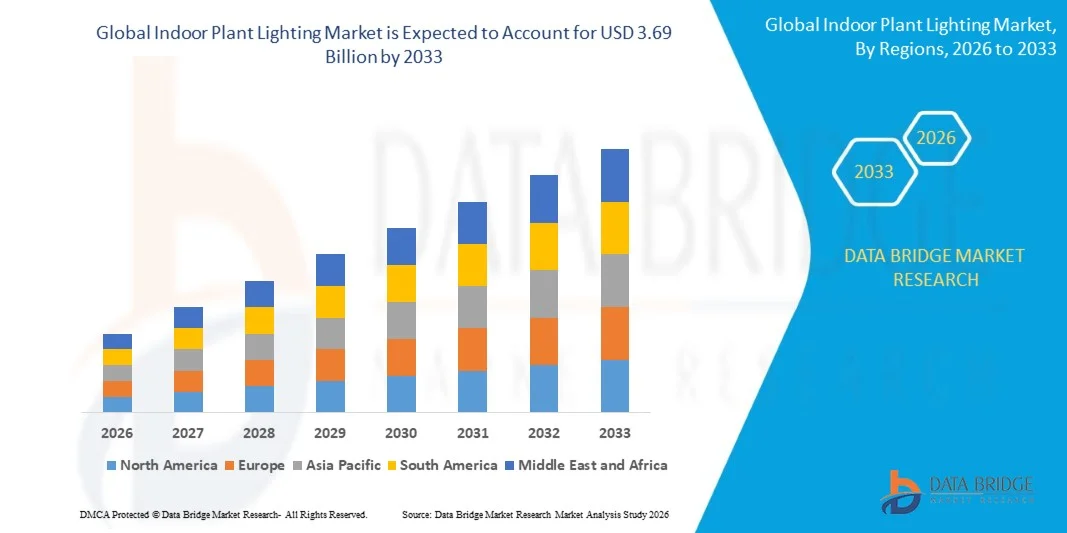
The Indoor Plant Lighting Market was valued at USD 1.80 billion in 2025 and is projected to reach USD 3.69 billion by 2033, growing at a CAGR of 9.40% from 2026 to 2033. Market growth is underpinned by the rapid expansion of indoor and vertical farming, rising adoption of controlled environment agriculture (CEA), and increasing consumer interest in home gardening and interior landscaping using live plants.
Growing urbanization, shrinking arable land, and climate variability are driving food producers and horticulture operators toward high-yield indoor production systems that require reliable, spectrum-optimized lighting solutions. Technological advances in LED grow lighting, including tunable spectra, higher photon efficacy, longer lifespans, and smart control integrations, are transforming energy consumption profiles and crop productivity in greenhouses and vertical farms. Additionally, indoor plant lighting is increasingly used in horticulture research facilities, botanical gardens, and educational green labs to support precision plant science.
Rising awareness about the role of light spectrum on plant growth, flowering, and nutritional quality is stimulating the adoption of specialized fixtures across both commercial and residential settings. Government incentives for energy-efficient lighting, sustainability mandates, and investments in urban agriculture across North America, Europe, and Asia-Pacific further support market expansion. The growing penetration of smart home ecosystems and IoT-enabled cultivation systems is also enhancing demand for connected and automated grow lighting solutions.
Key Market Trends & Insights
- North America dominated the Indoor Plant Lighting Market with the largest revenue share of 34.5% in 2025, driven by advanced controlled-environment agriculture infrastructure, strong presence of vertical farm operators, and high adoption of energy-efficient LED grow lights.
- Asia-Pacific is expected to be the fastest-growing region at a CAGR of 11.3% from 2026 to 2033, supported by rapid urbanization, government-backed vertical farming projects, and rising horticulture technology investments in China, Japan, South Korea, and Singapore.
- The LED Grow Lights segment led the product type category with a 52.0% market share in 2025, reflecting strong demand for high-efficiency, spectrum-tunable, and long-lifespan lighting solutions across commercial greenhouses, indoor farms, and premium residential setups.
- The Full Spectrum category dominated the light spectrum segmentation with a 43.0% market share in 2025, as growers increasingly favor broad-spectrum lighting that mimics natural sunlight and supports plants across all growth stages.
- By application, the Commercial Greenhouses segment led with a 32.0% market share in 2025, supported by large-scale horticultural production of vegetables, fruits, ornamentals, and medicinal plants under controlled lighting environments.
- The Smart Grow Lights segment in the technology category is anticipated to be the fastest-growing, expanding at a CAGR of 12.5% from 2026 to 2033, driven by IoT integration, remote monitoring, and data-driven light management.
- By end user, Commercial Growers dominated with a 41.0% market share in 2025, reflecting concentrated investments in yield optimization, crop quality enhancement, and energy efficiency.
- The Residential Customers end-user segment is projected to record a CAGR of 10.8% during the forecast period, fueled by increasing popularity of indoor gardening, houseplants, and small-scale hydroponic systems for hobbyists and wellness-oriented consumers.
Market Size & Forecast
- Global Market Value (2025): USD 1.80 Billion
- Expected Market Value (2033): USD 3.69 Billion
- Forecast CAGR (2025–2033): 9.40%
- Leading Region in 2025: North America
- Fastest Growing Region (CAGR 2025–2033): Asia-Pacific
Report Scope and Indoor Plant Lighting Market Segmentation
|
Attributes |
Indoor Plant Lighting Key Market Insights |
|
Segments Covered |
|
|
Countries Covered |
North America · U.S. · Canada · Mexico Europe · Germany · France · U.K. · Netherlands · Switzerland · Belgium · Russia · Italy · Spain · Turkey · Rest of Europe Asia-Pacific · China · Japan · India · South Korea · Singapore · Malaysia · Australia · Thailand · Indonesia · Philippines · Rest of Asia-Pacific Middle East and Africa · Saudi Arabia · U.A.E. · South Africa · Egypt · Israel · Rest of Middle East and Africa South America · Brazil · Argentina · Rest of South America |
|
Key Market Players |
· Signify NV (Netherlands) · OSRAM Licht AG (Germany) · Gavita International BV (Netherlands) · Fluence Bioengineering Inc. (U.S.) · Heliospectra AB (Sweden) · Valoya Oy (Finland) · California LightWorks (U.S.) · Illumitex Inc. (U.S.) · SANlight GmbH (Austria) · General Electric Company (U.S.) · Hortilux Schréder (Netherlands) · Lumileds Holding BV (Netherlands) |
|
Market Opportunities |
· Expansion of vertical farming, commercial greenhouses, and urban agriculture projects in emerging markets requiring high-efficiency, spectrum-optimized lighting solutions · Development of smart, IoT-enabled, and spectrum-tunable LED grow lights enabling precision cultivation, lower energy consumption, and data-driven crop optimization across both commercial and residential settings |
|
Value Added Data Infosets |
In addition to the insights on market scenarios such as market value, growth rate, segmentation, geographical coverage, and major players, the market reports curated by the Data Bridge Market Research also include depth expert analysis, patient epidemiology, pipeline analysis, pricing analysis, and regulatory framework. |
Indoor Plant Lighting Market Trends
Trend: Rapid Adoption of LED and Smart Grow Lighting for Energy Efficiency and Precision Cultivation
Indoor farming operators and greenhouse growers are rapidly transitioning from legacy fluorescent, HID, and incandescent systems to high-efficiency LED grow lights and smart lighting platforms. LED fixtures provide higher photosynthetic photon efficacy (PPE), lower heat output, longer lifetimes, and flexible spectrum tuning capabilities that directly impact plant morphology, flowering, and nutrient density. Smart grow lights integrated with sensors, cameras, and environmental controllers allow dynamic adjustment of light intensity, photoperiod, and spectral distribution based on crop type, growth stage, and real-time data.
For instance,
Fluence Bioengineering Inc. has expanded its portfolio of LED horticulture fixtures that integrate with digital cultivation management platforms, enabling growers to adjust spectra and intensity to optimize yields and energy use across large-scale greenhouse operations.
This trend firmly positions LED-based, data-driven lighting as the backbone of modern controlled-environment agriculture, ensuring that precision cultivation and energy optimization remain central growth levers for the indoor plant lighting market through the forecast period.
Indoor Plant Lighting Market Dynamics
Key Market Driver: Expansion of Indoor Farming, Vertical Agriculture, and Controlled-Environment Horticulture
The increasing need for year-round food production, coupled with urbanization and climate-related risks to outdoor farming, is significantly accelerating the adoption of indoor farming, vertical agriculture, and high-tech greenhouse cultivation. These systems rely heavily on high-quality grow lighting to replace or supplement natural sunlight and maintain consistent growth conditions.
For instance,
Numerous vertical farm operators in North America, Europe, and Asia-Pacific have reported substantial yield gains and shortened growth cycles when deploying spectrum-tunable LED grow lights tailored to leafy greens, herbs, and high-value specialty crops.
As indoor farming footprints expand globally—from commercial vegetable production and medicinal plants to microgreens and ornamentals—demand for efficient, spectrum-optimized lighting solutions will continue to rise, making CEA expansion a sustained and structural demand driver for the indoor plant lighting market.
Key Restraint/Challenge: High Upfront Investment and Technology Complexity for Advanced LED and Smart Systems
Despite substantial energy and performance benefits, advanced LED and smart grow lighting systems often require higher upfront capital investments than conventional fluorescent or HID solutions. Budget-sensitive growers, small-scale farms, and residential users may hesitate to adopt premium fixtures due to perceived payback periods, integration complexity, and uncertainty regarding optimal spectral configurations.
For instance,
Commercial operators considering large-scale LED retrofits must evaluate total cost of ownership, fixture density, heat management, and compatibility with existing control systems, requiring significant technical expertise and planning resources.
These financial and technological barriers can delay upgrade cycles and limit deployment among smaller growers or in cost-constrained regions. As a result, high initial costs and system complexity remain critical challenges, slowing universal adoption of advanced indoor plant lighting technologies despite their long-term efficiency gains.
Key Market Opportunity: Integration of IoT, AI, and Data Analytics into Smart Indoor Plant Lighting Ecosystems
The convergence of IoT connectivity, AI-driven analytics, and cloud-based cultivation management platforms presents a significant opportunity for next-generation indoor plant lighting solutions. Smart grow lights capable of communicating with environmental sensors, nutrient dosing systems, and imaging tools can support closed-loop optimization of plant growth conditions.
For instance,
Solutions combining spectral sensing, machine learning models, and dynamic dimming can tailor light recipes to specific cultivars, predicting optimal intensity, photoperiod, and spectrum for maximum yield and quality with minimal energy input.
This trend enables equipment manufacturers and technology providers to differentiate through software, data services, and integrated platforms, while helping growers reduce operational costs and improve consistency. Consequently, IoT- and AI-enabled smart lighting ecosystems represent a major growth opportunity for the indoor plant lighting market as digital agriculture capabilities mature.
Indoor Plant Lighting Market Scope
The indoor plant lighting market is segmented on the basis of product type, light spectrum, application, technology, and end user.
By Product Type
On the basis of product type, the Indoor Plant Lighting Market is segmented into LED Grow Lights, Fluorescent Grow Lights, High-Intensity Discharge (HID) Lights, and Incandescent Lights. LED grow lights dominated the Indoor Plant Lighting Market in the product type segment, accounting for a 52.0% market share in 2025. This leadership is primarily attributed to their superior energy efficiency, reduced heat output, and significantly longer operational lifespan compared to traditional lighting technologies. Their widespread adoption across commercial greenhouses, vertical farming systems, and high-end residential indoor gardening setups further strengthens their dominance. LED systems are also highly preferred because they enable precise control over light intensity and spectral output, allowing growers to optimize photosynthesis, flowering cycles, and overall plant morphology for higher yield and quality.
LED grow lights are expected to remain the fastest-growing segment, projected to register a CAGR of 11.5% from 2026 to 2033. This strong growth is supported by ongoing replacement of outdated fluorescent and HID lighting systems, continuous declines in LED component costs, and increasing regulatory emphasis on energy-efficient and sustainable horticulture technologies worldwide.
By Light Spectrum
On the basis of light spectrum, the Indoor Plant Lighting Market is segmented into full spectrum, red spectrum, blue spectrum, and white spectrum. The Full Spectrum lighting led the light spectrum category with a 43.0% market share in 2025. Full spectrum solutions are favored for their versatility across crop types and stages, simplifying fixture selection and supporting robust growth, color, and yield characteristics. White spectrum lights are commonly adopted in residential and mixed-use environments where visual comfort and aesthetics are also important.
Full Spectrum segment is expected to be the fastest-growing segment with an estimated CAGR of 10.5% from 2026 to 2033. Growth is driven by widespread adoption in commercial greenhouses, research facilities, and advanced indoor farms seeking consistency and operational simplicity. Specialized red and blue spectrum solutions will remain important for fine-tuning in targeted applications, such as flowering rooms and seedling nurseries. However, market momentum is increasingly concentrated in spectrum-optimized full-spectrum LED offerings that strike a balance between agronomic performance and deployment flexibility.
By Application
On the basis of application, the Indoor Plant Lighting Market is segmented into residential use, commercial greenhouses, indoor farming, horticulture research, and aquaponics and hydroponics. Commercial Greenhouses dominated the application segment with a 32.0% market share in 2025, due to extensive deployment of supplemental lighting for high-value crops, such as tomatoes, cucumbers, strawberries, ornamentals, and medicinal plants. Their scale and continuous production cycles support significant capital investments in advanced lighting systems.
Indoor Farming is expected to be the fastest-growing segment, projected to register a CAGR of 11.8% from 2026 to 2033. Growth is supported by increasing urban vertical farming initiatives, demand for pesticide-free and locally grown produce, and the economics of year-round high-density production. Aquaponics and hydroponics are also expected to expand steadily as sustainable and resource-efficient production methods gain traction. Residential use will benefit from lifestyle trends and indoor wellness, further diversifying demand across product ranges and price points.
By Technology
On the basis of technology, the Indoor Plant Lighting Market is segmented into smart grow lights, manual grow lights, automated systems, solar-powered lights, and conventional lighting solutions. The Manual Grow Lights maintained the largest share with 30.0%, due to their lower upfront cost, simplicity, and legacy installed base, particularly among small-scale growers and cost-sensitive operations.
Smart Grow Lights is expected to be the fastest-growing segment with an anticipated CAGR of 12.5% from 2026 to 2033. Growth is driven by increasing adoption of precision agriculture tools, demand for remote monitoring and control, and integration with data analytics platforms that optimize lighting strategies. Automated systems will also record healthy growth as commercial operators standardize their cultivation protocols. Solar-powered solutions are positioned as niche but strategic offerings for sustainably focused projects and regions with high solar irradiance.
By End User
On the basis of end user, the Indoor Plant Lighting Market is segmented into Residential Customers, Commercial Growers, Research Institutions, Landscapers and Gardeners, and Educational Institutions. The Commercial Growers dominated the end-user category with a 41.0% market share in 2025 because they run capital-intensive, yield-driven operations that require high-performance lighting systems and regular upgrades to maintain competitiveness and meet market demand.
Residential Customers is expected to be the fastest-growing segment, forecast to grow at a CAGR of 10.8% from 2026 to 2033. This growth is driven by rising interest in indoor plants, biophilic design, home-based food production, and wellness trends emphasizing green, calming living spaces. Educational institutions are also expected to increase adoption as they expand agritech and sustainability curricula. Research institutions will maintain steady demand for high-specification, highly controllable lighting systems to support advanced experimentation.
Indoor Plant Lighting Market Regional Analysis
North America dominated the indoor plant lighting market with a revenue share of 34.5% in 2025, supported by well-established greenhouse industries, a high concentration of vertical farms, and early adoption of advanced LED and smart lighting technologies. The region benefits from strong presence of leading lighting manufacturers and solution integrators, favorable energy-efficiency policies, and robust venture funding in agri-tech startups. Cultivation of high-value crops, such as cannabis (where permitted), leafy greens, and specialty herbs, has further stimulated investments in sophisticated lighting systems.
U.S. Indoor Plant Lighting Market Insight
The U.S. indoor plant lighting market is characterized by extensive commercial greenhouse operations, a rapidly growing vertical farming ecosystem, and strong consumer demand for indoor gardening solutions. The country accounted for an estimated 27.0% of the global market share in 2025, driven by high technology adoption, strong retail distribution channels, and an active community of hobbyist growers. Regulatory frameworks incentivizing energy-efficient lighting and the presence of leading horticulture lighting brands support ongoing upgrades from legacy systems to LED and smart solutions. The U.S. market is expected to register a CAGR of 9.2% from 2026 to 2033, reflecting continued investments in controlled-environment agriculture and home-based cultivation.
Europe Indoor Plant Lighting Market Insight
The Europe indoor plant lighting market remains a major contributor, supported by established greenhouse clusters in the Netherlands, Spain, and Italy, and strong R&D activities in Northern and Western Europe. Energy costs and stringent environmental regulations drive growers to adopt high-efficiency LED lighting and advanced control systems to minimize operating expenses and emissions. Adoption of renewable energy in greenhouses, combined with spectrum optimization, is a key focus for European operators.
U.K. Indoor Plant Lighting Market Insight
The U.K. indoor plant lighting market is experiencing steady growth as retailers, research institutions, and urban farms invest in modernized lighting infrastructures. Expansion of vertical farm projects near metropolitan areas and increased interest in year-round leafy green and herb production are key drivers. Public and private research initiatives exploring optimized light recipes for local crops further support demand for programmable, research-grade lighting systems across the country.
Germany Indoor Plant Lighting Market Insight
Germany’s strong engineering base and commitment to sustainable agriculture underpin its adoption of advanced indoor plant lighting solutions. Commercial greenhouse operators and research institutions across Germany leverage high-efficacy LED systems, smart controls, and integrated energy management platforms. Emphasis on quality, reliability, and compliance with strict efficiency standards encourages investment in premium lighting technologies, particularly for vegetables, ornamentals, and pharmaceutical plants.
Asia-Pacific Indoor Plant Lighting Market Insight
The Asia-Pacific indoor plant lighting market is projected to be the fastest-growing region, with an estimated CAGR of 11.3% from 2026 to 2033, driven by rapid urbanization, food security initiatives, and government-backed vertical farming and smart agriculture projects. Countries such as China, Japan, South Korea, and Singapore are deploying large-scale indoor farms and high-tech greenhouses that heavily rely on LED and smart lighting solutions. Asia-Pacific accounted for approximately 30.0% of the global market share in 2025, reflecting the region’s accelerating investments in controlled-environment horticulture.
Japan Indoor Plant Lighting Market Insight
The Japan indoor plant lighting market benefits from advanced technology adoption, demographic pressures, and strong interest in compact, urban production systems. Plant factories and vertical farms using fully artificial lighting are widespread, focusing on leafy greens, herbs, and pharmaceutical crops. Japan’s legacy in electronics and lighting innovation supports ongoing development of high-end LED fixtures and control systems tailored to domestic crop needs and energy constraints.
China Indoor Plant Lighting Market Insight
The China indoor plant lighting market is experiencing rapid expansion, driven by national strategies for food security, sustainability, and rural modernization. Large-scale greenhouse complexes and vertical farms are being developed around major cities, increasing demand for cost-effective yet high-performance LED grow lights. Domestic manufacturers are scaling production and improving technology to compete globally, while partnerships with research institutions enhance spectrum optimization and crop-specific solutions. China is estimated to have captured around 12.5% of global market share in 2025, with a forecast CAGR of 12.0% from 2026 to 2033, making it one of the fastest-growing country markets.
Indoor Plant Lighting Market Share
The indoor plant lighting industry is primarily led by well-established companies, including:
- Signify NV (Netherlands)
- OSRAM Licht AG (Germany)
- Gavita International BV (Netherlands)
- Fluence Bioengineering Inc. (U.S.)
- Heliospectra AB (Sweden)
- Valoya Oy (Finland)
- California LightWorks (U.S.)
- Illumitex Inc. (U.S.)
- SANlight GmbH (Austria)
- General Electric Company (U.S.)
- Hortilux Schréder (Netherlands)
- Lumileds Holding BV (Netherlands)
Latest Developments in Indoor Plant Lighting Market
- In October 2025, Fluence Bioengineering Inc. (U.S.) expanded its SPYDR LED horticulture lighting series with a new generation of high-efficacy fixtures optimized for vertical farming, integrating improved spectral tunability and higher photon efficiency to reduce operational costs and boost yields in multi-layer crop systems.
- In July 2025, Heliospectra AB (Sweden) announced the release of its updated helioCORE 3.0 control platform, providing advanced light automation, crop-specific light recipes, and remote monitoring functionalities designed to support commercial greenhouses and research facilities seeking data-driven cultivation strategies.
- In March 2025, Signify NV (Netherlands) unveiled an expansion of its Philips GreenPower LED toplighting compact range tailored for high-wire crops in greenhouses, delivering increased light output and energy savings while enabling growers to fine-tune spectra for tomatoes, cucumbers, and peppers.
- In November 2024, OSRAM Licht AG (Germany) introduced a new portfolio of OSLON Optimal horticulture LEDs offering improved efficiency and tailored spectra for indoor farming and greenhouse applications, aimed at enabling luminaire manufacturers to create more compact and efficient grow light designs.
- In August 2024, Gavita International BV (Netherlands) launched the Gavita CT 1930e LED grow light, designed as a direct replacement for traditional 1000W HPS fixtures, providing higher efficiency and lower radiant heat while simplifying retrofits in existing greenhouse infrastructures.
- In May 2023, Valoya Oy (Finland) released a new series of compact LED grow lights for research and growth chambers, delivering precise spectrum control and uniformity to support plant trials, breeding programs, and controlled-environment experiments.
- In February 2023, California LightWorks (U.S.) announced upgrades to its MegaDrive LED system for commercial greenhouses, integrating centralized power and control features that reduce installation costs and enhance reliability for large-scale growers.
- In September 2022, SANlight GmbH (Austria) introduced the EVO-Series LED grow lights targeting professional indoor cultivation and high-end hobbyist applications, featuring modular design, optimized spectra, and high photon efficacy.

- Interactive Data Analysis Dashboard
- Company Analysis Dashboard for high growth potential opportunities
- Research Analyst Access for customization & queries
- Competitor Analysis with Interactive dashboard
- Latest News, Updates & Trend analysis
- Harness the Power of Benchmark Analysis for Comprehensive Competitor Tracking
Global Indoor Plant Lighting Market, Supply Chain Analysis and Ecosystem Framework
To support market growth and help clients navigate the impact of geopolitical shifts, DBMR has integrated in-depth supply chain analysis into its Global Indoor Plant Lighting Market research reports. This addition empowers clients to respond effectively to global changes affecting their industries. The supply chain analysis section includes detailed insights such as Global Indoor Plant Lighting Market consumption and production by country, price trend analysis, the impact of tariffs and geopolitical developments, and import and export trends by country and HSN code. It also highlights major suppliers with data on production capacity and company profiles, as well as key importers and exporters. In addition to research, DBMR offers specialized supply chain consulting services backed by over a decade of experience, providing solutions like supplier discovery, supplier risk assessment, price trend analysis, impact evaluation of inflation and trade route changes, and comprehensive market trend analysis.
Data collection and base year analysis are done using data collection modules with large sample sizes. The stage includes obtaining market information or related data through various sources and strategies. It includes examining and planning all the data acquired from the past in advance. It likewise envelops the examination of information inconsistencies seen across different information sources. The market data is analysed and estimated using market statistical and coherent models. Also, market share analysis and key trend analysis are the major success factors in the market report. To know more, please request an analyst call or drop down your inquiry.
The key research methodology used by DBMR research team is data triangulation which involves data mining, analysis of the impact of data variables on the market and primary (industry expert) validation. Data models include Vendor Positioning Grid, Market Time Line Analysis, Market Overview and Guide, Company Positioning Grid, Patent Analysis, Pricing Analysis, Company Market Share Analysis, Standards of Measurement, Global versus Regional and Vendor Share Analysis. To know more about the research methodology, drop in an inquiry to speak to our industry experts.
Data Bridge Market Research is a leader in advanced formative research. We take pride in servicing our existing and new customers with data and analysis that match and suits their goal. The report can be customized to include price trend analysis of target brands understanding the market for additional countries (ask for the list of countries), clinical trial results data, literature review, refurbished market and product base analysis. Market analysis of target competitors can be analyzed from technology-based analysis to market portfolio strategies. We can add as many competitors that you require data about in the format and data style you are looking for. Our team of analysts can also provide you data in crude raw excel files pivot tables (Fact book) or can assist you in creating presentations from the data sets available in the report.













